



Community hub
Recent from talks
Knowledge base stats:
Talk channels stats:
Members stats:
Navier–Stokes existence and smoothness
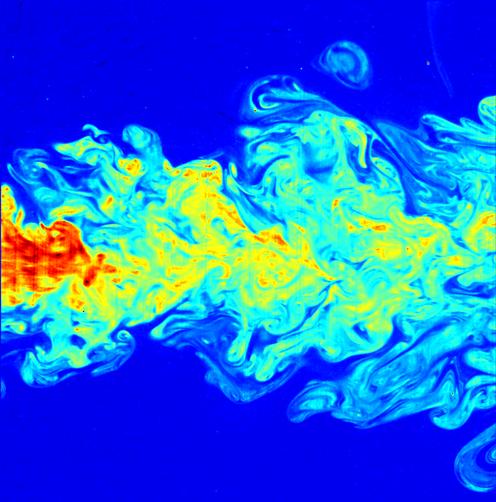
The Navier–Stokes existence and smoothness problem concerns the mathematical properties of solutions to the Navier–Stokes equations, a system of partial differential equations that describe the motion of a fluid in space. Solutions to the Navier–Stokes equations are used in many practical applications. However, theoretical understanding of the solutions to these equations is incomplete. In particular, solutions of the Navier–Stokes equations often include turbulence, which remains one of the greatest unsolved problems in physics, despite its immense importance in science and engineering.
Even more basic (and seemingly intuitive) properties of the solutions to Navier–Stokes have never been proven. For the three-dimensional system of equations, and given some initial conditions, mathematicians have neither proved that smooth solutions always exist, nor found any counter-examples. This is called the Navier–Stokes existence and smoothness problem.
Since understanding the Navier–Stokes equations is considered to be the first step to understanding the elusive phenomenon of turbulence, the Clay Mathematics Institute in May 2000 made this problem one of its seven Millennium Prize problems in mathematics. It offered a US$1,000,000 prize to the first person providing a solution for a specific statement of the problem:
Prove or give a counter-example of the following statement:
In three space dimensions and time, given an initial velocity field, there exists a vector velocity and a scalar pressure field, which are both smooth and globally defined, that solve the Navier–Stokes equations.
In mathematics, the Navier–Stokes equations are a system of nonlinear partial differential equations for abstract vector fields of any size. In physics and engineering, they are a system of equations that model the motion of liquids or non-rarefied gases (in which the mean free path is short enough so that it can be thought of as a continuum mean instead of a collection of particles) using continuum mechanics. The equations are a statement of Newton's second law, with the forces modeled according to those in a viscous Newtonian fluid—as the sum of contributions by pressure, viscous stress and an external body force. Since the setting of the problem proposed by the Clay Mathematics Institute is in three dimensions, for an incompressible and homogeneous fluid, only that case is considered below.
Let be a 3-dimensional vector field, the velocity of the fluid, and let be the pressure of the fluid. The Navier–Stokes equations are:


where is the kinematic viscosity, the external volumetric force, is the gradient operator and is the Laplacian operator, which is also denoted by or . Note that this is a vector equation, i.e. it has three scalar equations. Writing down the coordinates of the velocity and the external force


Hub AI
Navier–Stokes existence and smoothness AI simulator
(@Navier–Stokes existence and smoothness_simulator)
Navier–Stokes existence and smoothness
The Navier–Stokes existence and smoothness problem concerns the mathematical properties of solutions to the Navier–Stokes equations, a system of partial differential equations that describe the motion of a fluid in space. Solutions to the Navier–Stokes equations are used in many practical applications. However, theoretical understanding of the solutions to these equations is incomplete. In particular, solutions of the Navier–Stokes equations often include turbulence, which remains one of the greatest unsolved problems in physics, despite its immense importance in science and engineering.
Even more basic (and seemingly intuitive) properties of the solutions to Navier–Stokes have never been proven. For the three-dimensional system of equations, and given some initial conditions, mathematicians have neither proved that smooth solutions always exist, nor found any counter-examples. This is called the Navier–Stokes existence and smoothness problem.
Since understanding the Navier–Stokes equations is considered to be the first step to understanding the elusive phenomenon of turbulence, the Clay Mathematics Institute in May 2000 made this problem one of its seven Millennium Prize problems in mathematics. It offered a US$1,000,000 prize to the first person providing a solution for a specific statement of the problem:
Prove or give a counter-example of the following statement:
In three space dimensions and time, given an initial velocity field, there exists a vector velocity and a scalar pressure field, which are both smooth and globally defined, that solve the Navier–Stokes equations.
In mathematics, the Navier–Stokes equations are a system of nonlinear partial differential equations for abstract vector fields of any size. In physics and engineering, they are a system of equations that model the motion of liquids or non-rarefied gases (in which the mean free path is short enough so that it can be thought of as a continuum mean instead of a collection of particles) using continuum mechanics. The equations are a statement of Newton's second law, with the forces modeled according to those in a viscous Newtonian fluid—as the sum of contributions by pressure, viscous stress and an external body force. Since the setting of the problem proposed by the Clay Mathematics Institute is in three dimensions, for an incompressible and homogeneous fluid, only that case is considered below.
Let be a 3-dimensional vector field, the velocity of the fluid, and let be the pressure of the fluid. The Navier–Stokes equations are:
where is the kinematic viscosity, the external volumetric force, is the gradient operator and is the Laplacian operator, which is also denoted by or . Note that this is a vector equation, i.e. it has three scalar equations. Writing down the coordinates of the velocity and the external force