



Community hub
Recent from talks
Contribute something
Nothing was collected or created yet.
Initial condition
View on Wikipedia
In mathematics and particularly in dynamical systems, an initial condition is the initial value (often at time ) of a differential equation, difference equation, or other "time"-dependent equation which evolves in time. The most fundamental case, an ordinary differential equation of order k (the number of derivatives in the equation), generally requires k initial conditions to trace the equation's evolution through time. In other contexts, the term may refer to an initial value of a recurrence relation, discrete dynamical system, hyperbolic partial differential equation, or even a seed value of a pseudorandom number generator, at "time zero", enough such that the overall system can be evolved in "time", which may be discrete or continuous. The problem of determining a system's evolution from initial conditions is referred to as an initial value problem.

Linear system
[edit]Discrete time
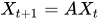
[edit]A linear matrix difference equation of the homogeneous (having no constant term) form has closed form solution predicated on the vector of initial conditions on the individual variables that are stacked into the vector; is called the vector of initial conditions or simply the initial condition, and contains nk pieces of information, n being the dimension of the vector X and k = 1 being the number of time lags in the system. The initial conditions in this linear system do not affect the qualitative nature of the future behavior of the state variable X; that behavior is stable or unstable based on the eigenvalues of the matrix A but not based on the initial conditions.


Alternatively, a dynamic process in a single variable x having multiple time lags is

Here the dimension is n = 1 and the order is k, so the necessary number of initial conditions to trace the system through time, either iteratively or via closed form solution, is nk = k. Again the initial conditions do not affect the qualitative nature of the variable's long-term evolution. The solution of this equation is found by using its characteristic equation to obtain the latter's k solutions, which are the characteristic values for use in the solution equation



Here the constants are found by solving a system of k different equations based on this equation, each using one of k different values of t for which the specific initial condition Is known.


Continuous time
[edit]A differential equation system of the first order with n variables stacked in a vector X is

Its behavior through time can be traced with a closed form solution conditional on an initial condition vector . The number of required initial pieces of information is the dimension n of the system times the order k = 1 of the system, or n. The initial conditions do not affect the qualitative behavior (stable or unstable) of the system.
A single kth order linear equation in a single variable x is

Here the number of initial conditions necessary for obtaining a closed form solution is the dimension n = 1 times the order k, or simply k. In this case the k initial pieces of information will typically not be different values of the variable x at different points in time, but rather the values of x and its first k – 1 derivatives, all at some point in time such as time zero. The initial conditions do not affect the qualitative nature of the system's behavior. The characteristic equation of this dynamic equation is whose solutions are the characteristic values these are used in the solution equation



This equation and its first k – 1 derivatives form a system of k equations that can be solved for the k parameters given the known initial conditions on x and its k – 1 derivatives' values at some time t.

Nonlinear systems
[edit]Nonlinear systems can exhibit a substantially richer variety of behavior than linear systems can. In particular, the initial conditions can affect whether the system diverges to infinity or whether it converges to one or another attractor of the system. Each attractor, a (possibly disconnected) region of values that some dynamic paths approach but never leave, has a (possibly disconnected) basin of attraction such that state variables with initial conditions in that basin (and nowhere else) will evolve toward that attractor. Even nearby initial conditions could be in basins of attraction of different attractors (see for example Newton's method#Basins of attraction).
Moreover, in those nonlinear systems showing chaotic behavior, the evolution of the variables exhibits sensitive dependence on initial conditions: the iterated values of any two very nearby points on the same strange attractor, while each remaining on the attractor, will diverge from each other over time. Thus even on a single attractor the precise values of the initial conditions make a substantial difference for the future positions of the iterates. This feature makes accurate simulation of future values difficult, and impossible over long horizons, because stating the initial conditions with exact precision is seldom possible and because rounding error is inevitable after even only a few iterations from an exact initial condition.
Empirical laws and initial conditions
[edit]Every empirical law has the disquieting quality that one does not know its limitations. We have seen that there are regularities in the events in the world around us which can be formulated in terms of mathematical concepts with an uncanny accuracy. There are, on the other hand, aspects of the world concerning which we do not believe in the existence of any accurate regularities. We call these initial conditions.[1]
See also
[edit]- Boundary condition
- Initialization vector, in cryptography
References
[edit]- ^ Wigner, Eugene P. (1960). "The unreasonable effectiveness of mathematics in the natural sciences. Richard Courant lecture in mathematical sciences delivered at New York University, May 11, 1959". Communications on Pure and Applied Mathematics. 13 (1): 1–14. Bibcode:1960CPAM...13....1W. doi:10.1002/cpa.3160130102. Archived from the original (PDF) on February 12, 2021.
External links
[edit] Quotations related to Initial condition at Wikiquote

Initial condition
View on GrokipediaFundamentals
Definition
In mathematics, physics, and engineering, an initial condition refers to the specified state or values of variables in a dynamical system at the start of a time interval, which uniquely determine the system's subsequent evolution according to its governing equations.[5] This concept is fundamental to initial value problems (IVPs), where the initial condition ensures the existence and uniqueness of solutions under suitable assumptions, such as those provided by the Picard-Lindelöf theorem for ordinary differential equations (ODEs).[6] For a single first-order ODE of the form with , the initial condition fixes the solution's value at the initial time , allowing the trajectory to be traced forward or backward in time.[7] In higher-order ODEs or systems of first-order equations, multiple initial conditions—corresponding to the solution and its derivatives up to order , or equivalently state variables—are required to specify a unique solution.[5] For instance, in the second-order equation , initial conditions might be and .[8] In the broader context of dynamical systems, initial conditions represent the starting point in phase space, influencing whether the system follows a periodic orbit, converges to an equilibrium, or exhibits chaotic behavior depending on the system's nonlinearity and parameters.[9] Discrete-time systems, such as those governed by difference equations like , similarly require an initial value to generate the sequence .[10] These conditions are not merely mathematical artifacts but encode empirical data, such as position and velocity in Newtonian mechanics, to model real-world phenomena accurately.[5]Role in Dynamical Systems
In dynamical systems theory, initial conditions specify the state of the system at a reference time, typically , and play a pivotal role in determining the unique trajectory or orbit followed thereafter. For a system governed by an ordinary differential equation (ODE) of the form , where and is a vector field, the initial value problem (IVP) is completed by setting , which defines the starting point in the phase space. This specification ensures that the solution evolves as the flow , tracing the system's path forward and backward in time under appropriate conditions.[11][12] The fundamental importance of initial conditions lies in theorems guaranteeing existence and uniqueness of solutions. The Picard-Lindelöf theorem states that if is locally Lipschitz continuous in , then for any initial condition , there exists a unique local solution to the IVP on some interval around . This Lipschitz condition, often satisfied by vector fields, prevents non-uniqueness issues, such as those arising in non-Lipschitz cases like with , where multiple solutions emanate from the same initial point. Global existence follows if the solution remains bounded, ensuring the trajectory is defined for all time. These properties underpin the predictability of system evolution from given initial states.[11][13] Beyond uniqueness, initial conditions influence the qualitative behavior of trajectories, particularly in nonlinear systems. In stable or hyperbolic dynamical systems, solutions exhibit continuous dependence on initial conditions: small perturbations in yield correspondingly small deviations in over finite times, as quantified by the shadowing lemma in Anosov diffeomorphisms. However, in chaotic systems, sensitive dependence on initial conditions prevails, where infinitesimal changes in lead to exponentially diverging trajectories, measured by positive Lyapunov exponents . The Lorenz system, , , , exemplifies this, as nearby initial conditions rapidly separate, limiting long-term predictability despite short-term accuracy.[11][12] This sensitivity underscores the role of initial conditions in distinguishing deterministic chaos from randomness, a concept central to applications in meteorology and fluid dynamics. For discrete-time systems, such as iterations of a map , initial conditions similarly dictate the orbit , with expansive maps like the horseshoe demonstrating divergence akin to continuous cases. Overall, initial conditions bridge the system's equations to its observable dynamics, enabling analysis of attractors, stability, and bifurcations.[11][12]Linear Systems
Discrete-Time Systems
In discrete-time linear systems, the dynamics are typically represented in state-space form as , where is the state vector at time step , is the input vector, is the state transition matrix, and is the input matrix. The output is given by , with and . The initial condition encapsulates the system's starting state and determines the natural response, influencing the entire trajectory even in the absence of inputs.[14] The general solution for the state trajectory decomposes into a homogeneous part driven by the initial condition and a particular part due to inputs: . If is diagonalizable as with containing eigenvalues , then , where , allowing explicit computation of the initial condition's contribution. This formulation highlights how propagates through powers of , with the system's behavior depending on the spectral properties of . For zero input , the response simplifies to , underscoring the initial condition's role in unforced evolution.[14] Initial conditions play a critical role in stability analysis. A discrete-time linear system is asymptotically stable if all eigenvalues of have magnitudes strictly less than 1 (i.e., inside the unit circle in the z-plane), ensuring as for any finite and zero input. In this case, the effect of the initial condition decays exponentially, with the decay rate governed by the eigenvalue with the largest magnitude. If any eigenvalue has magnitude exactly 1 (on the unit circle, non-repeated), the system is marginally stable, and the state remains bounded but may not converge to zero, depending on the projection of onto the corresponding eigenspace; repeated poles on the unit circle lead to instability due to polynomial growth. For bounded-input bounded-output (BIBO) stability with nonzero initial conditions, the system requires all poles of the transfer function to lie inside the unit circle, but internal stability (asymptotic) is assessed via the unforced response from .[15] In controllability and observability, initial conditions interact with system properties to determine achievable states or reconstructible information. The system is controllable if, for any and desired , there exists an input sequence steering the state from to in finite steps, verified by the rank condition . Observability allows reconstruction of from output measurements, with the observability matrix . Nonzero initial conditions can amplify transient effects in simulations or digital control, necessitating careful specification to avoid numerical issues in implementations like sampled-data systems, where discrete models approximate continuous dynamics via and initial states aligned at sampling instants.[16]Continuous-Time Systems
In continuous-time linear systems, the dynamics are typically modeled using state-space representations of the form , where is the state vector, is the input, and , are constant matrices for linear time-invariant (LTI) systems. The output is given by , with and . The initial condition specifies the starting state at time , which is essential for determining the system's evolution under the given input.[17][18][19] The solution to this initial value problem is unique and given by the variation of constants formula: where is the state transition matrix, satisfying with . This matrix can be computed via the matrix exponential, such as through Taylor series expansion or diagonalization if is diagonalizable. The first term, , represents the zero-input (homogeneous) response driven solely by the initial condition, while the integral term captures the zero-state (forced) response due to the input. Uniqueness follows from the Picard-Lindelöf theorem, which guarantees a unique solution for Lipschitz continuous right-hand sides, a property satisfied by linear systems.[17][18][19] The initial condition plays a pivotal role in the system's transient behavior and overall response. For instance, in the absence of input (), the state evolves purely as , determining the natural modes of the system based on the eigenvalues of . If is Hurwitz (all eigenvalues have negative real parts), the response converges to zero regardless of , but the initial condition influences the speed and path of this decay. In frequency-domain analysis via Laplace transforms, the initial condition contributes to the state as , highlighting its additive effect on the transform of the input. This separation underscores how initial conditions encode the system's "memory," enabling predictions of stability, controllability, and observability.[17][18][19] For linear time-varying systems, where and , the solution generalizes to , with the state transition matrix satisfying and . Here, the initial condition similarly drives the homogeneous part, but the time-varying nature complicates explicit computation, often requiring numerical methods. Stability and uniqueness still hold under mild conditions on , such as piecewise continuity.[17][18]Nonlinear Systems
Attractors and Basins of Attraction
In nonlinear dynamical systems, an attractor is a compact invariant set in the phase space to which a significant portion of trajectories converge as time evolves to infinity. This convergence occurs for initial conditions within a specific region, highlighting the critical role of initial states in determining long-term behavior. The concept was formalized in the context of strange attractors by Ruelle and Takens in their 1971 study on turbulence, where they described sets exhibiting fractal geometry and chaotic dynamics that attract nearby orbits despite their complexity. The basin of attraction for a given attractor comprises the set of all initial conditions whose forward orbits approach that attractor asymptotically. In nonlinear systems, multiple attractors can coexist, each with its own basin, leading to multistability where the system's fate depends sensitively on the precise initial condition. For instance, in systems with symmetric potentials, such as a double-well oscillator, initial conditions near one minimum may lead to convergence to that stable equilibrium, while those on the opposite side attract to the other, with the basin boundary often forming a stable manifold.[20] A hallmark of nonlinear systems is the potential for fractal basin boundaries, where small perturbations in initial conditions near the boundary can cause trajectories to diverge to different attractors, amplifying uncertainty in predictions. This fractal structure arises from chaotic mechanisms, such as stretching and folding in the phase space, and is quantified by metrics like the uncertainty exponent, which measures the scaling of misprediction probability with resolution; typical values around 0.2 indicate high sensitivity. In the forced damped pendulum, for example, the basin boundary exhibits a box-counting dimension of approximately 1.8, illustrating how initial conditions straddling this irregular frontier lead to unpredictable outcomes between periodic and chaotic attractors.[21] The Lorenz system provides a seminal example of a chaotic attractor and its basin. Defined by the equations with classical parameters , , , the attractor is a butterfly-shaped strange attractor with a Lyapunov dimension around 2.06. Its basin encompasses nearly all initial conditions except those on the z-axis, the stable manifold of the unstable origin fixed point, where trajectories approach the origin rather than the chaotic attractor. Thus, typical initial states in the phase space, perturbed slightly off the z-axis, converge to this single chaotic attractor, underscoring how initial conditions outside trivial sets dictate the emergence of complex, non-periodic motion. In systems with riddled basins, such as those involving symmetry-breaking bifurcations, the basins of different attractors interpenetrate densely, with points from one basin arbitrarily close to another, further emphasizing the fragility of initial condition selection in nonlinear dynamics. This phenomenon, explored in coupled oscillator networks, implies that noise or measurement errors can readily shift trajectories across basins, impacting applications from climate modeling to neural networks.[22]Sensitivity and Chaos
In nonlinear dynamical systems, sensitivity to initial conditions refers to the phenomenon where infinitesimally close starting points in phase space evolve into trajectories that diverge exponentially over time, a hallmark of chaotic behavior. This property implies that even minuscule perturbations in the initial state can lead to vastly different long-term outcomes, rendering precise long-term predictions impossible despite the system's deterministic nature. Edward Lorenz first demonstrated this in 1963 while modeling atmospheric convection using a simplified set of nonlinear differential equations, now known as the Lorenz equations, where he observed that rounding initial values from six to three decimal places caused trajectories to separate rapidly after an initial agreement period. The concept gained widespread recognition through the "butterfly effect," a term popularized by Lorenz to illustrate how a small change, such as the flap of a butterfly's wings in Brazil, could theoretically influence the formation of a tornado in Texas by amplifying through the system's dynamics. In his 1972 presentation, Lorenz emphasized that this sensitivity arises not from randomness but from the inherent structure of certain nonlinear systems, where initial differences grow at rates that double the separation distance roughly every unit of time in highly chaotic regimes. This effect underscores the practical limits of forecasting in fields like meteorology, as computational approximations inevitably introduce small errors that amplify unpredictably.[24] Sensitivity to initial conditions is quantitatively characterized by Lyapunov exponents, which measure the average exponential rates of divergence or convergence of nearby trajectories along different directions in phase space. Originating from the multiplicative ergodic theorem, these exponents exist for almost all initial conditions in ergodic systems and indicate chaos when the largest exponent is positive, signifying overall expansion in the tangent space. For instance, in the Lorenz attractor, the maximal Lyapunov exponent is approximately 0.906, confirming exponential divergence with a characteristic doubling time of about 0.77 units, while the sum of all exponents equals the negative trace of the Jacobian, ensuring volume contraction onto the attractor. This framework, applied across systems like the Hénon map or double pendulum, highlights how chaos coexists with bounded, fractal attractors despite the profound sensitivity.[25]Empirical Contexts
In Scientific Modeling
In scientific modeling, initial conditions refer to the specified values of state variables at the start of a simulation, which are essential for defining the trajectory of a system's evolution under the model's governing equations. These conditions are particularly vital in numerical simulations of physical, biological, and environmental processes, where they influence the accuracy, stability, and computational efficiency of predictions. For instance, in computational fluid dynamics or climate simulations, improper initial conditions can lead to numerical instability or divergent results, necessitating careful selection based on observational data or equilibrium assumptions.[26] The significance of initial conditions lies in their role in capturing the system's starting state, which determines subsequent behavior in both deterministic and stochastic models. In simulations of complex systems, even minor variations in initial conditions can amplify over time due to nonlinear interactions, highlighting the need for sensitivity analyses to assess robustness. A study on simulation models emphasizes that initial conditions channel interactions between components toward specific outcomes, as seen in cellular automata where differing starting configurations led to occupation rates varying from 88 to 191 squares in a tissue-growth model.[27] Similarly, in hydrologic modeling, initial water table depths (e.g., 1 m vs. 7 m) caused surface runoff variations of 40–88% and surface storage changes of 30–78%, with dry conditions exhibiting greater persistence and requiring longer spin-up periods (up to 10 years for equilibrium).[28] In systems biology, initial conditions affect parameter identifiability in dynamic models, where problematic values (e.g., zeros) can render parameters unobservable, impacting model validation. A systematic assessment of models like JAK/STAT and Epo signaling pathways revealed that adjusting initial conditions via sensitivity matrix rank analysis (using singular value decomposition) and symbolic methods (e.g., Lie derivatives) improved identifiability, identifying up to five unidentifiable parameters in real-world cases.[29] For reduced-order models of high-dimensional dynamical systems, deriving initial conditions through normal form transformations ensures faithful reproduction of long-term behavior, as demonstrated in examples where this approach aligned low-dimensional simulations with original system dynamics.[30] Climate modeling underscores the dual influence of initial conditions and boundary forcings on predictability, with initial-condition ensembles revealing their dominance in short- to medium-range forecasts. In IPCC evaluations, climate models often initialize atmospheric states from reanalysis data, but subsurface components like ocean temperatures require spin-up to mitigate drift, affecting global and regional projections. Large initial-condition ensembles (e.g., 40+ members) have shown value in quantifying uncertainty, though they remain computationally intensive and prone to biases if not paired with observational constraints.[31][32] Overall, best practices in scientific modeling involve testing multiple initial configurations, incorporating data assimilation for realism, and evaluating spin-up to balance fidelity and efficiency across disciplines.Philosophical Implications
The concept of initial conditions in dynamical systems raises profound questions about determinism and predictability in the philosophy of science. Classical determinism, as articulated by Pierre-Simon Laplace, posits that a superintelligence—often termed Laplace's demon—could predict the entire future state of the universe if it knew the precise initial conditions of all particles and the governing laws of nature.[33] However, this view assumes perfect knowledge and computation, which chaos theory challenges through sensitive dependence on initial conditions (SDIC), where arbitrarily small differences in starting states lead to exponentially diverging trajectories in nonlinear systems.[34] Despite maintaining ontological determinism—outcomes remain law-governed—SDIC renders long-term point predictions epistemically impossible, even with near-perfect initial data, as uncertainties amplify rapidly.[35] Chaos theory further implies a novel form of unpredictability: approximate probabilistic irrelevance of the past. In chaotic systems defined by mixing properties, knowledge of sufficiently distant initial conditions becomes irrelevant for forecasting future events, as the system's evolution erases informational traces of the starting state, yielding uniform probability distributions over outcomes.[34] This undermines Laplacean predictability without invoking indeterminism, highlighting an epistemological gap between deterministic laws and practical foresight; for instance, in the tent map model, initial distributions spread to cover the entire state space, making prior states probabilistically uninformative after a few iterations.[35] Philosophers argue this reveals that determinism does not entail predictability, shifting focus from absolute foreknowledge to probabilistic or ensemble-based modeling in complex systems like weather or biological populations.[34] In cosmology and physical modality, initial conditions complicate the distinction between necessary laws and contingent facts. Traditional views treat laws as modally robust while initial conditions are freely assignable, but in universes with a singular origin like the Big Bang, such conditions may be constrained by nomic necessities to ensure consistency, such as avoiding closed timelike curves in general relativity.[36] This raises implications for explanatory asymmetry, as seen in the second law of thermodynamics, where low-entropy initial conditions appear fine-tuned yet contingent, prompting debates on whether they reflect deeper necessities or mere happenstance.[36] Overall, initial conditions thus bridge ontology and epistemology, challenging reductionist determinism and emphasizing the role of contingency in scientific explanation.[36]References
- https://doi.org/10.1175/1520-0469(1963)020<0130:DNF>2.0.CO;2