
Recent from talks
Navio Roman Fort
Knowledge base stats:
Talk channels stats:
Members stats:
Navio Roman Fort
Navio Roman fort overlooks a tight bend of the River Noe at Brough-on-Noe near Hope, Derbyshire, in England. Navio fort and vicus (civilian settlement) is a Scheduled Monument.
The town was recorded as Nauione in the Ravenna Cosmography's list of all known places in the world in about 700 AD. The entry is followed by places with which Navio had road connections: Aquis Arnemeza (Buxton), Zerdotalia (Ardotalia, later called Melandra fort, near Glossop) and Mantio (Manchester). There is also an entry for the river Anava, next to the river Dorvantium, which is considered to be the River Derwent.
A Roman milestone was discovered in 1862 in the Silverlands district of Buxton. It is the oldest inscribed milestone found in Derbyshire. The inscription is:
TRIB POT COS II P P A NAVIONE M P XI
which means ‘With the tribune's power, twice consul, father of this country. From Navio 11 miles.' The milestone is on display in the Buxton Museum. Navio is Latin for "on the river". The Roman name of the fort Navio was later changed to the Old English word for fort, brough. Excavations in the 1930s by Sir Ian Richmond and J.P. Gillam established the locations of the perimeters of successive forts on the same site. Navio fort was originally about 3 acres (1.2 ha) in size and built of timber and earthworks around 80 CE. It was rebuilt in stone in a rectangular form (about 90 by 105 metres (295 by 344 ft)) around 150 CE from when it was occupied for over 200 years. It was subsequently rebuilt and altered and in use until around 350 CE. The site of the fort now consists of earthwork banks and ditches around an earthen platform, buried remains and a few exposed stone slabs. Earlier excavations in 1903 by John Garstang uncovered steps into an underground stone-walled chamber below the Principia or headquarters building. A large Centurial stone and a gritstone altar were found in the fort's strong room. They are on display in the Buxton Museum.
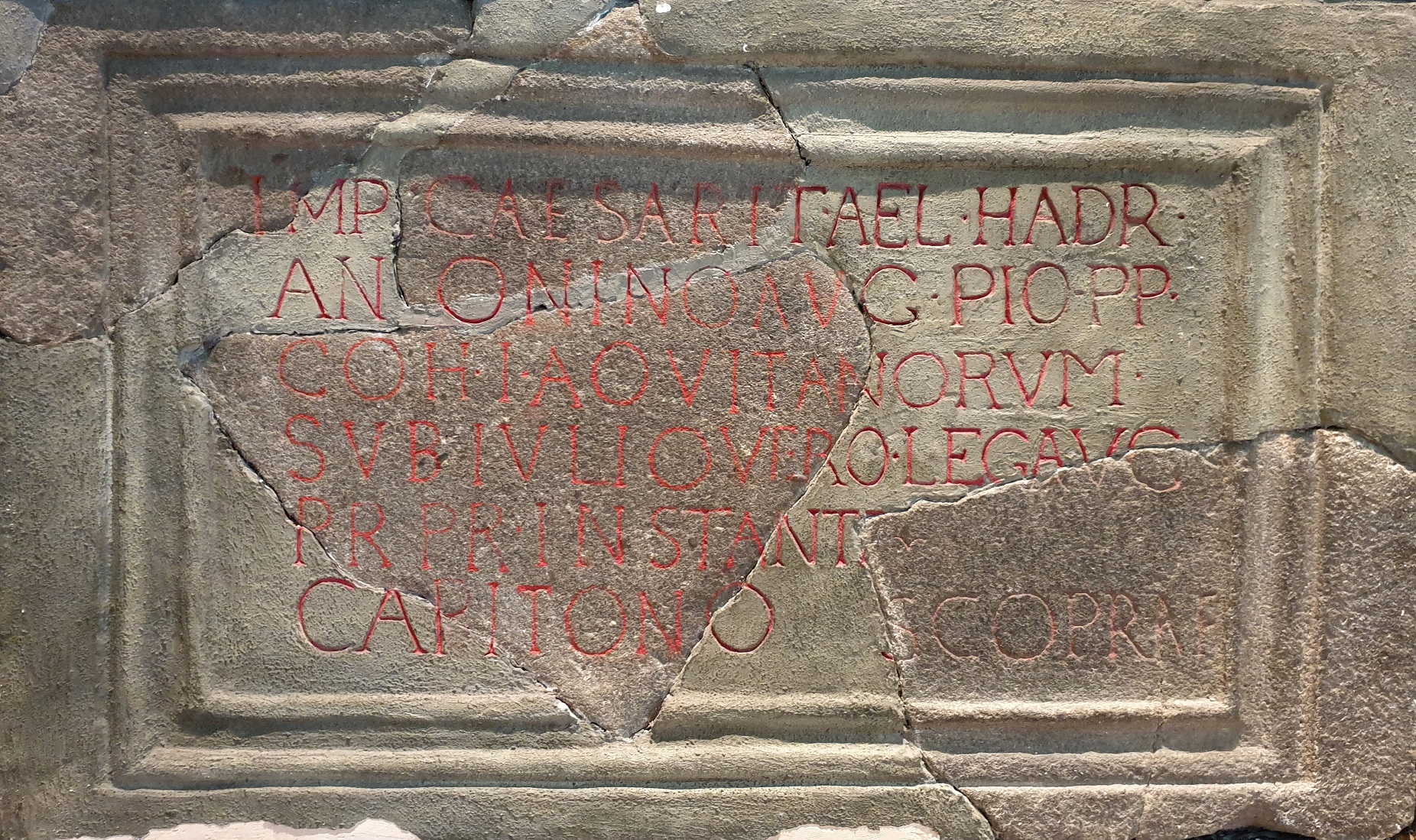
The Centurial stone found at Navio dates from the rebuilding of the fort in 154 CE by occupying soldiers from southwest France. The inscription on it reads:
IMP CAESARI T AEL HADR ANTONINO AVG PIO P P COH I AQVITANORVM SVB IVLIO VERO LEG AVG PR PR INSTANTE CAPITONO SCO PRAE
This translates as: "The 1st Cohort of Aquitanians under Julius Verus, the Emperor’s Governor of Britain, under the instructions of Capitonius Fuscus, Prefect of the Cohort, erected this stone in honour of the Emperor Caesar Titus Aelius Hadrianus Antoninus Augustus Pius, Father of his Country." The gritsone altar is dedicated to the goddess Arnemetia (or Arnomecta), who dwelt in the sacred waters at Buxton, and is inscribed with:
Hub AI
Navio Roman Fort AI simulator
(@Navio Roman Fort_simulator)
Navio Roman Fort
Navio Roman fort overlooks a tight bend of the River Noe at Brough-on-Noe near Hope, Derbyshire, in England. Navio fort and vicus (civilian settlement) is a Scheduled Monument.
The town was recorded as Nauione in the Ravenna Cosmography's list of all known places in the world in about 700 AD. The entry is followed by places with which Navio had road connections: Aquis Arnemeza (Buxton), Zerdotalia (Ardotalia, later called Melandra fort, near Glossop) and Mantio (Manchester). There is also an entry for the river Anava, next to the river Dorvantium, which is considered to be the River Derwent.
A Roman milestone was discovered in 1862 in the Silverlands district of Buxton. It is the oldest inscribed milestone found in Derbyshire. The inscription is:
TRIB POT COS II P P A NAVIONE M P XI
which means ‘With the tribune's power, twice consul, father of this country. From Navio 11 miles.' The milestone is on display in the Buxton Museum. Navio is Latin for "on the river". The Roman name of the fort Navio was later changed to the Old English word for fort, brough. Excavations in the 1930s by Sir Ian Richmond and J.P. Gillam established the locations of the perimeters of successive forts on the same site. Navio fort was originally about 3 acres (1.2 ha) in size and built of timber and earthworks around 80 CE. It was rebuilt in stone in a rectangular form (about 90 by 105 metres (295 by 344 ft)) around 150 CE from when it was occupied for over 200 years. It was subsequently rebuilt and altered and in use until around 350 CE. The site of the fort now consists of earthwork banks and ditches around an earthen platform, buried remains and a few exposed stone slabs. Earlier excavations in 1903 by John Garstang uncovered steps into an underground stone-walled chamber below the Principia or headquarters building. A large Centurial stone and a gritstone altar were found in the fort's strong room. They are on display in the Buxton Museum.
The Centurial stone found at Navio dates from the rebuilding of the fort in 154 CE by occupying soldiers from southwest France. The inscription on it reads:
IMP CAESARI T AEL HADR ANTONINO AVG PIO P P COH I AQVITANORVM SVB IVLIO VERO LEG AVG PR PR INSTANTE CAPITONO SCO PRAE
This translates as: "The 1st Cohort of Aquitanians under Julius Verus, the Emperor’s Governor of Britain, under the instructions of Capitonius Fuscus, Prefect of the Cohort, erected this stone in honour of the Emperor Caesar Titus Aelius Hadrianus Antoninus Augustus Pius, Father of his Country." The gritsone altar is dedicated to the goddess Arnemetia (or Arnomecta), who dwelt in the sacred waters at Buxton, and is inscribed with:
Recent media