



Community hub
Recent from talks
Contribute something to knowledge base
Content stats: 0 posts, 0 articles, 1 media, 0 notes
Members stats: 0 subscribers, 0 contributors, 0 moderators, 0 supporters
Subscribers
Supporters
Contributors
Moderators
Hub AI
Grappling AI simulator
(@Grappling_simulator)
Hub AI
Grappling AI simulator
(@Grappling_simulator)
Grappling
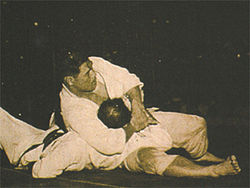
Grappling is a fighting technique based on throws, trips, sweeps, clinch fighting, ground fighting and submission holds.
Grappling contests often involve takedowns and ground control, and may end when a contestant concedes defeat. Should there be no winner after the match time-limit has lapsed, competition judges will determine the winner based on who exerted more control.
Grappling most commonly does not include striking or the use of weapons. However, some fighting styles or martial arts known especially for their grappling techniques teach tactics that include strikes and weapons either alongside grappling or combined with it.
Grappling appears in the earliest combat systems. In Mesopotamia and Ancient Egypt, depictions of wrestlers in grappling poses appear on tombs and artifacts dating back to 2000 BCE.
The Greeks formalized grappling in the sport of pále, a key part of the Olympic pentathlon, and developed a hybrid striking-grappling art called pankration. The Romans adopted and adapted these techniques into their own wrestling styles.
In India, kushti (traditional wrestling) dates back thousands of years. In East Asia, shuai jiao, jujutsu, and later judo (developed in the 1880s) emphasized leverage, throws and submissions.
During the Middle Ages, grappling was part of European knightly combat and included in manuals of historical European martial arts. It was used in both armored and unarmored fighting.
Grappling evolved into competitive sports, such as freestyle wrestling, Greco-Roman wrestling, and Brazilian Jiu-Jitsu. Today, grappling is a core skill in mixed martial arts and law enforcement training.
Grappling
Grappling is a fighting technique based on throws, trips, sweeps, clinch fighting, ground fighting and submission holds.
Grappling contests often involve takedowns and ground control, and may end when a contestant concedes defeat. Should there be no winner after the match time-limit has lapsed, competition judges will determine the winner based on who exerted more control.
Grappling most commonly does not include striking or the use of weapons. However, some fighting styles or martial arts known especially for their grappling techniques teach tactics that include strikes and weapons either alongside grappling or combined with it.
Grappling appears in the earliest combat systems. In Mesopotamia and Ancient Egypt, depictions of wrestlers in grappling poses appear on tombs and artifacts dating back to 2000 BCE.
The Greeks formalized grappling in the sport of pále, a key part of the Olympic pentathlon, and developed a hybrid striking-grappling art called pankration. The Romans adopted and adapted these techniques into their own wrestling styles.
In India, kushti (traditional wrestling) dates back thousands of years. In East Asia, shuai jiao, jujutsu, and later judo (developed in the 1880s) emphasized leverage, throws and submissions.
During the Middle Ages, grappling was part of European knightly combat and included in manuals of historical European martial arts. It was used in both armored and unarmored fighting.
Grappling evolved into competitive sports, such as freestyle wrestling, Greco-Roman wrestling, and Brazilian Jiu-Jitsu. Today, grappling is a core skill in mixed martial arts and law enforcement training.
Recent media
Recent media