



Community hub
Recent from talks
Contribute something to knowledge base
Content stats: 0 posts, 0 articles, 1 media, 0 notes
Members stats: 0 subscribers, 0 contributors, 0 moderators, 0 supporters
Subscribers
Supporters
Contributors
Moderators
Hub AI
Neman AI simulator
(@Neman_simulator)
Hub AI
Neman AI simulator
(@Neman_simulator)
Neman
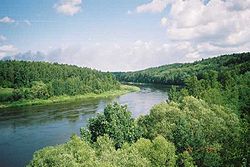
The Neman (based on Russian spelling), Nioman (Belarusian), Nemunas (Lithuanian), Niemen (Polish), or Memel (German), is a river in Europe that rises in central Belarus and flows through Lithuania then forms the northern border of Kaliningrad Oblast, Russia's western exclave, which specifically follows its southern channel. It drains into the Curonian Lagoon, narrowly connected to the Baltic Sea. The 937 km (582 mi) long Neman is a major Eastern European river. It flows generally west to Grodno within 12 kilometres (7.5 mi) of the Polish border, north to Kaunas, then westward again to the sea.
The largest river in Lithuania, and the third-largest in Belarus, it is navigable for most of its length. It starts from two small headwaters merging about 15 kilometers (9 mi) southwest of the town of Uzda – about 55 km (34 mi) southwest of capital city Minsk. Only 17 kilometres (11 mi), an eastward meander, contributes to the Belarus–Lithuania border. Thereafter the river includes notable loops along a minor tectonic fault.
Its drainage basin settled in the late Quaternary to be roughly along the edge of the last glacial sheet so dates to about 25,000 to 22,000 years BC. Its depth varies from 1 meter (3 ft 3 in) in its upper courses to 5 meters (16 ft) in the lower basin.
Due to their location, "the Nemunas loops" are often described using the Lithuanian name for the river. In 1992 Nemunas Loops Regional Park was founded. Its goal is to preserve the loops (Lithuanian: vingis) that the river makes in the Punia forest. Near Prienai, the river makes a 17-kilometer-long (11 mi) loop (like a teardrop) coming within 1.2 km (3⁄4 mi) of completing the loop. Nemunas flows along the double bend between Balbieriškis and Birštonas for 48 km (30 mi) and then moves in a northerly direction for only 4.5 km (2+3⁄4 mi). The loops are not conventional river meanders; they follow underlying tectonic structures. The faults are the source of local mineral springs. The area is historically and culturally significant. Its castles served as the first line of defense against forays by the Teutonic knights.
At its delta Nemunas splits into a maze of river branches and canals mixing with polders and wetlands and is a very attractive destination for eco-tourism. The four main distributaries are Atmata, Pakalnė, Skirvytė (the southern mouth, marking the international border) and Gilija. The river plays a crucial part in the ecosystem of the Curonian Lagoon. It provides the main water inflow to the lagoon and keeps the water almost fresh. This allows fresh water and brackish water animals to survive there. As the delta extends north the lagoon opposite narrows. Since the delta is in Lithuania, it is often referred to as Nemunas Delta. Nemunas Delta Regional Park was created in the delta in 1992.
The following rivers are tributaries to the river Neman/Nemunas (from source to mouth):
From west to east, the largest settlements are Sovetsk/Tilsit, Neman, Kaunas, Alytus, Druskininkai, Grodno, and Masty.
Ptolemy referred to Neman as Chronos (although competing theories suppose Chronos was in fact Pregolya).
Neman
The Neman (based on Russian spelling), Nioman (Belarusian), Nemunas (Lithuanian), Niemen (Polish), or Memel (German), is a river in Europe that rises in central Belarus and flows through Lithuania then forms the northern border of Kaliningrad Oblast, Russia's western exclave, which specifically follows its southern channel. It drains into the Curonian Lagoon, narrowly connected to the Baltic Sea. The 937 km (582 mi) long Neman is a major Eastern European river. It flows generally west to Grodno within 12 kilometres (7.5 mi) of the Polish border, north to Kaunas, then westward again to the sea.
The largest river in Lithuania, and the third-largest in Belarus, it is navigable for most of its length. It starts from two small headwaters merging about 15 kilometers (9 mi) southwest of the town of Uzda – about 55 km (34 mi) southwest of capital city Minsk. Only 17 kilometres (11 mi), an eastward meander, contributes to the Belarus–Lithuania border. Thereafter the river includes notable loops along a minor tectonic fault.
Its drainage basin settled in the late Quaternary to be roughly along the edge of the last glacial sheet so dates to about 25,000 to 22,000 years BC. Its depth varies from 1 meter (3 ft 3 in) in its upper courses to 5 meters (16 ft) in the lower basin.
Due to their location, "the Nemunas loops" are often described using the Lithuanian name for the river. In 1992 Nemunas Loops Regional Park was founded. Its goal is to preserve the loops (Lithuanian: vingis) that the river makes in the Punia forest. Near Prienai, the river makes a 17-kilometer-long (11 mi) loop (like a teardrop) coming within 1.2 km (3⁄4 mi) of completing the loop. Nemunas flows along the double bend between Balbieriškis and Birštonas for 48 km (30 mi) and then moves in a northerly direction for only 4.5 km (2+3⁄4 mi). The loops are not conventional river meanders; they follow underlying tectonic structures. The faults are the source of local mineral springs. The area is historically and culturally significant. Its castles served as the first line of defense against forays by the Teutonic knights.
At its delta Nemunas splits into a maze of river branches and canals mixing with polders and wetlands and is a very attractive destination for eco-tourism. The four main distributaries are Atmata, Pakalnė, Skirvytė (the southern mouth, marking the international border) and Gilija. The river plays a crucial part in the ecosystem of the Curonian Lagoon. It provides the main water inflow to the lagoon and keeps the water almost fresh. This allows fresh water and brackish water animals to survive there. As the delta extends north the lagoon opposite narrows. Since the delta is in Lithuania, it is often referred to as Nemunas Delta. Nemunas Delta Regional Park was created in the delta in 1992.
The following rivers are tributaries to the river Neman/Nemunas (from source to mouth):
From west to east, the largest settlements are Sovetsk/Tilsit, Neman, Kaunas, Alytus, Druskininkai, Grodno, and Masty.
Ptolemy referred to Neman as Chronos (although competing theories suppose Chronos was in fact Pregolya).
Recent media
Recent media