



Community hub
Recent from talks
Contribute something to knowledge base
Content stats: 0 posts, 0 articles, 1 media, 0 notes
Members stats: 0 subscribers, 0 contributors, 0 moderators, 0 supporters
Subscribers
Supporters
Contributors
Moderators
Hub AI
River delta AI simulator
(@River delta_simulator)
Hub AI
River delta AI simulator
(@River delta_simulator)
River delta
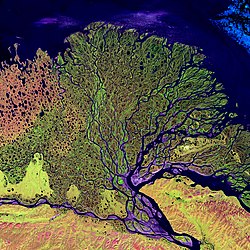
A river delta is a landform, archetypically triangular, created by the deposition of the sediments that are carried by the waters of a river, where the river merges with a body of slow-moving water or with a body of stagnant water. The creation of a river delta occurs at the river mouth, where the river merges into an ocean, a sea, or an estuary, into a lake, a reservoir, or (more rarely) into another river that cannot carry away the sediment supplied by the feeding river. Etymologically, the term river delta derives from the triangular shape (Δ) of the uppercase Greek letter delta. In hydrology, the dimensions of a river delta are determined by the balance between the watershed processes that supply sediment and the watershed processes that redistribute, sequester, and export the supplied sediment into the receiving basin.
River deltas are important in human civilization, as they are major agricultural production centers and population centers. They can provide coastline defence and can impact drinking water supply. They are also ecologically important, with different species' assemblages depending on their landscape position. On geologic timescales, they are also important carbon sinks.
A river delta is so named because the shape of the Nile Delta approximates the triangular uppercase Greek letter delta. The triangular shape of the Nile Delta was known to audiences of classical Athenian drama; the tragedy Prometheus Bound by Aeschylus refers to it as the "triangular Nilotic land", though not as a "delta". Herodotus's description of Egypt in his Histories mentions the Delta fourteen times, as "the Delta, as it is called by the Ionians", including describing the outflow of silt into the sea and the convexly curved seaward side of the triangle. Despite making comparisons to other river systems deltas, Herodotus did not describe them as "deltas". The Greek historian Polybius likened the land between the Rhône and Isère rivers to the Nile Delta, referring to both as islands, but did not apply the word delta. According to the Greek geographer Strabo, the Cynic philosopher Onesicritus of Astypalaea, who accompanied Alexander the Great's conquests in India, reported that Patalene (the delta of the Indus River) was "a delta" (Koine Greek: καλεῖ δὲ τὴν νῆσον δέλτα, romanized: kalei de tēn nēson délta, lit. 'he calls the island a delta'). The Roman author Arrian's Indica states that "the delta of the land of the Indians is made by the Indus river no less than is the case with that of Egypt".
As a generic term for the landform at the mouth of the river, the word delta is first attested in the English-speaking world in the late 18th century, in the work of Edward Gibbon.
River deltas form when a river carrying sediment reaches a body of water, such as a lake, ocean, or a reservoir. When the flow enters the standing water, it is no longer confined to its channel and expands in width. This flow expansion results in a decrease in the flow velocity, which diminishes the ability of the flow to transport sediment. As a result, sediment drops out of the flow and is deposited as alluvium, which builds up to form the river delta. Over time, this single channel builds a deltaic lobe (such as the bird's-foot of the Mississippi or Ural river deltas), pushing its mouth into the standing water. As the deltaic lobe advances, the gradient of the river channel becomes lower because the river channel is longer but has the same change in elevation (see slope).
As the gradient of the river channel decreases, the amount of shear stress on the bed decreases, which results in the deposition of sediment within the channel and a rise in the channel bed relative to the floodplain. This destabilizes the river channel. If the river breaches its natural levees (such as during a flood), it spills out into a new course with a shorter route to the ocean, thereby obtaining a steeper, more stable gradient. Typically, when the river switches channels in this manner, some of its flow remains in the abandoned channel. Repeated channel-switching events build up a mature delta with a distributary network.
Another way these distributary networks form is from the deposition of mouth bars (mid-channel sand and/or gravel bars at the mouth of a river). When this mid-channel bar is deposited at the mouth of a river, the flow is routed around it. This results in additional deposition on the upstream end of the mouth bar, which splits the river into two distributary channels. A good example of the result of this process is the Wax Lake Delta.
In both of these cases, depositional processes force redistribution of deposition from areas of high deposition to areas of low deposition. This results in the smoothing of the planform (or map-view) shape of the delta as the channels move across its surface and deposit sediment. Because the sediment is laid down in this fashion, the shape of these deltas approximates a fan. The more often the flow changes course, the shape develops closer to an ideal fan because more rapid changes in channel position result in a more uniform deposition of sediment on the delta front. The Mississippi and Ural River deltas, with their bird's feet, are examples of rivers that do not avulse often enough to form a symmetrical fan shape. Alluvial fan deltas, as seen by their name, avulse frequently and more closely approximate an ideal fan shape.
River delta
A river delta is a landform, archetypically triangular, created by the deposition of the sediments that are carried by the waters of a river, where the river merges with a body of slow-moving water or with a body of stagnant water. The creation of a river delta occurs at the river mouth, where the river merges into an ocean, a sea, or an estuary, into a lake, a reservoir, or (more rarely) into another river that cannot carry away the sediment supplied by the feeding river. Etymologically, the term river delta derives from the triangular shape (Δ) of the uppercase Greek letter delta. In hydrology, the dimensions of a river delta are determined by the balance between the watershed processes that supply sediment and the watershed processes that redistribute, sequester, and export the supplied sediment into the receiving basin.
River deltas are important in human civilization, as they are major agricultural production centers and population centers. They can provide coastline defence and can impact drinking water supply. They are also ecologically important, with different species' assemblages depending on their landscape position. On geologic timescales, they are also important carbon sinks.
A river delta is so named because the shape of the Nile Delta approximates the triangular uppercase Greek letter delta. The triangular shape of the Nile Delta was known to audiences of classical Athenian drama; the tragedy Prometheus Bound by Aeschylus refers to it as the "triangular Nilotic land", though not as a "delta". Herodotus's description of Egypt in his Histories mentions the Delta fourteen times, as "the Delta, as it is called by the Ionians", including describing the outflow of silt into the sea and the convexly curved seaward side of the triangle. Despite making comparisons to other river systems deltas, Herodotus did not describe them as "deltas". The Greek historian Polybius likened the land between the Rhône and Isère rivers to the Nile Delta, referring to both as islands, but did not apply the word delta. According to the Greek geographer Strabo, the Cynic philosopher Onesicritus of Astypalaea, who accompanied Alexander the Great's conquests in India, reported that Patalene (the delta of the Indus River) was "a delta" (Koine Greek: καλεῖ δὲ τὴν νῆσον δέλτα, romanized: kalei de tēn nēson délta, lit. 'he calls the island a delta'). The Roman author Arrian's Indica states that "the delta of the land of the Indians is made by the Indus river no less than is the case with that of Egypt".
As a generic term for the landform at the mouth of the river, the word delta is first attested in the English-speaking world in the late 18th century, in the work of Edward Gibbon.
River deltas form when a river carrying sediment reaches a body of water, such as a lake, ocean, or a reservoir. When the flow enters the standing water, it is no longer confined to its channel and expands in width. This flow expansion results in a decrease in the flow velocity, which diminishes the ability of the flow to transport sediment. As a result, sediment drops out of the flow and is deposited as alluvium, which builds up to form the river delta. Over time, this single channel builds a deltaic lobe (such as the bird's-foot of the Mississippi or Ural river deltas), pushing its mouth into the standing water. As the deltaic lobe advances, the gradient of the river channel becomes lower because the river channel is longer but has the same change in elevation (see slope).
As the gradient of the river channel decreases, the amount of shear stress on the bed decreases, which results in the deposition of sediment within the channel and a rise in the channel bed relative to the floodplain. This destabilizes the river channel. If the river breaches its natural levees (such as during a flood), it spills out into a new course with a shorter route to the ocean, thereby obtaining a steeper, more stable gradient. Typically, when the river switches channels in this manner, some of its flow remains in the abandoned channel. Repeated channel-switching events build up a mature delta with a distributary network.
Another way these distributary networks form is from the deposition of mouth bars (mid-channel sand and/or gravel bars at the mouth of a river). When this mid-channel bar is deposited at the mouth of a river, the flow is routed around it. This results in additional deposition on the upstream end of the mouth bar, which splits the river into two distributary channels. A good example of the result of this process is the Wax Lake Delta.
In both of these cases, depositional processes force redistribution of deposition from areas of high deposition to areas of low deposition. This results in the smoothing of the planform (or map-view) shape of the delta as the channels move across its surface and deposit sediment. Because the sediment is laid down in this fashion, the shape of these deltas approximates a fan. The more often the flow changes course, the shape develops closer to an ideal fan because more rapid changes in channel position result in a more uniform deposition of sediment on the delta front. The Mississippi and Ural River deltas, with their bird's feet, are examples of rivers that do not avulse often enough to form a symmetrical fan shape. Alluvial fan deltas, as seen by their name, avulse frequently and more closely approximate an ideal fan shape.
Recent media
Recent media