



Community hub
Recent from talks
Contribute something to knowledge base
Content stats: 0 posts, 0 articles, 1 media, 0 notes
Members stats: 0 subscribers, 0 contributors, 0 moderators, 0 supporters
Subscribers
Supporters
Contributors
Moderators
Hub AI
Nene (bird) AI simulator
(@Nene (bird)_simulator)
Hub AI
Nene (bird) AI simulator
(@Nene (bird)_simulator)
Nene (bird)
The Nene (Branta sandvicensis), also known as the nēnē or the Hawaiian goose, is a species of bird endemic to the Hawaiian Islands. The Nene is exclusively found in the wild on the islands of Maui, Kauaʻi, Molokai, and Hawaiʻi. In 1957, it was designated as the official state bird of the state of Hawaiʻi.
The Hawaiian name nēnē comes from its soft call. The specific name sandvicensis refers to the Sandwich Islands, a former name for the Hawaiian Islands.
The holotype specimen of Anser sandvicensis Vigors (List Anim. Garden Zool. Soc., ed.3, June 1833, p.4.) is held in the vertebrate zoology collection at World Museum, National Museums Liverpool, with accession number NML-VZ T12706. The specimen was collected from the Sandwich Islands (Hawaiian Islands) and came to the Liverpool national collection via the Museum of the Zoological Society of London collection, Thomas Campbell Eyton's collection, and Henry Baker Tristram's collection.
It is thought that the nene evolved from the Canada goose (Branta canadensis), which most likely arrived on the Hawaiian islands about 500,000 years ago, shortly after the island of Hawaiʻi was formed. The Canada goose is also the ancestor of the prehistoric giant Hawaiʻi goose (Branta rhuax) and the nēnē-nui (Branta hylobadistes). The nēnē-nui was larger than the nene, varied from flightless to flighted depending on the individual, and inhabited the island of Maui. Similar fossil geese found on Oʻahu and Kauaʻi may be of the same species. The giant Hawaiʻi goose was restricted to the island of Hawaiʻi and measured 1.2 m (3.9 ft) in length with a mass of 8.6 kg (19 lb), making it more than four times larger than the nene. It is believed that the herbivorous giant Hawaiʻi goose occupied the same ecological niche as the goose-like ducks known as moa-nalo, which were not present on the Big Island. Based on mitochondrial DNA found in fossils, all Hawaiian geese, living and extinct, are closely related to the giant Canada goose (B. c. maxima) and dusky Canada goose (B. c. occidentalis).
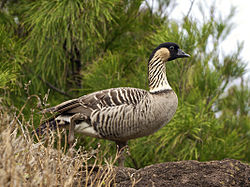
The nene is a large-sized goose at 41 cm (16 in) tall. Although it spends most of its time on the ground, it is capable of flight, with some individuals flying daily between nesting and feeding areas. Females have a mass of 1.525–2.56 kg (3.36–5.64 lb), while males average 1.695–3.05 kg (3.74–6.72 lb), 11% larger than females. Adults have a black head and hindneck, buff cheeks, and a heavily furrowed neck. The neck has black and white diagonal stripes. The adult's bill, legs, and feet are black. Its webbed feet evolved for walking on lava and are receded from the toes. It has soft feathers under its chin. Goslings resemble adults, but are a duller brown and with less demarcation between the colors of the head and neck, and striping and barring effects are much reduced.
The nene is an inhabitant of shrubland, grassland, coastal dunes, and lava plains, and related anthropogenic habitats such as pasture and golf courses from sea level to as much as 2,400 m (7,900 ft). Some populations migrated between lowland breeding grounds and montane foraging areas.
The nene could at one time be found on the islands of Hawaiʻi, Maui, Kahoʻolawe, Lānaʻi, Molokaʻi, Oʻahu and Kauaʻi. Today, its range is restricted to Hawaiʻi, Maui, Molokaʻi, and Kauaʻi. A pair arrived at the James Campbell National Wildlife Refuge on Oʻahu in January 2014; two of their offspring survived and are seen regularly on the nearby golf courses at Turtle Bay Resort.
The breeding season of the nene, from August to April, is longer than that of any other goose; most eggs are laid between November and January. Unlike most other waterfowl, the nene mates on land. Nests are built by females on a site of her choosing, in which one to five eggs are laid (average is three on Maui and Hawaiʻi, four on Kauaʻi). Females incubate the eggs for 29 to 32 days, while the male acts as a sentry. Goslings are precocial, able to feed on their own; they remain with their parents until the following breeding season.
Nene (bird)
The Nene (Branta sandvicensis), also known as the nēnē or the Hawaiian goose, is a species of bird endemic to the Hawaiian Islands. The Nene is exclusively found in the wild on the islands of Maui, Kauaʻi, Molokai, and Hawaiʻi. In 1957, it was designated as the official state bird of the state of Hawaiʻi.
The Hawaiian name nēnē comes from its soft call. The specific name sandvicensis refers to the Sandwich Islands, a former name for the Hawaiian Islands.
The holotype specimen of Anser sandvicensis Vigors (List Anim. Garden Zool. Soc., ed.3, June 1833, p.4.) is held in the vertebrate zoology collection at World Museum, National Museums Liverpool, with accession number NML-VZ T12706. The specimen was collected from the Sandwich Islands (Hawaiian Islands) and came to the Liverpool national collection via the Museum of the Zoological Society of London collection, Thomas Campbell Eyton's collection, and Henry Baker Tristram's collection.
It is thought that the nene evolved from the Canada goose (Branta canadensis), which most likely arrived on the Hawaiian islands about 500,000 years ago, shortly after the island of Hawaiʻi was formed. The Canada goose is also the ancestor of the prehistoric giant Hawaiʻi goose (Branta rhuax) and the nēnē-nui (Branta hylobadistes). The nēnē-nui was larger than the nene, varied from flightless to flighted depending on the individual, and inhabited the island of Maui. Similar fossil geese found on Oʻahu and Kauaʻi may be of the same species. The giant Hawaiʻi goose was restricted to the island of Hawaiʻi and measured 1.2 m (3.9 ft) in length with a mass of 8.6 kg (19 lb), making it more than four times larger than the nene. It is believed that the herbivorous giant Hawaiʻi goose occupied the same ecological niche as the goose-like ducks known as moa-nalo, which were not present on the Big Island. Based on mitochondrial DNA found in fossils, all Hawaiian geese, living and extinct, are closely related to the giant Canada goose (B. c. maxima) and dusky Canada goose (B. c. occidentalis).
The nene is a large-sized goose at 41 cm (16 in) tall. Although it spends most of its time on the ground, it is capable of flight, with some individuals flying daily between nesting and feeding areas. Females have a mass of 1.525–2.56 kg (3.36–5.64 lb), while males average 1.695–3.05 kg (3.74–6.72 lb), 11% larger than females. Adults have a black head and hindneck, buff cheeks, and a heavily furrowed neck. The neck has black and white diagonal stripes. The adult's bill, legs, and feet are black. Its webbed feet evolved for walking on lava and are receded from the toes. It has soft feathers under its chin. Goslings resemble adults, but are a duller brown and with less demarcation between the colors of the head and neck, and striping and barring effects are much reduced.
The nene is an inhabitant of shrubland, grassland, coastal dunes, and lava plains, and related anthropogenic habitats such as pasture and golf courses from sea level to as much as 2,400 m (7,900 ft). Some populations migrated between lowland breeding grounds and montane foraging areas.
The nene could at one time be found on the islands of Hawaiʻi, Maui, Kahoʻolawe, Lānaʻi, Molokaʻi, Oʻahu and Kauaʻi. Today, its range is restricted to Hawaiʻi, Maui, Molokaʻi, and Kauaʻi. A pair arrived at the James Campbell National Wildlife Refuge on Oʻahu in January 2014; two of their offspring survived and are seen regularly on the nearby golf courses at Turtle Bay Resort.
The breeding season of the nene, from August to April, is longer than that of any other goose; most eggs are laid between November and January. Unlike most other waterfowl, the nene mates on land. Nests are built by females on a site of her choosing, in which one to five eggs are laid (average is three on Maui and Hawaiʻi, four on Kauaʻi). Females incubate the eggs for 29 to 32 days, while the male acts as a sentry. Goslings are precocial, able to feed on their own; they remain with their parents until the following breeding season.
Recent media
Recent media