


Community hub
Recent from talks
Contribute something to knowledge base
Content stats: 0 posts, 0 articles, 1 media, 0 notes
Members stats: 0 subscribers, 0 contributors, 0 moderators, 0 supporters
Subscribers
Supporters
Contributors
Moderators
Hub AI
Neonatal resuscitation AI simulator
(@Neonatal resuscitation_simulator)
Hub AI
Neonatal resuscitation AI simulator
(@Neonatal resuscitation_simulator)
Neonatal resuscitation
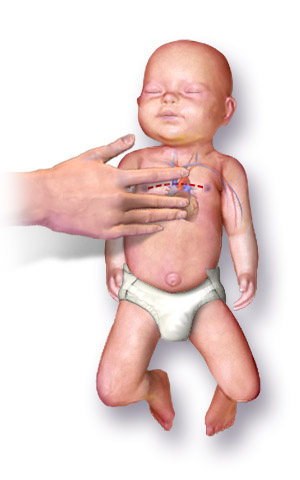
Neonatal resuscitation, also known as newborn resuscitation, is an emergency procedure focused on supporting approximately 10% of newborn children who do not readily begin breathing, putting them at risk of irreversible organ injury and death. Many of the infants who require this support to start breathing well on their own after assistance. Through positive airway pressure, and in severe cases chest compressions, medical personnel certified in neonatal resuscitation can often stimulate neonates to begin breathing on their own, with attendant normalization of heart rate.
Face masks that cover the infant's mouth and nose are often used in the resuscitation procedures. Nasal prongs/tubes/masks and laryngeal mask airway devices are also sometimes used.
Up to 10% of infants are born requiring assistance to begin breathing. After assistance, many of these infants begin to breathe on their own and are healthy. Breathing problems at birth is a high priority emergency and interventions such as breathing support and resuscitation is sometimes required.
All infants who are 'gasping', show signs of being apnoeic (suspension of breathing), or have bradycardia with a heart rate lower than 100 beats per minute after birth are recommended to be administered positive pressure ventilation with a 'manual ventilation device' to provide breathing support. Examples of manual ventilation devices include a self-inflating bag or a T-piece.
About a quarter of all neonatal deaths globally are caused by birth asphyxia. This dangerous condition of oxygen deprivation may begin before birth. For example, if the umbilical cord, which supplies oxygen throughout fetal development, is compressed or tears during delivery. Depending on how quickly and successfully the infant is resuscitated, hypoxic damage can occur to most of the infant's organs (heart, lungs, liver, gut, kidneys). One serious complication is a brain injury known as neonatal hypoxic-ischemic encephalopathy.[citation needed]
The most widely known training/certification for neonatal resuscitation is the Neonatal Resuscitation Program (NRP).
The International Liaison Committee on Resuscitation (ILCOR) has published Consensus on science and treatment recommendations for neonatal resuscitation. Traditionally, newborn children have been resuscitated using mechanical ventilation with 100% oxygen, but there has since the 1980s increasingly been debated whether newborn infants with asphyxia should be resuscitated with 100% oxygen or normal air, and notably Ola Didrik Saugstad has been a major advocate of using normal air.
In 2020, the International Liaison Committee on Resuscitation (ILCOR) published its 4th and most recent recommendations for newborn life support. The committee reviewed 8 major topics, including anticipation and preparation, initial assessment and intervention, physiologic monitoring and feedback devices, ventilation and oxygenation, circulatory support, drug and fluid administration, prognostication during CPR, and post-resuscitation care.
Neonatal resuscitation
Neonatal resuscitation, also known as newborn resuscitation, is an emergency procedure focused on supporting approximately 10% of newborn children who do not readily begin breathing, putting them at risk of irreversible organ injury and death. Many of the infants who require this support to start breathing well on their own after assistance. Through positive airway pressure, and in severe cases chest compressions, medical personnel certified in neonatal resuscitation can often stimulate neonates to begin breathing on their own, with attendant normalization of heart rate.
Face masks that cover the infant's mouth and nose are often used in the resuscitation procedures. Nasal prongs/tubes/masks and laryngeal mask airway devices are also sometimes used.
Up to 10% of infants are born requiring assistance to begin breathing. After assistance, many of these infants begin to breathe on their own and are healthy. Breathing problems at birth is a high priority emergency and interventions such as breathing support and resuscitation is sometimes required.
All infants who are 'gasping', show signs of being apnoeic (suspension of breathing), or have bradycardia with a heart rate lower than 100 beats per minute after birth are recommended to be administered positive pressure ventilation with a 'manual ventilation device' to provide breathing support. Examples of manual ventilation devices include a self-inflating bag or a T-piece.
About a quarter of all neonatal deaths globally are caused by birth asphyxia. This dangerous condition of oxygen deprivation may begin before birth. For example, if the umbilical cord, which supplies oxygen throughout fetal development, is compressed or tears during delivery. Depending on how quickly and successfully the infant is resuscitated, hypoxic damage can occur to most of the infant's organs (heart, lungs, liver, gut, kidneys). One serious complication is a brain injury known as neonatal hypoxic-ischemic encephalopathy.[citation needed]
The most widely known training/certification for neonatal resuscitation is the Neonatal Resuscitation Program (NRP).
The International Liaison Committee on Resuscitation (ILCOR) has published Consensus on science and treatment recommendations for neonatal resuscitation. Traditionally, newborn children have been resuscitated using mechanical ventilation with 100% oxygen, but there has since the 1980s increasingly been debated whether newborn infants with asphyxia should be resuscitated with 100% oxygen or normal air, and notably Ola Didrik Saugstad has been a major advocate of using normal air.
In 2020, the International Liaison Committee on Resuscitation (ILCOR) published its 4th and most recent recommendations for newborn life support. The committee reviewed 8 major topics, including anticipation and preparation, initial assessment and intervention, physiologic monitoring and feedback devices, ventilation and oxygenation, circulatory support, drug and fluid administration, prognostication during CPR, and post-resuscitation care.
Recent media
Recent media