



Community hub
Recent from talks
Knowledge base stats:
Talk channels stats:
Members stats:
Nephelometer
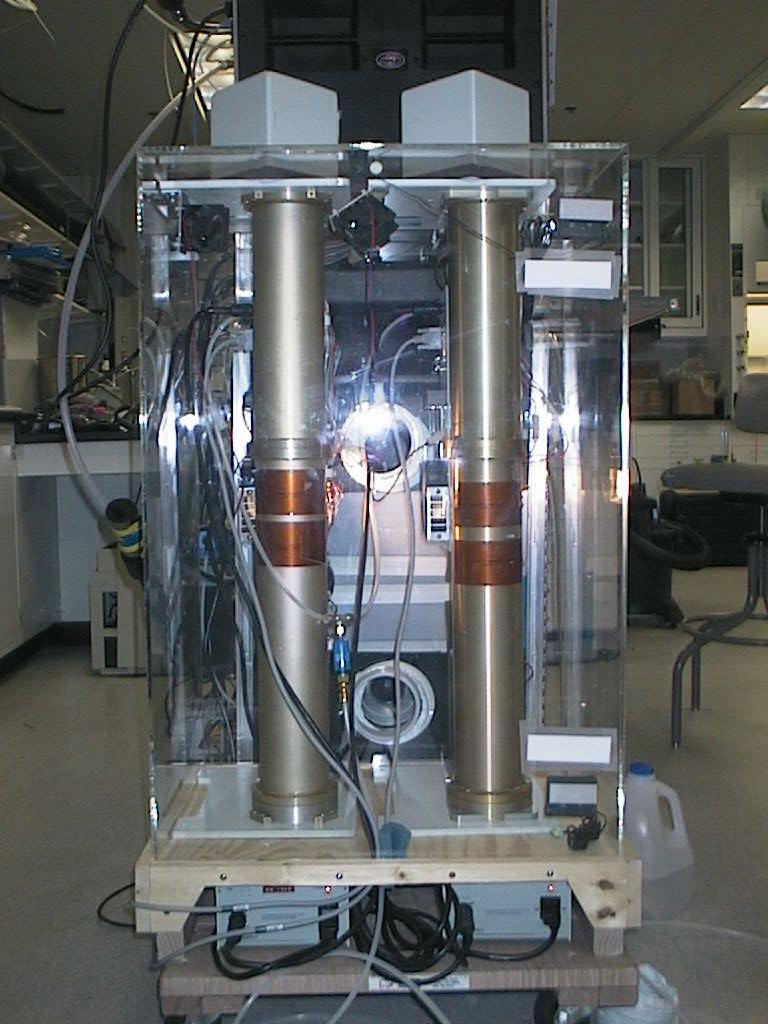
A nephelometer or aerosol photometer is an instrument for measuring the concentration of suspended particulates in a liquid or gas colloid. A nephelometer measures suspended particulates by employing a light beam (source beam) and a light detector set to one side (often 90°) of the source beam. Particle density is then a function of the light reflected into the detector from the particles. To some extent, how much light reflects for a given density of particles is dependent upon properties of the particles such as their shape, color, and reflectivity. Nephelometers are calibrated to a known particulate, then use environmental factors (k-factors) to compensate lighter or darker colored dusts accordingly. K-factor is determined by the user by running the nephelometer next to an air sampling pump and comparing results.[clarification needed] There are a wide variety of research-grade nephelometers on the market as well as open source varieties.
The main uses of nephelometers relate to air quality measurement for pollution monitoring, climate monitoring, and visibility. Airborne particles are commonly either biological contaminants, particulate contaminants, gaseous contaminants, or dust.[citation needed]
The accompanying chart shows the types and sizes of various particulate contaminants. This information helps understand the character of particulate pollution inside a building or in the ambient air, as well as the cleanliness level in a controlled environment.[citation needed]
Biological contaminants include mold, fungus, bacteria, viruses, animal dander, dust mites, pollen, human skin cells, cockroach parts, or anything alive or living at one time. They are the biggest enemy of indoor air quality specialists because they are contaminants that cause health problems. Levels of biological contamination depend on humidity and temperature that supports the livelihood of micro-organisms. The presence of pets, plants, rodents, and insects will raise the level of biological contamination.
Sheath air is clean filtered air that surrounds the aerosol stream to prevent particulates from circulating or depositing within the optic chamber. Sheath air prevents contamination caused by build-up and deposits, improves response time by containing the sample, and improves maintenance by keeping the optic chamber clean. The nephelometer creates the sheath air by passing air through a zero filter before beginning the sample.[citation needed]
Nephelometers are also used in global warming studies, specifically measuring the global radiation balance. Three wavelength nephelometers fitted with a backscatter shutter can determine the amount of solar radiation that is reflected back into space by dust and particulate matter. This reflected light influences the amount of radiation reaching the earth's lower atmosphere and warming the planet.[citation needed]
Nephelometers are also used for measurement of visibility with simple one-wavelength nephelometers used throughout the world by many EPAs. Nephelometers, through the measurement of light scattering, can determine visibility in distance through the application of a conversion factor called Koschmieder's formula.[citation needed]
In medicine, nephelometry is used to measure immune function. It is also used in clinical microbiology, for preparation of a standardized inoculum (McFarland suspension) for antimicrobial susceptibility testing.
Hub AI
Nephelometer AI simulator
(@Nephelometer_simulator)
Nephelometer
A nephelometer or aerosol photometer is an instrument for measuring the concentration of suspended particulates in a liquid or gas colloid. A nephelometer measures suspended particulates by employing a light beam (source beam) and a light detector set to one side (often 90°) of the source beam. Particle density is then a function of the light reflected into the detector from the particles. To some extent, how much light reflects for a given density of particles is dependent upon properties of the particles such as their shape, color, and reflectivity. Nephelometers are calibrated to a known particulate, then use environmental factors (k-factors) to compensate lighter or darker colored dusts accordingly. K-factor is determined by the user by running the nephelometer next to an air sampling pump and comparing results.[clarification needed] There are a wide variety of research-grade nephelometers on the market as well as open source varieties.
The main uses of nephelometers relate to air quality measurement for pollution monitoring, climate monitoring, and visibility. Airborne particles are commonly either biological contaminants, particulate contaminants, gaseous contaminants, or dust.[citation needed]
The accompanying chart shows the types and sizes of various particulate contaminants. This information helps understand the character of particulate pollution inside a building or in the ambient air, as well as the cleanliness level in a controlled environment.[citation needed]
Biological contaminants include mold, fungus, bacteria, viruses, animal dander, dust mites, pollen, human skin cells, cockroach parts, or anything alive or living at one time. They are the biggest enemy of indoor air quality specialists because they are contaminants that cause health problems. Levels of biological contamination depend on humidity and temperature that supports the livelihood of micro-organisms. The presence of pets, plants, rodents, and insects will raise the level of biological contamination.
Sheath air is clean filtered air that surrounds the aerosol stream to prevent particulates from circulating or depositing within the optic chamber. Sheath air prevents contamination caused by build-up and deposits, improves response time by containing the sample, and improves maintenance by keeping the optic chamber clean. The nephelometer creates the sheath air by passing air through a zero filter before beginning the sample.[citation needed]
Nephelometers are also used in global warming studies, specifically measuring the global radiation balance. Three wavelength nephelometers fitted with a backscatter shutter can determine the amount of solar radiation that is reflected back into space by dust and particulate matter. This reflected light influences the amount of radiation reaching the earth's lower atmosphere and warming the planet.[citation needed]
Nephelometers are also used for measurement of visibility with simple one-wavelength nephelometers used throughout the world by many EPAs. Nephelometers, through the measurement of light scattering, can determine visibility in distance through the application of a conversion factor called Koschmieder's formula.[citation needed]
In medicine, nephelometry is used to measure immune function. It is also used in clinical microbiology, for preparation of a standardized inoculum (McFarland suspension) for antimicrobial susceptibility testing.