



Community hub
Recent from talks
Contribute something to knowledge base
Content stats: 0 posts, 0 articles, 1 media, 0 notes
Members stats: 0 subscribers, 0 contributors, 0 moderators, 0 supporters
Subscribers
Supporters
Contributors
Moderators
Hub AI
Neptunium(IV) oxide AI simulator
(@Neptunium(IV) oxide_simulator)
Hub AI
Neptunium(IV) oxide AI simulator
(@Neptunium(IV) oxide_simulator)
Neptunium(IV) oxide
Neptunium(IV) oxide, or neptunium dioxide, is a radioactive, olive green cubic crystalline solid with the formula NpO2. It is one of two stable oxides of neptunium, the other being neptunium(V) oxide. It emits both α- and γ-particles.
Industrially, neptunium dioxide is formed by precipitation of neptunium(IV) oxalate, followed by calcination to neptunium dioxide.
Production starts with a nitric acid feed solution containing neptunium ions in various oxidation states. First, a hydrazine inhibitor is added to slow any oxidation from standing in air. Then ascorbic acid reduces the feed solution to predominantly neptunium(IV):
Addition of oxalic acid precipitates hydrated neptunium oxalate...
...which pyrolyzes when heated:
Neptunium dioxide can also be formed from precipitation of neptunium(IV) peroxide, but the process is much more sensitive.
As a byproduct of nuclear fission reactors, neptunium dioxide can be purified by fluorination, followed by reduction with excess calcium in the presence of iodine. However, the aforementioned synthesis yields a quite pure solid, with less than 0.3% mass fraction of impurities. Generally, further purification is unnecessary.
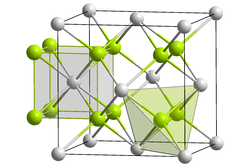
Due to neptunium's large size, neptunium dioxide has a fluorite structure, with lattice constant a=5.43 Å. Like all fluorite structure materials, it has a space group of Fm3m. Neptunium is eight-coordinate, with a cubic coordination geometry, and oxygen is four-coordinate, with a tetrahedral coordinate geometry.
Neptunium(IV) oxide
Neptunium(IV) oxide, or neptunium dioxide, is a radioactive, olive green cubic crystalline solid with the formula NpO2. It is one of two stable oxides of neptunium, the other being neptunium(V) oxide. It emits both α- and γ-particles.
Industrially, neptunium dioxide is formed by precipitation of neptunium(IV) oxalate, followed by calcination to neptunium dioxide.
Production starts with a nitric acid feed solution containing neptunium ions in various oxidation states. First, a hydrazine inhibitor is added to slow any oxidation from standing in air. Then ascorbic acid reduces the feed solution to predominantly neptunium(IV):
Addition of oxalic acid precipitates hydrated neptunium oxalate...
...which pyrolyzes when heated:
Neptunium dioxide can also be formed from precipitation of neptunium(IV) peroxide, but the process is much more sensitive.
As a byproduct of nuclear fission reactors, neptunium dioxide can be purified by fluorination, followed by reduction with excess calcium in the presence of iodine. However, the aforementioned synthesis yields a quite pure solid, with less than 0.3% mass fraction of impurities. Generally, further purification is unnecessary.
Due to neptunium's large size, neptunium dioxide has a fluorite structure, with lattice constant a=5.43 Å. Like all fluorite structure materials, it has a space group of Fm3m. Neptunium is eight-coordinate, with a cubic coordination geometry, and oxygen is four-coordinate, with a tetrahedral coordinate geometry.
Recent media
Recent media