
Recent from talks
Neural correlates of consciousness
Knowledge base stats:
Talk channels stats:
Members stats:
Neural correlates of consciousness
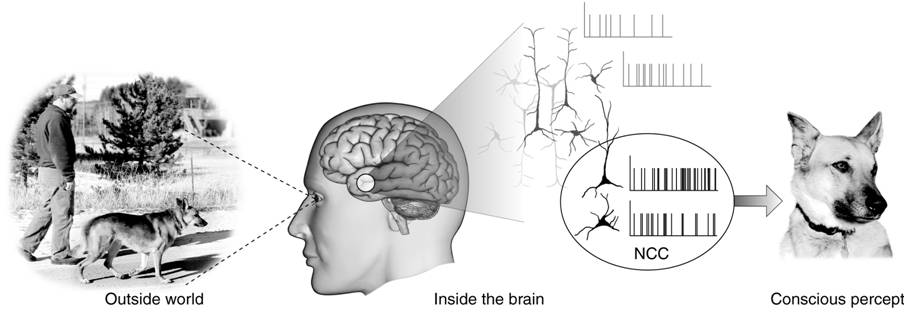
The neural correlates of consciousness (NCC) are the minimal set of neuronal events and mechanisms sufficient for the occurrence of the mental states to which they are related. Neuroscientists use empirical approaches to discover neural correlates of subjective phenomena; that is, neural changes which necessarily and regularly correlate with a specific experience.
A science of consciousness must explain the exact relationship between subjective mental states and brain states, the nature of the relationship between the conscious mind and the electrochemical interactions in the body (mind–body problem). Progress in neuropsychology and neurophilosophy has come from focusing on the body rather than the mind. In this context the neuronal correlates of consciousness may be viewed as its causes, and consciousness may be thought of as a state-dependent property of an undefined complex, adaptive, and highly interconnected biological system.
Discovering and characterizing neural correlates does not offer a causal theory of consciousness that can explain how particular systems experience anything, the so-called hard problem of consciousness, but understanding the NCC may be a step toward a causal theory. Most neurobiologists propose that the variables giving rise to consciousness are to be found at the neuronal level, governed by classical physics. There are theories proposed of quantum consciousness based on quantum mechanics.
There is an apparent redundancy and parallelism in neural networks so, while activity in one group of neurons may correlate with a percept in one case, a different population may mediate a related percept if the former population is lost or inactivated. It may be that every phenomenal, subjective state has a neural correlate. Where the NCC can be induced artificially, the subject will experience the associated percept, while perturbing or inactivating the region of correlation for a specific percept will affect the percept or cause it to disappear, giving a cause-effect relationship from the neural region to the nature of the percept.[citation needed]
Proposals that have been advanced over the years include: what characterizes the NCC? What are the commonalities between the NCC for seeing and for hearing? Will the NCC involve all the pyramidal neurons in the cortex at any given point in time? Or only a subset of long-range projection cells in the frontal lobes that project to the sensory cortices in the back? Neurons that fire in a rhythmic manner? Neurons that fire in a synchronous manner?
The growing ability of neuroscientists to manipulate neurons using methods from molecular biology in combination with optical tools (e.g., Adamantidis et al. 2007) depends on the simultaneous development of appropriate behavioral assays and model organisms amenable to large-scale genomic analysis and manipulation. The combination of fine-grained neuronal analysis in animals with increasingly more sensitive psychophysical and brain imaging techniques in humans, complemented by the development of a robust theoretical predictive framework, will hopefully lead to a rational understanding of consciousness, one of the central mysteries of life. Research has shown a correlation between significant measurable changes in brain structure at the end of the second trimester of the human fetus development, which facilitate the emergence of early consciousness in the fetus. These structural developments include the maturation of neural connections and the formation of key brain regions associated with sensory processing and emotional regulation. As these areas become more integrated, the fetus begins to exhibit responses to external stimuli, suggesting a nascent awareness of its environment. This early stage of consciousness is crucial, as it lays the foundation for later cognitive and social development, influencing how individuals will interact with the world around them after birth.
There are two common but distinct dimensions of the term consciousness, one involving arousal and states of consciousness and the other involving content of consciousness and conscious states. To be conscious of anything the brain must be in a relatively high state of arousal (sometimes called vigilance), whether in wakefulness or REM sleep, vividly experienced in dreams although usually not remembered. Brain arousal level fluctuates in a circadian rhythm but may be influenced by lack of sleep, drugs and alcohol, physical exertion, etc. Arousal can be measured behaviorally by the signal amplitude that triggers some criterion reaction (for instance, the sound level necessary to evoke an eye movement or a head turn toward the sound source). Clinicians use scoring systems such as the Glasgow Coma Scale to assess the level of arousal in patients.[citation needed] Similarly, the NCC are delineated in research by content-specific and full types; both are distinct from the background conditions for consciousness.
High arousal states are associated with conscious states that have specific content, seeing, hearing, remembering, planning or fantasizing about something. Different levels or states of consciousness are associated with different kinds of conscious experiences. The "awake" state is quite different from the "dreaming" state (for instance, the latter has little or no self-reflection) and from the state of deep sleep. In all three cases the basic physiology of the brain is affected, as it also is in altered states of consciousness, for instance after taking drugs or during meditation when conscious perception and insight may be enhanced compared to the normal waking state.[citation needed]
Hub AI
Neural correlates of consciousness AI simulator
(@Neural correlates of consciousness_simulator)
Neural correlates of consciousness
The neural correlates of consciousness (NCC) are the minimal set of neuronal events and mechanisms sufficient for the occurrence of the mental states to which they are related. Neuroscientists use empirical approaches to discover neural correlates of subjective phenomena; that is, neural changes which necessarily and regularly correlate with a specific experience.
A science of consciousness must explain the exact relationship between subjective mental states and brain states, the nature of the relationship between the conscious mind and the electrochemical interactions in the body (mind–body problem). Progress in neuropsychology and neurophilosophy has come from focusing on the body rather than the mind. In this context the neuronal correlates of consciousness may be viewed as its causes, and consciousness may be thought of as a state-dependent property of an undefined complex, adaptive, and highly interconnected biological system.
Discovering and characterizing neural correlates does not offer a causal theory of consciousness that can explain how particular systems experience anything, the so-called hard problem of consciousness, but understanding the NCC may be a step toward a causal theory. Most neurobiologists propose that the variables giving rise to consciousness are to be found at the neuronal level, governed by classical physics. There are theories proposed of quantum consciousness based on quantum mechanics.
There is an apparent redundancy and parallelism in neural networks so, while activity in one group of neurons may correlate with a percept in one case, a different population may mediate a related percept if the former population is lost or inactivated. It may be that every phenomenal, subjective state has a neural correlate. Where the NCC can be induced artificially, the subject will experience the associated percept, while perturbing or inactivating the region of correlation for a specific percept will affect the percept or cause it to disappear, giving a cause-effect relationship from the neural region to the nature of the percept.[citation needed]
Proposals that have been advanced over the years include: what characterizes the NCC? What are the commonalities between the NCC for seeing and for hearing? Will the NCC involve all the pyramidal neurons in the cortex at any given point in time? Or only a subset of long-range projection cells in the frontal lobes that project to the sensory cortices in the back? Neurons that fire in a rhythmic manner? Neurons that fire in a synchronous manner?
The growing ability of neuroscientists to manipulate neurons using methods from molecular biology in combination with optical tools (e.g., Adamantidis et al. 2007) depends on the simultaneous development of appropriate behavioral assays and model organisms amenable to large-scale genomic analysis and manipulation. The combination of fine-grained neuronal analysis in animals with increasingly more sensitive psychophysical and brain imaging techniques in humans, complemented by the development of a robust theoretical predictive framework, will hopefully lead to a rational understanding of consciousness, one of the central mysteries of life. Research has shown a correlation between significant measurable changes in brain structure at the end of the second trimester of the human fetus development, which facilitate the emergence of early consciousness in the fetus. These structural developments include the maturation of neural connections and the formation of key brain regions associated with sensory processing and emotional regulation. As these areas become more integrated, the fetus begins to exhibit responses to external stimuli, suggesting a nascent awareness of its environment. This early stage of consciousness is crucial, as it lays the foundation for later cognitive and social development, influencing how individuals will interact with the world around them after birth.
There are two common but distinct dimensions of the term consciousness, one involving arousal and states of consciousness and the other involving content of consciousness and conscious states. To be conscious of anything the brain must be in a relatively high state of arousal (sometimes called vigilance), whether in wakefulness or REM sleep, vividly experienced in dreams although usually not remembered. Brain arousal level fluctuates in a circadian rhythm but may be influenced by lack of sleep, drugs and alcohol, physical exertion, etc. Arousal can be measured behaviorally by the signal amplitude that triggers some criterion reaction (for instance, the sound level necessary to evoke an eye movement or a head turn toward the sound source). Clinicians use scoring systems such as the Glasgow Coma Scale to assess the level of arousal in patients.[citation needed] Similarly, the NCC are delineated in research by content-specific and full types; both are distinct from the background conditions for consciousness.
High arousal states are associated with conscious states that have specific content, seeing, hearing, remembering, planning or fantasizing about something. Different levels or states of consciousness are associated with different kinds of conscious experiences. The "awake" state is quite different from the "dreaming" state (for instance, the latter has little or no self-reflection) and from the state of deep sleep. In all three cases the basic physiology of the brain is affected, as it also is in altered states of consciousness, for instance after taking drugs or during meditation when conscious perception and insight may be enhanced compared to the normal waking state.[citation needed]
Recent media