



Community hub
Recent from talks
Contribute something to knowledge base
Content stats: 0 posts, 0 articles, 1 media, 0 notes
Members stats: 0 subscribers, 0 contributors, 0 moderators, 0 supporters
Subscribers
Supporters
Contributors
Moderators
Hub AI
Neural tube defect AI simulator
(@Neural tube defect_simulator)
Hub AI
Neural tube defect AI simulator
(@Neural tube defect_simulator)
Neural tube defect
Neural tube defects (NTDs) are a group of birth defects in which an opening in the spine or cranium remains from early in human development. In the third week of pregnancy called gastrulation, specialized cells on the dorsal side of the embryo begin to change shape and form the neural tube. When the neural tube does not close completely, an NTD develops.
Specific types include: spina bifida which affects the spine, anencephaly which results in little to no brain, encephalocele which affects the skull, and iniencephaly which results in severe neck problems.
NTDs are one of the most common birth defects, affecting over 300,000 births each year worldwide. For example, spina bifida affects approximately 1,500 births annually in the United States, or about 3.5 in every 10,000 (0.035% of US births), which has decreased from around 5 per 10,000 (0.05% of US births) since folate fortification of grain products was started. The number of deaths in the US each year due to neural tube defects also declined from 1,200 before folate fortification was started to 840.
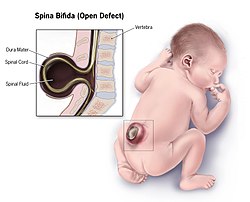
There are two classes of NTDs: open, which are more common, and closed. Open NTDs occur when the brain and/or spinal cord are exposed at birth through a defect in the skull or vertebrae (spinal column). Open NTDs include anencephaly, encephaloceles, hydranencephaly, iniencephaly, schizencephaly, and the most common form, spina bifida. Closed NTDs occur when the spinal defect is covered by skin. Types of closed NTDs include lipomeningocele, lipomyelomeningocele, and tethered cord.
Anencephaly (without brain) is a severe neural tube defect that occurs when the anterior-most end of the neural tube fails to close, usually during the 23rd and 26th days of pregnancy. This results in an absence of a major portion of the brain and skull. Infants born with this condition lack the main part of the forebrain and are usually blind, deaf and display major craniofacial anomalies. The lack of a functioning cerebrum will prevent the infant from even gaining consciousness. Infants are either stillborn or usually die within a few hours or days after birth. For example, anencephaly in humans can result from mutations in the NUAK2 kinase.
Encephaloceles are characterized by protrusions of the brain through the skull that are sac-like and covered with membrane. They can be a groove down the middle of the upper part of the skull, between the forehead and nose, or the back of the skull. Due to the range in its location, encephaloceles are classified by the location as well as the type of defect it causes. Subtypes include occipital encephalocele, encephalocele of the cranial vault, and nasal encephaloceles (frontoethmoidal encephaloceles and basal encephaloceles), with approximately 80% of all encephaloceles occurring in the occipital area. Encephaloceles are often obvious and diagnosed immediately. Sometimes small encephaloceles in the nasal and forehead are undetected. Despite the wide range in its implications, encephaloceles are most likely to be caused by improper separation of the surface ectoderm and the neuroectoderm after the closure of the neural folds in the fourth week of gastrulation.
Hydranencephaly is a condition in which the cerebral hemispheres are missing and instead filled with sacs of cerebrospinal fluid. People are born with hydranencephaly, but most of the time, the symptoms appear in a later stage. Newborns with hydrancephaly can swallow, cry, sleep and their head is in proportion to their body. However, after a few weeks, the infants develop increased muscle tone and irritability. After a few months, the brain start to fill with cerebrospinal fluid (hydrocephalus). This has several consequences. Infants start to develop problems with seeing, hearing, growing, and learning. The missing parts of the brain and the amount of cerebrospinal fluid can also lead to seizures, spasm, problems with regulating their body temperature, and breathing and digestion problems. Besides problems in the brain, hydranencephaly can also be seen on the outside of the body. Hydrocephalus leads to more cerebrospinal fluid in the brain, which can result in an enlarged head.
The cause of hydranencephaly is not clear. Hydranencephaly is a result of an injury of the nervous system or an abnormal development of the nervous system. The neural tube closes in the sixth week of the pregnancy, so hydranencephaly develops during these weeks of the pregnancy. The cause of these injuries/development is not clear.
Neural tube defect
Neural tube defects (NTDs) are a group of birth defects in which an opening in the spine or cranium remains from early in human development. In the third week of pregnancy called gastrulation, specialized cells on the dorsal side of the embryo begin to change shape and form the neural tube. When the neural tube does not close completely, an NTD develops.
Specific types include: spina bifida which affects the spine, anencephaly which results in little to no brain, encephalocele which affects the skull, and iniencephaly which results in severe neck problems.
NTDs are one of the most common birth defects, affecting over 300,000 births each year worldwide. For example, spina bifida affects approximately 1,500 births annually in the United States, or about 3.5 in every 10,000 (0.035% of US births), which has decreased from around 5 per 10,000 (0.05% of US births) since folate fortification of grain products was started. The number of deaths in the US each year due to neural tube defects also declined from 1,200 before folate fortification was started to 840.
There are two classes of NTDs: open, which are more common, and closed. Open NTDs occur when the brain and/or spinal cord are exposed at birth through a defect in the skull or vertebrae (spinal column). Open NTDs include anencephaly, encephaloceles, hydranencephaly, iniencephaly, schizencephaly, and the most common form, spina bifida. Closed NTDs occur when the spinal defect is covered by skin. Types of closed NTDs include lipomeningocele, lipomyelomeningocele, and tethered cord.
Anencephaly (without brain) is a severe neural tube defect that occurs when the anterior-most end of the neural tube fails to close, usually during the 23rd and 26th days of pregnancy. This results in an absence of a major portion of the brain and skull. Infants born with this condition lack the main part of the forebrain and are usually blind, deaf and display major craniofacial anomalies. The lack of a functioning cerebrum will prevent the infant from even gaining consciousness. Infants are either stillborn or usually die within a few hours or days after birth. For example, anencephaly in humans can result from mutations in the NUAK2 kinase.
Encephaloceles are characterized by protrusions of the brain through the skull that are sac-like and covered with membrane. They can be a groove down the middle of the upper part of the skull, between the forehead and nose, or the back of the skull. Due to the range in its location, encephaloceles are classified by the location as well as the type of defect it causes. Subtypes include occipital encephalocele, encephalocele of the cranial vault, and nasal encephaloceles (frontoethmoidal encephaloceles and basal encephaloceles), with approximately 80% of all encephaloceles occurring in the occipital area. Encephaloceles are often obvious and diagnosed immediately. Sometimes small encephaloceles in the nasal and forehead are undetected. Despite the wide range in its implications, encephaloceles are most likely to be caused by improper separation of the surface ectoderm and the neuroectoderm after the closure of the neural folds in the fourth week of gastrulation.
Hydranencephaly is a condition in which the cerebral hemispheres are missing and instead filled with sacs of cerebrospinal fluid. People are born with hydranencephaly, but most of the time, the symptoms appear in a later stage. Newborns with hydrancephaly can swallow, cry, sleep and their head is in proportion to their body. However, after a few weeks, the infants develop increased muscle tone and irritability. After a few months, the brain start to fill with cerebrospinal fluid (hydrocephalus). This has several consequences. Infants start to develop problems with seeing, hearing, growing, and learning. The missing parts of the brain and the amount of cerebrospinal fluid can also lead to seizures, spasm, problems with regulating their body temperature, and breathing and digestion problems. Besides problems in the brain, hydranencephaly can also be seen on the outside of the body. Hydrocephalus leads to more cerebrospinal fluid in the brain, which can result in an enlarged head.
The cause of hydranencephaly is not clear. Hydranencephaly is a result of an injury of the nervous system or an abnormal development of the nervous system. The neural tube closes in the sixth week of the pregnancy, so hydranencephaly develops during these weeks of the pregnancy. The cause of these injuries/development is not clear.
Recent media
Recent media