
Recent from talks
Neville Wran
Knowledge base stats:
Talk channels stats:
Members stats:
Neville Wran
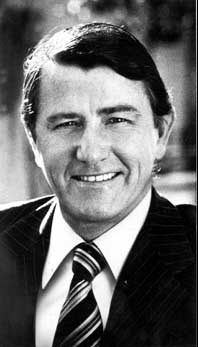
Neville Kenneth Wran, AC, CNZM, QC (11 October 1926 – 20 April 2014) was an Australian politician who was the Premier of New South Wales from 1976 to 1986. He was the national president of the Australian Labor Party (ALP) from 1980 to 1986 and chairman of both the Lionel Murphy Foundation and the Commonwealth Scientific and Industrial Research Organisation (CSIRO) from 1986 to 1991.
Wran was born in the Sydney suburb of Paddington, the eighth and last child of Joseph Wran and his wife Lillian (née Langley). He was educated at Nicholson Street Public School, Balmain, Fort Street Boys High and the University of Sydney, where he was a member of the Liberal Club, and from which he gained a Bachelor of Laws in 1948. He was admitted as a solicitor in 1951, called to the Bar in 1957, and became a Queen's Counsel in 1968.
His great-grandfather, the eminent High Victorian architectural sculptor, Thomas Vallance Wran (1832–1891), whose carvings can be seen on the Martin Place front of the General Post Office, came from Chichester. Thomas Wran – the surname is Austrian – settled initially at St Lawrence, Queensland, before he established himself in Caroline Street, Balmain, in 1872.
Wran began his political career in 1970 when he became a member of the upper house of the Parliament of New South Wales, the Legislative Council. Three years afterwards, he moved to the lower house, the Legislative Assembly, in the seat of Bass Hill. Support for this move had been organised by the General Secretary of the FMWU, Ray Gietzelt. He then challenged Pat Hills for the state leadership of the Labor Party (which Hills had held since 1968). In this challenge he had cross-faction support from right-wing powerbroker John Ducker and left-winger Jack Ferguson. There were two rounds to the leadership vote which resulted in a tie between Hills and Wran in the second ballot. However, under Labor Party rules of the time, in the event of a tie in the second ballot, the candidate who won the most votes in the first ballot would be the winner. Since Wran had won one vote more than Hills in the first ballot, Wran was therefore declared the new leader.
In May 1976, six months after Gough Whitlam's federal Labor government's dismissal, Wran led Labor to victory, narrowly defeating the Liberal Party premier, Sir Eric Willis. Wran's win was not assured until it became clear that Gosford and Hurstville had fallen to Labor by only 74 and 44 votes respectively, giving Wran a one-seat majority.
In 1978, Willis resigned, causing a by-election to be held for the seat of Earlwood, which had been held by the Liberal Party for three decades. Labor won the by-election, beating the Liberal candidate Alan Jones. Later that year, campaigning with the slogan "Wran's our Man", his government won a 13-seat swing, popularly known as the "Wranslide". This came on the back of 57.7 percent of the primary vote, the largest primary vote for any party in a century. The Opposition Leader on that occasion, Peter Coleman, lost his seat.
In 1981, Wran won a second "Wranslide", picking up a six-seat swing for what is still NSW Labor's largest proportion of seats in Parliament (69 out of 99 seats, 69.7 percent of the chamber). The Opposition Leader, Bruce McDonald, failed to be elected to the seat that he contested, marking the second time in a row that an Opposition Leader had failed to be elected to Parliament. Labor also reduced the Liberals to 14 seats, the same as its nominal junior partner, the National Country Party. He won a fourth term in 1984; although he suffered an 11-seat swing, he still won a larger majority than any of the victories won by the Liberals' Sir Robert Askin in the 1960s and 1970s.
In 1977, Wran supported Al Grassby, former Federal Immigration Minister, in allowing Domenico Barbaro, a Mafia figure in the Griffith region of New South Wales, back into Australia after having been earlier deported because of his criminal record. However, as journalist David Hickie explains, Wran attempted to undermine the influence of organised crime, particularly in the area of illegal casinos.
Hub AI
Neville Wran AI simulator
(@Neville Wran_simulator)
Neville Wran
Neville Kenneth Wran, AC, CNZM, QC (11 October 1926 – 20 April 2014) was an Australian politician who was the Premier of New South Wales from 1976 to 1986. He was the national president of the Australian Labor Party (ALP) from 1980 to 1986 and chairman of both the Lionel Murphy Foundation and the Commonwealth Scientific and Industrial Research Organisation (CSIRO) from 1986 to 1991.
Wran was born in the Sydney suburb of Paddington, the eighth and last child of Joseph Wran and his wife Lillian (née Langley). He was educated at Nicholson Street Public School, Balmain, Fort Street Boys High and the University of Sydney, where he was a member of the Liberal Club, and from which he gained a Bachelor of Laws in 1948. He was admitted as a solicitor in 1951, called to the Bar in 1957, and became a Queen's Counsel in 1968.
His great-grandfather, the eminent High Victorian architectural sculptor, Thomas Vallance Wran (1832–1891), whose carvings can be seen on the Martin Place front of the General Post Office, came from Chichester. Thomas Wran – the surname is Austrian – settled initially at St Lawrence, Queensland, before he established himself in Caroline Street, Balmain, in 1872.
Wran began his political career in 1970 when he became a member of the upper house of the Parliament of New South Wales, the Legislative Council. Three years afterwards, he moved to the lower house, the Legislative Assembly, in the seat of Bass Hill. Support for this move had been organised by the General Secretary of the FMWU, Ray Gietzelt. He then challenged Pat Hills for the state leadership of the Labor Party (which Hills had held since 1968). In this challenge he had cross-faction support from right-wing powerbroker John Ducker and left-winger Jack Ferguson. There were two rounds to the leadership vote which resulted in a tie between Hills and Wran in the second ballot. However, under Labor Party rules of the time, in the event of a tie in the second ballot, the candidate who won the most votes in the first ballot would be the winner. Since Wran had won one vote more than Hills in the first ballot, Wran was therefore declared the new leader.
In May 1976, six months after Gough Whitlam's federal Labor government's dismissal, Wran led Labor to victory, narrowly defeating the Liberal Party premier, Sir Eric Willis. Wran's win was not assured until it became clear that Gosford and Hurstville had fallen to Labor by only 74 and 44 votes respectively, giving Wran a one-seat majority.
In 1978, Willis resigned, causing a by-election to be held for the seat of Earlwood, which had been held by the Liberal Party for three decades. Labor won the by-election, beating the Liberal candidate Alan Jones. Later that year, campaigning with the slogan "Wran's our Man", his government won a 13-seat swing, popularly known as the "Wranslide". This came on the back of 57.7 percent of the primary vote, the largest primary vote for any party in a century. The Opposition Leader on that occasion, Peter Coleman, lost his seat.
In 1981, Wran won a second "Wranslide", picking up a six-seat swing for what is still NSW Labor's largest proportion of seats in Parliament (69 out of 99 seats, 69.7 percent of the chamber). The Opposition Leader, Bruce McDonald, failed to be elected to the seat that he contested, marking the second time in a row that an Opposition Leader had failed to be elected to Parliament. Labor also reduced the Liberals to 14 seats, the same as its nominal junior partner, the National Country Party. He won a fourth term in 1984; although he suffered an 11-seat swing, he still won a larger majority than any of the victories won by the Liberals' Sir Robert Askin in the 1960s and 1970s.
In 1977, Wran supported Al Grassby, former Federal Immigration Minister, in allowing Domenico Barbaro, a Mafia figure in the Griffith region of New South Wales, back into Australia after having been earlier deported because of his criminal record. However, as journalist David Hickie explains, Wran attempted to undermine the influence of organised crime, particularly in the area of illegal casinos.
Recent media