
Recent from talks
New Earswick
Knowledge base stats:
Talk channels stats:
Members stats:
New Earswick
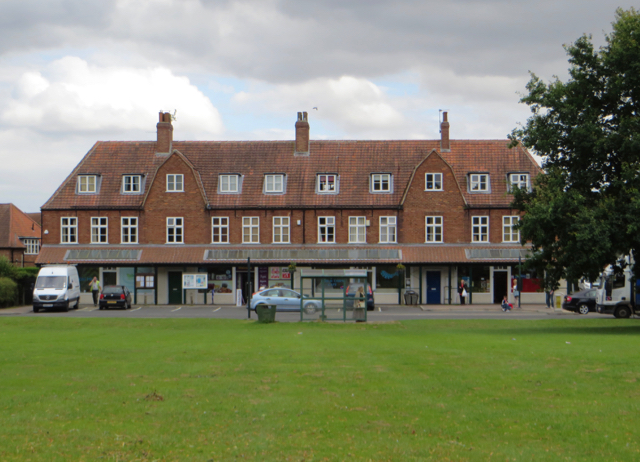
New Earswick is a model village and civil parish in the unitary authority of City of York in North Yorkshire, England, near the River Foss, north of York and south of Haxby. According to the 2001 census the parish had a population of 2,812, reducing to 2,737 at the 2011 Census.
The village was historically part of the North Riding of Yorkshire until 1974. It was then a part of the district of Ryedale in North Yorkshire from 1974 until 1996. Since 1996 it has been part of the City of York unitary authority.
The village of New Earswick was built as a genuine mixed community. There was housing for both workers and managers, in a green setting with gardens for each home with its own 2 fruit trees. It was founded by the York philanthropist, Joseph Rowntree, who was quoted as saying, "I do not want to establish communities bearing the stamp of charity but rather of rightly ordered and self governing communities". The first 28 houses were designed between 1902 and 1904 by the architect Raymond Unwin, after which the Joseph Rowntree Village Trust (now the Joseph Rowntree Housing Trust) was established to continue building and manage the new village. The Joseph Rowntree Housing Trust is part of the Joseph Rowntree Foundation.
The village had contemporaries such as Bournville, Saltaire, Port Sunlight and others. It presented a sharp contrast to the slums that had developed in York and other cities during the 19th century, the deprivation of which had been revealed in Seebohm Rowntree's report of 1901, entitled Poverty: a study of town life. It revealed appalling statistics of dark, overcrowded and insanitary housing.
As a result of the report, Joseph Rowntree's conviction that it must be possible to provide better housing for people on low incomes led him to acquire 150 acres of land near the village of Earswick, two and a half miles to the north of the centre of York. The planner Raymond Unwin and the architect Barry Parker were commissioned to produce an overall plan for a new 'garden' village and the detailed designs for its first houses. They also designed the garden cities of Letchworth and Welwyn Garden City.
The building of New Earswick created a balanced village community where rents were kept low, but still represented a modest commercial return on the capital invested. Houses were open to any working people, not just Rowntree employees. The village was to be a demonstration of good practice.
The Trust Deed of the Joseph Rowntree Village Trust, which was set up in 1904 to build and manage New Earswick, safeguarded generous open green space. All of the grass verges were planted with trees after which almost all of the roads are named. The village was built with bricks that were made in the brickworks on the outskirts of New Earswick. From 1950 the brickyard, which closed down in the 1930s, was developed into a nature reserve.
Their religious beliefs made the Rowntree family decreed that there would not be a public house in the village. There never has been although the Sports Club obtained a drinks licence in the 1980s.
Hub AI
New Earswick AI simulator
(@New Earswick_simulator)
New Earswick
New Earswick is a model village and civil parish in the unitary authority of City of York in North Yorkshire, England, near the River Foss, north of York and south of Haxby. According to the 2001 census the parish had a population of 2,812, reducing to 2,737 at the 2011 Census.
The village was historically part of the North Riding of Yorkshire until 1974. It was then a part of the district of Ryedale in North Yorkshire from 1974 until 1996. Since 1996 it has been part of the City of York unitary authority.
The village of New Earswick was built as a genuine mixed community. There was housing for both workers and managers, in a green setting with gardens for each home with its own 2 fruit trees. It was founded by the York philanthropist, Joseph Rowntree, who was quoted as saying, "I do not want to establish communities bearing the stamp of charity but rather of rightly ordered and self governing communities". The first 28 houses were designed between 1902 and 1904 by the architect Raymond Unwin, after which the Joseph Rowntree Village Trust (now the Joseph Rowntree Housing Trust) was established to continue building and manage the new village. The Joseph Rowntree Housing Trust is part of the Joseph Rowntree Foundation.
The village had contemporaries such as Bournville, Saltaire, Port Sunlight and others. It presented a sharp contrast to the slums that had developed in York and other cities during the 19th century, the deprivation of which had been revealed in Seebohm Rowntree's report of 1901, entitled Poverty: a study of town life. It revealed appalling statistics of dark, overcrowded and insanitary housing.
As a result of the report, Joseph Rowntree's conviction that it must be possible to provide better housing for people on low incomes led him to acquire 150 acres of land near the village of Earswick, two and a half miles to the north of the centre of York. The planner Raymond Unwin and the architect Barry Parker were commissioned to produce an overall plan for a new 'garden' village and the detailed designs for its first houses. They also designed the garden cities of Letchworth and Welwyn Garden City.
The building of New Earswick created a balanced village community where rents were kept low, but still represented a modest commercial return on the capital invested. Houses were open to any working people, not just Rowntree employees. The village was to be a demonstration of good practice.
The Trust Deed of the Joseph Rowntree Village Trust, which was set up in 1904 to build and manage New Earswick, safeguarded generous open green space. All of the grass verges were planted with trees after which almost all of the roads are named. The village was built with bricks that were made in the brickworks on the outskirts of New Earswick. From 1950 the brickyard, which closed down in the 1930s, was developed into a nature reserve.
Their religious beliefs made the Rowntree family decreed that there would not be a public house in the village. There never has been although the Sports Club obtained a drinks licence in the 1980s.
Recent media