
Recent from talks
New Orleans Voodoo Revival
Knowledge base stats:
Talk channels stats:
Members stats:
New Orleans Voodoo Revival
In New Orleans, Louisiana, various groups practicing African diasporic religions have established since the closing decades of the 20th century. Although usually practicing versions of Haitian Vodou or Cuban Santería, they have largely adopted the term "Voodoo" in reference to Louisiana Voodoo, the religion present in that region from the 18th to the early 20th century.
During the Atlantic slave trade of the 16th to the 19th century, West and Central Africans were forcibly transplanted to the Americas, where their traditional religions syncretized with Christianity and other non-African influences to develop new traditions, such as Haitian Vodou or Cuban Santería. In Louisiana, a tradition commonly termed Voodoo emerged and survived into the early 20th century, at which point it died out, although some vernacular traditions persevered as Hoodoo. After the 1960s, the New Orleans tourist industry increasingly used references to Voodoo to attract visitors, while a Voodoo revival took place, the practitioners of which often drew heavily on other African diasporic religions.
The New Orleans Voodoo Revival differs from historical Louisiana Voodoo in various respects. Rather than venerating the deities historically venerated in Louisiana, it often focuses attention on the lwa, spirits found in Haitian Vodou.
In the late 20th century there was a revival of Louisiana Voodoo, creating a tradition that "more closely resembles" Haitian Vodou and Cuban Santería than the 19th-century Louisiana Voodoo that is described in historical accounts. Some 21st-century practitioners have also sought instruction from West African traditions, for instance, being initiated into West African Vodun. Author Jeffery Anderson deemed the link between the historical tradition and the revivalist practices to be "quite tenuous", stating that "today's New Orleans Voodoo" is "an emerging faith inspired by and seeking to reconstruct the older religion".
Various groups emerged; in 1990 the African American priestess Miriam Chamani established the Voodoo Spiritual Temple in the French Quarter, which venerated deities from Haitian Vodou and Cuban Santería. A Ukrainian-Jewish American initiate of Haitian Vodou, Sallie Ann Glassman, launched another group, La Source Ancienne, in the Bywater neighborhood; she also operated the Island of Salvation Botanica store. The most publicly prominent of the new Voodoo practitioners was Ava Kay Jones, a Louisiana Creole woman who had been initiated into both Haitian Vodou and Orisha-Vodu, a U.S.-based derivative of Santería. Scholar Carolyn Long believed that these groups reflected a "Voodoo revival" rather than a direct continuation of 18th and 19th century traditions; she noted that this new Voodoo typically resembled Haitian Vodou or Santería more than the 19th-century Louisiana Voodoo. These groups sought to promote understanding of their religion through websites, newsletters, and workshops.
In the 21st century, Voodoo practitioners have combined Voodoo with, for instance, elements of Judaism and the Kabbalah, or Hinduism.
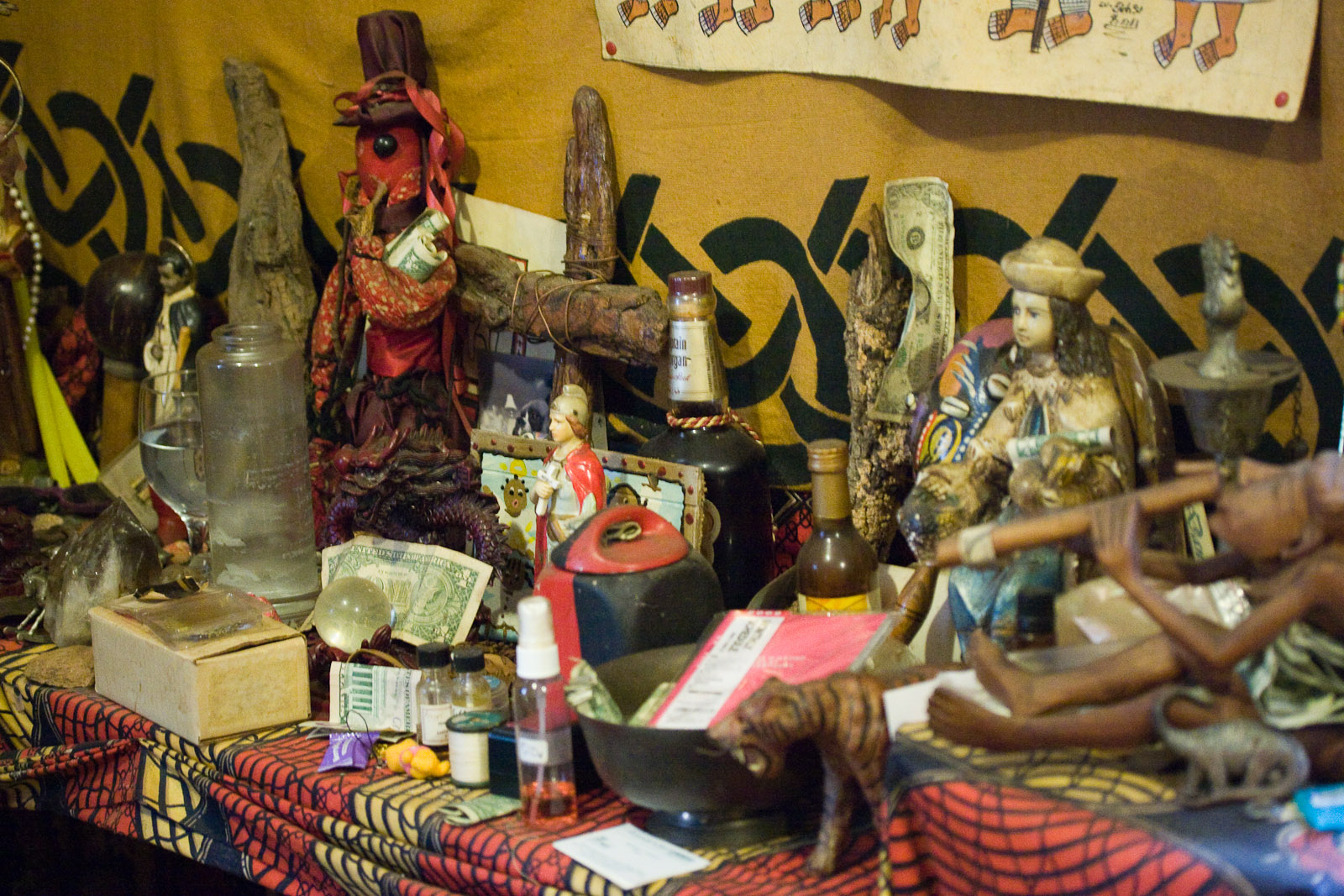
The Voodoo revival of the late 20th century has drawn many of its deities from Haitian Vodou, where these divinities are called lwa[10]. Among the lwa commonly venerated are Erzulie Freda Ezili la Flambo, Ogoun, Mara, and Papa Legba. These can be divided into separate nanchon (nations), such as the Rada and the Petwo. Glassman's New Orleans temple for instance has separate altars to the Rada and Petwo lwa. Each of these is associated with particular items, colors, numbers, foodstuff, and drinks. They are often considered to be intermediaries of God, who in Haitian Vodou is usually termed Le Bon Dieu.
In the 21st century, Louisiana Voodoo has been characterized as a system of ancestor worship. Communicating with the ancestors is an important part of its practice, with these ancestral spirits often invoked during ceremonies.
Hub AI
New Orleans Voodoo Revival AI simulator
(@New Orleans Voodoo Revival_simulator)
New Orleans Voodoo Revival
In New Orleans, Louisiana, various groups practicing African diasporic religions have established since the closing decades of the 20th century. Although usually practicing versions of Haitian Vodou or Cuban Santería, they have largely adopted the term "Voodoo" in reference to Louisiana Voodoo, the religion present in that region from the 18th to the early 20th century.
During the Atlantic slave trade of the 16th to the 19th century, West and Central Africans were forcibly transplanted to the Americas, where their traditional religions syncretized with Christianity and other non-African influences to develop new traditions, such as Haitian Vodou or Cuban Santería. In Louisiana, a tradition commonly termed Voodoo emerged and survived into the early 20th century, at which point it died out, although some vernacular traditions persevered as Hoodoo. After the 1960s, the New Orleans tourist industry increasingly used references to Voodoo to attract visitors, while a Voodoo revival took place, the practitioners of which often drew heavily on other African diasporic religions.
The New Orleans Voodoo Revival differs from historical Louisiana Voodoo in various respects. Rather than venerating the deities historically venerated in Louisiana, it often focuses attention on the lwa, spirits found in Haitian Vodou.
In the late 20th century there was a revival of Louisiana Voodoo, creating a tradition that "more closely resembles" Haitian Vodou and Cuban Santería than the 19th-century Louisiana Voodoo that is described in historical accounts. Some 21st-century practitioners have also sought instruction from West African traditions, for instance, being initiated into West African Vodun. Author Jeffery Anderson deemed the link between the historical tradition and the revivalist practices to be "quite tenuous", stating that "today's New Orleans Voodoo" is "an emerging faith inspired by and seeking to reconstruct the older religion".
Various groups emerged; in 1990 the African American priestess Miriam Chamani established the Voodoo Spiritual Temple in the French Quarter, which venerated deities from Haitian Vodou and Cuban Santería. A Ukrainian-Jewish American initiate of Haitian Vodou, Sallie Ann Glassman, launched another group, La Source Ancienne, in the Bywater neighborhood; she also operated the Island of Salvation Botanica store. The most publicly prominent of the new Voodoo practitioners was Ava Kay Jones, a Louisiana Creole woman who had been initiated into both Haitian Vodou and Orisha-Vodu, a U.S.-based derivative of Santería. Scholar Carolyn Long believed that these groups reflected a "Voodoo revival" rather than a direct continuation of 18th and 19th century traditions; she noted that this new Voodoo typically resembled Haitian Vodou or Santería more than the 19th-century Louisiana Voodoo. These groups sought to promote understanding of their religion through websites, newsletters, and workshops.
In the 21st century, Voodoo practitioners have combined Voodoo with, for instance, elements of Judaism and the Kabbalah, or Hinduism.
The Voodoo revival of the late 20th century has drawn many of its deities from Haitian Vodou, where these divinities are called lwa[10]. Among the lwa commonly venerated are Erzulie Freda Ezili la Flambo, Ogoun, Mara, and Papa Legba. These can be divided into separate nanchon (nations), such as the Rada and the Petwo. Glassman's New Orleans temple for instance has separate altars to the Rada and Petwo lwa. Each of these is associated with particular items, colors, numbers, foodstuff, and drinks. They are often considered to be intermediaries of God, who in Haitian Vodou is usually termed Le Bon Dieu.
In the 21st century, Louisiana Voodoo has been characterized as a system of ancestor worship. Communicating with the ancestors is an important part of its practice, with these ancestral spirits often invoked during ceremonies.
Recent media