
Recent from talks
New World vulture
Knowledge base stats:
Talk channels stats:
Members stats:
New World vulture
Cathartidae, known commonly as New World vultures or condors, are a family of birds of prey consisting of seven extant species in five genera. It includes five extant vultures and two extant condors found in the Americas. They are known as "New World" vultures to distinguish them from Old World vultures, with which the Cathartidae does not form a single clade despite the two being similar in appearance and behavior as a result of convergent evolution.
Like other vultures, New World vultures are scavengers, having evolved to feed off of the carcasses of dead animals without any notable ill effects. Some species of New World vulture (Cathartes sp.) have a good sense of smell, whereas Old World vultures find carcasses exclusively by sight. Other adaptations shared by both Old and New World vultures include a bald head, devoid of feathers which helps prevent rotting matter from accumulating while feeding, and an extremely disease-resistant digestive system to protect against dangerous pathogens found in decaying meat.
The family Cathartidae was introduced (as the subfamily Cathartinae) by the French ornithologist Frédéric de Lafresnaye in 1839. The New World vultures comprise seven species in five genera, being Coragyps, Cathartes, Gymnogyps, Sarcoramphus, and Vultur. Of these, only Cathartes is not monotypic. The family's scientific name, Cathartidae, comes from cathartes, Greek for "purifier". Although New World vultures and Old World vultures are not very closely related, they share many resemblances because of convergent evolution. Phylogenetic analyses including all Cathartidae species found two primary clades. The first consists of black vultures (Coragyps atratus) together with the three Cathartes species (lesser yellow-headed vultures (C. burrovianus), greater yellow-headed vultures (C. melambrotus), and turkey vultures (C. aura)), while the second consists of king vultures (Sarcoramphus papa), California condors (Gymnogyps californianus) and Andean condors (Vultur gryphus).
New World vultures were traditionally placed in a family of their own in the Falconiformes. However, in the late 20th century some ornithologists argued that they are more closely related to storks on the basis of karyotype, morphological, and behavioral data. Thus some authorities placed them in the Ciconiiformes with storks and herons; Sibley and Monroe (1990) even considered them a subfamily of the storks. This was criticized, and an early DNA sequence study was based on erroneous data and subsequently retracted. There was then an attempt to raise the New World vultures to the rank of an independent order, Cathartiformes, not closely associated with either the birds of prey or the storks and herons.
Recent multi-locus DNA studies on the evolutionary relationships between bird groups indicate that New World vultures are related to the other birds of prey, excluding the Falconidae. This analysis argues that New World vultures should either be a part of a new order Accipitriformes or part of an order (Cathartiformes) closely related to, but distinct from, other birds of prey. New World vultures are a sister group to Accipitriformes, a group consisting of Accipitridae, the osprey and secretarybird. Both groups are basal members of the recently recognized clade Afroaves.
The fossil history of the Cathartidae is complex, and many taxa that may possibly have been New World vultures have at some stage been treated as early representatives of the family. There is no unequivocal European record from the Neogene.
It is clear that the Cathartidae had a much higher diversity in the Plio-Pleistocene, rivalling the current diversity of Old World vultures and their relatives in shapes, sizes, and ecological niches. Extinct taxa include:
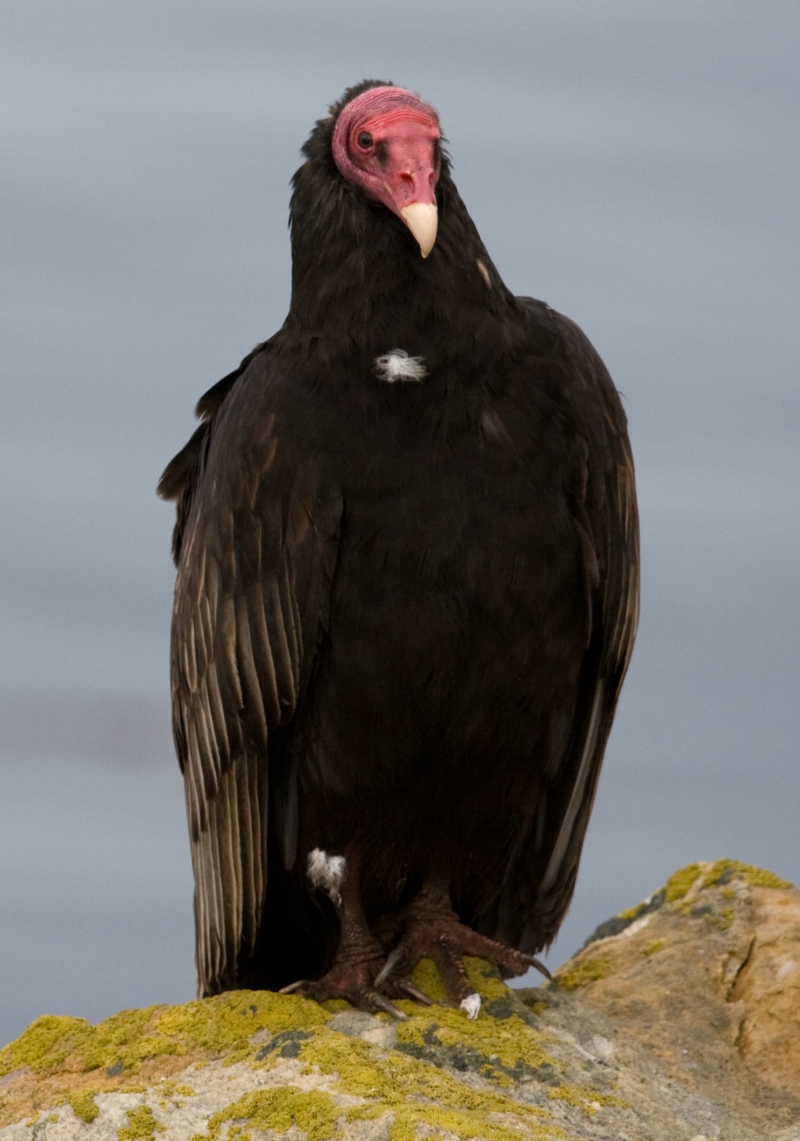
New World vultures are generally large, ranging in length from the lesser yellow-headed vulture at 56–61 centimeters (22–24 inches) up to the California and Andean condors, both of which can reach 120 centimeters (48 inches) in length and weigh 12 or more kilograms (26 or more pounds). Plumage is predominantly black or brown, and is sometimes marked with white. All species have featherless heads and necks. In some, this skin is brightly colored, and in the king vulture it is developed into colorful wattles and outgrowths.
Hub AI
New World vulture AI simulator
(@New World vulture_simulator)
New World vulture
Cathartidae, known commonly as New World vultures or condors, are a family of birds of prey consisting of seven extant species in five genera. It includes five extant vultures and two extant condors found in the Americas. They are known as "New World" vultures to distinguish them from Old World vultures, with which the Cathartidae does not form a single clade despite the two being similar in appearance and behavior as a result of convergent evolution.
Like other vultures, New World vultures are scavengers, having evolved to feed off of the carcasses of dead animals without any notable ill effects. Some species of New World vulture (Cathartes sp.) have a good sense of smell, whereas Old World vultures find carcasses exclusively by sight. Other adaptations shared by both Old and New World vultures include a bald head, devoid of feathers which helps prevent rotting matter from accumulating while feeding, and an extremely disease-resistant digestive system to protect against dangerous pathogens found in decaying meat.
The family Cathartidae was introduced (as the subfamily Cathartinae) by the French ornithologist Frédéric de Lafresnaye in 1839. The New World vultures comprise seven species in five genera, being Coragyps, Cathartes, Gymnogyps, Sarcoramphus, and Vultur. Of these, only Cathartes is not monotypic. The family's scientific name, Cathartidae, comes from cathartes, Greek for "purifier". Although New World vultures and Old World vultures are not very closely related, they share many resemblances because of convergent evolution. Phylogenetic analyses including all Cathartidae species found two primary clades. The first consists of black vultures (Coragyps atratus) together with the three Cathartes species (lesser yellow-headed vultures (C. burrovianus), greater yellow-headed vultures (C. melambrotus), and turkey vultures (C. aura)), while the second consists of king vultures (Sarcoramphus papa), California condors (Gymnogyps californianus) and Andean condors (Vultur gryphus).
New World vultures were traditionally placed in a family of their own in the Falconiformes. However, in the late 20th century some ornithologists argued that they are more closely related to storks on the basis of karyotype, morphological, and behavioral data. Thus some authorities placed them in the Ciconiiformes with storks and herons; Sibley and Monroe (1990) even considered them a subfamily of the storks. This was criticized, and an early DNA sequence study was based on erroneous data and subsequently retracted. There was then an attempt to raise the New World vultures to the rank of an independent order, Cathartiformes, not closely associated with either the birds of prey or the storks and herons.
Recent multi-locus DNA studies on the evolutionary relationships between bird groups indicate that New World vultures are related to the other birds of prey, excluding the Falconidae. This analysis argues that New World vultures should either be a part of a new order Accipitriformes or part of an order (Cathartiformes) closely related to, but distinct from, other birds of prey. New World vultures are a sister group to Accipitriformes, a group consisting of Accipitridae, the osprey and secretarybird. Both groups are basal members of the recently recognized clade Afroaves.
The fossil history of the Cathartidae is complex, and many taxa that may possibly have been New World vultures have at some stage been treated as early representatives of the family. There is no unequivocal European record from the Neogene.
It is clear that the Cathartidae had a much higher diversity in the Plio-Pleistocene, rivalling the current diversity of Old World vultures and their relatives in shapes, sizes, and ecological niches. Extinct taxa include:
New World vultures are generally large, ranging in length from the lesser yellow-headed vulture at 56–61 centimeters (22–24 inches) up to the California and Andean condors, both of which can reach 120 centimeters (48 inches) in length and weigh 12 or more kilograms (26 or more pounds). Plumage is predominantly black or brown, and is sometimes marked with white. All species have featherless heads and necks. In some, this skin is brightly colored, and in the king vulture it is developed into colorful wattles and outgrowths.
Recent media