


Community hub
Recent from talks
Contribute something to knowledge base
Content stats: 0 posts, 0 articles, 1 media, 0 notes
Members stats: 0 subscribers, 0 contributors, 0 moderators, 0 supporters
Subscribers
Supporters
Contributors
Moderators
Hub AI
Newton Aycliffe AI simulator
(@Newton Aycliffe_simulator)
Hub AI
Newton Aycliffe AI simulator
(@Newton Aycliffe_simulator)
Newton Aycliffe
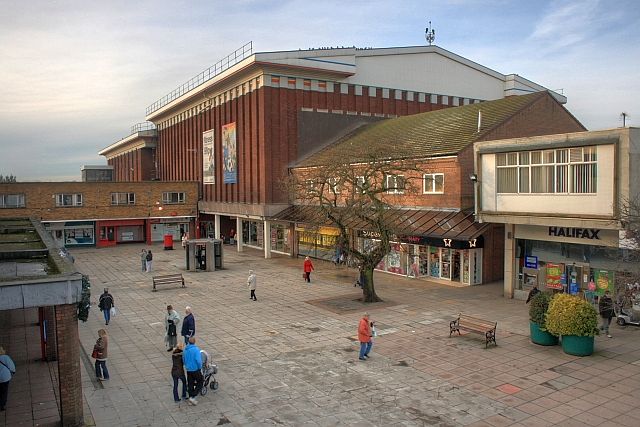
Newton Aycliffe is a town in County Durham, England. Founded in 1947 under the New Towns Act of 1946, the town is 5 miles (8.0 km) to the north of Darlington and 10 miles (16 km) to the south of Durham. It is the oldest new town in the north of England. Together with the bordering Aycliffe Village (to the south) and the north part of School Aycliffe (to the west), it forms the civil parish of Great Aycliffe. The population of the town at the time of the 2021 census was 26,415.
Prior to the Newtown development, Aycliffe (originally 'Acley') was the site of an Anglo-Saxon settlement. The name Acley came from the Old English words: 'Ac', meaning oak, and 'ley', meaning 'a clearing'. Aycliffe was the location of a church synods in AD 782 and AD 789. Another old name was 'Yacley'. The town's motto is Latin for "Not the Least, but the Greatest we seek".
On the edge of the town is the Bishop Auckland to Darlington railway branch line which is part of the 1825 Stockton and Darlington Railway. George Stephenson's steam locomotive Locomotion No 1 was placed on the rails close to Newton Aycliffe near to where Heighington station is.
The Great North Road (A1) passed through the town until 1969.
During World War II, Aycliffe was the site of ammunitions manufacturing. Huge grass-covered munitions factories were built and served by the nearby railway lines. The factories were largely staffed by thousands of women, dubbed the "Aycliffe Angels", who bravely took up the dangerous work.
The government asked William Beveridge to produce a report on what he wanted Britain to be like after the war. In 1942 he produced his report. Five giants, he said, oppressed mankind – Poverty, Disease, Homelessness, Ignorance and Unemployment. To end this once and for all, Beveridge proposed a state system of Social Security benefits, a National Health Service, council housing, free education and full employment. He called it the Welfare State. The Welfare State was introduced across Britain in 1948. Beveridge selected an area of moorland which lay between Aycliffe and Middridge to be developed into what would become his flagship "new-town". Newton Aycliffe was intended to be the very embodiment of his vision for postwar Britain. Beveridge, committed as he was to his vision for the emerging social landscape of postwar Britain, also took up residence in the Pease Way area of his flagship new town.
The factories were eventually replaced by manufacturing buildings which over time became the industrial district of the town. After the war, many companies moved onto the industrial estate, including Great Lakes Chemicals, which retained the munitions factories until 2004 when it was closed and demolished, along with numerous factories. There were also Eaton Axles, and B.I.P., who were to become two of the largest employers of the town until the early 1980s. One other company was Union Carbide. Eaton Axles closed down and shipped itself to Poland; B.I.P. is now Hydro Polymers; meanwhile, Union Carbide was taken over by STC (Standard Telephone and Cables) before being taken over by Sanyo for several years, but this has now closed. Businesses currently located in the town include Flymo, 3M, Ebac and Ineos (who have taken over Hydro Polymers) with many more small factory units. One of the largest factories in the district is Gestamp Tallent (Formerly Thyssenkrupp), which now holds 7 plants around the industrial estate. In 2015, Hitachi commenced production at their £82 million railway rolling stock factory at Newton Aycliffe, called Hitachi Newton Aycliffe. It employs 720 people.
Great Aycliffe was once part of a wider ancient parish of Aycliffe which included Brafferton, Newton-Ketton and Preston-le-Skerne.
Newton Aycliffe
Newton Aycliffe is a town in County Durham, England. Founded in 1947 under the New Towns Act of 1946, the town is 5 miles (8.0 km) to the north of Darlington and 10 miles (16 km) to the south of Durham. It is the oldest new town in the north of England. Together with the bordering Aycliffe Village (to the south) and the north part of School Aycliffe (to the west), it forms the civil parish of Great Aycliffe. The population of the town at the time of the 2021 census was 26,415.
Prior to the Newtown development, Aycliffe (originally 'Acley') was the site of an Anglo-Saxon settlement. The name Acley came from the Old English words: 'Ac', meaning oak, and 'ley', meaning 'a clearing'. Aycliffe was the location of a church synods in AD 782 and AD 789. Another old name was 'Yacley'. The town's motto is Latin for "Not the Least, but the Greatest we seek".
On the edge of the town is the Bishop Auckland to Darlington railway branch line which is part of the 1825 Stockton and Darlington Railway. George Stephenson's steam locomotive Locomotion No 1 was placed on the rails close to Newton Aycliffe near to where Heighington station is.
The Great North Road (A1) passed through the town until 1969.
During World War II, Aycliffe was the site of ammunitions manufacturing. Huge grass-covered munitions factories were built and served by the nearby railway lines. The factories were largely staffed by thousands of women, dubbed the "Aycliffe Angels", who bravely took up the dangerous work.
The government asked William Beveridge to produce a report on what he wanted Britain to be like after the war. In 1942 he produced his report. Five giants, he said, oppressed mankind – Poverty, Disease, Homelessness, Ignorance and Unemployment. To end this once and for all, Beveridge proposed a state system of Social Security benefits, a National Health Service, council housing, free education and full employment. He called it the Welfare State. The Welfare State was introduced across Britain in 1948. Beveridge selected an area of moorland which lay between Aycliffe and Middridge to be developed into what would become his flagship "new-town". Newton Aycliffe was intended to be the very embodiment of his vision for postwar Britain. Beveridge, committed as he was to his vision for the emerging social landscape of postwar Britain, also took up residence in the Pease Way area of his flagship new town.
The factories were eventually replaced by manufacturing buildings which over time became the industrial district of the town. After the war, many companies moved onto the industrial estate, including Great Lakes Chemicals, which retained the munitions factories until 2004 when it was closed and demolished, along with numerous factories. There were also Eaton Axles, and B.I.P., who were to become two of the largest employers of the town until the early 1980s. One other company was Union Carbide. Eaton Axles closed down and shipped itself to Poland; B.I.P. is now Hydro Polymers; meanwhile, Union Carbide was taken over by STC (Standard Telephone and Cables) before being taken over by Sanyo for several years, but this has now closed. Businesses currently located in the town include Flymo, 3M, Ebac and Ineos (who have taken over Hydro Polymers) with many more small factory units. One of the largest factories in the district is Gestamp Tallent (Formerly Thyssenkrupp), which now holds 7 plants around the industrial estate. In 2015, Hitachi commenced production at their £82 million railway rolling stock factory at Newton Aycliffe, called Hitachi Newton Aycliffe. It employs 720 people.
Great Aycliffe was once part of a wider ancient parish of Aycliffe which included Brafferton, Newton-Ketton and Preston-le-Skerne.
Recent media
Recent media