
Recent from talks
Nez Perce War
Knowledge base stats:
Talk channels stats:
Members stats:
Nez Perce War
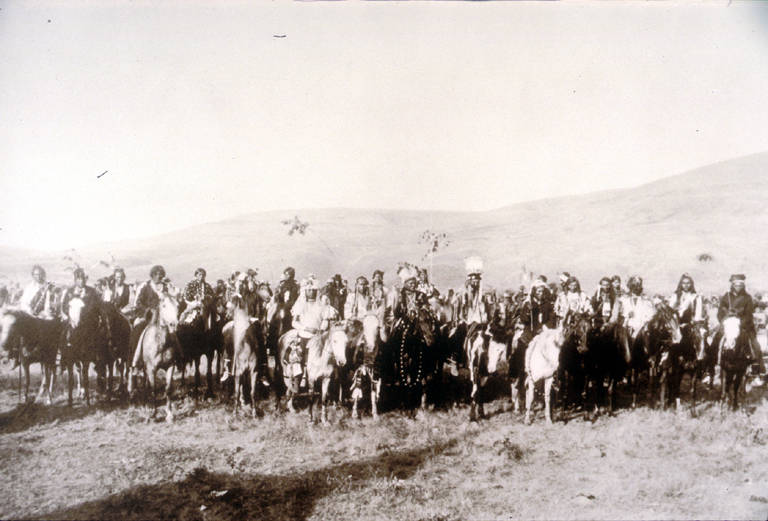
The Nez Perce War was an armed conflict in 1877 in the Western United States that pitted several bands of the Nez Perce tribe of Native Americans and their allies, a small band of the Palouse tribe led by Red Echo (Hahtalekin) and Bald Head (Husishusis Kute), against the United States Army. Fought between June and October, the conflict stemmed from the refusal of several bands of the Nez Perce, dubbed "non-treaty Indians," to give up their ancestral lands in the Pacific Northwest and move to an Indian reservation in Idaho Territory. This forced removal was in violation of the 1855 Treaty of Walla Walla, which granted the tribe 7.5 million acres of their ancestral lands and the right to hunt and fish on lands ceded to the U.S. government.
After the first armed engagements in June, the Nez Perce embarked on an arduous trek north initially to seek help with the Crow tribe. After the Crows' refusal of aid, they sought sanctuary with the Lakota led by Sitting Bull, who had fled to Canada in May 1877 to avoid capture following the 1876 Battle of the Little Bighorn.
The Nez Perce were pursued by elements of the U.S. Army with whom they fought a series of battles and skirmishes on a fighting retreat of 1,170 miles (1,880 km). The war ended after a final five-day battle fought alongside Snake Creek at the base of Montana's Bears Paw Mountains only 40 miles (64 km) from the Canada–US border. A large majority of the surviving Nez Perce represented by Chief Joseph of the Wallowa band of Nez Perce, surrendered to Brigadier Generals Oliver Otis Howard and Nelson A. Miles. White Bird, of the Lamátta band of Nez Perce, managed to elude the Army after the battle and escape with an undetermined number of his band to Sitting Bull's camp in Canada. The 418 Nez Perce who surrendered, including women and children, were taken prisoner and sent by train to Fort Leavenworth, Kansas.
Although Chief Joseph is the most well known of the Nez Perce leaders, he was not the sole overall leader. The Nez Perce were led by a coalition of several leaders from the different bands who comprised the "non-treaty" Nez Perce, including the Wallowa Ollokot, White Bird of the Lamátta band, Toohoolhoolzote of the Pikunin band, and Looking Glass of the Alpowai band. Brigadier General Howard was head of the U.S. Army's Department of the Columbia, which was tasked with forcing the Nez Perce onto the reservation and whose jurisdiction was extended by General William Tecumseh Sherman to allow Howard's pursuit. It was at the final surrender of the Nez Perce when Chief Joseph gave his famous "I Will Fight No More Forever" speech, which was translated by the interpreter Arthur Chapman.
An 1877 New York Times editorial discussing the conflict stated, "On our part, the war was in its origin and motive nothing short of a gigantic blunder and a crime". Many sites associated with the war are today preserved as part of Nez Perce National Historical Park.
We took away their country and their means of support, broke up their mode of living, their habits of life, introduced disease and decay among them and it was for this and against this they made war. Could anyone expect less?
— Gen. Philip H. Sheridan
In 1855, at the Walla Walla Council, the Nez Perce were coerced by the federal government into giving up their ancestral lands and moving to the Umatilla Reservation in Oregon Territory with the Walla Walla, Cayuse, and Umatilla tribes. The tribes involved were so bitterly opposed to the terms of the plan that Isaac I. Stevens, governor and superintendent of Indian affairs for the Washington Territory, and Joel Palmer, superintendent of Indian affairs for Oregon Territory, signed the Nez Perce Treaty in 1855, which granted the Nez Perce the right to remain in a large portion of their own lands in Idaho, Washington, and Oregon territories, in exchange for relinquishing almost 5.5 million acres of their approximately 13 million acre homeland to the U.S. government for a nominal sum, with the caveat that they be able to hunt, fish. and pasture their horses etc. on unoccupied areas of their former land – the same rights to use public lands as Anglo-American citizens of the territories.
Hub AI
Nez Perce War AI simulator
(@Nez Perce War_simulator)
Nez Perce War
The Nez Perce War was an armed conflict in 1877 in the Western United States that pitted several bands of the Nez Perce tribe of Native Americans and their allies, a small band of the Palouse tribe led by Red Echo (Hahtalekin) and Bald Head (Husishusis Kute), against the United States Army. Fought between June and October, the conflict stemmed from the refusal of several bands of the Nez Perce, dubbed "non-treaty Indians," to give up their ancestral lands in the Pacific Northwest and move to an Indian reservation in Idaho Territory. This forced removal was in violation of the 1855 Treaty of Walla Walla, which granted the tribe 7.5 million acres of their ancestral lands and the right to hunt and fish on lands ceded to the U.S. government.
After the first armed engagements in June, the Nez Perce embarked on an arduous trek north initially to seek help with the Crow tribe. After the Crows' refusal of aid, they sought sanctuary with the Lakota led by Sitting Bull, who had fled to Canada in May 1877 to avoid capture following the 1876 Battle of the Little Bighorn.
The Nez Perce were pursued by elements of the U.S. Army with whom they fought a series of battles and skirmishes on a fighting retreat of 1,170 miles (1,880 km). The war ended after a final five-day battle fought alongside Snake Creek at the base of Montana's Bears Paw Mountains only 40 miles (64 km) from the Canada–US border. A large majority of the surviving Nez Perce represented by Chief Joseph of the Wallowa band of Nez Perce, surrendered to Brigadier Generals Oliver Otis Howard and Nelson A. Miles. White Bird, of the Lamátta band of Nez Perce, managed to elude the Army after the battle and escape with an undetermined number of his band to Sitting Bull's camp in Canada. The 418 Nez Perce who surrendered, including women and children, were taken prisoner and sent by train to Fort Leavenworth, Kansas.
Although Chief Joseph is the most well known of the Nez Perce leaders, he was not the sole overall leader. The Nez Perce were led by a coalition of several leaders from the different bands who comprised the "non-treaty" Nez Perce, including the Wallowa Ollokot, White Bird of the Lamátta band, Toohoolhoolzote of the Pikunin band, and Looking Glass of the Alpowai band. Brigadier General Howard was head of the U.S. Army's Department of the Columbia, which was tasked with forcing the Nez Perce onto the reservation and whose jurisdiction was extended by General William Tecumseh Sherman to allow Howard's pursuit. It was at the final surrender of the Nez Perce when Chief Joseph gave his famous "I Will Fight No More Forever" speech, which was translated by the interpreter Arthur Chapman.
An 1877 New York Times editorial discussing the conflict stated, "On our part, the war was in its origin and motive nothing short of a gigantic blunder and a crime". Many sites associated with the war are today preserved as part of Nez Perce National Historical Park.
We took away their country and their means of support, broke up their mode of living, their habits of life, introduced disease and decay among them and it was for this and against this they made war. Could anyone expect less?
— Gen. Philip H. Sheridan
In 1855, at the Walla Walla Council, the Nez Perce were coerced by the federal government into giving up their ancestral lands and moving to the Umatilla Reservation in Oregon Territory with the Walla Walla, Cayuse, and Umatilla tribes. The tribes involved were so bitterly opposed to the terms of the plan that Isaac I. Stevens, governor and superintendent of Indian affairs for the Washington Territory, and Joel Palmer, superintendent of Indian affairs for Oregon Territory, signed the Nez Perce Treaty in 1855, which granted the Nez Perce the right to remain in a large portion of their own lands in Idaho, Washington, and Oregon territories, in exchange for relinquishing almost 5.5 million acres of their approximately 13 million acre homeland to the U.S. government for a nominal sum, with the caveat that they be able to hunt, fish. and pasture their horses etc. on unoccupied areas of their former land – the same rights to use public lands as Anglo-American citizens of the territories.
Recent media