



Community hub
Recent from talks
Contribute something to knowledge base
Content stats: 0 posts, 0 articles, 1 media, 0 notes
Members stats: 0 subscribers, 0 contributors, 0 moderators, 0 supporters
Subscribers
Supporters
Contributors
Moderators
Hub AI
Nicolas Steno AI simulator
(@Nicolas Steno_simulator)
Hub AI
Nicolas Steno AI simulator
(@Nicolas Steno_simulator)
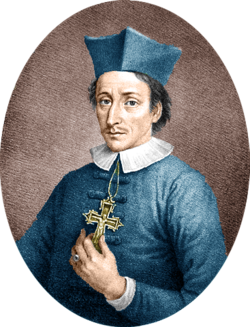
Nicolas Steno
Niels Steensen (Danish: Niels Steensen; Latinized to Nicolas Steno or Nicolaus Stenonius; 1 January 1638 – 25 November 1686 [NS: 11 January 1638 – 5 December 1686]) was a Danish scientist, a pioneer in both anatomy and geology who became a Catholic bishop in his later years. He has been beatified by the Catholic Church.
Steensen was trained in the classical texts on science; however, by 1659 he seriously questioned accepted knowledge of the natural world. Importantly he questioned explanations for tear production, the idea that fossils grew in the ground and explanations of rock formation. His investigations and his subsequent conclusions on fossils and rock formation have led scholars to consider him one of the founders of modern stratigraphy and modern geology. The importance of Steensen's foundational contributions to geology may be gauged from the fact that half of the twenty papers in a 2009 miscellany volume on The Revolution in Geology from the Renaissance to the Enlightenment focus on Steensen, the "preeminent Baroque polymath and founder of modern geologic thought".
Born to a Lutheran family, Steensen converted to Catholicism in 1667. After his conversion, his interest in the natural sciences rapidly waned giving way to his interest in theology. At the beginning of 1675, he decided to become a priest. Four months later, he was ordained in the Catholic clergy on Easter Sunday in 1675. As a clergyman, he was later appointed Vicar Apostolic of Nordic Missions and Titular Bishop of Titopolis by Pope Innocent XI. Steensen played an active role in the Counter-Reformation in Northern Germany.
His canonization process began in 1938 and Pope John Paul II beatified Steensen in 1988.
Niels Steensen was born in Copenhagen on New Year's Day 1638 (Julian calendar), the son of a Lutheran goldsmith who worked regularly for King Christian IV of Denmark. He became ill at age three, suffering from an unknown disease, and grew up in isolation during his childhood. In 1644 his father died, after which his mother married another goldsmith. In 1654–1655, 240 pupils of his school died due to the plague. Across the street lived Peder Schumacher (who would offer Steensen a post as professor in Copenhagen in 1671). At the age of 19, Steensen entered the University of Copenhagen to pursue medical studies. After completing his university education, Steensen set out to travel through Europe; in fact, he would be on the move for the rest of his life. In the Netherlands, France, Italy and Germany he came into contact with prominent physicians and scientists. These influences led him to use his own powers of observation to make important scientific discoveries.
At the urging of Thomas Bartholin, Steensen first travelled to Rostock, then to Amsterdam, where he studied anatomy under and lodged with Gerard Blasius, focusing on the lymphatic system. Within a few months Steensen moved to Leiden, where he met the students Jan Swammerdam, Frederik Ruysch, Reinier de Graaf, Franciscus de le Boe Sylvius, a famous professor, and Baruch Spinoza. Steensen doubted Descartes's recently published explanation of the origin of tears as produced by the brain. Invited to Paris by Henri Louis Habert de Montmor and Pierre Bourdelot, he there met Ole Borch and Melchisédech Thévenot who were interested in new research and in demonstrations of his skills. In 1665 Steensen travelled to Saumur, Bordeaux and Montpellier, where he met Martin Lister and William Croone, who introduced Steensen's work to the Royal Society.
After travelling through France, he settled in Italy in 1666 – at first as professor of anatomy at the University of Padua and then in Florence as in-house physician of Grand Duke of Tuscany Ferdinando II de' Medici, who supported arts and science and whom Steensen had met in Pisa. Steensen was invited to live in the Palazzo Vecchio; in return he had to gather a cabinet of curiosities. Steensen went to Rome and met Pope Alexander VII and Marcello Malpighi, whom he admired. On his way back he watched a Corpus Christi procession in Livorno and wondered if he had the right belief.
During his stay in Amsterdam, Steensen discovered a previously undescribed structure, the "ductus Stenonis" (the duct of the parotid salivary gland) in sheep, dog and rabbit heads. A dispute with Blasius over credit for the discovery arose, but Steensen's name remained associated with this structure known today as the Stensen's duct. In Leiden, Steensen studied the boiled heart of a cow, and determined that it was an ordinary muscle. and not the center of warmth as Galenus and Descartes believed. In Florence, Steensen focused on the muscular system and the nature of muscle contraction. He became a member of Accademia del Cimento and had long discussions with Francesco Redi. Like Vincenzo Viviani, Steensen proposed a geometrical model of muscles to show that a contracting muscle changes its shape but not its volume.
Nicolas Steno
Niels Steensen (Danish: Niels Steensen; Latinized to Nicolas Steno or Nicolaus Stenonius; 1 January 1638 – 25 November 1686 [NS: 11 January 1638 – 5 December 1686]) was a Danish scientist, a pioneer in both anatomy and geology who became a Catholic bishop in his later years. He has been beatified by the Catholic Church.
Steensen was trained in the classical texts on science; however, by 1659 he seriously questioned accepted knowledge of the natural world. Importantly he questioned explanations for tear production, the idea that fossils grew in the ground and explanations of rock formation. His investigations and his subsequent conclusions on fossils and rock formation have led scholars to consider him one of the founders of modern stratigraphy and modern geology. The importance of Steensen's foundational contributions to geology may be gauged from the fact that half of the twenty papers in a 2009 miscellany volume on The Revolution in Geology from the Renaissance to the Enlightenment focus on Steensen, the "preeminent Baroque polymath and founder of modern geologic thought".
Born to a Lutheran family, Steensen converted to Catholicism in 1667. After his conversion, his interest in the natural sciences rapidly waned giving way to his interest in theology. At the beginning of 1675, he decided to become a priest. Four months later, he was ordained in the Catholic clergy on Easter Sunday in 1675. As a clergyman, he was later appointed Vicar Apostolic of Nordic Missions and Titular Bishop of Titopolis by Pope Innocent XI. Steensen played an active role in the Counter-Reformation in Northern Germany.
His canonization process began in 1938 and Pope John Paul II beatified Steensen in 1988.
Niels Steensen was born in Copenhagen on New Year's Day 1638 (Julian calendar), the son of a Lutheran goldsmith who worked regularly for King Christian IV of Denmark. He became ill at age three, suffering from an unknown disease, and grew up in isolation during his childhood. In 1644 his father died, after which his mother married another goldsmith. In 1654–1655, 240 pupils of his school died due to the plague. Across the street lived Peder Schumacher (who would offer Steensen a post as professor in Copenhagen in 1671). At the age of 19, Steensen entered the University of Copenhagen to pursue medical studies. After completing his university education, Steensen set out to travel through Europe; in fact, he would be on the move for the rest of his life. In the Netherlands, France, Italy and Germany he came into contact with prominent physicians and scientists. These influences led him to use his own powers of observation to make important scientific discoveries.
At the urging of Thomas Bartholin, Steensen first travelled to Rostock, then to Amsterdam, where he studied anatomy under and lodged with Gerard Blasius, focusing on the lymphatic system. Within a few months Steensen moved to Leiden, where he met the students Jan Swammerdam, Frederik Ruysch, Reinier de Graaf, Franciscus de le Boe Sylvius, a famous professor, and Baruch Spinoza. Steensen doubted Descartes's recently published explanation of the origin of tears as produced by the brain. Invited to Paris by Henri Louis Habert de Montmor and Pierre Bourdelot, he there met Ole Borch and Melchisédech Thévenot who were interested in new research and in demonstrations of his skills. In 1665 Steensen travelled to Saumur, Bordeaux and Montpellier, where he met Martin Lister and William Croone, who introduced Steensen's work to the Royal Society.
After travelling through France, he settled in Italy in 1666 – at first as professor of anatomy at the University of Padua and then in Florence as in-house physician of Grand Duke of Tuscany Ferdinando II de' Medici, who supported arts and science and whom Steensen had met in Pisa. Steensen was invited to live in the Palazzo Vecchio; in return he had to gather a cabinet of curiosities. Steensen went to Rome and met Pope Alexander VII and Marcello Malpighi, whom he admired. On his way back he watched a Corpus Christi procession in Livorno and wondered if he had the right belief.
During his stay in Amsterdam, Steensen discovered a previously undescribed structure, the "ductus Stenonis" (the duct of the parotid salivary gland) in sheep, dog and rabbit heads. A dispute with Blasius over credit for the discovery arose, but Steensen's name remained associated with this structure known today as the Stensen's duct. In Leiden, Steensen studied the boiled heart of a cow, and determined that it was an ordinary muscle. and not the center of warmth as Galenus and Descartes believed. In Florence, Steensen focused on the muscular system and the nature of muscle contraction. He became a member of Accademia del Cimento and had long discussions with Francesco Redi. Like Vincenzo Viviani, Steensen proposed a geometrical model of muscles to show that a contracting muscle changes its shape but not its volume.
Recent media
Recent media