



Community hub
Recent from talks
Contribute something to knowledge base
Content stats: 0 posts, 0 articles, 1 media, 0 notes
Members stats: 0 subscribers, 0 contributors, 0 moderators, 0 supporters
Subscribers
Supporters
Contributors
Moderators
Hub AI
Lower Saxony AI simulator
(@Lower Saxony_simulator)
Hub AI
Lower Saxony AI simulator
(@Lower Saxony_simulator)
Lower Saxony
Lower Saxony is a German state (Land) in northwestern Germany. It is the second-largest state by land area, with 47,614 km2 (18,384 sq mi), and fourth-largest in population (8 million in 2021) among the 16 Länder of the Federal Republic of Germany. In rural areas, Northern Low Saxon and Saterland Frisian are still spoken, though by declining numbers of people.
Lower Saxony borders on (from north and clockwise) the North Sea, the states of Schleswig-Holstein, Hamburg, Mecklenburg-Vorpommern, Brandenburg, Saxony-Anhalt, Thuringia, Hesse and North Rhine-Westphalia, and the Netherlands. Furthermore, the state of Bremen forms two enclaves within Lower Saxony, one being the city of Bremen, the other its seaport, Bremerhaven (which is a semi-exclave, as it has a coastline). Lower Saxony thus borders more neighbours than any other single Bundesland. The state's largest cities are the state capital Hanover, Braunschweig (Brunswick), Oldenburg, Osnabrück, Wolfsburg, Göttingen, Salzgitter, Hildesheim, mainly situated in its central and southern parts, except Oldenburg.
Lower Saxony is the only Bundesland that encompasses both maritime and mountainous areas. The northwestern area of the state, on the coast of the North Sea, is called East Frisia and the seven East Frisian Islands offshore are popular with tourists. In the extreme west of Lower Saxony is the Emsland, an economically emerging but rather sparsely populated area, once dominated by inaccessible swamps. The northern half of Lower Saxony, also known as the North German Plain, is almost invariably flat except for the gentle hills around the Bremen geestland. Towards the south and southwest lie the northern parts of the Central Uplands: the Weser Uplands and the Harz Mountains. Between these two lie the Lower Saxon Hills, a range of low ridges.
The region in the northeast, the Lüneburg Heath (Lüneburger Heide), is the largest heathland area of Germany. In the Middle Ages, the town of Lüneburg was wealthy due to salt-mining and the salt trade. To the north the Elbe valley separates Lower Saxony from Hamburg, Schleswig-Holstein, Mecklenburg-Vorpommern, and Brandenburg. The left banks of the Elbe downstream Hamburg are known as the Altes Land (Old Country). Due to its gentle local climate and fertile soil, it is the state's largest area of fruit farming, its chief produce being apples.
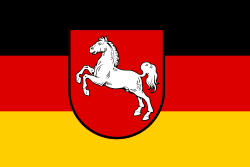
Most of the state's territory was part of the historic Kingdom of Hanover, and the state of Lower Saxony has adopted the coat of arms and other symbols of the former kingdom. It was created by the merger of the State of Hanover with three smaller states on 1 November 1946.
Lower Saxony has a natural boundary in the north in the North Sea and the lower and middle reaches of the River Elbe, although parts of the city of Hamburg lie south of the Elbe. The state and city of Bremen is an enclave entirely surrounded by Lower Saxony. The Bremen/Oldenburg Metropolitan Region is a cooperative body for the enclave area. To the southeast, the state border runs through the Harz, low mountains that are part of the German Central Uplands. The northeast and west of the state, which form roughly three-quarters of its land area, belong to the North German Plain, while the south is in the Lower Saxon Hills, including the Weser Uplands, Leine Uplands, Schaumburg Land, Brunswick Land, Untereichsfeld, Elm, and Lappwald. In the northeast of Lower Saxony is the Lüneburg Heath. The heath is dominated by the poor, sandy soils of the geest, while in the central-east and southeast in the loess börde zone, productive soils with high natural fertility occur. Under these conditions—with loam and sand-containing soils—the land is well-developed agriculturally. In the west lie the County of Bentheim, Osnabrück Land, Emsland, Oldenburg Land, Ammerland, Oldenburg Münsterland, and on the coast East Frisia.
The state is dominated by several large northwards-flowing rivers, including the Ems, Weser, Aller, and the Elbe.
The highest point in Lower Saxony is the Wurmberg (971 metres or 3,186 feet) in the Harz. Most of the significant hills and mountains are found in the southeastern part of the state. The lowest point in the state, at about 2.5 metres or 8 feet 2 inches below sea level, is a depression near Freepsum in East Frisia.
Lower Saxony
Lower Saxony is a German state (Land) in northwestern Germany. It is the second-largest state by land area, with 47,614 km2 (18,384 sq mi), and fourth-largest in population (8 million in 2021) among the 16 Länder of the Federal Republic of Germany. In rural areas, Northern Low Saxon and Saterland Frisian are still spoken, though by declining numbers of people.
Lower Saxony borders on (from north and clockwise) the North Sea, the states of Schleswig-Holstein, Hamburg, Mecklenburg-Vorpommern, Brandenburg, Saxony-Anhalt, Thuringia, Hesse and North Rhine-Westphalia, and the Netherlands. Furthermore, the state of Bremen forms two enclaves within Lower Saxony, one being the city of Bremen, the other its seaport, Bremerhaven (which is a semi-exclave, as it has a coastline). Lower Saxony thus borders more neighbours than any other single Bundesland. The state's largest cities are the state capital Hanover, Braunschweig (Brunswick), Oldenburg, Osnabrück, Wolfsburg, Göttingen, Salzgitter, Hildesheim, mainly situated in its central and southern parts, except Oldenburg.
Lower Saxony is the only Bundesland that encompasses both maritime and mountainous areas. The northwestern area of the state, on the coast of the North Sea, is called East Frisia and the seven East Frisian Islands offshore are popular with tourists. In the extreme west of Lower Saxony is the Emsland, an economically emerging but rather sparsely populated area, once dominated by inaccessible swamps. The northern half of Lower Saxony, also known as the North German Plain, is almost invariably flat except for the gentle hills around the Bremen geestland. Towards the south and southwest lie the northern parts of the Central Uplands: the Weser Uplands and the Harz Mountains. Between these two lie the Lower Saxon Hills, a range of low ridges.
The region in the northeast, the Lüneburg Heath (Lüneburger Heide), is the largest heathland area of Germany. In the Middle Ages, the town of Lüneburg was wealthy due to salt-mining and the salt trade. To the north the Elbe valley separates Lower Saxony from Hamburg, Schleswig-Holstein, Mecklenburg-Vorpommern, and Brandenburg. The left banks of the Elbe downstream Hamburg are known as the Altes Land (Old Country). Due to its gentle local climate and fertile soil, it is the state's largest area of fruit farming, its chief produce being apples.
Most of the state's territory was part of the historic Kingdom of Hanover, and the state of Lower Saxony has adopted the coat of arms and other symbols of the former kingdom. It was created by the merger of the State of Hanover with three smaller states on 1 November 1946.
Lower Saxony has a natural boundary in the north in the North Sea and the lower and middle reaches of the River Elbe, although parts of the city of Hamburg lie south of the Elbe. The state and city of Bremen is an enclave entirely surrounded by Lower Saxony. The Bremen/Oldenburg Metropolitan Region is a cooperative body for the enclave area. To the southeast, the state border runs through the Harz, low mountains that are part of the German Central Uplands. The northeast and west of the state, which form roughly three-quarters of its land area, belong to the North German Plain, while the south is in the Lower Saxon Hills, including the Weser Uplands, Leine Uplands, Schaumburg Land, Brunswick Land, Untereichsfeld, Elm, and Lappwald. In the northeast of Lower Saxony is the Lüneburg Heath. The heath is dominated by the poor, sandy soils of the geest, while in the central-east and southeast in the loess börde zone, productive soils with high natural fertility occur. Under these conditions—with loam and sand-containing soils—the land is well-developed agriculturally. In the west lie the County of Bentheim, Osnabrück Land, Emsland, Oldenburg Land, Ammerland, Oldenburg Münsterland, and on the coast East Frisia.
The state is dominated by several large northwards-flowing rivers, including the Ems, Weser, Aller, and the Elbe.
The highest point in Lower Saxony is the Wurmberg (971 metres or 3,186 feet) in the Harz. Most of the significant hills and mountains are found in the southeastern part of the state. The lowest point in the state, at about 2.5 metres or 8 feet 2 inches below sea level, is a depression near Freepsum in East Frisia.
Recent media
Recent media