


Community hub
Recent from talks
Contribute something
Nothing was collected or created yet.

A port is a maritime facility comprising one or more wharves or loading areas, where ships load and discharge cargo and passengers. Although usually situated on a sea coast or estuary, ports can also be found far inland, such as Hamburg, Manchester and Duluth; these access the sea via rivers or canals. Because of their roles as ports of entry for immigrants as well as soldiers in wartime, many port cities have experienced dramatic multi-ethnic and multicultural changes throughout their histories.[1][2]
Ports are extremely important to the global economy; 70% of global merchandise trade by value passes through a port.[3] For this reason, ports are also often densely populated settlements that provide the labor for processing and handling goods and related services for the ports. Today by far the greatest growth in port development is in Asia, the continent with some of the world's largest and busiest ports, such as Singapore and the Chinese ports of Shanghai and Ningbo-Zhoushan. As of 2020, the busiest passenger port in Europe is the Port of Helsinki in Finland.[4] Nevertheless, countless smaller ports do exist that may only serve their local tourism or fishing industries.
Ports can have a wide environmental impact on local ecologies and waterways, most importantly water quality, which can be caused by dredging, spills and other pollution. Ports are heavily affected by changing environmental factors caused by climate change as most port infrastructure is extremely vulnerable to sea level rise and coastal flooding.[3] Internationally, global ports are beginning to identify ways to improve coastal management practices and integrate climate change adaptation practices into their construction.[3]
Historical ports
[edit]
Wherever ancient civilisations engaged in maritime trade, they tended to develop sea ports. One of the world's oldest known artificial harbors is at Wadi al-Jarf on the Red Sea.[5] Along with the finding of harbor structures, ancient anchors have also been found.
Other ancient ports include Guangzhou during Qin dynasty China and Canopus, the principal Egyptian port for Greek trade before the foundation of Alexandria. In Ancient Greece, Athens' port of Piraeus was the base for the Athenian fleet which played a crucial role in the Battle of Salamis against the Persians in 480 BCE. In ancient India from 3700 BCE, Lothal was a prominent city of the Indus valley civilisation, located in the Bhal region of the modern state of Gujarāt.[6] Ostia Antica was the port of ancient Rome with Portus established by Claudius and enlarged by Trajan to supplement the nearby port of Ostia. In Japan, during the Edo period, the island of Dejima was the only port open for trade with Europe and received only a single Dutch ship per year, whereas Osaka was the largest domestic port and the main trade hub for rice.

Ostia Antica (lit. 'Ancient Ostia') is an ancient Roman city and the port of Rome located at the mouth of the Tiber. It is near modern Ostia, 25 km (16 mi) southwest of Rome. Due to silting and the invasion of sand, the site now lies 3 km (2 mi) from the sea.[7] The name Ostia (the plural of ostium) derives from Latin os 'mouth'. Ostia is now a large archaeological site noted for the excellent preservation of its ancient buildings, magnificent frescoes and impressive mosaics. The city's decline after antiquity led to harbor deterioration, marshy conditions, and reduced population. Sand dunes covering the site aided its preservation. Its remains provide insights into a city of commercial importance. As in Pompeii, Ostia's ruins provide details about Roman urbanism that are not accessible within the city of Rome itself.[8] Post-classical Swahili kingdoms are known to have had trade port islands and trade routes[9] with the Islamic world and Asia. They were described by Greek historians as "metropolises".[10] Famous African trade ports such as Mombasa, Zanzibar, Mogadishu and Kilwa[11] were known to Chinese sailors such as Zheng He and medieval Islamic historians such as the Berber Islamic voyager Abu Abdullah ibn Battuta.[12]
Many of these ancient sites no longer exist or function as modern ports. Even in more recent times, ports sometimes fall out of use. Rye, East Sussex, was an important English port in the Middle Ages, but the coastline changed and it is now 2 miles (3.2 km) from the sea, while the ports of Ravenspurn and Dunwich have been lost to coastal erosion.

The maritime republics (Italian: repubbliche marinare), also called merchant republics (Italian: repubbliche mercantili), were Italian thalassocratic port cities which, starting from the Middle Ages, enjoyed political autonomy and economic prosperity brought about by their maritime activities. The term, coined during the 19th century, generally refers to four Italian cities, whose coats of arms have been shown since 1947 on the flags of the Italian Navy and the Italian Merchant Navy:[13] Amalfi, Genoa, Pisa, and Venice. In addition to the four best known cities, Ancona,[14][15] Gaeta,[16] Noli,[17][18][19] and, in Dalmatia, Ragusa, are also considered maritime republics; in certain historical periods, they had no secondary importance compared to some of the better known cities.
Uniformly scattered across the Italian peninsula, the maritime republics were important not only for the history of navigation and commerce: in addition to precious goods otherwise unobtainable in Europe, new artistic ideas and news concerning distant countries also spread. From the 10th century, they built fleets of ships both for their own protection and to support extensive trade networks across the Mediterranean, giving them an essential role in reestablishing contacts between Europe, Asia, and Africa, which had been interrupted during the early Middle Ages. They also had an essential role in the Crusades and produced renowned explorers and navigators such as Marco Polo and Christopher Columbus.[20]
Over the centuries, the maritime republics — both the best known and the lesser known but not always less important — experienced fluctuating fortunes. In the 9th and 10th centuries, this phenomenon began with Amalfi and Gaeta, which soon reached their heyday. Meanwhile, Venice began its gradual ascent, while the other cities were still experiencing the long gestation that would lead them to their autonomy and to follow up on their seafaring vocation. After the 11th century, Amalfi and Gaeta declined rapidly, while Genoa and Venice became the most powerful republics. Pisa followed and experienced its most flourishing period in the 13th century, and Ancona and Ragusa allied to resist Venetian power. Following the 14th century, while Pisa declined to the point of losing its autonomy, Venice and Genoa continued to dominate navigation, followed by Ragusa and Ancona, which experienced their golden age in the 15th century. In the 16th century, with Ancona's loss of autonomy, only the republics of Venice, Genoa, and Ragusa remained, which still experienced great moments of splendor until the mid-17th century, followed by over a century of slow decline that ended with the Napoleonic invasion.
Modern ports
[edit]
Whereas early ports tended to be just simple harbours, modern ports tend to be multimodal distribution hubs, with transport links using sea, river, canal, road, rail and air routes. Successful ports are located to optimize access to an active hinterland, such as the London Gateway. Ideally, a port will grant easy navigation to ships, and will give shelter from wind and waves. Ports are often on estuaries, where the water may be shallow and may need regular dredging. Deep water ports such as Milford Haven are less common, but can handle larger ships with a greater draft, such as super tankers, Post-Panamax vessels and large container ships. Other businesses such as regional distribution centres, warehouses and freight-forwarders, canneries and other processing facilities find it advantageous to be located within a port or nearby. Modern ports will have specialised cargo-handling equipment, such as gantry cranes, reach stackers and forklift trucks.
Ports usually have specialised functions: some tend to cater mainly for passenger ferries and cruise ships; some specialise in container traffic or general cargo; and some ports play an important military role for their nation's navy. Some third world countries and small islands such as Ascension and St Helena still have limited port facilities, so that ships must anchor off while their cargo and passengers are taken ashore by barge or launch (respectively).
In modern times, ports survive or decline, depending on current economic trends. In the UK, both the ports of Liverpool and Southampton were once significant in the transatlantic passenger liner business. Once airliner traffic decimated that trade, both ports diversified to container cargo and cruise ships. Up until the 1950s the Port of London was a major international port on the River Thames, but changes in shipping and the use of containers and larger ships have led to its decline. Thamesport,[21] a small semi-automated container port (with links to the Port of Felixstowe, the UK's largest container port) thrived for some years, but has been hit hard by competition from the emergent London Gateway port and logistics hub.
In mainland Europe, it is normal for ports to be publicly owned, so that, for instance, the ports of Rotterdam and Amsterdam are owned partly by the state and partly by the cities themselves.[22]
Even though modern ships tend to have bow-thrusters and stern-thrusters,[citation needed] many port authorities still require vessels to use pilots and tugboats for manoeuvering large ships in tight quarters. For instance, ships approaching the Belgian port of Antwerp, an inland port on the River Scheldt, are obliged to use Dutch pilots when navigating on that part of the estuary that belongs to the Netherlands.
Ports with international traffic have customs facilities.
Types
[edit]The terms "port" and "seaport" are used for different types of facilities handling ocean-going vessels, and river port is used for river traffic, such as barges and other shallow-draft vessels.
Seaport
[edit]
A seaport is a port located on the shore of a sea or ocean. It is further categorized as commercial and non-commercial:[23]
- Commercial ones includes "cruise ports" and "cargo ports". Additionally, "cruise ports" are also known as a "home port" or a "port of call"; and "cargo port" is also further categorized into a "bulk" or "break bulk port" or as a "container port".
- Non-commercial seaports are marina and fishing ports.
Cargo port
[edit]Cargo ports are quite different from cruise ports, because each handles very different cargo, which has to be loaded and unloaded by a variety of mechanical means.
Bulk cargo ports may handle one particular type of cargo or numerous cargoes, such as grains, liquid fuels, liquid chemicals, wood, and automobiles. Such ports are known as the "bulk" or "break bulk ports".
Ports that handle containerized cargo are known as container ports.
Most cargo ports handle all sorts of cargo, but some ports are very specific as to what cargo they handle. Additionally, individual cargo ports may be divided into different operating terminals which handle the different types of cargoes, and may be operated by different companies, also known as terminal operators, or stevedores.[24]
Cruise port
[edit]A cruise home port is the port where cruise ship passengers board (or embark) to start their cruise and disembark the cruise ship at the end of their cruise. It is also where the cruise ship's supplies are loaded for the cruise, which includes everything from fresh water and fuel to fruits, vegetables, champagne, and any other supplies needed for the cruise. "Cruise home ports" are very busy places during the day the cruise ship is in port, because off-going passengers debark their baggage and on-coming passengers board the ship in addition to all the supplies being loaded. Cruise home ports tend to have large passenger terminals to handle the large number of passengers passing through the port. The busiest cruise home port in the world is the Port of Miami, Florida.
Port of call
[edit]A port of call is an intermediate stop for a ship on its sailing itinerary. At these ports, cargo ships may take on supplies or fuel, as well as unloading and loading cargo while cruise liners have passengers get on or off ship.
Fishing port
[edit]A fishing port is a port or harbor for landing and distributing fish. It may be a recreational facility, but it is usually commercial. A fishing port is the only port that depends on an ocean product, and depletion of fish may cause a fishing port to be uneconomical.
Marina
[edit]
A marina is a port for recreational boating.
Warm-water port
[edit]A warm-water port (also known as an ice-free port) is one where the water does not freeze in winter. This is mainly used in the context of countries with mostly cold winters where parts of the coastline freezes over every winter. Because they are available year-round, warm-water ports can be of great geopolitical or economic interest. Such settlements as Narvik in Norway, Dalian in China, Murmansk, Novorossiysk, Petropavlovsk-Kamchatsky and Vostochny Port[25] in Russia, Odesa in Ukraine, Kushiro in Japan and Valdez at the terminus of the Alaska Pipeline owe their very existence to being ice-free ports. The Baltic Sea and similar areas have ports available year-round beginning in the 20th century thanks to icebreakers, but earlier access problems prompted Russia to expand its territory to the Black Sea.[citation needed]
Inland port
[edit]
An inland port is a port on a navigable lake, river (fluvial port), or canal with access to a sea or ocean, which therefore allows a ship to sail from the ocean inland to the port to load or unload its cargo. An example of this is the St. Lawrence Seaway which allows ships to travel from the Atlantic Ocean several thousand kilometers inland to Great Lakes ports like Toronto, Duluth-Superior, and Chicago.[26] The term inland port is also used for dry ports. A dry port is an inland intermodal terminal directly connected by road or rail to a seaport and operating as a centre for the transshipment of sea cargo to inland destinations.[27] An inland port is a port on a navigable lake, river (fluvial port), or canal with access to a sea or ocean, which therefore allows a ship to sail from the ocean inland to the port to load or unload its cargo. An example of this is the St. Lawrence Seaway which allows ships to travel from the Atlantic Ocean several thousand kilometers inland to Great Lakes ports like Toronto, Duluth-Superior, and Chicago.[28] The term inland port is also used for dry ports.
Smart port
[edit]A smart port uses technologies, including the Internet of Things (IoT) and artificial intelligence (AI) to be more efficient at handling goods.[29] Smart ports usually deploy cloud-based software as part of the process of greater automation to help generate the operating flow that helps the port work smoothly.[30] At present, most of the world's ports have somewhat embedded technology, if not for full leadership. However, thanks to global government initiatives and exponential growth in maritime trade, the number of intelligent ports has gradually increased. A report by business intelligence provider Visiongain assessed that Smart Ports Market spending would reach $1.5 bn in 2019.[31]
Environmental issues
[edit]Ports and their operation are often a cause of environmental issues, such as sediment contamination and spills from ships and are susceptible to larger environmental issues, such as human caused climate change and its effects.[32]
Dredging
[edit]Every year 100 million cubic metres of marine sediment are dredged to improve waterways around ports. Dredging, in its practice, disturbs local ecosystems, brings sediments into the water column, and can stir up pollutants captured in the sediments.[32]
Invasive species
[edit]Invasive species are often spread by the bilge water and species attached to the hulls of ships.[32] It is estimated that there are over 7000 invasive species transported in bilge water around the world on a daily basis[33] Invasive species can have direct or indirect interactions with native sea life. Direct interaction such as predation, is when a native species with no natural predator is all of a sudden prey of an invasive specie. Indirect interaction can be diseases or other health conditions brought by invasive species.[34]

Air pollution
[edit]Ports are also a source of increased air pollution as a result of ships and land transportation at the port. Transportation corridors around ports have higher exhaust emissions and this can have related health effects on local communities.[32]
Water quality
[edit]Water quality around ports is often lower because of both direct and indirect pollution from the shipping, and other challenges caused by the port's community, such as trash washing into the ocean.[32]
Spills, pollution and contamination
[edit]Sewage from ships, and leaks of oil and chemicals from shipping vessels can contaminate local water, and cause other effects like nutrient pollution in the water.[32]
Climate change and sea level rise
[edit]Ports and their infrastructure are very vulnerable to climate change and sea level rise, because many of them are in low-lying areas designed for status quo water levels.[3] Variable weather, coastal erosion, and sea level rise all put pressure on existing infrastructure, resulting in subsidence, coastal flooding and other direct pressures on the port.[3]
Reducing impact
[edit].jpg)
There are several initiatives to decrease negative environmental impacts of ports.[35][36][37] The World Port Sustainability Program points to all of the Sustainable Development Goals as potential ways of addressing port sustainability.[38] These include SIMPYC, the World Ports Climate Initiative, the African Green Port Initiative, EcoPorts and Green Marine.[37][39]
World's major ports
[edit]Africa
[edit]- The port of Tangier Med is the largest port on the Mediterranean and in Africa by capacity and went into service in July 2007.
- The busiest port in Africa is Port Said in Egypt.
Asia
[edit]
The port of Shanghai is the largest port in the world in both cargo tonnage and activity. It regained its position as the world's busiest port by cargo tonnage and the world's busiest container port in 2009 and 2010, respectively. It is followed by the ports of Singapore, Hong Kong and Kaohsiung, Taiwan, all of which are in East and Southeast Asia.
The port of Singapore is the world's second-busiest port in terms of total shipping tonnage, it also transships a third of the world's shipping containers, half of the world's annual supply of crude oil, and is the world's busiest transshipment port.
Europe
[edit]
Europe's busiest container port and biggest port by cargo tonnage by far is the Port of Rotterdam, in the Netherlands. It is followed by the Belgian Port of Antwerp or the German Port of Hamburg, depending on which metric is used.[40] In turn, the Spanish Port of Valencia is the busiest port in the Mediterranean basin, while the Portuguese Port of Sines is the busiest Atlantic port. The Port of Trieste, Italy, is the main port of the northern Adriatic and starting point of the Transalpine Pipeline.
North America
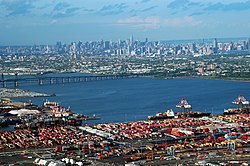
[edit]The largest ports include the Port of South Louisiana, a vast sprawling port centered in the New Orleans area, Houston, Port of New York/New Jersey, Los Angeles in the U.S., Manzanillo in Mexico and Vancouver in Canada.[citation needed] Panama also has the Panama Canal that connects the Pacific and Atlantic Ocean, and is a key conduit for international trade.
Oceania
[edit]The largest port in Oceania is the Port of Melbourne.
South America
[edit]According to ECLAC's "Maritime and Logistics Profile of Latin America and the Caribbean", the largest ports in South America are the Port of Santos in Brazil, Cartagena in Colombia, Callao in Peru, Guayaquil in Ecuador, and the Port of Buenos Aires in Argentina.[41]
See also
[edit]- Anchorage (shipping)
- Megaproject
- Marina – port for recreational boating
- Port management
- Port operator
- Ship transport
- Port of Nantes
Other logistics hubs
[edit]Lists
[edit]References
[edit]- ^ Caves, R. W. (2004). Encyclopedia of the City. Routledge. pp. 528. ISBN 978-0-415-25225-6.
- ^ John Gerring; Brendan Apfeld; Tore Wig; Andreas Forø Tollefsen (2022). "Maritime Geography". The Deep Roots of Modern Democracy: Geography and the Diffusion of Political Institutions. Cambridge University Press. pp. 45–208. doi:10.1017/9781009115223.004. ISBN 978-1-009-10037-3.
- ^ a b c d e Asariotis, Regina; Benamara, Hassiba; Mohos-Naray, Viktoria (December 2017). Port Industry Survey on Climate Change Impacts and Adaptation (PDF) (Report). UN Conference on Trade and Development. Archived (PDF) from the original on 2020-11-25.
- ^ "Maritime ports freight and passenger statistics" (PDF). Eurostat. Archived (PDF) from the original on 2017-07-22. Retrieved 18 June 2020.
- ^ Rossella Lorenzi (12 April 2013). "Most Ancient Port, Hieroglyphic Papyri Found". Discovery News. Archived from the original on 14 April 2013. Retrieved 21 April 2013.
- ^ Rao, S. R. Rao (1985). Lothal. Archeological Survey of India.
- ^ Ostia-Introduction http://www.ostia-antica.org/intro.htm Archived 2017-09-03 at the Wayback Machine
- ^ Gates, Charles (2011). Ancient cities: the archaeology of urban life in the ancient Near East and Egypt, Greece and Rome (2nd ed.). London [u.a]: Routledge. pp. 367–370. ISBN 978-0-203-83057-4.
- ^ "Eastern and Southern Africa 500–1000 AD". Metmuseum.org. Archived from the original on 4 October 2001. Retrieved 21 April 2009.
- ^ "Tanzanian dig unearths ancient secret by Tira Shubart". BBC News. 17 April 2002. Archived from the original on 20 December 2002. Retrieved 21 April 2009.
- ^ Newitt, M.D.D. (1995). A History of Mozambique. Indiana University Press. ISBN 978-0-253-34006-1.
- ^ "Ibn Battuta: Travels in Asia and Africa 1325–1354". Fordham.edu. 21 February 2001. Archived from the original on 13 May 2011. Retrieved 21 April 2009.
- ^ "La Bandiera della Marina Militare". Marina Militare (in Italian). Ministero della Difesa. Archived from the original on December 27, 2013. Retrieved July 29, 2023.
- ^ The International Geographic Encyclopedia and Atlas, Ancona (p. 27), Springer, 1979. ISBN 9781349050024.
- ^ Peris Persi, in Conoscere l'Italia, vol. Marche, Istituto Geografico De Agostini, Novara 1982 (p. 74); AA.VV. Meravigliosa Italia, Enciclopedia delle regioni, edited by Valerio Lugoni, Aristea, Milano; Guido Piovene, in Tuttitalia, Casa Editrice Sansoni, Firenze & Istituto Geografico De Agostini, Novara (p. 31); Pietro Zampetti, in Itinerari dell'Espresso, vol. Marche, edited by Neri Pozza, Editrice L'Espresso, Rome, 1980
- ^ Touring Club Italiano, Lazio Touring Editore, 1981 (p. 743); Giovanna Bergamaschi, Arte in Italia: guida ai luoghi ed alle opere dell'Italia artistica, Electa, 1983 (p. 243); Salvatore Aurigemma, Angelo de Santis, Gaeta, Formia, Minturno.
- ^ Giovanni Murialdo, Dinamiche territoriali e commerciali nella Noli signorile e comunale..., in: Mauro Darchi, Francesca Bandini, La repubblica di Noli e l'importanza dei porti minori del Mediterraneo nel Medioevo, Firenze, All'Insegna del Giglio, 2004 (p. 9)
- ^ Bohun Lynch, The Italian Riviera: Its Scenery, Customs, and Food, with Notes Upon the Maritime Alps, Doubleday, Doran, 1927 (p. 159).
- ^ AA. VV., Medioevo latino, bollettino bibliografico della cultura europea da Boezio a Erasmo (secoli VI – XV), volume 28, Sismel Edizioni del Galluzzo, 2007, (p. 1338); Giuseppe Gallo, La Repubblica di Genova tra nobili e popolari (1257–1528), edizioni De Ferrari, 1997, p. 44
- ^ Cartwright, Mark (8 January 2019). "Trade in Medieval Europe". World History Encyclopedia. Archived from the original on 20 June 2021. Retrieved 2021-06-02.
- ^ "Welcome". London Thamesport. Retrieved 6 September 2018.
- ^ "Organisation". Port of Rotterdam. 2015-06-15. Retrieved 2020-10-07.
- ^ "Different types of Ports". Fulcrum. Archived from the original on Dec 17, 2023.
- ^ Khan, Khalil U. (15 September 2014). "Stevedoring & The Role of Stevedores in Shipping". International Institute of Marine Surveying. Retrieved 7 April 2021.
- ^ "Vostochny Port JSC, Geography, Location". Vostochny Port website. 2007. Archived from the original on 29 November 2012. Retrieved 13 December 2012.
Vostochny Port is located in the south of Primorsky Region, in the southeast of Nakhodka bay, in Vrangel bay. This is unique natural harbor is no ice restrictions even in severe winters.
- ^ "Seaway System". greatlakes-seaway.com.
- ^ "Feasibility Study on the network operation of Hinterland Hubs (Dry Port Concept) to improve and modernise ports' connections to the hinterland and to improve networking" (PDF). InLoc. January 2007. Archived from the original on 2008-04-13. Retrieved 2008-03-10.
- ^ "Seaway System". greatlakes-seaway.com.
- ^ "Smart Ports of the Future: A Digital Tomorrow". Port Technology International. 2019-09-17. Archived from the original on 2019-10-11. Retrieved 2019-10-11.
- ^ "Ports in the Cloud: The Next Step in Automation?". Port Technology International. 2018-11-09. Archived from the original on 11 October 2019. Retrieved 2019-10-11.
- ^ "'Smart Ports Market spending will reach $1.5bn in 2019', says Visiongain". Visiongain (Press release). 2019-09-05. Retrieved 2019-09-09.
- ^ a b c d e f OECD (2011-02-17). Braathen, Nils Axel (ed.). Environmental Impacts of International Shipping: The Role of Ports. OECD. doi:10.1787/9789264097339-en. ISBN 978-92-64-09682-0.
- ^ "What are California Marine Invasive Species?". wildlife.ca.gov. Retrieved 2021-05-13.
- ^ "Invasive and Exotic Marine Species". NOAA Fisheries. NOAA. 2021-05-07. Retrieved 2021-05-13.
- ^ Hossain, Tahazzud; Adams, Michelle; Walker, Tony R. (2020). "Role of sustainability in global seaports". Ocean & Coastal Management. 202 105435. doi:10.1016/j.ocecoaman.2020.105435.
- ^ Hossain, Tahazzud; Adams, Michelle; Walker, Tony R. (2019). "Sustainability initiatives in Canadian ports". Marine Policy. 106 103519. Bibcode:2019MarPo.10603519H. doi:10.1016/j.marpol.2019.103519. S2CID 164819617.
- ^ a b Walker, Tony R. (2016). "Green Marine: An environmental program to establish sustainability in marine transportation". Marine Pollution Bulletin. 105 (1): 199–207. Bibcode:2016MarPB.105..199W. doi:10.1016/j.marpolbul.2016.02.029. PMID 26899158.
- ^ "Areas of Interest – World Port Sustainability Program". sustainableworldports.org. Retrieved 2020-12-19.
- ^ EOS magazine, 6, 2012
- ^ "World Port Rankings 2011" (PDF). Agência Nacional de Transportes Aquaviários. Antaq, Brazil. 2011. Archived (PDF) from the original on 2012-12-02. Retrieved 6 September 2018.
- ^ "Los 10 mayores puertos de América Latina y Caribe en tráfico de contenedores". Revista de Ingeniería Naval (in Spanish). Madrid, Spain: Asociación de Ingenieros Navales y Oceánicos de España. September 28, 2016. Retrieved May 3, 2017.
External links
[edit]
- Port Industry Statistics, American Association of Port Authorities
- Information on yachting facilities at ports around the world from Noonsite.com
- Social & Economic Benefits of PORTS from "NOAA Socioeconomics" website initiative
- Antunes, Cátia: Early Modern Ports, 1500–1750, European History Online, Mainz: Institute of European History, 2011, retrieved: November 2, 2011.
| Types | |
|---|---|
| Rankings | |
| Locations | |
| Port management | |
| Conventions | |


Definition and Functions
Core Functions in Logistics
Ports function as critical nodes in logistics networks, facilitating the seamless transfer of cargo between maritime vessels and inland transportation modes such as rail, road, and barge systems. This intermodal interface minimizes delays and optimizes supply chain efficiency by consolidating diverse transport modalities at a single location.[7] In global trade, ports handle approximately 80% of merchandise trade by volume, underscoring their role in enabling cost-effective bulk movement of commodities like oil, grains, and containers.[3] Core cargo handling operations encompass loading and unloading vessels, often utilizing specialized equipment such as cranes, conveyor systems, and automated guided vehicles to process millions of twenty-foot equivalent units (TEUs) annually at major facilities. For instance, stevedores and terminal operators manage the transfer of goods from ship holds to quay-side storage, ensuring rapid turnaround times that average 24-48 hours for container ships at efficient ports.[8] Temporary storage in warehouses or open yards allows for inventory buffering against fluctuations in vessel arrivals or inland transport availability, with bonded facilities enabling deferred customs duties to accelerate throughput.[9] [10] Customs clearance and regulatory compliance represent another essential function, where port authorities coordinate inspections, documentation verification, and quarantine procedures to enforce international trade standards and prevent illicit activities. This involves collaboration with government agencies for duties collection and security screening, such as under the World Customs Organization frameworks, which can process declarations electronically to reduce clearance times to under 24 hours in digitized systems.[11] Logistics coordination extends to value-added services like sorting, labeling, repackaging, and hazardous material handling, often outsourced to third-party providers that integrate port activities with broader supply chain management software for real-time tracking.[12] These functions collectively reduce overall logistics costs by up to 20% through economies of scale and proximity to deep-water berths capable of accommodating ultra-large container vessels exceeding 20,000 TEUs capacity.[3]Economic and Trade Significance
Ports facilitate the movement of over 80 percent of global merchandise trade by volume, serving as essential gateways for international commerce and supply chain integration.[3] In 2024, seaborne trade volumes exceeded 12.35 billion tons, underscoring ports' role in handling bulk commodities, containers, and energy resources that drive industrial and consumer economies.[13] This throughput supports economic multipliers, including direct employment in stevedoring, logistics, and maintenance, as well as indirect effects through ancillary industries like manufacturing and retail. Efficient port infrastructure reduces transportation costs, which can account for 10-20 percent of product prices in trade-dependent economies, thereby enhancing competitiveness and fostering export-led growth.[5] For instance, top-performing ports in East Asia maintained high efficiency in 2024 despite global disruptions, processing millions of twenty-foot equivalent units (TEUs) and contributing to regional GDP through just-in-time inventory systems.[15] In the United States, ports handled cargo valued at approximately $2.1 trillion in 2023, representing 41.5 percent of international trade value and generating nearly $2.9 trillion in annual economic output alongside 21.8 million jobs across port-related sectors.[16][17] Trade significance extends to vulnerability mitigation; ports enable diversification of supply routes, as seen in rerouting around chokepoints like the Suez Canal, which influences commodity prices and inflation globally.[18] However, slowing maritime trade growth—projected at 0.5 percent in 2025 amid geopolitical tensions and economic deceleration—highlights risks to port-dependent revenues and underscores the need for resilient infrastructure investments.[19] Developing nations, where maritime transport often exceeds 90 percent of external trade, rely on port performance for poverty reduction and industrialization, though inefficiencies can exacerbate trade imbalances.[20]Historical Development
Ancient and Medieval Ports
The earliest known port structures date to the Bronze Age in the Levant, with facilities at sites like Byblos, Sidon, and Tyre facilitating maritime trade between Egypt, Mesopotamia, and Anatolia as early as the 3rd millennium BCE.[21] Phoenician ports such as Tyre and Sidon became central to Mediterranean commerce by exporting cedar wood, fine linens, purple-dyed textiles, and glass, while importing metals, ivory, and papyrus from regions including Egypt and Greece.[22] These harbors featured rudimentary breakwaters and quays constructed from timber and stone, enabling the loading and unloading of ships for long-distance voyages that connected disparate ancient economies.[23] In ancient Greece, ports like Piraeus near Athens emerged around the 5th century BCE as key naval and commercial bases, supporting trade in olive oil, wine, and pottery while integrating with overland networks via roads and the diolkos—a paved slipway for dragging ships across the Isthmus of Corinth.[24] Roman engineering advanced port infrastructure significantly; Ostia, Rome's primary river port on the Tiber, handled grain imports from Egypt and North Africa, but silting issues prompted Emperor Claudius to construct the artificial harbor of Portus in 42 CE, featuring hexagonal breakwaters and a capacity for over 200 hectares of facilities by Trajan's expansions around 110 CE.[25] Roman ports incorporated concrete moles, lighthouses, and dredged channels, enhancing connectivity across the Mediterranean and sustaining an empire reliant on imported staples like 400,000 tons of Egyptian grain annually for Rome's population.[26][27] Medieval ports evolved amid feudal fragmentation and Crusades, with Italian city-states like Venice and Genoa establishing fortified harbors and trading colonies in the Levant by the 11th century, controlling routes for spices, silk, and slaves from the East.[28] Venice's Arsenal, operational from 1104, standardized galley production for naval dominance, while Genoa's ports facilitated banking and overland links to Flanders, amassing wealth through monopolies on Levantine trade.[28] In Northern Europe, the Hanseatic League, formalized by the 13th century, networked over 200 Baltic and North Sea ports including Lübeck and Hamburg, dominating exports of timber, furs, salt, and herring to supply growing inland markets and enforce monopolies via armed convoys.[29] These medieval systems emphasized defensive walls, cranes for cargo like wool bales, and guild regulations, fostering economic interdependence that peaked in the 14th century before competition from Atlantic routes.[30]Industrial Revolution and Steam Age
The Industrial Revolution, commencing in Britain around 1760, dramatically increased the volume of seaborne trade in raw materials such as coal and iron ore, alongside manufactured exports like textiles, compelling ports to expand quays and construct jetties to accommodate surging cargo throughput.[31] In Liverpool, this manifested as rapid dock proliferation along the River Mersey, where imports of raw cotton—essential for mechanized mills in nearby Manchester—drove the port's growth into Britain's premier entrepôt by the early 19th century, with annual cotton arrivals exceeding 500,000 bales by 1830.[32][33] Similar expansions occurred in London, where tidal constraints on the Thames prompted the development of enclosed wet docks, beginning with the West India Docks operationalized in 1802 to handle sugar and rum cargoes efficiently under private enterprise management.[34] The Steam Age, accelerating from the 1830s with the proliferation of reliable paddle-steamers and later screw-propelled vessels, further reshaped port infrastructure by enabling schedule-dependent voyages less vulnerable to wind variability, thereby intensifying global trade flows and necessitating adaptations for larger, iron-hulled ships with drafts up to 20 feet.[35] Ports invested in dredging channels, erecting breakwaters, and installing coaling facilities, as steamers consumed vast quantities of fuel—often 100 tons per transatlantic crossing—spurring the construction of dedicated bunkering wharves.[36] In Liverpool, steam-powered hydraulic cranes, introduced around 1846, mechanized cargo handling, reducing unloading times for bulk goods from days to hours and exemplifying the era's shift toward capital-intensive operations.[37] These transformations synchronized across major ports, fostering specialization: coal-exporting facilities in Newcastle proliferated with output rising from 4 million tons in 1800 to 30 million by 1850, while continental hubs like Hamburg and Antwerp deepened approaches to integrate rail links for hinterland distribution.[38] The resultant efficiency gains lowered freight costs by up to 50% on key routes, underpinning industrial expansion but also straining labor conditions, as evidenced by London's 1889 dock strike involving 100,000 workers demanding fair wages amid mechanized pressures.[36][39] By the late 19th century, such ports formed integrated nodes in steam-driven networks, handling diversified cargoes including grain and timber via steam elevators and conveyor systems.[40]Containerization and Late 20th Century Expansion
Containerization emerged as a transformative innovation in maritime transport when American trucking entrepreneur Malcolm McLean developed standardized steel containers to facilitate intermodal freight movement. On April 26, 1956, McLean's converted tanker Ideal X completed its maiden voyage from Newark, New Jersey, to Houston, Texas, carrying 58 aluminum containers equivalent to truck trailers, marking the practical debut of container shipping.[41][42] This system addressed longstanding inefficiencies in break-bulk cargo handling, where goods were individually loaded and unloaded, often resulting in damage, theft, and delays spanning days at ports. By the late 1950s and into the 1960s, early adoption occurred primarily through Sea-Land Service, McLean's company, establishing routes linking North American ports to the Caribbean and Europe, necessitating initial port modifications like gantry cranes for container lifting. Widespread implementation accelerated in the 1970s as shipping lines invested in purpose-built cellular containerships, which featured below-deck slots for secure stacking, reducing cargo exposure and enabling faster vessel turnaround times from weeks to hours.[43][44] Ports adapted by constructing dedicated container terminals with roll-on/roll-off ramps, straddle carriers, and quay cranes, shifting labor from manual stevedoring to mechanized operations and cutting handling costs by up to 90% in some estimates due to standardization and economies of scale.[45][46] The late 20th century witnessed explosive expansion in container port capacity, driven by post-war globalization, trade liberalization, and surging demand for manufactured goods. Global container throughput grew from approximately 36 million twenty-foot equivalent units (TEU) in 1980 to 237 million TEU by 2000, reflecting a compound annual growth rate exceeding 10% amid larger vessel deployments and new terminal developments in Asia and Europe.[47] Major ports like Rotterdam and Singapore pioneered deep-water facilities for post-Panamax ships exceeding 3,000 TEU, while the number of viable container-handling ports rose from a handful in the 1970s to hundreds by the 1990s, supported by dredging, land reclamation, and intermodal rail links to inland distribution.[48] This infrastructure boom facilitated just-in-time inventory practices, amplifying international trade volumes but also concentrating traffic at hub ports, where efficiency gains from scale offset rising congestion pressures.[49]Types of Ports
Seaports
Seaports are coastal facilities that serve as interfaces between maritime and terrestrial transport networks, enabling the loading, unloading, and transshipment of cargo and passengers from ocean-going vessels. They feature specialized infrastructure including deep-water berths, quay walls, gantry cranes, and warehousing, often clustered in functional zones to optimize logistics flows. Unlike inland ports located on rivers or lakes, which handle regional traffic and connect indirectly to sea routes, seaports directly accommodate large-draft ships and manage international trade volumes, reducing reliance on intermediate transfers.[50][51] These ports process diverse cargo types, from containerized goods to bulk commodities like oil, coal, and grain, supporting global supply chains through efficient handling equipment and connectivity to hinterland transport modes such as rail and road. In 2024, seaports handled the majority of international freight, with container throughput exceeding 800 million TEUs worldwide, underscoring their role in facilitating over 90% of global merchandise trade by volume. The Port of Shanghai led in container volume at 51.51 million TEUs, followed by Singapore at approximately 39 million TEUs, reflecting concentrations in Asia due to manufacturing hubs and trade imbalances.[52][53] Seaports' strategic locations at natural harbors or dredged channels enhance accessibility, with tidal ranges and wave conditions influencing design; for instance, ports like Rotterdam employ advanced breakwaters to mitigate North Sea exposures. Economic viability depends on throughput scale, with larger facilities achieving economies through automation and scale, though vulnerability to geopolitical disruptions, such as Suez Canal blockages in 2021, highlights risks to just-in-time logistics. Governance varies, from public authorities to landlord models leasing terminals to private operators, prioritizing efficiency amid rising demands from e-commerce and energy transitions.[54][55]Inland and River Ports
Inland ports, also known as river ports when situated on navigable rivers, serve as critical nodes for cargo transfer between land-based transport modes and inland waterways such as rivers, canals, or lakes, distinct from coastal seaports by their non-oceanic location and focus on barge or push-boat operations.[56] These facilities primarily handle bulk commodities like agricultural products, coal, petroleum, and containers, facilitating transloading from maritime-sized units to smaller domestic barges or vice versa to optimize inland distribution.[57] Unlike seaports, inland ports operate in shallower drafts, typically 9-12 feet, necessitating specialized infrastructure to navigate locks, dams, and variable water levels.[58] Operations at inland and river ports emphasize intermodal connectivity, including customs clearance, warehousing, and rail or truck integration to alleviate congestion at upstream seaports and extend supply chain reach to interior regions.[59] Key equipment includes gantry cranes adapted for barge unloading, conveyor systems for bulk goods, and push boats that assemble flotillas of 15-40 barges for efficient tonnage movement, with capacities often exceeding 1,500 tons per barge.[60] Infrastructure challenges include aging locks and dams, which handle over 500 million tons annually on U.S. inland waterways alone, requiring regular dredging and maintenance to sustain navigability amid fluctuating river flows influenced by seasonal precipitation and climate variability.[61] Prominent examples include the Port of Duisburg on Germany's Rhine River, Europe's largest inland port, which processed 118 million tons of cargo in 2022, underscoring its role in trans-European bulk and container flows.[62] In the United States, the Port of South Louisiana on the Mississippi River ranks among the world's busiest for waterborne tonnage, moving 238 million tons in 2023, primarily petrochemicals and grains that support agricultural exports from the Midwest.[63] The Tulsa Port of Catoosa on the Arkansas River exemplifies regional impact, handling steel, chemicals, and aggregates to bolster local manufacturing and contributing to a $1.2 billion annual economic output in surrounding counties.[64] These ports offer economic advantages through lower per-ton-mile transport costs—up to 20 times cheaper than rail for bulk goods—and reduced emissions compared to road haulage, enhancing supply chain resilience for landlocked industries.[65] [66] However, challenges persist, including vulnerability to low water levels from droughts, which curtailed Rhine traffic by 30% in 2022, and regulatory hurdles for infrastructure upgrades estimated at $8.7 billion needed for U.S. inland systems by 2030 to maintain competitiveness.[67] [68]Dry Ports and Intermodal Hubs
Dry ports, also known as inland container depots or inland ports, are land-based intermodal terminals directly linked to seaports via high-capacity rail or road networks, enabling the handling, storage, and customs processing of containers as if at the maritime facility itself.[69] These facilities perform core functions such as container reception, sorting, consolidation, inspection, and customs clearance, thereby decongesting seaports and extending their effective hinterland reach.[70] Intermodal hubs, a broader category encompassing dry ports, integrate multiple transport modes—including rail, road, and sometimes barge—to facilitate seamless freight transfers, optimizing logistics chains by minimizing mode-specific handling.[69] The primary advantages of dry ports over traditional seaports include reduced terminal congestion, enhanced inland accessibility, and operational efficiencies that lower overall supply chain costs. Seaports benefit from dry ports by offloading non-waterborne activities, freeing quay space for vessel operations and sensitive cargo like alcohol or tobacco, which expands capacity without major infrastructure expansions. Empirical analyses indicate that dry port integration can decrease greenhouse gas emissions by approximately 5.79% compared to road-only transport scenarios, primarily through rail substitution for drayage trucking.[71] Additionally, these hubs improve hinterland connectivity, with studies showing seaport operators gaining competitive edges via buffered inventory during peak volumes and diversified modal access.[72] Major examples illustrate their global scale and impact. The Port of Duisburg in Germany, one of the largest inland hubs, processes over 3 million twenty-foot equivalent units (TEUs) annually, serving as a critical node for Eurasian rail corridors linked to Rotterdam and Antwerp seaports.[73] In Asia, facilities like the Xiangyu Dry Port in China connect to Shanghai, handling multimodal transfers that support regional manufacturing exports. These hubs often incorporate value-added services such as repair, repacking, and temporary storage, fostering economic clusters around logistics and distribution.[74] Despite benefits, dry ports face challenges like dependency on reliable intermodal links and regulatory harmonization for cross-border operations. Their development has accelerated post-2000 with containerization growth, driven by the need to mitigate seaport bottlenecks amid rising global trade volumes exceeding 10 billion tons annually.[75] Integration with digital tracking systems further enhances visibility, reducing dwell times and errors in freight routing.[76]Specialized Ports
Specialized ports are maritime facilities engineered for handling particular cargo types or operational needs, incorporating dedicated infrastructure such as conveyor systems, storage silos, or specialized berths to maximize throughput and minimize handling risks, distinct from multipurpose or container-focused ports.[77] These include dry bulk terminals for loose commodities like iron ore and coal, liquid bulk terminals for petroleum and chemicals, liquefied natural gas (LNG) facilities, roll-on/roll-off (ro-ro) terminals for vehicles, fishing harbors, and passenger terminals for ferries or cruises.[51] Such specialization reduces cross-contamination, optimizes vessel turnaround, and aligns with commodity-specific safety protocols, though it limits flexibility for diverse cargoes.[77] Dry bulk terminals manage unpackaged solid cargoes via grabs, belts, and stockpiles, serving industries like mining and agriculture. Port Hedland in Australia, the world's leading iron ore export terminal, processed over 484 million tonnes in 2016, primarily iron ore from Pilbara mines, with expansions enabling deeper drafts for capesize vessels.[78] In the United States, the Port of South Louisiana leads dry bulk throughput, handling grains, soybeans, and minerals exceeding hundreds of millions of tonnes annually, supported by Mississippi River access.[79] These ports often feature dust suppression and environmental controls to mitigate particulate emissions during loading.[80] Liquid bulk terminals, including oil export facilities, employ pipelines, pumps, and floating hoses for hydrocarbons, with segregated systems to prevent mixing. Ras Tanura in Saudi Arabia, the largest crude oil export terminal globally, has a capacity of 6.5 million barrels per day, facilitating Saudi Aramco's shipments via supertankers.[81] The Port of Corpus Christi in Texas ranks third worldwide, exporting over 2 million barrels per day of crude and refined products as of 2024, bolstered by Permian Basin pipelines.[81] LNG terminals require cryogenic storage and regasification units; Qatar's Ras Laffan, the top LNG exporter, shipped volumes supporting over 77 million tonnes per annum capacity, with specialized jetties for LNG carriers.[82] In the U.S., Freeport LNG in Texas, the third-largest export terminal, operates at around 15 million tonnes annually.[83] Ro-ro terminals accommodate wheeled cargo like automobiles and trucks via ramps and internal roadways, enabling drive-on/drive-off operations without cranes. European hubs like those in Bremerhaven or Zeebrugge handle millions of vehicles yearly, with the European Ro-Ro Association reporting top ports processing over 1 million units in 2023 for automotive exports.[84] These facilities prioritize vehicle storage lots and security fencing to prevent theft and damage during transit.[77] Fishing ports feature auction halls, cold storage, and fish processing plants tailored to perishable seafood, often with ice-making and waste management for hygiene. Dutch Harbor in Alaska, the top U.S. port by volume, landed over 700 million pounds of pollock and other species in 2022, driven by Bering Sea fleets.[85] Globally, Chinese ports dominate vessel visits, though exact catch volumes vary; high-seas fleets unload at specialized berths supporting industrial-scale processing.[86] Passenger terminals for cruises and ferries include customs halls, gangways, and amenities for high-volume foot traffic, focusing on rapid embarkation. Port Canaveral in Florida became the world's busiest cruise port in 2022, with 4.07 million passenger movements, surpassing Miami's 4.03 million, aided by multiple mega-ship berths.[87] These ports integrate retail and excursion services, handling surges up to 10,000 passengers per vessel.[88]Operations and Infrastructure
Cargo Handling and Equipment
Cargo handling in ports encompasses the loading, unloading, and transfer of goods between ships, quays, storage yards, and inland transport systems, utilizing equipment designed for efficiency and safety across diverse cargo types including containers, bulk materials, and break-bulk items. Primary processes involve ship-to-shore transfer, horizontal transport within terminals, and stacking or temporary storage, with equipment selection driven by cargo volume, weight, and handling requirements to minimize dwell times and damage risks.[89] Containerized cargo, which dominates global trade volumes, relies on ship-to-shore (STS) gantry cranes as the core equipment for unloading from vessels; these rail-mounted cranes feature trolleys and spreaders that lift standard 20- or 40-foot ISO containers, with lifting capacities typically ranging from 40 to 65 metric tons and outreach spans up to 70 meters to accommodate mega-vessels.[90] [91] Once ashore, rubber-tired gantry (RTG) cranes or rail-mounted gantry (RMG) cranes stack containers in yards, offering heights of up to 1+6 wide stacks for RTGs and automated variants enhancing throughput to over 40 moves per hour per crane. [92] Ground-level operations employ straddle carriers, reach stackers, and terminal tractors with chassis for horizontal movement, where straddle carriers can handle up to 45-ton loads autonomously across terminals without fixed infrastructure.[93] Bulk cargo handling, suited for unpackaged commodities like coal, ore, or grains, employs grab-equipped cranes with clamshell or orange-peel grabs capable of capacities from 10 to 35 cubic meters per cycle, enabling discharge rates of 1,000 to 2,000 tons per hour depending on grab size and crane power.[90] [94] Continuous unloaders using screw or belt mechanisms supplement grabs for high-volume dry bulks, achieving rates up to 4,000 tons per hour by feeding directly into conveyor systems that transport material to silos or stockpiles.[95] Front-end loaders and conveyor belts facilitate yard storage and reclaiming, with belt speeds optimized at 2-5 meters per second to reduce dust and energy use in enclosed systems. Break-bulk and general cargo, including machinery or packaged goods, utilize mobile harbor cranes with interchangeable attachments such as hooks, magnets, or vacuum lifters, offering flex-luffing booms for precise positioning and capacities up to 2,000 tons per lift in specialized units.[90] Forklifts and sideloaders handle palletized items in sheds, with electric variants increasingly adopted for emissions reduction, while terminal tractors tow trailers for inter-modal links. [96] Overall, equipment integration via terminal operating systems coordinates movements, with productivity metrics like moves per hour guiding investments in electrification and automation to sustain throughputs exceeding 100 million TEUs annually at major hubs.Automation and Digital Technologies
Automation in ports primarily encompasses the deployment of robotic and autonomous systems for cargo handling, aiming to enhance throughput, safety, and operational reliability by minimizing manual labor exposure to hazardous environments. Core technologies include Automated Guided Vehicles (AGVs) for horizontal container transport within terminals, Automated Stacking Cranes (ASCs) for vertical and horizontal stacking in storage yards, and Automated Quay Cranes (AQCs) for loading and unloading vessels. These systems often operate via remote control or full autonomy, guided by GPS, laser navigation, and machine vision to achieve precise movements. As of mid-2024, 72 container terminals globally were classified as fully or semi-automated, representing a small but growing fraction of the approximately 850 major container facilities worldwide.[97][98] Prominent examples include the Port of Rotterdam's Maasvlakte II terminal, which integrates AGVs and ASCs to handle over 2.5 million twenty-foot equivalent units (TEUs) annually with reduced downtime, and the Port of Qingdao in China, featuring the world's first fully automated quay crane system operational since 2017, capable of processing ships at rates exceeding 40 moves per hour per crane. The global market for automated container terminals was valued at USD 10.89 billion in 2023, driven by labor cost savings and scalability, with projections estimating growth to USD 18.95 billion by 2030 at a compound annual growth rate of around 8%.[99][100] Such implementations have demonstrated up to 30% improvements in vessel turnaround times compared to manual operations, though initial capital investments can exceed USD 1 billion per terminal due to infrastructure retrofitting requirements.[101] Digital technologies complement automation through data-driven enhancements, with the Internet of Things (IoT) enabling real-time monitoring of equipment, containers, and environmental conditions via sensors for predictive maintenance and inventory tracking. Artificial intelligence (AI) algorithms optimize berth allocation, crane scheduling, and traffic flow, as seen in Singapore's Tuas Mega Port project, which leverages AI to simulate and forecast operational scenarios, potentially increasing capacity by 20-30%. Blockchain integration facilitates secure, tamper-proof documentation for bills of lading and customs clearance, reducing paperwork delays by up to 50% in pilot programs at ports like Hamburg.[102][103] By 2025, 5G networks and edge computing are increasingly adopted to support low-latency data processing, enabling seamless coordination between automated assets and external stakeholders like shipping lines.[104] These advancements, while empirically boosting efficiency metrics, face implementation barriers such as cybersecurity vulnerabilities and interoperability standards across diverse vendor systems.[105]Governance and Management
Ownership and Privatization Models
Ports are managed through distinct ownership and operational models, primarily classified into four categories by the United Nations Conference on Trade and Development (UNCTAD): public service ports, tool ports, landlord ports, and private service ports.[106] In public service ports, the government owns all assets, including land, infrastructure, equipment, and superstructure, while also handling all operations such as cargo handling and terminal management.[106] Tool ports involve public ownership of land, infrastructure, and equipment, with private entities contracted to perform operational tasks like stevedoring, though the public authority retains direct control over equipment provision.[106] Landlord ports, the most prevalent model applied in over 80% of global ports, feature public ownership of land and core infrastructure (e.g., docks and breakwaters), with land leased long-term to private operators who finance, build, and manage terminal equipment and operations.[107][106] Private service ports are entirely owned and operated by private companies, with minimal public involvement beyond regulatory oversight.[106] Global trends since the 1980s have favored privatization and hybrid models like the landlord port to attract private capital, enhance efficiency, and reduce fiscal burdens on governments, driven by containerization demands and competitive pressures in maritime trade.[108][109] Empirical analyses indicate that greater private sector participation correlates with improved operational efficiency, as private operators invest in technology and labor optimization to lower costs and boost throughput.[110] For instance, a study of Spanish ports transitioning from tool to landlord models between 1997 and 2018 found that privatization reforms spurred private investments exceeding €1.5 billion in terminals, yielding statistically significant gains in productivity and cost efficiency for port authorities.[111] Similarly, private management of terminals in Spain from 2002 to 2018 enhanced overall port technical efficiency by optimizing resource allocation and reducing idle times.[112] Notable privatization examples include the United Kingdom, where the 1983 sale of the 19 ports under Associated British Ports to private entities shifted operations toward market-driven practices, resulting in expanded capacity and throughput growth without public subsidies; by 2023, UK private ports handled over 70% of national capacity.[108][113] In Australia, leases of major container ports like Brisbane (2010, 99-year term), Melbourne (2014, 50-year term), and Botany (2013, 99-year term) to private consortia aimed to inject capital for infrastructure upgrades, though performance data shows mixed outcomes: while investments reached billions in AUD, some analyses highlight persistent under-pricing of access charges leading to high operator profits amid stagnant labor productivity.[114][115] Comparative econometric studies, such as those contrasting Panama's partial privatization with U.S. public ports, confirm that privatization types involving operational concessions yield positive effects on production efficiency through financial incentives, though full asset sales like in the UK provide stronger long-term gains absent regulatory capture.[116] Critics of privatization argue it can exacerbate regional inequalities or prioritize short-term profits over strategic investments, yet causal evidence from data envelopment analyses across global samples consistently links private involvement to measurable efficiency uplifts, attributing gains to competitive bidding and performance-based contracts rather than public monopolies.[117][110] In developing economies, World Bank-supported reforms have promoted landlord models to balance public oversight with private dynamism, as seen in over 50% of top-100 container ports incorporating private terminal operations by 2010, correlating with a 20-30% average reduction in turnaround times.[118][119] Overall, while no model universally outperforms others without contextual adaptation, empirical data underscores the landlord port's hybrid approach as optimal for fostering investment and resilience in volatile trade environments.[120]Labor Dynamics and Efficiency Challenges
Labor dynamics in ports are characterized by strong union representation, particularly among dockworkers, which has historically ensured high wages and job protections but often at the cost of operational flexibility. In the United States, the International Longshoremen's Association (ILA), representing approximately 47,000 workers across East and Gulf Coast ports, has negotiated contracts that include substantial wage increases—such as a proposed 60% rise over six years in 2024 talks—alongside restrictions on technological adoption to safeguard employment.[121] These agreements reflect a causal tension: union militancy secures short-term worker gains but impedes long-term efficiency by limiting innovations like automated cranes and gates, which could reduce labor dependency and turnaround times.[122] Efficiency challenges manifest in frequent labor disputes that disrupt global supply chains. A notable example occurred in October 2024, when ILA members struck 36 U.S. ports from Texas to Maine over contract expiration, halting cargo handling and threatening shortages in consumer goods, automobiles, and perishables; the action was resolved after three days with a tentative deal extending the prior agreement through January 2025, but automation bans remained a core contention.[123] Similar tensions persisted into 2025, with negotiations resuming in January amid threats of renewed strikes if employers pursued automated truck entry systems, which the ILA views as eroding job security.[124] Globally, such disruptions compound productivity lags; the World Bank's Container Port Performance Index (CPPI) for 2020-2024 ranks U.S. ports poorly relative to East Asian counterparts, attributing declines to vessel delays, equipment shortages, and labor-induced bottlenecks rather than infrastructure deficits alone.[15] Automation represents a pivotal efficiency frontier, yet labor resistance has curtailed its adoption in many Western ports. Proponents argue that semi-automated or fully automated systems, as implemented in Singapore and Rotterdam, enhance throughput by minimizing human error, reducing injury rates, and cutting emissions—benefits quantified in U.S. Government Accountability Office analyses showing potential for faster vessel handling without proportional job losses through retraining.[125] However, unions like the ILA demand outright bans on such technologies, citing fears of widespread displacement; empirical studies on port automation yield mixed results, with some indicating net employment reductions in manual roles but overall sector growth via expanded operations.[126] In contrast, high-performing ports in China, which dominate the 2024 CPPI top 20, leverage automation without equivalent union constraints, achieving superior vessel turnaround efficiency amid global disruptions like the Red Sea crisis.[127] This disparity underscores a core challenge: while automation could address causal inefficiencies from rigid work rules—such as mandatory breaks and manning requirements—entrenched labor structures prioritize incumbency over adaptability, elevating costs and vulnerability to strikes.[128]Security and Geopolitics
Operational Threats and Piracy
Operational threats to seaports include disruptions from criminal activities such as theft, trespassing, and armed robbery against vessels at anchorages or berths, which compromise cargo security, delay operations, and endanger personnel. These incidents often exploit lax vigilance in high-traffic areas, leading to direct economic losses from stolen goods and heightened insurance premiums. Insider threats, where port workers facilitate smuggling or sabotage, further exacerbate vulnerabilities, as evidenced by reports of coordinated theft rings in major facilities.[129][130] Piracy and armed robbery represent acute operational risks, particularly in chokepoints and coastal zones near ports, where attackers board ships to seize crew, cargo, or fuel. The International Maritime Bureau (IMB) documented 116 such incidents worldwide in 2024, including 94 boardings, 126 crew held hostage, 12 kidnappings, and 26 firearm uses, with Southeast Asia's Singapore Strait accounting for over half of low-level thefts from anchored vessels.[131] In the Gulf of Guinea, 15 incidents occurred in the first nine months of 2025, up from 12 in 2024, featuring kidnappings that deter vessel calls to ports like Lagos and force rerouting, inflating transit times by up to 20%.[132] These acts, often perpetrated by organized groups using small boats, have persisted despite naval patrols, with perpetrators targeting product tankers for oil theft near Nigerian terminals.[133] Mitigation relies on enhanced vigilance, such as 24-hour watches and fortified access, but gaps remain in under-resourced regions, where underreporting—estimated at 50% by IMB—masks the full threat scale. Ports in Indonesia and Bangladesh reported multiple boardings in 2024, underscoring how proximity to shallow waters enables quick escapes and repeated strikes on feeder traffic.[134] While global incidents dipped 3% from 2023 levels, the persistence of kidnappings (14 crew in West Africa through September 2025) signals ongoing risks to operational continuity, prompting industry advisories for armed guards on high-risk approaches.[135][132]Strategic Vulnerabilities and Foreign Influence
Seaports constitute vital chokepoints in global trade, facilitating over 80% of merchandise trade by volume and exposing economies to disruptions from geopolitical tensions, blockades, or targeted attacks.[136] These vulnerabilities are amplified at strategic locations like the Strait of Hormuz or Bab el-Mandeb, where conflicts—such as Houthi drone strikes on shipping since October 2023—have forced rerouting and inflated costs, demonstrating how non-state actors can exploit port dependencies for asymmetric leverage.[137] Cyber threats further compound risks, with state-sponsored intrusions targeting port automation systems to halt operations, as seen in rising incidents attributed to actors from Russia and China amid escalating great-power competition.[138] Foreign influence in ports often arises through state-directed investments, enabling operational access, intelligence gathering, or coercion without overt military presence. Chinese entities, via initiatives like the Belt and Road, control or operate terminals at more than 90 deepwater ports across 50 countries as of 2025, including full ownership in eight and majority stakes in others, per analyses of corporate filings and contracts.[139] [140] This network, dominated by state-owned firms like COSCO and China Merchants, introduces risks of dual-use infrastructure, where commercial facilities could pivot to support People's Liberation Army logistics or surveillance, as highlighted in U.S. assessments of ports near naval routes.[141] Notable cases underscore these dynamics: In Piraeus, Greece, COSCO acquired a 51% stake in 2016 and expanded to 67% by 2021, transforming it into Europe's fastest-growing container port but prompting EU scrutiny over potential Chinese sway in NATO-aligned logistics.[142] Similarly, Sri Lanka leased Hambantota port to China Merchants for 99 years in 2017 following debt defaults, yielding Beijing de facto control and raising entrapment concerns where economic dependencies deter host resistance to Chinese geopolitical aims.[143] In Latin America and the Caribbean, Chinese involvement in 37 ports—often via loans or build-operate-transfer deals—poses risks to U.S. supply chains and hemispheric security, including data exfiltration from digital systems and proximity to military transit lanes.[144] Host governments mitigate these through investment screening: The U.S. Committee on Foreign Investment (CFIUS) has blocked or conditioned deals near sensitive sites, while the EU's Foreign Subsidies Regulation, effective since 2023, targets distortive state aid in port acquisitions.[145] Yet, commercial motivations—such as efficiency gains from Chinese expertise—persist, though causal analysis reveals state ownership heightens entrapment risks over purely private investments, as Beijing can repurpose assets via directives absent in market-driven models.[143] Such influence extends beyond China, with UAE and Qatari funds acquiring stakes in European ports like Rotterdam, but lacks the centralized strategic intent observed in PRC cases.[146]Environmental and Sustainability Issues
Pollution and Habitat Impacts
Port operations generate significant air pollution, primarily from ship emissions including nitrogen oxides (NOx), sulfur oxides (SOx), and particulate matter (PM2.5), as well as dust from dry bulk cargo handling. Empirical analysis of nearly 5,000 ports in 35 OECD countries from 2001 to 2019 indicates that port regions exhibit higher local air pollution levels compared to non-port areas, with health impacts varying by port size and location. The International Maritime Organization's (IMO) 2020 sulfur cap reduced global SOx emissions from shipping by approximately 77%, yet residual emissions continue to affect port-adjacent communities.[147][147][148] Water pollution in ports arises from multiple sources, including ballast water discharge, bilge water, and operational runoff containing heavy metals, oils, and sediments. Ballast water, used for ship stability, facilitates the introduction of invasive species; untreated discharges have led to ecological disruptions such as the spread of zebra mussels (Dreissena polymorpha), which clog infrastructure and outcompete native species. Dredging activities resuspend contaminated sediments, releasing pollutants like polychlorinated biphenyls (PCBs) and heavy metals into surrounding waters, exacerbating toxicity in benthic environments.[149][150][151] Habitat impacts from port development include direct destruction through dredging and land reclamation, which remove or bury benthic communities and alter coastal ecosystems. Dredging for navigation channels disturbs marine sediments, leading to habitat loss for fish, invertebrates, and plants dependent on stable substrates, with recovery times extending years in sensitive areas like coral reefs. Land reclamation displaces fishery resources and modifies hydrological patterns, reducing biodiversity in intertidal zones and wetlands. These alterations contribute to long-term declines in local fish stocks and ecosystem services, as observed in various coastal development projects.[151][152][153]Regulatory Tradeoffs and Mitigation Strategies
Environmental regulations for ports often involve tradeoffs between reducing pollution and maintaining operational efficiency and economic competitiveness. For instance, the International Maritime Organization's (IMO) 2020 global sulfur cap limited marine fuel sulfur content to 0.50% m/m outside emission control areas, significantly cutting sulfur oxide (SOx) emissions linked to acid rain and respiratory issues, but it raised fuel costs as low-sulfur alternatives proved more expensive than high-sulfur fuel oil.[148][154] This regulation increased operating expenses for shipping companies, with fuel comprising the largest cost component, potentially leading to higher freight rates and reduced trade volumes at affected ports if compliance burdens ports' throughput.[155] Similarly, dredging requirements under frameworks like the U.S. Clean Water Act mandate permits to minimize sediment resuspension and habitat disruption, yet frequent maintenance dredging is essential for navigational depths; delays from regulatory reviews can elevate costs and hinder port access, creating a tension between ecological preservation and infrastructure functionality.[156][157] These tradeoffs extend to air and water quality standards, where stricter emission controls under the EU Emissions Trading System (ETS), expanded in 2025 to include more offshore vessels, impose financial liabilities on ports via carbon allowances, risking competitive disadvantages for non-EU facilities without equivalent mechanisms.[158] Empirical assessments indicate that while such rules yield health benefits by curbing particulate matter and greenhouse gases, they can shift cargo to less-regulated routes or modes like rail, underscoring causal links between regulatory stringency and modal competition.[159] Port authorities mitigate these by adopting scrubber technologies to remove SOx from exhaust, though installation costs average millions per vessel and raise wastewater disposal challenges.[154] Mitigation strategies emphasize technological and operational adaptations to balance compliance with viability. Ports implement shore-side electricity to curtail idling ship emissions, as seen in U.S. facilities reducing diesel use during berthing, alongside electrification of cranes and trucks to lower on-site pollution.[160] Beneficial reuse of dredged sediments for habitat restoration or construction materials offsets disposal impacts and regulatory hurdles, transforming potential liabilities into assets while preserving ecosystems.[161] Governance approaches include emission inventories to prioritize interventions and incentives like grants for alternative fuels, enabling ports to achieve reductions—up to 80% in some pollutants via available technologies—without fully eroding economic throughput.[159][162] Collaborative frameworks, such as the World Ports Sustainability Program, facilitate knowledge sharing on these measures, ensuring regulations drive innovation rather than stagnation.[163]Major Ports Worldwide
African Ports
African ports facilitate over 90% of the continent's international trade by volume, processing more than 500 million tonnes of cargo each year, though inefficiencies such as congestion and equipment shortages limit their contribution to economic growth. Container throughput has expanded, driven by investments in North and East African facilities, yet the World Bank's 2023 Container Port Performance Index ranks many African terminals among the global lowest due to vessel stay times exceeding efficient benchmarks by factors of 2-5 times. Southern and West African ports, including Durban and Lagos, exemplify persistent operational bottlenecks from labor disputes, power outages, and outdated infrastructure, resulting in diverted traffic and elevated logistics costs that can add 20-30% to import prices.[164][165][166] In North Africa, Tanger Med in Morocco leads with robust expansion, handling 7.6 million twenty-foot equivalent units (TEUs) in 2022 through automated terminals and strategic positioning near Europe, supporting transshipment for Mediterranean routes. Egypt's Port Said, integrated with the Suez Canal, processed 4.4 million TEUs in recent assessments, benefiting from canal proximity that captures 12% of global container traffic, while Alexandria manages over 60% of Egypt's maritime trade volume, though primarily in bulk and general cargo exceeding 50 million tonnes annually. These ports underscore North Africa's comparative advantage in throughput, with TEU growth averaging 10-15% yearly amid foreign investments from China and Europe.[167][168][169] East African hubs like Kenya's Mombasa demonstrate capacity upgrades, achieving 2.005 million TEUs in 2024—a 24% rise from 2023—via the second container terminal's phase-two completion, adding 450,000 TEUs annually to a total infrastructure limit of 2.3 million TEUs. Tanzania's Dar es Salaam complements this, handling around 1 million TEUs, serving landlocked neighbors through rail links, though both face dwell times of 5-10 days from customs delays. Djibouti, with 1.2 million TEUs, acts as a regional gateway but relies heavily on foreign operators, including Chinese firms managing 80% of traffic since 2017.[170][171][172] West Africa's Lagos complex, encompassing Apapa and Tin Can terminals, processes Nigeria's dominant import-export flows—estimated at 1.5 million TEUs yearly—but chronic congestion from manual processes and truck gridlock extends vessel waits to 7-14 days, diverting volumes to neighbors like Tema, Ghana (3.7 million TEUs capacity). Reforms since 2023, including $1 billion modernization beyond Lagos, aim to alleviate this, yet port stay durations for bulk carriers averaged 4.5 days in early 2025, reflecting unresolved bottlenecks.[173][174] South Africa's Durban, the subcontinent's largest, manages 60% of national container volumes but ranked last globally in the 2024 Container Port Performance Index due to backlogs peaking at 79 vessels in late 2023 and productivity stagnation despite 100,000 TEU year-on-year gains in mid-2025. Investments of R3.4 billion ($190 million) in equipment and R233 million in tugs have yielded marginal improvements, yet power crises and union actions sustain inefficiencies, with cranes operating below 20 moves per hour versus global averages of 30-40.[175][176][177]| Port | Country | TEU Throughput (Recent) | Key Challenge |
|---|---|---|---|
| Tanger Med | Morocco | 7.6 million (2022) | Transshipment dependency |
| Port Said | Egypt | 4.4 million (2023-24) | Canal disruption vulnerability |
| Mombasa | Kenya | 2.0 million (2024) | Customs dwell times |
| Durban | South Africa | ~2.7 million (est. 2023) | Equipment and power shortages |
| Lagos/Apapa | Nigeria | ~1.5 million (est. 2023) | Truck and process congestion |
Asian Ports
Asian ports dominate global container throughput, accounting for the majority of the world's busiest facilities. In 2024, East Asian ports led international rankings for performance, handling record volumes amid supply chain pressures, with China's ports securing six of the top ten positions worldwide by container traffic.[15][179][180] The Port of Shanghai in China maintained its position as the world's busiest container port, achieving a milestone of 50 million twenty-foot equivalent units (TEUs) in 2024, the first port to reach this volume annually. This throughput, up from 49.16 million TEUs in the prior year, supported nearly 350 international shipping services connecting to over 700 ports across more than 200 countries. The port's infrastructure includes deep-water terminals and automated systems, facilitating over 25% of China's total cargo exports.[181][182][183] The Port of Singapore ranked second globally, processing 41.12 million TEUs in 2024, a 5.4% increase from 39.01 million the previous year, while leading in total shipping tonnage with over 140,000 vessel calls annually. Its strategic location at the Strait of Malacca positions it as a critical transshipment hub, handling bunkering for one-fifth of global maritime fuel needs and contributing about 7% to Singapore's GDP through 170,000 related jobs. Efficiency enhancements, including digitalization and expanded capacity at Tuas Terminal, have sustained its competitiveness despite regional congestion.[183][184][185] Other prominent Asian ports include Ningbo-Zhoushan in China, which handled approximately 39.3 million TEUs in 2024, benefiting from integrated rail and highway links to inland markets; Shenzhen, with strong growth in electronics exports; and Busan in South Korea, a key Northeast Asian gateway processing over 20 million TEUs. These facilities underscore Asia's role in global trade, driven by manufacturing hubs and infrastructure investments, though vulnerabilities to geopolitical tensions and weather disruptions persist.[186][187]| Port | Country | 2024 TEU Throughput (millions) |
|---|---|---|
| Shanghai | China | 50.0[181] |
| Singapore | Singapore | 41.12[183] |
| Ningbo-Zhoushan | China | 39.3[186] |
European Ports
The major European ports function as primary interfaces for the continent's maritime trade, handling bulk commodities, containers, and energy imports essential to industrial supply chains. In 2024, the fifteen largest container ports within the European Union processed 76.77 million twenty-foot equivalent units (TEUs), reflecting resilience amid geopolitical disruptions such as Red Sea rerouting and Black Sea tensions. Northwest European hubs dominate, accounting for over half of EU container throughput due to their proximity to major inland markets and deep-water access for ultra-large vessels. These ports collectively underpin the EU's external trade, where maritime transport moves approximately 75% of total freight volume by weight, facilitating just-in-time logistics for manufacturing sectors like automotive and chemicals.[188][189][190] The Port of Rotterdam in the Netherlands remains Europe's largest by container volume, managing 13.82 million TEUs in 2024, a 2.8% rise driven by expanded LNG and hydrogen infrastructure alongside conventional cargo. Its strategic location on the Rhine River enables efficient hinterland connections via barge and rail, reducing road congestion and emissions compared to truck-dependent alternatives. Antwerp-Bruges in Belgium, Europe's second-busiest, achieved 13.53 million TEUs, up 6.8% year-over-year, bolstered by investments in automation and dredging to accommodate larger ships post-merger in 2022. The port's focus on chemical and petrochemical handling—over 50 million tonnes annually—highlights its role in energy security, particularly for imported feedstocks amid reduced Russian supplies. Hamburg in Germany recorded 7.8 million TEUs, a modest 0.9% gain, sustained by increased service calls despite labor disputes and cyber incidents that temporarily halted operations in prior years.[191][192][193] Mediterranean ports complement northern gateways by serving transshipment for Africa, Middle East, and intra-regional flows. Valencia in Spain surged to become the EU's fourth-largest, with volumes exceeding 5.4 million TEUs after a 14.1% increase, fueled by diversified traffic from Asia and Latin America offsetting transshipment declines. Piraeus in Greece, majority-owned by COSCO Shipping since 2016, experienced a 7.8% drop to around 4.5 million TEUs, attributable to Houthi attacks disrupting Suez routes and reduced Black Sea feeder services following the Russia-Ukraine conflict. Ports like Algeciras and Barcelona further enhance southern connectivity, with aggregate Spanish throughput rising 10.6% amid post-pandemic recovery.[188][194][188]| Port | Country | TEUs (millions, 2024) | Year-over-Year Change |
|---|---|---|---|
| Rotterdam | Netherlands | 13.82 | +2.8% |
| Antwerp-Bruges | Belgium | 13.53 | +6.8% |
| Hamburg | Germany | 7.80 | +0.9% |
| Valencia | Spain | ~5.4 | +14.1% |
| Piraeus | Greece | ~4.5 | -7.8% |
North American Ports
North American ports serve as primary gateways for international trade, handling the majority of the continent's containerized cargo, bulk commodities, and energy exports. In 2024, U.S. seaports alone processed 40.4 million twenty-foot equivalent units (TEUs) of international containerized trade, representing a key node in global supply chains dominated by imports from Asia and exports to Europe and Latin America.[195] These facilities face logistical challenges including labor disputes, infrastructure constraints, and vulnerability to Pacific typhoons or East Coast hurricanes, yet they underpin economic activity through efficient multimodal connections to rail and highway networks. Canadian and Mexican ports complement this system, with Vancouver and Manzanillo emerging as transshipment hubs amid nearshoring trends post-USMCA implementation. The Ports of Los Angeles and Long Beach in California lead in volume, functioning as the principal U.S. entry point for consumer goods from China and Southeast Asia. The Port of Los Angeles achieved approximately 10 million TEUs in 2024, the second such year in its history, driven by post-pandemic demand recovery and operational efficiencies like reduced dwell times.[196] Neighboring Long Beach handled around 9 million TEUs, contributing to the duo's combined throughput exceeding 19 million TEUs despite capacity limits from channel deepening projects and environmental regulations on emissions.[197] On the East Coast, the Port of New York and New Jersey, the largest by volume, managed about 8-9 million TEUs, benefiting from deeper berths accommodating mega-vessels up to 18,000 TEUs and serving inland markets via the Hudson River corridor.[198] The Port of Houston, a Gulf Coast powerhouse, reached a record 4.13 million TEUs, fueled by petrochemical exports and intra-regional trade, though its focus remains more on tonnage (220.1 million short tons foreign waterborne) than pure container metrics.[199][200] Canadian ports emphasize bulk and forest products alongside containers, with the Port of Vancouver processing 3.47 million TEUs in 2024—a 11% rise—via its four terminals, supporting Asia-Pacific routes and Canadian grain exports totaling 158 million tonnes of cargo overall.[201] The Port of Prince Rupert handled 23.1 million tons, with intermodal rail enhancing its role as a northern gateway bypassing congested U.S. West Coast chokepoints.[202] In Mexico, Pacific ports like Manzanillo led with an estimated 3-4 million TEUs, contributing to national totals of 9.5 million TEUs amid 13% growth from infrastructure upgrades and U.S. manufacturing relocation.[203] [204] Lázaro Cárdenas and Veracruz followed, handling automotive and agricultural flows, though corruption risks and cartel influence near some facilities have prompted enhanced security measures.[205]| Port | Country | 2024 TEU Volume (millions) | Key Role |
|---|---|---|---|
| Los Angeles | USA | ~10 | Asia imports, consumer goods |
| Long Beach | USA | ~9 | Complementary to LA, apparel/electronics |
| New York/New Jersey | USA | ~8-9 | East Coast hub, pharmaceuticals |
| Houston | USA | 4.13 | Energy exports, chemicals |
| Vancouver | Canada | 3.47 | Grain, lumber to Asia |
| Manzanillo | Mexico | ~3-4 | Transshipment, autos |
Other Regions
In South America, the Port of Santos in Brazil serves as the continent's primary cargo hub, processing 173.3 million metric tons in 2023, driven by exports of soybeans, sugar, coffee, and containerized goods.[206] This volume marked an annual record at the time, with container throughput approaching 5 million twenty-foot equivalent units (TEUs) by 2024 amid expansions to boost capacity.[207][208] The port's dominance stems from Brazil's agricultural output, though it faces congestion challenges, with only 23% of container shipments departing on time in 2024 due to high utilization rates exceeding 100% at key terminals.[209] Other significant South American ports include Callao in Peru, which handled 1.64 million TEUs in 2023, supporting the country's mining and fisheries exports through modernized terminals operated by DP World and APM Terminals.[210] Ports like Cartagena in Colombia and Buenos Aires in Argentina also contribute substantially to regional trade, with Cartagena managing over 2.6 million TEUs in recent years focused on transshipment and consumer goods.[211] These facilities underscore Latin America's reliance on maritime routes for commodity exports, though infrastructure bottlenecks and geopolitical route disruptions have elevated freight rates, such as Asia-South America lines surging 386% from 2019 to 2022.[212] In Oceania, Australia's Port of Melbourne functions as the nation's busiest container port, achieving approximately 3.12 million TEUs in 2023 before rising to 3.396 million in 2024, facilitating imports of manufactured goods and exports of wool and machinery.[213] Bulk cargo ports like Hedland dominate iron ore shipments, exporting over 500 million tonnes annually to support global steel production. New Zealand's Port of Tauranga leads domestically, processing 1.2 million TEUs and over 20 million tonnes of total cargo in fiscal year 2024-25, primarily logs, dairy, and meat products, accounting for 41% of the country's exports.[214][215] These ports benefit from stable regional trade but contend with vessel delays, evidenced by Tauranga's 55% on-time arrival rate.[216]Recent Developments and Future Outlook
Global Disruptions and Recovery Trends
The COVID-19 pandemic triggered widespread port disruptions starting in early 2020, with lockdowns and labor shortages causing severe congestion at major hubs like the Ports of Los Angeles and Long Beach, where vessel dwell times exceeded 10 days on average by mid-2021, and Yantian's closure in May-June 2021 halted up to 10% of global container traffic temporarily.[217] Global container throughput plummeted by over 5% in 2020 before rebounding, as surging demand for goods outpaced capacity, leading to vessel backlogs and empty container shortages that inflated freight rates to peaks rivaling those of 2021 by mid-2024.[19] Geopolitical events compounded these issues, notably the Ever Given blockage of the Suez Canal on March 23, 2021, which stranded over 400 vessels and delayed an estimated $9.6 billion in daily trade, though recovery was swift with full canal clearance by March 29.[217] More persistently, Houthi attacks in the Red Sea from late 2023 onward reduced Suez transits by up to 75% for containers, forcing rerouting around the Cape of Good Hope and adding 10-14 days to Asia-Europe voyages, which elevated spot rates and contributed to a 30% share of global container trade being affected.[218] [219] Concurrently, El Niño-induced droughts restricted Panama Canal drafts from 2023, slashing transits by over 30% at peak in late 2023-early 2024, though partial recovery by September 2025 stabilized average transit times within a 45-minute range amid rising water levels.[220] [221] Recovery trends post-2022 have shown resilience in throughput volumes, with global container handling reaching a record 183.2 million TEUs in 2024, including three months exceeding 16 million TEUs each, driven by normalized demand and capacity expansions outpacing pre-pandemic levels.[222] For the first eight months of 2025, volumes hit 126.75 million TEUs, up 4.4% year-over-year, though North American and European ports lagged due to lingering congestion effects from Red Sea and Panama disruptions, scoring lower in performance indices.[223] [224] Freight rates, while volatile, eased from 2024 peaks but remained elevated, signaling incomplete normalization amid projected global growth stagnation at 2.7% for 2025-2026 and risks from ongoing chokepoint vulnerabilities.[19] Ports in developing regions, less exposed to these routes, often posted gains, highlighting uneven global recovery patterns.[225]Infrastructure Growth and Innovation
Global port infrastructure investments reached $73 billion in 2024, driven by rising maritime trade volumes projected to double by 2050, necessitating expansions in capacity to accommodate larger vessels and increased container throughput.[18] The global port infrastructure market, valued at $213.38 billion in 2025, is expected to expand to $290.86 billion by 2032 at a compound annual growth rate (CAGR) of 4.5%, reflecting upgrades in terminals, dredging for deeper drafts, and intermodal connections to support containerization and logistics efficiency.[226] Port construction activities, estimated at $41.2 billion in 2023, are forecasted to grow to $70.1 billion by 2032, with major projects including India's Paradip Port expansion for enhanced coal and container handling, Saudi Arabia's Neom Port development as a green hydrogen hub, and Thailand's Laem Chabang deep-sea terminal to boost regional trade.[227][228] Despite disruptions like the Red Sea crisis and Panama Canal constraints that reduced port performance from 2020 to 2024, infrastructure growth persists through targeted investments yielding measurable returns, such as a 42% increase in trade volume per additional ship capacity at expanded ports alongside 4% less congestion.[15][229] Innovations in automation have accelerated, with automated guided vehicles (AGVs), remote-controlled cranes, and rail-mounted gantry systems reducing labor dependencies and operational times; for instance, digital yard management integrates real-time tracking to optimize container stacking and retrieval.[230][231] Digitalization further drives efficiency via Internet of Things (IoT) sensors for predictive maintenance, artificial intelligence (AI) for traffic forecasting, and blockchain for secure supply chain documentation, enabling transparent transactions and reduced paperwork delays.[104] Adoption of 5G networks supports seamless data exchange among stakeholders, while big data analytics enhance vessel scheduling and berth allocation, as seen in smart port initiatives that have improved throughput by minimizing idle times.[104][232] These technologies, patented increasingly since 2016 in areas like advanced automation and IoT, prioritize operational resilience over geopolitical vulnerabilities.[232] Sustainability-focused innovations include electrification of equipment to cut emissions, shore-to-ship power supplies reducing idling fuel use, and infrastructure for alternative fuels like ammonia and hydrogen, aligning with global calls for resilient green ports amid stalled trade growth projections for 2025.[19][20] Such advancements, though capital-intensive, address empirical needs for efficiency in a sector handling 80-90% of world trade by volume, with digital tools mitigating human-error risks exposed during events like the COVID-19 disruptions.[233]References
- https://www.worldbank.org/en/topic/[transport](/page/Transport)/brief/sustainable-development-in-shipping-and-ports