



Community hub
Recent from talks
Contribute something to knowledge base
Content stats: 0 posts, 0 articles, 1 media, 0 notes
Members stats: 0 subscribers, 0 contributors, 0 moderators, 0 supporters
Subscribers
Supporters
Contributors
Moderators
Hub AI
Nijō Castle AI simulator
(@Nijō Castle_simulator)
Hub AI
Nijō Castle AI simulator
(@Nijō Castle_simulator)
Nijō Castle
Nijō Castle (二条城, Nijō-jō) is a flatland castle in Kyoto, Japan. The castle consists of two concentric rings (Kuruwa) of fortifications, the Ninomaru Palace, the ruins of the Honmaru Palace, various support buildings and several gardens. The surface area of the castle is 275,000 square metres (27.5 ha; 68 acres), of which 8,000 square metres (86,000 sq ft) is occupied by buildings.
It is one of the seventeen Historic Monuments of Ancient Kyoto which have been designated by UNESCO as a World Heritage Site.
In 1601, Tokugawa Ieyasu, the founder of the Tokugawa shogunate, ordered all the feudal lords in western Japan to contribute to the construction of Nijō Castle, which was completed during the reign of his grandson Tokugawa Iemitsu in 1626. While the castle was being built, a portion of land from the partially abandoned Shinsenen Garden (originally part of the imperial palace and located south) was absorbed, and its abundant water was used in the castle gardens and ponds. Parts of Fushimi Castle, such as the main tower and the karamon, were moved here in 1625–26. Nijo Castle was built as the Kyoto residence of the Tokugawa shōguns. The Tokugawa shogunate used Edo as the capital city, but Kyoto continued to be the home of the Imperial Court. Kyoto Imperial Palace is located north-east of Nijō Castle.
The central keep, or tenshu, was struck by lightning and burned to the ground in 1750. In 1788, the Inner Ward was destroyed by a citywide fire. The site remained empty until it was replaced by a prince's residence transferred from the Kyoto Imperial Palace in 1893.
In 1867, the Ninomaru Palace, in the Outer Ward, was the stage for the declaration by Tokugawa Yoshinobu, returning the authority to the Imperial Court (大政奉還). In 1868 the Imperial Cabinet was installed in the castle. The palace became imperial property and was declared a detached palace. During this time, the Tokugawa hollyhock crest was removed wherever possible and replaced with the imperial chrysanthemum.
In 1939, the palace was donated to the city of Kyoto and opened to the public the following year. In the 21st century, typhoons have periodically caused sections of plaster to peel off the walls after exposure to rain and wind.
It is generally believed that the karamon gate of Toyokuni shrine was originally built for Hideyoshi's Fushimi castle in 1598. When the castle was dismantled in 1623, the gate was first moved to Nijō castle, and then to the Konchi-in in Nanzen-ji. It was finally relocated to Toyokuni shrine in 1876 after the Meiji Restoration.
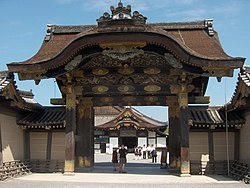
Nijō Castle has two concentric rings of fortifications, each consisting of a wall and a wide moat. The outer wall has four gates, while the inner wall has two, one of them in ruins. Originally, there were only three gates on the outer wall, but the Minamimon ("South Gate") was built in 1915 for a visit from the emperor. Two corner turrets survive on the outer wall as well. In the southwest corner of the inner wall, there are foundations of a five-story keep, destroyed by a fire in 1750. The inner walls surround the Inner Ward, which contain Honmaru ("Inner Ward") Palace with its garden. Ninomaru ("Second Ward") Palace, the kitchens, guard house, three storehouses, and a number of gates and several gardens are located in the Outer Ward, between the two main rings of fortifications.
Nijō Castle
Nijō Castle (二条城, Nijō-jō) is a flatland castle in Kyoto, Japan. The castle consists of two concentric rings (Kuruwa) of fortifications, the Ninomaru Palace, the ruins of the Honmaru Palace, various support buildings and several gardens. The surface area of the castle is 275,000 square metres (27.5 ha; 68 acres), of which 8,000 square metres (86,000 sq ft) is occupied by buildings.
It is one of the seventeen Historic Monuments of Ancient Kyoto which have been designated by UNESCO as a World Heritage Site.
In 1601, Tokugawa Ieyasu, the founder of the Tokugawa shogunate, ordered all the feudal lords in western Japan to contribute to the construction of Nijō Castle, which was completed during the reign of his grandson Tokugawa Iemitsu in 1626. While the castle was being built, a portion of land from the partially abandoned Shinsenen Garden (originally part of the imperial palace and located south) was absorbed, and its abundant water was used in the castle gardens and ponds. Parts of Fushimi Castle, such as the main tower and the karamon, were moved here in 1625–26. Nijo Castle was built as the Kyoto residence of the Tokugawa shōguns. The Tokugawa shogunate used Edo as the capital city, but Kyoto continued to be the home of the Imperial Court. Kyoto Imperial Palace is located north-east of Nijō Castle.
The central keep, or tenshu, was struck by lightning and burned to the ground in 1750. In 1788, the Inner Ward was destroyed by a citywide fire. The site remained empty until it was replaced by a prince's residence transferred from the Kyoto Imperial Palace in 1893.
In 1867, the Ninomaru Palace, in the Outer Ward, was the stage for the declaration by Tokugawa Yoshinobu, returning the authority to the Imperial Court (大政奉還). In 1868 the Imperial Cabinet was installed in the castle. The palace became imperial property and was declared a detached palace. During this time, the Tokugawa hollyhock crest was removed wherever possible and replaced with the imperial chrysanthemum.
In 1939, the palace was donated to the city of Kyoto and opened to the public the following year. In the 21st century, typhoons have periodically caused sections of plaster to peel off the walls after exposure to rain and wind.
It is generally believed that the karamon gate of Toyokuni shrine was originally built for Hideyoshi's Fushimi castle in 1598. When the castle was dismantled in 1623, the gate was first moved to Nijō castle, and then to the Konchi-in in Nanzen-ji. It was finally relocated to Toyokuni shrine in 1876 after the Meiji Restoration.
Nijō Castle has two concentric rings of fortifications, each consisting of a wall and a wide moat. The outer wall has four gates, while the inner wall has two, one of them in ruins. Originally, there were only three gates on the outer wall, but the Minamimon ("South Gate") was built in 1915 for a visit from the emperor. Two corner turrets survive on the outer wall as well. In the southwest corner of the inner wall, there are foundations of a five-story keep, destroyed by a fire in 1750. The inner walls surround the Inner Ward, which contain Honmaru ("Inner Ward") Palace with its garden. Ninomaru ("Second Ward") Palace, the kitchens, guard house, three storehouses, and a number of gates and several gardens are located in the Outer Ward, between the two main rings of fortifications.
Recent media
Recent media