Hubbry Logo
AlceaAlceaMain
Open search
Alcea
Community hub
Alcea
logo
8 pages, 0 posts
0 subscribers
Be the first to start a discussion here.
Contribute something
Alcea
Alcea
from Wikipedia

Alcea
Alcea setosa
Scientific classification Edit this classification
Kingdom: Plantae
Clade: Tracheophytes
Clade: Angiosperms
Clade: Eudicots
Clade: Rosids
Order: Malvales
Family: Malvaceae
Subfamily: Malvoideae
Tribe: Malveae
Genus: Alcea
L.
Species

See text

Alcea is a genus of over 80 species of flowering plants in the mallow family Malvaceae, commonly known as the hollyhocks.[1] They are native to Asia and Europe.[1] The single species of hollyhock from the Americas, the streambank wild hollyhock, belongs to a different genus.

Description

[edit]

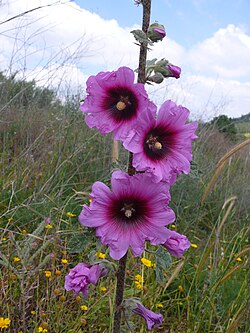
Hollyhocks are annual, biennial, or perennial plants usually taking an erect, unbranched form. The herbage usually has a coating of star-shaped hairs. The leaf blades are often lobed or toothed, and are borne on long petioles. The flowers may be solitary or arranged in fascicles or racemes. The notched petals are usually over three centimeters wide and may be pink, white, purple, or yellow. The fruit is a schizocarp, a dry disc divided into over 15 sections that contain seeds.[1]

Species

[edit]

The following species are accepted:[2]

Uses

[edit]

Hollyhocks are popular garden ornamental plants. They are easily grown from seed. Breeds with red flowers attract hummingbirds and butterflies. Cultivars have been bred, especially from A. rosea. They include the double-flowered 'Chater's Double', the raspberry-colored 'Creme de Cassis', and 'The Watchman', which has dark, nearly black, maroon flowers.[3]

The stems of hollyhocks can be used as firewood, and the roots have been used medicinally.[1][4]

Pests and diseases

[edit]
Rhopalapion longirostre
Hollyhock weevil (Rhopalapion longirostre)

Alcea species are used as food plants by the larvae of some Lepidoptera species including Bucculatrix quadrigemina and Vanessa cardui, the painted lady.

The mallow flea beetle (Podagrica fuscicornis) is a pest that makes tiny holes in the leaves. Cutworms, aphids, and capsid bugs use the plant as a food source in hotter and drier conditions.[5] A number of weevils use A. rosea as their host plant, including Rhopalapion longirostre, Alocentron curvirostre, and Aspidapion validum.[6]

The plants are also susceptible to the pathogenic fungus Puccinia malvacearum, the hollyhock rust.[7]

Culture

[edit]

The Aoi Matsuri (Hollyhock Festival) is one of the three main festivals of the city of Kyoto. During the Victorian era, the hollyhock symbolized both ambition and fecundity in the language of flowers.[8]

The UK National Collection of hollyhocks is held by Jonathan Sheppard in Lincolnshire.[9][10]

[edit]

References

[edit]
[edit]
Revisions and contributorsEdit on WikipediaRead on Wikipedia
from Grokipedia
Alcea is a of approximately 83 of herbaceous flowering in the mallow family , native to from eastern through the eastern to . These are typically annuals, biennials, or short-lived perennials with erect, usually simple stems that can reach heights of 1–3 meters, orbiculate to cordate leaves that are crenate-serrate and covered in stellate hairs, and showy rotate flowers in , , , , or yellow, featuring an exserted, five-angled staminal column and superior ovary. The is distinguished from related genera like Althaea by its two-chambered mericarps (with the upper chamber vestigial) and yellowish anthers. Widely introduced and naturalized in temperate regions worldwide, including North America, Alcea species thrive in full sun and well-drained soils, often in disturbed habitats, roadsides, or as garden ornamentals. The most prominent species, Alcea rosea (common hollyhock), is a biennial or short-lived perennial prized for its tall spikes of large, disk-shaped flowers that bloom from summer to fall, making it a staple in cottage gardens and historical landscaping since ancient times. Other notable species include Alcea rugosa, with deeply lobed leaves and pale yellow flowers, and Alcea ficifolia, known for fig-leaved foliage. While primarily cultivated for aesthetic value, some species have historical uses in traditional medicine for their mucilaginous properties, though they can be susceptible to rust diseases like Puccinia malvacearum.

Taxonomy

Etymology and nomenclature

The genus name Alcea derives from the word alkea (ἀλκεά), referring to a type of mallow plant valued for its healing properties in , a usage echoed in related genera like Althaea. This etymological root highlights the historical medicinal significance of mallow , where and leaves were employed as emollients and demulcents in ancient Greek and Roman . Alcea is classified within the family Juss., subfamily , and tribe Malveae, encompassing 83 accepted species according to current taxonomic assessments. The genus was first formally described by in his (1753), distinguishing it from the closely related Althaea L., though early classifications occasionally merged the two due to morphological similarities in their mallow-like flowers and fruits. Historical reflects this overlap, with species like the type L. previously treated under Althaea rosea (L.) Cav. in some 19th-century floras, before molecular and morphological revisions solidified Alcea as distinct. The type species, , serves as the nomenclatural type for the genus, originally described by Linnaeus from cultivated plants of uncertain wild origin in western .

Accepted species

The genus Alcea comprises 83 accepted species, as recognized in the World Checklist of Vascular Plants and detailed in (as of 2025), with the majority native to southwestern , particularly from and eastward to , and a few extending into southeastern and . These species exhibit diversity in pubescence, morphology, and floral traits, often adapted to dry, rocky habitats. Recent taxonomic studies, including morphological analyses of seeds and proteins, have refined species delimitations, particularly in where 18 taxa are now recognized, incorporating genetic and micromorphological data to resolve previously ambiguous boundaries. For a complete list of accepted species, see Plants of the World Online. Examples include: Alcea abchazica Iljin (endemic to the Caucasus, with densely tomentose leaves), Alcea acaulis (Cav.) Alef. (stemless habit, native to the eastern Mediterranean), Alcea afghanica I.Riedl (Afghanistan, pale flowers), Alcea angulata (Freyn) Freyn & Sint. ex Iljin (angular stems, Turkey), Alcea antoninae Iljin (Central Asia, compact growth), Alcea arnena Boiss. (Armenian endemic, small flowers), *Alcea armeniaca (Boiss.) Boiss. (Armenia, lobed leaves), *Alcea atlantica (Christ) Boiss. (North Africa, coastal distribution), *Alcea aucheri (Boiss.) Boiss. (Iran, yellow flowers), *Alcea balcanica (Iljin) Iljin (Balkans, rare), *Alcea boissieri (Kuntze) Boiss. (Turkey-Iran, pubescent), *Alcea calyculata Iljin (Central Asia, calyculate bracts), *Alcea capitata Cav. (Iberian Peninsula, capitate flowers), *Alcea cavanillesii (Grossh.) Iljin (Caucasus, named for explorer), *Alcea chingiana Y.T.Ma (China, recent addition), *Alcea cirsiumfolia Boiss. & Huet. (thistle-like leaves, Iran), *Alcea confusa Riedl (confusingly similar to congeners, Afghanistan), *Alcea cretica Willd. (Crete endemic, island-adapted), *Alcea cursorum Iljin (steppe species, Central Asia), *Alcea cypria Meikle (Cyprus, vulnerable island endemic), *Alcea dasycalyx (Fisch. & C.A.Mey.) Iljin (hairy calyx, Caucasus), *Alcea digitata (Trautv.) Iljin (digitately lobed leaves, Turkmenistan), *Alcea djuzgunensis Iljin (rare, Uzbekistan), *Alcea elbursensis Iljin (Elburz Mountains, Iran), *Alcea eremoprymnus Iljin (desert-adapted, Central Asia), *Alcea fargesii Franch. (China, high-altitude), *Alcea fedtschenkoana Iljin (Tajikistan, named for explorer), Alcea ficifolia L. (see below for details), *Alcea flavovirens (Boiss.) Boiss. (yellow-green flowers, Iran), *Alcea freynii (Heldr.) Boiss. (Turkey, named for botanist), *Alcea fujianensis (Chun & C.T.Wu) Y.T.Ma (Fujian, China), *Alcea gaganensis Iljin (Gagan region, rare), *Alcea gokchaica Iljin (Gokcha Lake area, Armenia), Alcea grossheimii Iljin (Caucasus, potentially vulnerable due to limited range), Alcea guestii Eig (Iraq-Turkey-Iran, critically endangered in Turkey per regional assessments), *Alcea heldreichii Boiss. (Greece, named for botanist), Alcea hohenackeri Boiss. (Iran, robust stems), Alcea iberica Stev. (Iberia-Caucasus, pale flowers), Alcea iljinii Riedl (named for taxonomist, Central Asia), Alcea jacquemontii (Decne.) Boiss. (Himalayan foothills, India-Pakistan), Alcea kelleri Iljin (Tajikistan, alpine), Alcea khirkitensis (Kusn.) Iljin (Khirkit, rare), Alcea koelzii I.Riedl (Pakistan, named for collector), Alcea kurdica Iljin (Kurdistan region, pubescent), Alcea lachnocephala Iljin (woolly-headed, Central Asia), Alcea lavateriflora (Poir.) Boiss. (lavatera-like flowers, Algeria), Alcea lenkoran Iljin (Lenkoran, Azerbaijan), Alcea litvinowii (Iljin) Iljin (named for botanist, Central Asia), Alcea longiloba (M.Bieb.) Stev. (long-lobed leaves, Caucasus), Alcea macrophylla Iljin (large leaves, Iran), Alcea mauritiana (Pomel) Boiss. (Mauritania, North African), Alcea michauxii (Boiss.) Boiss. (named for explorer, Iran), Alcea mogoltavica (Grossh.) Iljin (Mogoltau, Uzbekistan), Alcea moreana (Borbás) Soó (Morea, Greece), Alcea multiflora (Kuntze) Boiss. (multi-flowered, Turkey), Alcea muricella Iljin (muricate fruits, Central Asia), Alcea nudiflora (Lindl.) Boiss. (naked stems, Iran), Alcea olympica Boiss. (Olympus Mountains, Greece), Alcea ornata Iljin (ornate flowers, rare), Alcea pallasii (L.) L. (Pallas's, Caucasus), Alcea pallida (Willd.) Boiss. (pale flowers, Turkey), Alcea pamphylica Boiss. & Heldr. (Pamphylia, Turkey), Alcea pashkovae Iljin (named for collector, Caucasus), Alcea paulii Riedl (Iran, recent), Alcea persica Boiss. (Persia, Iran), Alcea pisidica Hub.-Mor. (Pisidia, Turkey), Alcea popovii Iljin (named for botanist, Central Asia), Alcea pterocarpa (Schrenk) Boiss. (winged fruits, Central Asia), Alcea pulchella (L.) Alef. (pretty, Mediterranean), Alcea rosea L. (see below), Alcea rufescens Boiss. (reddish, Iran), Alcea samarqandensis Iljin (Samarkand, Uzbekistan), Alcea sandrasea (Boiss.) Boiss. (Sandras Mountains, Turkey), Alcea savelitica Iljin (Savelli, rare), Alcea setosa Boiss. & Huet. (see below), Alcea sicyonica (Boiss.) Boiss. (Sicyon, Greece), Alcea sieversiana (L.) Kuntze (Sievers's, Central Asia), Alcea sojakii Riedl (named for botanist, Turkey), Alcea sosnovskyi Iljin (named for explorer, Caucasus), Alcea stanjarovii Iljin (Stanjarov, rare), Alcea striata (DC.) Alef. (striped stems, Middle East), Alcea suworowii (Regel) Iljin (Suworov's, Central Asia), Alcea tabrisiana Boiss. & Buhse (Tabriz, Iran), Alcea taurica (L.) Alef. (Tauric, Crimea), Alcea tenuiloba (M.Bieb.) Stev. (slender lobes, Caucasus), Alcea tholozanii Stapf (Tholozan, Iran), Alcea tortuosisepala Iljin (twisted sepals, Central Asia), Alcea transcaucasica Iljin (Transcaucasia), Alcea turkestana Iljin (Turkestan), Alcea turkmenorum Iljin (Turkmenistan endemic), Alcea undulata (Boiss.) Boiss. (wavy leaves, Iran), Alcea urmiensis Iljin (Urmia, Iran), Alcea uzbekistanica Iljin (Uzbekistan), Alcea vanensis Boiss. (Van, Turkey), Alcea vavilovii Iljin (named for geneticist, Central Asia), Alcea webbiana (Stapf) Iljin (Webb's, Iran), Alcea wilsonii (Hemsl.) J.T.Pan (Wilson's, China), Alcea xiphosantha Iljin (sword-like anthers, rare), Alcea zingirensis Iljin (Zingir, Turkey), and Alcea zopfi (C.A.Mey.) Boiss. (Zopf's, Caucasus). This inventory reflects updates from genetic and morphological revisions as of 2025, with no major genus-wide splits or mergers reported since 2012, though ongoing studies in Central Asia suggest potential refinements for endemics. Among these, Alcea rosea L., the common hollyhock, stands out as a cultigen likely originating from Turkey, now globally naturalized and cultivated for its erect stems up to 3 m tall bearing racemes of 8–10 cm diameter flowers in diverse colors (pink, red, white, yellow, or maroon), with rounded, crenate leaves; it lacks a true wild progenitor but is integral to horticulture. Alcea ficifolia L., the fig-leaved hollyhock, native to northern Iran, is distinguished by its large, palmate leaves resembling fig foliage and clusters of pale yellow to cream-colored flowers up to 5 cm wide on stems to 2 m, often grown for ornamental contrast. Alcea setosa Boiss. & Huet., endemic to the Caucasus (Georgia, Armenia, Azerbaijan), features densely bristly (setose) stems and leaves, pale pink to white flowers in lax panicles, and a preference for woodland edges, making it a regional specialty. Conservation assessments are limited, but some Central Asian and Middle Eastern endemics face risks; for instance, Alcea guestii Eig is classified as critically endangered in southeastern due to habitat loss and small populations, while Alcea cypria Meikle is vulnerable on from and , per regional IUCN-aligned evaluations. No global entries were identified for the genus as of 2025, though monitoring is recommended for narrow endemics like Alcea djuzgunensis and Alcea savelitica in .

Description

Growth habit and morphology

Alcea species exhibit a range of growth habits, including , biennial, and short-lived forms, typically manifesting as tall herbaceous that can reach heights of 1 to 3 meters at maturity. These often develop as erect forbs, with a basal rosette of leaves in the first year for biennials and short-lived perennials, followed by an elongated flowering stem in the subsequent season or year. The stems of Alcea are characteristically erect, stout, and herbaceous, usually unbranched or sparingly branched, arising directly from a and often ribbed longitudinally. They are covered in stellate pubescence—star-shaped hairs that impart a rough texture—though this may diminish with age in some species, leading to a more glabrous appearance. This pubescence, sometimes intermixed with longer simple hairs, contributes to the plant's overall morphology and adaptation to environmental stresses. Leaves in the are alternate along the stem, petiolate, and palmately (3–)5–7(–9)-lobed or unlobed, with blades that are rounded to heart-shaped (cordate or ovate), measuring 7 to 20 cm in length and featuring toothed or lobed margins and palmate venation. The lower leaves tend to be larger and more shallowly lobed, while those higher on the stem are progressively smaller and more deeply divided. Like the stems, the leaves bear stellate hairs, enhancing their coarse texture. The root system of Alcea is taprooted, with a deep and sturdy primary root that anchors the plant and facilitates access to deeper , thereby conferring moderate once the plant is established. This morphological feature supports the genus's resilience in varied conditions, though young plants require consistent moisture for establishment.

Flowers, fruits, and reproduction

The inflorescences of Alcea species are typically tall, terminal racemes or spike-like structures, often unbranched and bearing numerous flowers along the stem, with axillary fascicles of 1–5 flowers contributing to a total of 10 or more blooms per main stem. These arrangements emerge from the upper portions of the erect stems, creating elongated clusters that enhance visibility to pollinators. Flowers of Alcea are actinomorphic and measure 3–10 cm in diameter, featuring five distinct petals that are obovate to rounded, often notched at the apex, and range in color from white and yellow to , , and or maroon shades. Beneath the petals lie five sepals, fused at the base into a cup-like calyx, accompanied by 6–9 sepal-like bractlets (epicalyx). The reproductive organs include numerous stamens, with filaments united into a central column surrounding the style—a characteristic feature of the family—while the is superior and multi-carpellate. Pollination in Alcea is primarily entomophilous, facilitated by bees, hummingbirds, and butterflies that access nectar and pollen from the open flowers, though self-pollination is possible. Following fertilization, the ovary develops into a schizocarpic fruit, a flattened, disc-shaped structure approximately 1–2 cm in diameter that dehisces at maturity into 15 or more indehiscent mericarps arranged in a ring. The mericarps are two-chambered, with the proximal chamber containing the seed and the distal chamber vestigial. Each mericarp encloses 1 reniform, brown seed, which are dispersed primarily by gravity as the mericarps detach and fall near the parent plant, though wind may aid in occasional longer-distance transport; seeds maintain viability for 1–2 years under suitable storage conditions, germinating readily after cold stratification.

Distribution and ecology

Native range and habitats

The genus Alcea comprises 83 accepted species native to Eurasia from eastern central Europe through the eastern Mediterranean to central Asia, with the highest diversity concentrated in southwestern Asia, including countries such as , , , , , and , as well as extending into southeastern Europe (e.g., , , and ). These plants primarily inhabit the , though some species extend into subtropical zones. In their native settings, Alcea species favor sunny, well-drained locations such as rocky slopes, roadsides, field margins, fallow ground, and disturbed areas, often at elevations from to 1200 m. They also occur in grasslands, pastures, shrublands, and clearings within open woodlands, acting as pioneer plants that colonize open or disturbed sites in these ecosystems. The genus shows a preference for neutral to alkaline soils that are fertile and well-drained, reflecting the and loamy substrates common in their regions of origin. Alcea species are adapted to temperate climates with hot, dry summers and winters, demonstrating once established in summer-dry Mediterranean and central Asian environments. Their hardiness allows in areas equivalent to USDA zones 3-9, enabling persistence across varied seasonal extremes in their native range.

Introduced ranges and interactions

Alcea species originating from , particularly Alcea rosea, were introduced beyond their native Eurasian range starting in the through routes, reaching by the mid-1500s and subsequently spreading to other continents. The plant arrived in Britain around 1573, likely transported from via , where it quickly became a popular ornamental. By the mid-19th century, it had established in , as documented in early American gardening texts, and reached by 1899, often via horticultural imports. These introductions have led to widespread in temperate zones globally, where Alcea commonly escapes cultivation and persists in disturbed habitats like roadsides, dumps, and waste grounds. In , it is frequently naturalized but rarely forms dense stands; however, it is regarded as invasive in select areas of the , and occasionally in Australian regions where it acts as a "sleeper" . In introduced ecosystems, Alcea engages in notable interactions with , serving as a valuable source and attracting such as the painted lady (), which also uses it as a host plant for larvae. This can support local populations in urban or disturbed settings. Nonetheless, where is aggressive, Alcea may compete with native plants for light, water, and soil nutrients, potentially reducing in sensitive habitats. Alcea faces no significant global conservation threats as a , given its widespread cultivation and adaptability. However, recent assessments emphasize the need for continued monitoring of its invasiveness in novel regions, particularly through horticultural pathways, to prevent escalation in ecological impacts.

Cultivation

Propagation methods

Alcea , commonly known as hollyhocks, are primarily propagated by , which is the simplest and most common method for both wild and cultivated varieties. To start seeds indoors, sow them 8-10 weeks before the last expected in a filled with moist, peat-free , pressing the large seeds lightly into the surface and covering with a thin layer of or about 6 mm deep; no or pretreatment is required, and typically occurs in 10-14 days at temperatures between 65-75°F (18-24°C). Alternatively, direct sowing can be done in early fall in prepared garden beds, allowing natural cold stratification over winter for spring , which helps establish deep taproots before summer heat. For established perennial clumps, division is an effective way to propagate and rejuvenate plants, recommended every 1-3 years in early spring before new growth emerges to maintain vigor and prevent overcrowding. Carefully dig up the entire clump, trim back foliage to 10 cm, and use a sharp knife to separate into sections, ensuring each division has at least one and a portion of the ; replant immediately in well-prepared at the same depth, watering thoroughly to settle the roots. Basal stem cuttings provide another reliable propagation option, particularly in early spring when new shoots appear at the base of mature plants. Select healthy, non-flowering shoots about 10 cm long, sever them cleanly just below a node, remove lower leaves, and insert the cuttings 2-3 cm deep into a pot of moist, sterile or cuttings ; cover with a clear to maintain and place in a warm, bright location out of direct sun, where roots should form in 3-4 weeks as indicated by new top growth. Hybrid cultivars, such as the compact 'Queeny Purple' (), are often propagated true-to-type from collected from mature pods, though offspring may vary slightly from the parent due to cross-pollination; follow standard seed sowing protocols, but source from reputable breeders to maximize uniformity.

Growing conditions and care

Alcea species, commonly known as hollyhocks, thrive in sites with full sun exposure of at least six hours per day, though they tolerate . They prefer well-drained loamy soils rich in , with a range of 6.0 to 8.0, encompassing neutral to slightly alkaline conditions. For optimal growth and to promote air circulation, space 18 to 24 inches apart, particularly since dense planting can exacerbate disease issues. Watering should be moderate to maintain consistent , especially during dry periods, while ensuring good drainage to prevent ; once established, plants exhibit some . Applying a 2- to 3-inch layer of organic mulch around the base helps retain and suppress weeds. Fertilize in early spring with a balanced, slow-release product incorporated into the to support vigorous growth, avoiding excessive that could lead to leggy stems. Deadheading spent flowers by removing them at the base encourages prolonged blooming and prevents self-seeding if undesired, while pinching the early in the promotes bushier, more compact . Tall varieties, which can reach 6 to 8 feet, often require staking or support in windy locations to prevent toppling. As biennials or short-lived s, Alcea plants are hardy in USDA zones 3 to 9 and readily self-seed to ensure future generations. In colder climates within this range, apply a layer of over the root zone in late fall to protect against winter heaving and frost damage.

Uses and significance

Ornamental and horticultural uses

Alcea species, particularly , are prized in ornamental for their towering spikes of colorful flowers, which add vertical interest to compositions, often reaching heights of 5 to 8 feet. These plants excel as back-of-the-border accents, providing structure and scale in perennial beds, or as natural screens to soften fences and walls, creating a sense of without overwhelming smaller spaces. Their rigid stems and upward-facing blooms make them ideal for drawing the eye vertically, enhancing the depth of mixed plantings. In and English styles, hollyhocks contribute to an informal, nostalgic charm when grouped in odd numbers—such as threes or fives—for focal points along pathways or in massed displays. Dwarf cultivars like 'Majorette Mixed' offer versatility for compact , producing fully double flowers in shades of pink, red, yellow, and white on sturdy stems only 30 to 48 inches tall, allowing placement in containers or front borders without dominating the scene. Taller selections, such as 'Blacknight' from the Spotlight series, feature single, deep black-purple blooms with a yellow throat on 5- to 6-foot spikes, delivering bold contrast and long midsummer displays. Modern hybrids, such as those in the Spring Celebrities series (introduced around 2009), emphasize disease resistance to and other foliar issues, promoting healthier, more persistent growth in humid climates. These plants support biodiversity by attracting pollinators, with their open, nectar-rich flowers drawing bees, butterflies, and hummingbirds to enhance garden ecosystems. For companion planting, pairing hollyhocks with roses or delphiniums creates dynamic color contrasts—vibrant pinks and reds against softer blues or whites—while their heights complement the sprawling forms of these perennials in layered borders. Single- and double-flowered types alike thrive in such arrangements, briefly referencing the spectrum of hues from white to deep available across varieties.

Medicinal, historical, and other applications

Alcea species, particularly Alcea rosea, have been cultivated in ancient since at least the 5th century CE, where they were valued for their ornamental and practical qualities. The plant likely reached through the trade routes, with records indicating its presence in southwestern and eventual spread to Britain in the 16th century, with mentions by the 1570s. By the , A. rosea gained immense popularity in English cottage gardens, symbolizing the romantic, naturalistic aesthetic of the period and becoming a staple in informal, abundant plantings. In , roots and flowers of are prepared as teas to soothe coughs, respiratory irritation, and due to their high content, which forms a protective coating on mucous membranes. These mucilaginous compounds, including , contribute to the plant's emollient and properties, making it a common component in herbal remedies for throat and digestive issues across various cultures. Beyond medicine, the woody stems of serve as lightweight or kindling, providing quick-burning material suitable for starting fires. Historically, fibers extracted from the stems have been used to produce rough textiles, cordage, and , leveraging the plant's bast-like qualities in resource-scarce settings. Young leaves are in some cultures, consumed raw in salads or cooked as a mild pot , adding a subtle flavor to dishes without concerns. Culturally, holds symbolism in as a harbinger of and , often planted near cottage doorways to attract abundance and protect the home. In modern applications, its flowers, especially dark varieties like 'Nigra', are used in eco-dyeing to produce shades of purple, green, or gray on natural fibers such as and , offering a sustainable alternative to synthetic dyes through simple extraction processes.

Pests and diseases

Common insect pests

Alcea species, commonly known as hollyhocks, are susceptible to several insect pests that can damage foliage, stems, flowers, and seeds, potentially reducing plant vigor and ornamental value. These pests vary by region but commonly include weevils, beetles, aphids, and caterpillars, with damage often appearing as chewed leaves, distorted growth, or severed stems. The hollyhock weevil (Rhopalapion longirostre), a small gray to black about 3 mm long with a distinctive long , is one of the most prevalent pests affecting Alcea. Adults overwinter in protected sites near host plants, emerging in spring to feed on leaves, creating small notches along margins. Females lay eggs inside flower buds or developing seed pods, where white, legless larvae hatch and feed on the seeds or between sepals, often destroying the pod's contents entirely. The larvae pupate within the pod, and new adults emerge in late summer or fall to feed briefly before overwintering, completing one generation per year. Damage symptoms include reduced seed production from larval feeding inside seed pods. Adults feed on leaves, buds, and tender stems, potentially leading to weakened stalks, with peak activity from mid-spring to . Japanese beetles (Popillia japonica), metallic green approximately 1 cm long with copper-brown wing covers, also target Alcea foliage during their adult stage. These beetles have a one-year life cycle, with adults active from June to August, feeding in groups on the upper surfaces and consuming tissue between veins, resulting in skeletonized leaves that appear lacy or browned. Larvae develop in soil as grubs feeding on , but aboveground damage to hollyhocks peaks in , potentially defoliating plants if populations are high. Aphids, such as the green peach aphid (Myzus persicae), form colonies on tender buds, stems, and undersides, sucking sap and causing curled or distorted growth along with sticky honeydew excretion that promotes . These soft-bodied reproduce rapidly in warm weather, with females giving live birth to nymphs that mature in 7–10 days, leading to multiple generations per season. Damage is most noticeable on new shoots, weakening and potentially stunting flower development. Mallow flea beetles (species in the genus Podagrica or related Chrysomelidae) are small, shiny black or metallic jumping beetles that chew numerous tiny holes in leaves, creating a pinhole or shot-hole appearance, particularly on young foliage. Adults overwinter in or , becoming active in spring to feed and lay eggs on host plants in the family, with larvae developing in ; damage intensifies in early summer as beetles hop between plants. Cutworms, the larvae of various noctuid moths (e.g., Agrotis ipsilon), attack young Alcea seedlings and transplants at level, severing stems overnight and causing sudden wilting or collapse. These plump, gray to brown caterpillars are nocturnal, hiding in during the day, and complete their life cycle in 2–6 weeks with multiple generations possible in a season; damage is most severe in spring on newly emerged . Monitoring for these pests involves regular of leaves, stems, and buds, especially in evening hours when adults are active, to detect early signs like notching or clustering. Non-chemical controls include handpicking and Japanese beetles into soapy water, particularly at , and removing and destroying infested seed pods to break the weevil life cycle. For and beetles, applications of or can suppress populations by disrupting feeding and molting, while physical barriers like collars around bases prevent access. These methods emphasize sanitation and biological disruption over broad applications.

Fungal and other diseases

Hollyhock rust, caused by the fungus , is the most prevalent fungal disease affecting Alcea species, particularly A. rosea. It manifests as small, raised orange pustules containing spores on the undersides of leaves and stems, with corresponding yellow spots on the upper surfaces; severe infections lead to leaf yellowing, , and premature defoliation, weakening the and reducing flowering. The overwinters as teliospores on infected plant debris or basal leaves, with airborne urediniospores spreading the during the growing season in warm, humid conditions; it is autoecious, completing its lifecycle primarily on hosts like hollyhock, mallow, and lavatera, without requiring alternate hosts in many regions. Powdery mildew, primarily caused by Neoerysiphe galeopsidis (formerly Erysiphe spp.) or Leveillula taurica, appears as a white, powdery fungal growth on leaf surfaces, stems, and sometimes flowers, distorting new growth and causing chlorosis or premature leaf drop in moderate to severe cases. This disease thrives in warm, dry weather with high humidity at night, favoring crowded plantings with poor air circulation. Anthracnose, induced by Colletotrichum spp. such as C. malvarum, produces dark, sunken lesions with pinkish spore masses on leaves, stems, petioles, and flower parts, potentially girdling stems and causing dieback; it is most severe in wet, humid environments. In the 2020s, breeding efforts have focused on developing rust-resistant Alcea cultivars, including hybrids derived from A. ficifolia (figleaf hollyhock) and the 'Halo' series, which exhibit reduced susceptibility through genetic selection for tolerance to P. malvacearum. These advancements aim to mitigate the pathogen's impact in ornamental gardens, with varieties like 'Halo Red' and 'Queeny Purple' showing improved performance in field trials. Management of these diseases emphasizes cultural practices, such as spacing plants for adequate air circulation, removing and destroying infected debris at season's end to reduce overwintering inoculum, and avoiding overhead watering to minimize leaf wetness. Where necessary, preventive applications of fungicides like sulfur-based compounds, , or can suppress rust and anthracnose, applied at the first sign of symptoms and repeated according to label instructions; powdery mildew responds well to or fungicides. Integrated approaches combining resistant cultivars with have proven most effective for long-term control.

References

Add your contribution
Related Hubs
Contribute something
User Avatar
No comments yet.