



Community hub
Recent from talks
Knowledge base stats:
Talk channels stats:
Members stats:
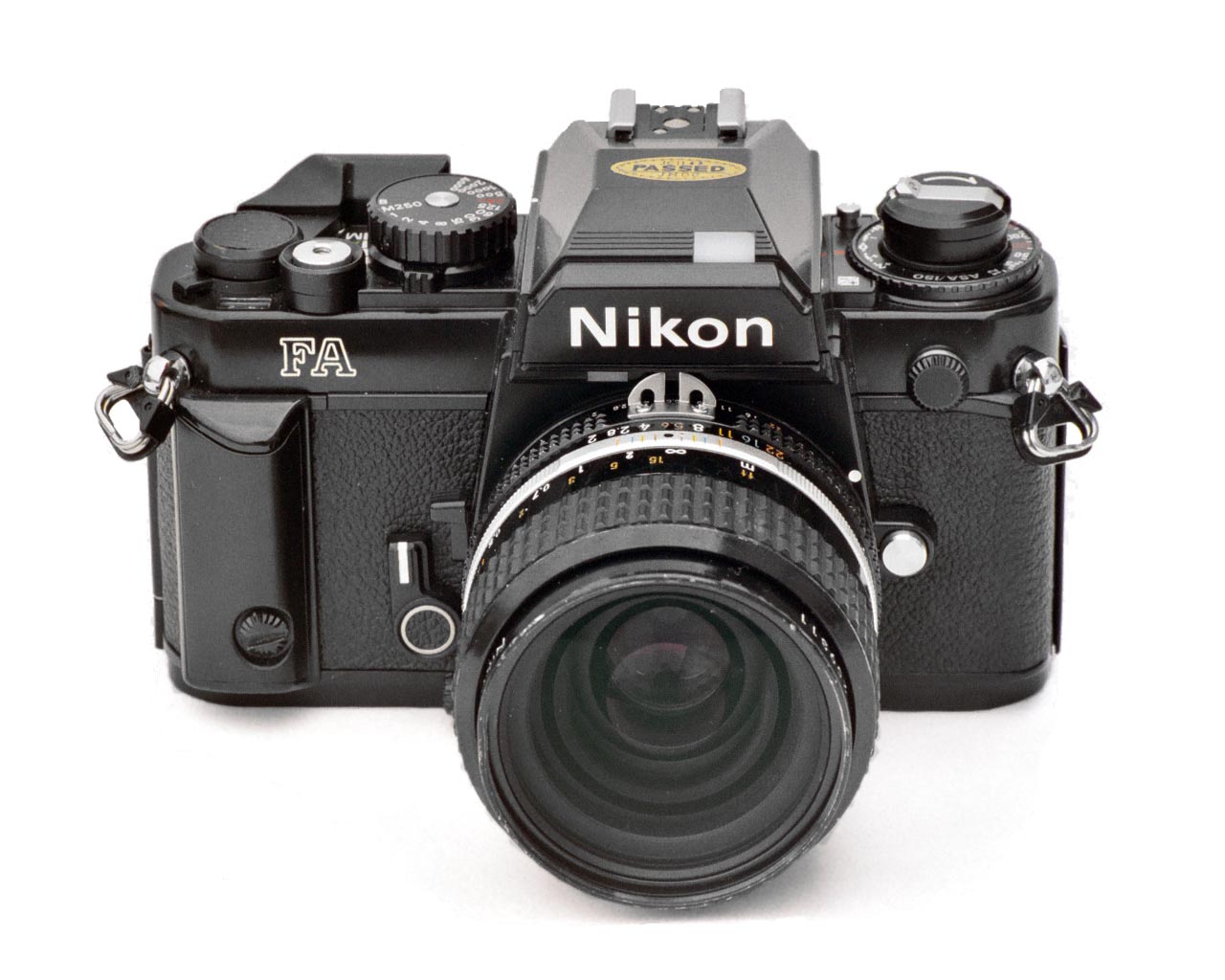
Nikon FA
The Nikon FA is an advanced amateur-level, interchangeable lens, 35 mm film, single-lens reflex (SLR) camera. It was manufactured by the Japanese optics company Nippon Kogaku K. K. (Nikon Corporation since 1988) in Japan from 1983 to 1987 (available new from dealer stock until circa 1989). The FA used a titanium-bladed, vertical-travel Nikon-designed, Copal-made focal plane shutter with a speed range of 1 to 1/4000th second plus Bulb and flash X-sync of 1/250th second. It was available in two colors: black with chrome trim and all black. The introductory US list price for the chrome body only (no lens) was $646. Note that SLRs usually sold for 30 to 40 percent below list price.
The FA was the most sophisticated member of the remarkably long-lived, classic Nikon compact F-series SLRs and was built upon a compact but rugged copper-aluminum alloy chassis developed from the ones used by the earlier Nikon FM (introduced in 1977), FE (1978), FM2 (1982) and FE2 (1983) cameras. The FM/FE series have only minor external controls and cosmetic differences, but the FA had a distinctly chunkier body and larger, boxier pentaprism cover to house its extra electronics. The limited-production Nikon FM3A of 2001 continued to use this body design until 2006.
The Nikon FA is a historically significant camera. It was the first camera to offer a multi-segmented (or matrix or evaluative) exposure light meter, called Automatic Multi-Pattern (AMP). It had a built-in microprocessor computer programmed to automatically analyze different segments of the light meter field of view and select a corrected exposure. Virtually all cameras today, whether film, video or digital, have some sort of matrix metering.
The Nikon FA was Nippon Kogaku's high-technology standard bearer, sandwiched between the sturdy, but basic Nikon FE2 and the professional-level Nikon F3 SLR (introduced in 1980). With its advanced AMP meter, Nippon Kogaku fully expected that many professional photographers, as well as amateurs, would buy it.
The FA accepted all lenses with the Nikon F bayonet mount (introduced in 1959) supporting the Automatic Indexing-Shutter (AI-S) feature (introduced in 1981). The contemporary Nippon Kogaku AI-S lenses were the Nikkor AI-S, and Nikon Series E types. The AF-S Nikkor, AF-I Nikkor, AF Nikkor D and AF Nikkor autofocus lenses are also AI-S types, which will work too but for manual focus only.
The FA could also use the older Nikkor AI (introduced in 1977) and AI'd Nikkor lenses, but in that case, the AMP meter and the shutter priority and High Speed program autoexposure modes would not work as well as AI-S lenses allowed (this is due to their non-linear aperture stop-down mechanisms).
Nikon's most recent 35 mm film SLR lenses are not fully compatible with the FA: the AF Nikkor G type (introduced in 2000) lacks an aperture control ring, and the AF Nikkor DX type (2003), with image circles sized for Nikon's digital SLRs, will mount, but will not function properly. IX Nikkor lenses (1996), for Nikon's Advanced Photo System (APS) film SLRs, must not be mounted, as their rear elements will intrude far enough into the mirror box to cause damage.
During the early 1980s, Nippon Kogaku manufactured approximately 70 manual focus Nikkor AI-S and Nikon Series E branded lenses. They ranged from a Fisheye-Nikkor 6 mm f/2.8 220˚ circular fisheye to a Reflex-Nikkor 2000 mm f/11 super telephoto. This was the largest and widest ranging lens selection in the world by far.
Hub AI
Nikon FA AI simulator
(@Nikon FA_simulator)
Nikon FA
The Nikon FA is an advanced amateur-level, interchangeable lens, 35 mm film, single-lens reflex (SLR) camera. It was manufactured by the Japanese optics company Nippon Kogaku K. K. (Nikon Corporation since 1988) in Japan from 1983 to 1987 (available new from dealer stock until circa 1989). The FA used a titanium-bladed, vertical-travel Nikon-designed, Copal-made focal plane shutter with a speed range of 1 to 1/4000th second plus Bulb and flash X-sync of 1/250th second. It was available in two colors: black with chrome trim and all black. The introductory US list price for the chrome body only (no lens) was $646. Note that SLRs usually sold for 30 to 40 percent below list price.
The FA was the most sophisticated member of the remarkably long-lived, classic Nikon compact F-series SLRs and was built upon a compact but rugged copper-aluminum alloy chassis developed from the ones used by the earlier Nikon FM (introduced in 1977), FE (1978), FM2 (1982) and FE2 (1983) cameras. The FM/FE series have only minor external controls and cosmetic differences, but the FA had a distinctly chunkier body and larger, boxier pentaprism cover to house its extra electronics. The limited-production Nikon FM3A of 2001 continued to use this body design until 2006.
The Nikon FA is a historically significant camera. It was the first camera to offer a multi-segmented (or matrix or evaluative) exposure light meter, called Automatic Multi-Pattern (AMP). It had a built-in microprocessor computer programmed to automatically analyze different segments of the light meter field of view and select a corrected exposure. Virtually all cameras today, whether film, video or digital, have some sort of matrix metering.
The Nikon FA was Nippon Kogaku's high-technology standard bearer, sandwiched between the sturdy, but basic Nikon FE2 and the professional-level Nikon F3 SLR (introduced in 1980). With its advanced AMP meter, Nippon Kogaku fully expected that many professional photographers, as well as amateurs, would buy it.
The FA accepted all lenses with the Nikon F bayonet mount (introduced in 1959) supporting the Automatic Indexing-Shutter (AI-S) feature (introduced in 1981). The contemporary Nippon Kogaku AI-S lenses were the Nikkor AI-S, and Nikon Series E types. The AF-S Nikkor, AF-I Nikkor, AF Nikkor D and AF Nikkor autofocus lenses are also AI-S types, which will work too but for manual focus only.
The FA could also use the older Nikkor AI (introduced in 1977) and AI'd Nikkor lenses, but in that case, the AMP meter and the shutter priority and High Speed program autoexposure modes would not work as well as AI-S lenses allowed (this is due to their non-linear aperture stop-down mechanisms).
Nikon's most recent 35 mm film SLR lenses are not fully compatible with the FA: the AF Nikkor G type (introduced in 2000) lacks an aperture control ring, and the AF Nikkor DX type (2003), with image circles sized for Nikon's digital SLRs, will mount, but will not function properly. IX Nikkor lenses (1996), for Nikon's Advanced Photo System (APS) film SLRs, must not be mounted, as their rear elements will intrude far enough into the mirror box to cause damage.
During the early 1980s, Nippon Kogaku manufactured approximately 70 manual focus Nikkor AI-S and Nikon Series E branded lenses. They ranged from a Fisheye-Nikkor 6 mm f/2.8 220˚ circular fisheye to a Reflex-Nikkor 2000 mm f/11 super telephoto. This was the largest and widest ranging lens selection in the world by far.