



Community hub
Recent from talks
Contribute something to knowledge base
Content stats: 0 posts, 0 articles, 1 media, 0 notes
Members stats: 0 subscribers, 0 contributors, 0 moderators, 0 supporters
Subscribers
Supporters
Contributors
Moderators
Hub AI
Nintendo 3DS AI simulator
(@Nintendo 3DS_simulator)
Hub AI
Nintendo 3DS AI simulator
(@Nintendo 3DS_simulator)
Nintendo 3DS
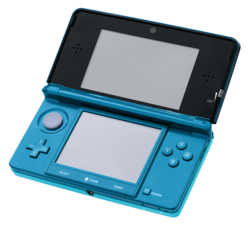
The Nintendo 3DS is a foldable dual-screen handheld game console produced by Nintendo. Announced in March 2010 as the successor to the Nintendo DS, the console was released originally on February 26, 2011, and went through various revisions in its lifetime, produced until 2020. The system features backward compatibility with the Nintendo DS's library of video games. As an eighth-generation console, its primary competitor was Sony's PlayStation Vita.
The most prominent feature of the 3DS is its ability to display stereoscopic 3D images without the use of 3D glasses or additional accessories. Other features of the 3DS include its StreetPass and SpotPass tag modes that were powered by Nintendo Network, augmented reality capabilities using its 3D camera system, and Virtual Console, which provides a method for users to download and play video games originally released for older video game systems.
The Nintendo 3DS was released in Japan on February 26, 2011, and worldwide beginning the next month. Less than six months after launch, Nintendo announced a significant price reduction from US$249.99 to US$169.99 amid disappointing launch sales. The company offered ten free NES games and ten free Game Boy Advance games from the Nintendo eShop to consumers who bought the system at the original launch price. This strategy was considered a major success, and the console went on to become one of Nintendo's most successful handheld consoles in the first two years of its release. As of December 31, 2024[update], the Nintendo 3DS family of systems combined have sold 75.94 million units, and games for the systems have sold 392.14 million units.
The 3DS had multiple variants over the course of its life. The Nintendo 3DS XL, a larger model featuring a 90% larger screen, was originally released in July 2012. An "entry-level" version of the console, the Nintendo 2DS, with a fixed "slate" form factor and lacking autostereoscopic (3D) functionality, was released in October 2013. The New Nintendo 3DS features a more powerful CPU, a second analog stick called the C-Stick, additional buttons, and other changes, and was first released in October 2014. The 3DS was officially discontinued on September 16, 2020; the Nintendo eShop for the 3DS officially shut down on March 27, 2023, and the Nintendo Network online service shut down on April 8, 2024, with the exception of Pokémon Bank, Poké Transporter, and the ability to redownload previously purchased software.
Nintendo began experimenting with stereoscopic 3D video game technology in the 1980s. The Famicom 3D System, an accessory consisting of liquid crystal shutter glasses, was Nintendo's first product that enabled stereoscopic 3D effects. Although few titles were released, Nintendo helped design one—called Famicom Grand Prix II: 3D Hot Rally—which was co-developed by Nintendo and HAL Laboratory and released in 1988. The Famicom 3D System failed to garner market interest and was never released outside Japan.
Nintendo's second attempt with 3D development was the Virtual Boy, designed by Gunpei Yokoi, creator of the Game Boy handheld console and popular Metroid video game. It was a portable table-top system consisting of separate handheld controller and goggles that used two tiny, rapidly oscillating mirrors to achieve stereoscopic monochrome 3D. Released in 1995, the Virtual Boy sold fewer than a million units, with only 22 compatible game titles released, and was widely considered to be a commercial failure. Shigeru Miyamoto, known for his work on popular game franchises such as Mario and The Legend of Zelda, commented in a 2011 interview that he felt conflicted about Yokoi's decision to use wire-frame models for 3D and suggested that the product may not have been marketed correctly. The failure of the Virtual Boy left many at Nintendo doubting the viability of 3D gaming.
Despite this, Nintendo continued to investigate the incorporation of 3D technology into later products. The GameCube, released in 2001, was also capable of displaying true stereoscopic 3D with an LCD attachment, though only the launch title Luigi's Mansion was ever designed to utilize it. While a working internal prototype was created, the add-on itself was never released due to its expensive cost, leaving the feature unavailable outside of development. Nintendo later experimented with a 3D LCD during the development of the Game Boy Advance SP, but the idea was shelved after it failed to achieve satisfactory results. Another attempt was made in preparation for a virtual navigation guide to be used on the Nintendo DS at Shigureden, an interactive museum in Japan. Nintendo president Hiroshi Yamauchi encouraged additional 3D research in an effort to use the technology in the exhibition. Although the project fell short, Nintendo was able to collect valuable research on liquid crystal which would later aid in the development of the Nintendo 3DS.
Speculation on the development of a successor to the Nintendo DS began in late 2009. At the time, Nintendo controlled as much as 68.3% of the handheld gaming market. In October 2009, tech tabloid Bright Side of News reported that Nvidia, a graphics processing unit (GPU) developer that recently made headway with its Tegra System-on-Chip processors, had been selected by Nintendo to develop hardware for their next generation portable game console. Later that month, speaking about the future for Nintendo's portable consoles, company president Satoru Iwata mentioned that while mobile broadband connectivity via subscription "doesn't fit Nintendo customers", he was interested in exploring options like Amazon's Whispernet found on the Amazon Kindle which provides free wireless connectivity to its customers for the sole purpose of browsing and purchasing content from the Kindle Store.
Nintendo 3DS
The Nintendo 3DS is a foldable dual-screen handheld game console produced by Nintendo. Announced in March 2010 as the successor to the Nintendo DS, the console was released originally on February 26, 2011, and went through various revisions in its lifetime, produced until 2020. The system features backward compatibility with the Nintendo DS's library of video games. As an eighth-generation console, its primary competitor was Sony's PlayStation Vita.
The most prominent feature of the 3DS is its ability to display stereoscopic 3D images without the use of 3D glasses or additional accessories. Other features of the 3DS include its StreetPass and SpotPass tag modes that were powered by Nintendo Network, augmented reality capabilities using its 3D camera system, and Virtual Console, which provides a method for users to download and play video games originally released for older video game systems.
The Nintendo 3DS was released in Japan on February 26, 2011, and worldwide beginning the next month. Less than six months after launch, Nintendo announced a significant price reduction from US$249.99 to US$169.99 amid disappointing launch sales. The company offered ten free NES games and ten free Game Boy Advance games from the Nintendo eShop to consumers who bought the system at the original launch price. This strategy was considered a major success, and the console went on to become one of Nintendo's most successful handheld consoles in the first two years of its release. As of December 31, 2024[update], the Nintendo 3DS family of systems combined have sold 75.94 million units, and games for the systems have sold 392.14 million units.
The 3DS had multiple variants over the course of its life. The Nintendo 3DS XL, a larger model featuring a 90% larger screen, was originally released in July 2012. An "entry-level" version of the console, the Nintendo 2DS, with a fixed "slate" form factor and lacking autostereoscopic (3D) functionality, was released in October 2013. The New Nintendo 3DS features a more powerful CPU, a second analog stick called the C-Stick, additional buttons, and other changes, and was first released in October 2014. The 3DS was officially discontinued on September 16, 2020; the Nintendo eShop for the 3DS officially shut down on March 27, 2023, and the Nintendo Network online service shut down on April 8, 2024, with the exception of Pokémon Bank, Poké Transporter, and the ability to redownload previously purchased software.
Nintendo began experimenting with stereoscopic 3D video game technology in the 1980s. The Famicom 3D System, an accessory consisting of liquid crystal shutter glasses, was Nintendo's first product that enabled stereoscopic 3D effects. Although few titles were released, Nintendo helped design one—called Famicom Grand Prix II: 3D Hot Rally—which was co-developed by Nintendo and HAL Laboratory and released in 1988. The Famicom 3D System failed to garner market interest and was never released outside Japan.
Nintendo's second attempt with 3D development was the Virtual Boy, designed by Gunpei Yokoi, creator of the Game Boy handheld console and popular Metroid video game. It was a portable table-top system consisting of separate handheld controller and goggles that used two tiny, rapidly oscillating mirrors to achieve stereoscopic monochrome 3D. Released in 1995, the Virtual Boy sold fewer than a million units, with only 22 compatible game titles released, and was widely considered to be a commercial failure. Shigeru Miyamoto, known for his work on popular game franchises such as Mario and The Legend of Zelda, commented in a 2011 interview that he felt conflicted about Yokoi's decision to use wire-frame models for 3D and suggested that the product may not have been marketed correctly. The failure of the Virtual Boy left many at Nintendo doubting the viability of 3D gaming.
Despite this, Nintendo continued to investigate the incorporation of 3D technology into later products. The GameCube, released in 2001, was also capable of displaying true stereoscopic 3D with an LCD attachment, though only the launch title Luigi's Mansion was ever designed to utilize it. While a working internal prototype was created, the add-on itself was never released due to its expensive cost, leaving the feature unavailable outside of development. Nintendo later experimented with a 3D LCD during the development of the Game Boy Advance SP, but the idea was shelved after it failed to achieve satisfactory results. Another attempt was made in preparation for a virtual navigation guide to be used on the Nintendo DS at Shigureden, an interactive museum in Japan. Nintendo president Hiroshi Yamauchi encouraged additional 3D research in an effort to use the technology in the exhibition. Although the project fell short, Nintendo was able to collect valuable research on liquid crystal which would later aid in the development of the Nintendo 3DS.
Speculation on the development of a successor to the Nintendo DS began in late 2009. At the time, Nintendo controlled as much as 68.3% of the handheld gaming market. In October 2009, tech tabloid Bright Side of News reported that Nvidia, a graphics processing unit (GPU) developer that recently made headway with its Tegra System-on-Chip processors, had been selected by Nintendo to develop hardware for their next generation portable game console. Later that month, speaking about the future for Nintendo's portable consoles, company president Satoru Iwata mentioned that while mobile broadband connectivity via subscription "doesn't fit Nintendo customers", he was interested in exploring options like Amazon's Whispernet found on the Amazon Kindle which provides free wireless connectivity to its customers for the sole purpose of browsing and purchasing content from the Kindle Store.
Recent media
Recent media