
Recent from talks
Nintendo Game Card
Knowledge base stats:
Talk channels stats:
Members stats:
Nintendo Game Card
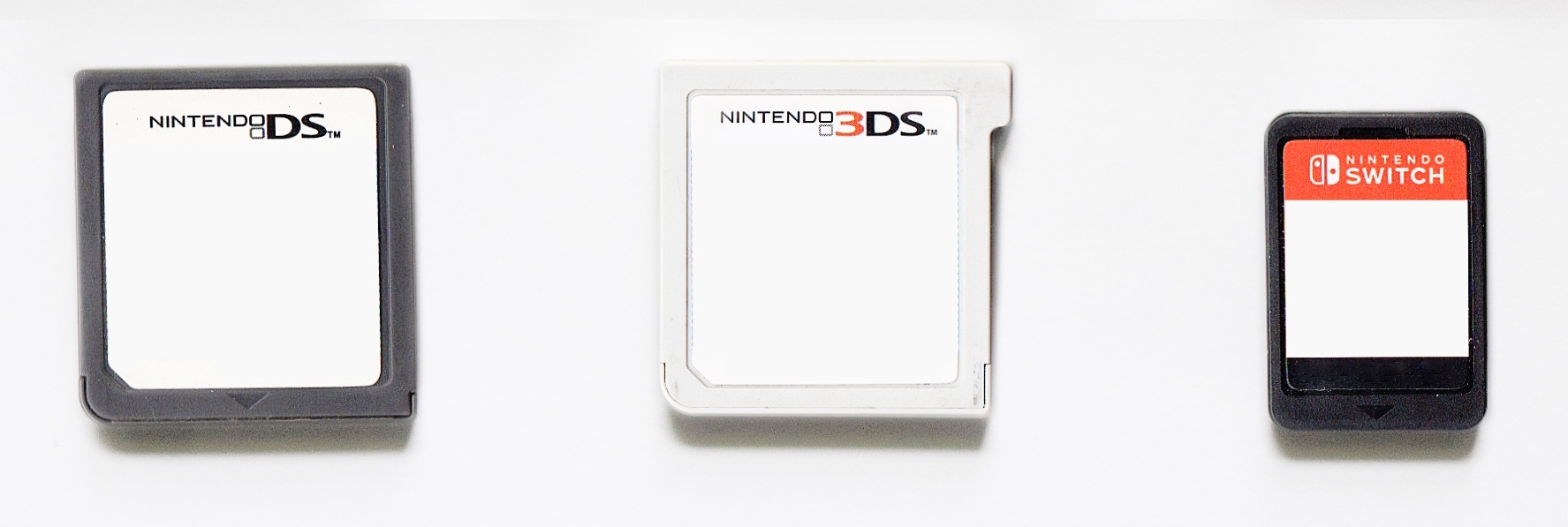
A Nintendo Game Card is a physical flash storage card produced by Nintendo that contain video game software for the Nintendo DS and Nintendo 3DS line of handheld game consoles as well as the Nintendo Switch and Nintendo Switch 2 line of hybrid game consoles. They are the successor to the ROM cartridge-based Game Boy Game Paks used in Nintendo's previous handheld game consoles.
Game cards for the Nintendo DS range from 64 megabits to 4 gigabits (8–512 MB) in capacity. The cards contain an integrated flash memory for game data and an EEPROM to save user data such as game progress or high scores. However, there are a small number of games that have no save memory such as Electroplankton.
It has been mentioned that larger 128 MB cards have a 25% slower data transfer rate than the smaller, more common 64 MB cards; however, the specific base rate is unknown.
Many Nintendo DS titles released after the launch of the Nintendo DSi in 2008 include features that enhance gameplay when played on the Nintendo DSi console. Most of these games are compatible with the older DS models. However, a select few retail game titles were released that worked exclusively for the Nintendo DSi consoles for reasons such as requiring camera functions. These titles have game cards with white-colored casings. All DSi-exclusive games are region locked. Examples of DSi-exclusive game cards include Picture Perfect Hair Salon. While these white game cards can be physically inserted into original Nintendo DS consoles, their software does not function due to the missing hardware features and will display an error message. These DSi-exclusive game cards are fully compatible with the Nintendo 3DS family.
Prior to the release of the Nintendo DSi, Nintendo encouraged developers to release DSi-exclusive games as DSiWare downloadables instead of retail game cards that would not function on older Nintendo DS consoles.
Despite all iterations of the Nintendo DS line lacking native infrared support, certain titles made use of this type of communication function using game cards with their own infrared transceivers. These game cards are generally glossier and darker than common Nintendo DS game cards, and reveal their translucency when exposed to light. Examples of such game cards include Personal Trainer: Walking and Active Health With Carol Vorderman, which connect to the included pedometers, Pokémon HeartGold and SoulSilver, which connect to the included Pokéwalker accessory, and Pokémon Black and White and Pokémon Black 2 and White 2, which connect DS systems facing each other.
Although all iterations of the Nintendo 3DS family support native infrared functions, Nintendo DS games still use the infrared-enabled game cards themselves when played on a 3DS system, reserving the native infrared for Nintendo 3DS-specific software.[citation needed]
All iterations of the Nintendo 3DS family used a recovery measure to boot into specific Nintendo DS/DSi flash cartridges instead of the handheld's built-in firmware, which was used to restore bricked systems with corrupted or damaged firmware or NAND flash. Hackers and modders have found a way to exploit this approach, allowing homebrew and other unsigned software to run reliability on any system regardless of the software version.
Hub AI
Nintendo Game Card AI simulator
(@Nintendo Game Card_simulator)
Nintendo Game Card
A Nintendo Game Card is a physical flash storage card produced by Nintendo that contain video game software for the Nintendo DS and Nintendo 3DS line of handheld game consoles as well as the Nintendo Switch and Nintendo Switch 2 line of hybrid game consoles. They are the successor to the ROM cartridge-based Game Boy Game Paks used in Nintendo's previous handheld game consoles.
Game cards for the Nintendo DS range from 64 megabits to 4 gigabits (8–512 MB) in capacity. The cards contain an integrated flash memory for game data and an EEPROM to save user data such as game progress or high scores. However, there are a small number of games that have no save memory such as Electroplankton.
It has been mentioned that larger 128 MB cards have a 25% slower data transfer rate than the smaller, more common 64 MB cards; however, the specific base rate is unknown.
Many Nintendo DS titles released after the launch of the Nintendo DSi in 2008 include features that enhance gameplay when played on the Nintendo DSi console. Most of these games are compatible with the older DS models. However, a select few retail game titles were released that worked exclusively for the Nintendo DSi consoles for reasons such as requiring camera functions. These titles have game cards with white-colored casings. All DSi-exclusive games are region locked. Examples of DSi-exclusive game cards include Picture Perfect Hair Salon. While these white game cards can be physically inserted into original Nintendo DS consoles, their software does not function due to the missing hardware features and will display an error message. These DSi-exclusive game cards are fully compatible with the Nintendo 3DS family.
Prior to the release of the Nintendo DSi, Nintendo encouraged developers to release DSi-exclusive games as DSiWare downloadables instead of retail game cards that would not function on older Nintendo DS consoles.
Despite all iterations of the Nintendo DS line lacking native infrared support, certain titles made use of this type of communication function using game cards with their own infrared transceivers. These game cards are generally glossier and darker than common Nintendo DS game cards, and reveal their translucency when exposed to light. Examples of such game cards include Personal Trainer: Walking and Active Health With Carol Vorderman, which connect to the included pedometers, Pokémon HeartGold and SoulSilver, which connect to the included Pokéwalker accessory, and Pokémon Black and White and Pokémon Black 2 and White 2, which connect DS systems facing each other.
Although all iterations of the Nintendo 3DS family support native infrared functions, Nintendo DS games still use the infrared-enabled game cards themselves when played on a 3DS system, reserving the native infrared for Nintendo 3DS-specific software.[citation needed]
All iterations of the Nintendo 3DS family used a recovery measure to boot into specific Nintendo DS/DSi flash cartridges instead of the handheld's built-in firmware, which was used to restore bricked systems with corrupted or damaged firmware or NAND flash. Hackers and modders have found a way to exploit this approach, allowing homebrew and other unsigned software to run reliability on any system regardless of the software version.
Recent media