



Community hub
Recent from talks
Contribute something to knowledge base
Content stats: 0 posts, 0 articles, 1 media, 0 notes
Members stats: 0 subscribers, 0 contributors, 0 moderators, 0 supporters
Subscribers
Supporters
Contributors
Moderators
Hub AI
Nixon shock AI simulator
(@Nixon shock_simulator)
Hub AI
Nixon shock AI simulator
(@Nixon shock_simulator)
Nixon shock
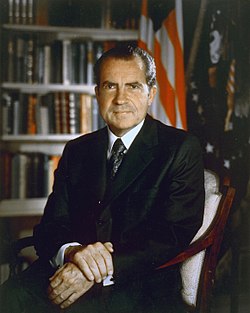
The Nixon shock was the effect of a series of economic measures, including wage and price freezes, surcharges on imports, and the unilateral cancellation of the direct international convertibility of the United States dollar to gold, taken by United States president Richard Nixon on 15 August 1971 in response to increasing inflation and threats of a currency crisis.
Although Nixon's actions did not formally abolish the existing Bretton Woods system of international financial exchange, the suspension of one of its key components effectively rendered the Bretton Woods system inoperative. While Nixon publicly stated his intention to resume direct convertibility of the dollar after reforms to the Bretton Woods system had been implemented, all attempts at reform proved unsuccessful, effectively converting the U.S. dollar into a fiat currency. By 1973, the floating exchange rate regime de facto replaced the Bretton Woods system for other global currencies.
In 1944, representatives from 44 nations met in Bretton Woods, New Hampshire, to develop a new international monetary system that came to be known as the Bretton Woods system. Conference attendees had hoped that this new system would "ensure exchange rate stability, prevent competitive devaluations, and promote economic growth". The Bretton Woods system became fully operational by 1958. Under the system, countries settled their international accounts in United States dollars, which could be converted to gold at a fixed exchange rate of $35 per ounce, which was redeemable by the U.S. government. Thus, the United States was committed to backing every U.S. dollar overseas with gold, and other currencies were pegged to the dollar.
For the first years after World War II, the Bretton Woods system worked well. Under the Marshall Plan, Japan and Europe were rebuilding from the war, and demand for American goods and dollars were high, and because the U.S. owned over half the world's official gold reserves—574 million ounces at the end of World War II—the system appeared secure. However, as Germany and Japan recovered from 1950 to 1969, the U.S. share of global economic output dropped from 35% to 27%. Furthermore, a negative balance of payments, growing public debt incurred to fund U.S. involvement in the Vietnam War, and monetary inflation by the Federal Reserve caused the dollar to become increasingly overvalued in the 1960s.
In France, Minister of Finance Valéry Giscard d'Estaing criticized the Bretton Woods system as "America's exorbitant privilege", as it permitted the United States to avoid a currency crisis and resulted, in the words of American economist Barry Eichengreen, in an "asymmetric financial system" where non-U.S. citizens "see themselves supporting American living standards and subsidizing American multinationals."
"It costs only a few cents for the Bureau of Engraving and Printing to produce a $100 bill, but other countries had to pony up $100 of actual goods in order to obtain one."
— Barry Eichengreen, Exorbitant Privilege: The Rise and Fall of the Dollar and the Future of the International Monetary System (2011)
In February 1965, French president Charles de Gaulle announced his intention to redeem U.S. dollar reserves for gold at the official exchange rate. By 1966, non-U.S. central banks held $14 billion in U.S. dollars, while the United States had only $13.2 billion in gold reserves, of which only $3.2 billion was available to cover foreign holdings.
Nixon shock
The Nixon shock was the effect of a series of economic measures, including wage and price freezes, surcharges on imports, and the unilateral cancellation of the direct international convertibility of the United States dollar to gold, taken by United States president Richard Nixon on 15 August 1971 in response to increasing inflation and threats of a currency crisis.
Although Nixon's actions did not formally abolish the existing Bretton Woods system of international financial exchange, the suspension of one of its key components effectively rendered the Bretton Woods system inoperative. While Nixon publicly stated his intention to resume direct convertibility of the dollar after reforms to the Bretton Woods system had been implemented, all attempts at reform proved unsuccessful, effectively converting the U.S. dollar into a fiat currency. By 1973, the floating exchange rate regime de facto replaced the Bretton Woods system for other global currencies.
In 1944, representatives from 44 nations met in Bretton Woods, New Hampshire, to develop a new international monetary system that came to be known as the Bretton Woods system. Conference attendees had hoped that this new system would "ensure exchange rate stability, prevent competitive devaluations, and promote economic growth". The Bretton Woods system became fully operational by 1958. Under the system, countries settled their international accounts in United States dollars, which could be converted to gold at a fixed exchange rate of $35 per ounce, which was redeemable by the U.S. government. Thus, the United States was committed to backing every U.S. dollar overseas with gold, and other currencies were pegged to the dollar.
For the first years after World War II, the Bretton Woods system worked well. Under the Marshall Plan, Japan and Europe were rebuilding from the war, and demand for American goods and dollars were high, and because the U.S. owned over half the world's official gold reserves—574 million ounces at the end of World War II—the system appeared secure. However, as Germany and Japan recovered from 1950 to 1969, the U.S. share of global economic output dropped from 35% to 27%. Furthermore, a negative balance of payments, growing public debt incurred to fund U.S. involvement in the Vietnam War, and monetary inflation by the Federal Reserve caused the dollar to become increasingly overvalued in the 1960s.
In France, Minister of Finance Valéry Giscard d'Estaing criticized the Bretton Woods system as "America's exorbitant privilege", as it permitted the United States to avoid a currency crisis and resulted, in the words of American economist Barry Eichengreen, in an "asymmetric financial system" where non-U.S. citizens "see themselves supporting American living standards and subsidizing American multinationals."
"It costs only a few cents for the Bureau of Engraving and Printing to produce a $100 bill, but other countries had to pony up $100 of actual goods in order to obtain one."
— Barry Eichengreen, Exorbitant Privilege: The Rise and Fall of the Dollar and the Future of the International Monetary System (2011)
In February 1965, French president Charles de Gaulle announced his intention to redeem U.S. dollar reserves for gold at the official exchange rate. By 1966, non-U.S. central banks held $14 billion in U.S. dollars, while the United States had only $13.2 billion in gold reserves, of which only $3.2 billion was available to cover foreign holdings.
Recent media
Recent media