



Community hub
Recent from talks
Knowledge base stats:
Talk channels stats:
Members stats:
No-mind
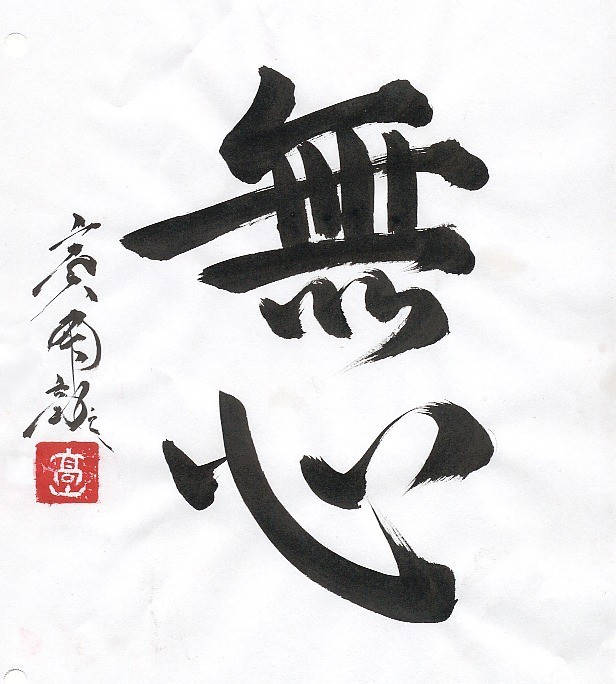
No-mind (Chinese: 無心, pinyin: wúxīn; Japanese: mushin; Sanskrit: acitta, acittika, acintya; nirvikalpa) is a mental state that is important in East Asian religions, Asian culture, and the arts. The idea is discussed in classic Chan/Zen Buddhist texts and has been described as "the experience of an instantaneous severing of thought that occurs in the course of a thoroughgoing pursuit of a Buddhist meditative exercise". It is not necessarily a total absence of thinking however, instead, it can refer to an absence of clinging, conceptual proliferation, or being stuck in thought. Chinese Buddhist texts also link this experience with Buddhist metaphysical concepts, like buddha-nature and Dharmakaya. The term is also found in Daoist literature, including the Zhuangzi.
This idea eventually influenced other aspects of Asian culture and the arts. Thus, the effortless state of "no mind" is one which is cultivated by artists, poets, craftsmen, performers, and trained martial artists, who may or may not be associated with Buddhism or Daoism. In this context, the term may have no religious connotations (or it may retain it, depending on the artist's own context), and is used to mean "the state at which a master is so at one with his art that his body naturally and spontaneously responds to all challenges without thought". This has been compared to the psychological concept of flow and "being in the zone".
The term 無心 contains the Chinese character for negation, "not" or "without" (無), along with the character for heart-mind (心). Likewise, in Sanskrit, the term is a compound of the prefix a- (for negation) and the word citta (mind, thought, consciousness, heart). In China, the term came to mean a state in which there was no mental activity, or a mind free of all discrimination and conceptualization, making it similar to the Buddhist Sanskrit term nisprapañca and the Sanskrit term nirvikalpa. Another similar Sanskrit term is amanasikāra (non-thinking, mental non-engagement), which is found in the works of the 11th century tantric yogi Maitripa.
Some scholars like D.T. Suzuki see the term wu-nien (無念, without thought, without recollection, with nien possibly rendering smṛti, "mindfulness") as being synonymous to wu-xin. Furthermore, while wunien is common in the texts of the Southern school of Zen, the texts of the Northern school prefer the term "freedom from thought" or "freedom from conceptualization" (離念). Some scholars also offer other Sanskrit terms as being the source of the Chinese term wunien, including: a-cintya, a-vikalpa or a-saṃjñā.
Regarding terms which negate "vikalpa" (conceptualization, discrimination, imagination), such as avikalpa and nirvikalpa, these are also widely used in Buddhist sources. The type of knowledge known as nirvikalpa-jñāna is an important term used in Mahayana Buddhist sources to refer to a transcendent type of knowledge. Furthermore, the term nirvikalpa is also sometimes applied to other concepts, such as Buddha nature. The Laṅkāvatāra Sūtra for example, states that the buddha-nature is nirvikalpa and nirbhāsa (without appearance). Other Mahayana sources use nirvikalpa as a description of the Buddha's Dharmakaya (Dharma-body).
Another related Sanskrit term is anupalabdhi / anupalambha (non-perception, non-apprehension) which is found in the Prajñaparamita sutras as a description of Prajñaparamita (the perfection of wisdom). For example, in the Diamond Sutra, the Buddha states: "there is nothing whatsoever for me to apprehend in unexcelled complete perfect enlightenment." The Aṣṭasāhasrikā prajñāpāramitā sutra even equates the two, stating: "the non-perception (anupalambha) of all principles (dharmas) is called the perfection of wisdom".
The term no-mind is also found in the Japanese phrase mushin no shin (無心の心), a Zen expression meaning the mind without mind. That is, a mind not fixed or occupied by thought or emotion and thus open to everything. It is translated by D.T. Suzuki as "being free from mind-attachment".
"Stopping thought," or "quieting the mind," is also a practice in Zen and other forms of meditation and yoga referring to the achievement of the mental state of samādhi, where the normal mental chatter slows and then stops for brief or longer periods. This may first occur during zazen and other meditation practices.
Hub AI
No-mind AI simulator
(@No-mind_simulator)
No-mind
No-mind (Chinese: 無心, pinyin: wúxīn; Japanese: mushin; Sanskrit: acitta, acittika, acintya; nirvikalpa) is a mental state that is important in East Asian religions, Asian culture, and the arts. The idea is discussed in classic Chan/Zen Buddhist texts and has been described as "the experience of an instantaneous severing of thought that occurs in the course of a thoroughgoing pursuit of a Buddhist meditative exercise". It is not necessarily a total absence of thinking however, instead, it can refer to an absence of clinging, conceptual proliferation, or being stuck in thought. Chinese Buddhist texts also link this experience with Buddhist metaphysical concepts, like buddha-nature and Dharmakaya. The term is also found in Daoist literature, including the Zhuangzi.
This idea eventually influenced other aspects of Asian culture and the arts. Thus, the effortless state of "no mind" is one which is cultivated by artists, poets, craftsmen, performers, and trained martial artists, who may or may not be associated with Buddhism or Daoism. In this context, the term may have no religious connotations (or it may retain it, depending on the artist's own context), and is used to mean "the state at which a master is so at one with his art that his body naturally and spontaneously responds to all challenges without thought". This has been compared to the psychological concept of flow and "being in the zone".
The term 無心 contains the Chinese character for negation, "not" or "without" (無), along with the character for heart-mind (心). Likewise, in Sanskrit, the term is a compound of the prefix a- (for negation) and the word citta (mind, thought, consciousness, heart). In China, the term came to mean a state in which there was no mental activity, or a mind free of all discrimination and conceptualization, making it similar to the Buddhist Sanskrit term nisprapañca and the Sanskrit term nirvikalpa. Another similar Sanskrit term is amanasikāra (non-thinking, mental non-engagement), which is found in the works of the 11th century tantric yogi Maitripa.
Some scholars like D.T. Suzuki see the term wu-nien (無念, without thought, without recollection, with nien possibly rendering smṛti, "mindfulness") as being synonymous to wu-xin. Furthermore, while wunien is common in the texts of the Southern school of Zen, the texts of the Northern school prefer the term "freedom from thought" or "freedom from conceptualization" (離念). Some scholars also offer other Sanskrit terms as being the source of the Chinese term wunien, including: a-cintya, a-vikalpa or a-saṃjñā.
Regarding terms which negate "vikalpa" (conceptualization, discrimination, imagination), such as avikalpa and nirvikalpa, these are also widely used in Buddhist sources. The type of knowledge known as nirvikalpa-jñāna is an important term used in Mahayana Buddhist sources to refer to a transcendent type of knowledge. Furthermore, the term nirvikalpa is also sometimes applied to other concepts, such as Buddha nature. The Laṅkāvatāra Sūtra for example, states that the buddha-nature is nirvikalpa and nirbhāsa (without appearance). Other Mahayana sources use nirvikalpa as a description of the Buddha's Dharmakaya (Dharma-body).
Another related Sanskrit term is anupalabdhi / anupalambha (non-perception, non-apprehension) which is found in the Prajñaparamita sutras as a description of Prajñaparamita (the perfection of wisdom). For example, in the Diamond Sutra, the Buddha states: "there is nothing whatsoever for me to apprehend in unexcelled complete perfect enlightenment." The Aṣṭasāhasrikā prajñāpāramitā sutra even equates the two, stating: "the non-perception (anupalambha) of all principles (dharmas) is called the perfection of wisdom".
The term no-mind is also found in the Japanese phrase mushin no shin (無心の心), a Zen expression meaning the mind without mind. That is, a mind not fixed or occupied by thought or emotion and thus open to everything. It is translated by D.T. Suzuki as "being free from mind-attachment".
"Stopping thought," or "quieting the mind," is also a practice in Zen and other forms of meditation and yoga referring to the achievement of the mental state of samādhi, where the normal mental chatter slows and then stops for brief or longer periods. This may first occur during zazen and other meditation practices.