



Community hub
Recent from talks
Knowledge base stats:
Talk channels stats:
Members stats:
No. 2 Squadron RAF
Number 2 Squadron, also known as No. II (Army Co-operation) Squadron, is the most senior squadron of the Royal Air Force. It is currently equipped with the Eurofighter Typhoon FGR4 at RAF Lossiemouth, Moray, since reforming there on 12 January 2015.
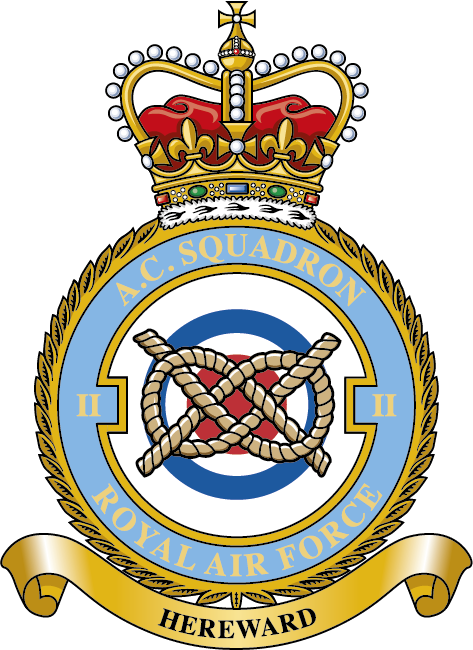
No. 2 Squadron's traditional army co-operation role is reflected in the "AC" of its title, its motto 'Hereward – Guardian of the Army', and the symbol of a wake knot on its crest. Its unofficial nickname is Shiny Two.
No. 2 Squadron was formed at Farnborough, Hampshire on 13 May 1912, on the founding of the Royal Flying Corps as one of the first three squadrons of the new force. It was formed from a detachment of No. 2 (Aeroplane) Company of the Royal Engineers Air Battalion. Both No. 2 Squadron and No. 3 Squadron were equipped with fixed wing aeroplanes, while No. 1 Squadron was equipped with airships. The Squadron's first commander was Major C J Burke. The Squadron was equipped with a mixture of aircraft types, including the prototype Royal Aircraft Factory B.E.2.
From 26 February 1913, the squadron was based at Montrose Air Station in Angus, Scotland, the first operational Royal Flying Corps base in the UK. This was established on the instructions of the First Lord of the Admiralty, Winston Churchill, to protect the Royal Navy. At Montrose the ghost story of Desmond Arthur spread around the flying corps. In May 1914, when the Squadron was transferring south from Montrose, five aircraft crashed when they hit a bank of fog just south of the River Tees. Six of the aircraft had to land, with five of them crash landing, resulting in many injuries and two deaths (a Lieutenant and a First Class Mechanic) in a field near Hutton Bonville in the North Riding of Yorkshire.
No. 2 Squadron was the first to fly the English Channel into France at the start of the First World War with H.D. Harvey-Kelly being the first pilot to land his aircraft. The squadron spent the war on reconnaissance duties in France flying, amongst other aircraft, the B.E.2.
Although its principal role was not air-to-air combat, it still had one flying ace among its ranks in Arthur William Hammond. It also numbered the first aviation Victoria Cross winners in its ranks, in Second Lieutenant Rhodes-Moorhouse and Lieutenant Alan Arnett McLeod.
The squadron gained the 'AC' in its title in the inter-war years, flying army co-operation (AC) sorties during the partition of Ireland in the early 1920s. After time in China during 1927, the squadron re-equipped with the Armstrong Whitworth Atlas again on army co-operation work.
At the outbreak of the Second World War the unit was flying Westland Lysanders. In France until the Dunkirk evacuation. It was then based at RAF Sawbridgeworth in Hertfordshire as the principal squadron in that location. Over time the squadron equipped with fighters – the Curtiss Tomahawk in 1941, the North American Mustang in 1942. In July 1944, assigned to the 2nd Tactical Air Force, the squadron returned to France in the reconnaissance role. It was re-equipped with Supermarine Spitfire Mk.XIVs in November 1944. Shiny Two relocated to RAF Celle in June 1945 after the war in Europe was won as part of the British Air Forces of Occupation.
Hub AI
No. 2 Squadron RAF AI simulator
(@No. 2 Squadron RAF_simulator)
No. 2 Squadron RAF
Number 2 Squadron, also known as No. II (Army Co-operation) Squadron, is the most senior squadron of the Royal Air Force. It is currently equipped with the Eurofighter Typhoon FGR4 at RAF Lossiemouth, Moray, since reforming there on 12 January 2015.
No. 2 Squadron's traditional army co-operation role is reflected in the "AC" of its title, its motto 'Hereward – Guardian of the Army', and the symbol of a wake knot on its crest. Its unofficial nickname is Shiny Two.
No. 2 Squadron was formed at Farnborough, Hampshire on 13 May 1912, on the founding of the Royal Flying Corps as one of the first three squadrons of the new force. It was formed from a detachment of No. 2 (Aeroplane) Company of the Royal Engineers Air Battalion. Both No. 2 Squadron and No. 3 Squadron were equipped with fixed wing aeroplanes, while No. 1 Squadron was equipped with airships. The Squadron's first commander was Major C J Burke. The Squadron was equipped with a mixture of aircraft types, including the prototype Royal Aircraft Factory B.E.2.
From 26 February 1913, the squadron was based at Montrose Air Station in Angus, Scotland, the first operational Royal Flying Corps base in the UK. This was established on the instructions of the First Lord of the Admiralty, Winston Churchill, to protect the Royal Navy. At Montrose the ghost story of Desmond Arthur spread around the flying corps. In May 1914, when the Squadron was transferring south from Montrose, five aircraft crashed when they hit a bank of fog just south of the River Tees. Six of the aircraft had to land, with five of them crash landing, resulting in many injuries and two deaths (a Lieutenant and a First Class Mechanic) in a field near Hutton Bonville in the North Riding of Yorkshire.
No. 2 Squadron was the first to fly the English Channel into France at the start of the First World War with H.D. Harvey-Kelly being the first pilot to land his aircraft. The squadron spent the war on reconnaissance duties in France flying, amongst other aircraft, the B.E.2.
Although its principal role was not air-to-air combat, it still had one flying ace among its ranks in Arthur William Hammond. It also numbered the first aviation Victoria Cross winners in its ranks, in Second Lieutenant Rhodes-Moorhouse and Lieutenant Alan Arnett McLeod.
The squadron gained the 'AC' in its title in the inter-war years, flying army co-operation (AC) sorties during the partition of Ireland in the early 1920s. After time in China during 1927, the squadron re-equipped with the Armstrong Whitworth Atlas again on army co-operation work.
At the outbreak of the Second World War the unit was flying Westland Lysanders. In France until the Dunkirk evacuation. It was then based at RAF Sawbridgeworth in Hertfordshire as the principal squadron in that location. Over time the squadron equipped with fighters – the Curtiss Tomahawk in 1941, the North American Mustang in 1942. In July 1944, assigned to the 2nd Tactical Air Force, the squadron returned to France in the reconnaissance role. It was re-equipped with Supermarine Spitfire Mk.XIVs in November 1944. Shiny Two relocated to RAF Celle in June 1945 after the war in Europe was won as part of the British Air Forces of Occupation.