
Recent from talks
No. 74 Squadron RAF
Knowledge base stats:
Talk channels stats:
Members stats:
No. 74 Squadron RAF
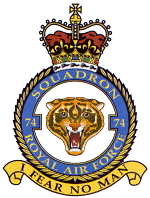
No. 74 Squadron, also known as 'Tiger Squadron' from its tiger-head motif, was a squadron of the Royal Air Force (RAF). It operated fighter aircraft from 1917 to the 1990s, and then trainer aircraft until its disbandment in 2000. It was the Royal Air Force's member of the NATO Tiger Association from 1961 until the squadron's disbandment, it has since been replaced by No. 230 Squadron.
Forming in 1917 as No. 74 (Training Depot) Squadron, the unit began life as a training squadron. Sent to the Western Front in 1918 as No. 74 (Fighter) Squadron, the unit quickly developed a fierce reputation during the First World War due to its pilots having an aggressive 'Tiger'-like spirit. With many aces amongst its ranks (such as Mick Mannock, Taffy Jones and Sydney Carlin), No. 74 (F) Squadron managed 225 victories in only seven months at the front. 'The Tigers' went on to serve during the Second World War, fighting in the Battle of Britain. After the war, it formed the first all-jet fighter wing with No. 616 and No. 504 Squadrons, flying the Gloster Meteor F.3. In 1960, they became the first unit in the RAF to operate the English Electric Lightning F.1. Between 1962 and 1963, No. 74 (F) Squadron operated an aerobatic display team called 'The Tigers' made up of nine Lightnings; it was the first display team in the world to fly aircraft capable of Mach 2.
From October 1984 onwards, 'The Tigers' operated from RAF Wattisham, Suffolk, flying the unique McDonnell Douglas F-4J(UK) Phantom. These were kept up until January 1991, when they were exchanged for the Spey–powered Phantom FGR.2s. Under the Options for Change defence review in 1990, it was decided to retire the remaining Phantom squadrons (No. 74 (F) Squadron and No. 56 (F) Squadron), with this coming to fruition by October 1992. 'The Tigers' spent their last eight years as No. 74 (Reserve) Squadron, operating the BAe Hawk T.1/T.1A from RAF Valley training future fighter pilots. No. 74 (R) Squadron disbanded for the last time on 22 September 2000.
No. 74 Squadron was first formed at Northolt on 1 July 1917, as No. 74 (Training Depot) Squadron of the Royal Flying Corps (RFC), before relocating to the aerodrome at London Colney nine days later. Beginning life as a training unit, the squadron initially flew the Avro 504Ks, among other types, before working-up to a fighter squadron. In February 1918, Mick Mannock became the senior flight commander of the squadron as it reached front-line status, becoming No. 74 (Fighter) Squadron.
On 20 March 1918, the squadron received its first operational fighters, the Royal Aircraft Factory S.E.5a. On 30 March, the squadron was sent over to the RFC headquarters in Saint-Omer, France. No. 74 (F) Squadron saw its first action on 12 April when it engaged in a dogfight near Merville against the German Luftstreitkräfte, with Mannock scoring 'the Tigers' first kill: an Albatros Scout. Within 70 days of being on the continent, No. 74 (F) Squadron had notched 100 enemy kills to just one loss. The squadron served in France from April until February 1919, when it returned home to RAF Lopcombe Corner, Hampshire, where it was disbanded on 3 July 1919.
During its 7-month-long wartime service, it was credited with 140 enemy planes destroyed and 85 driven down out of control, for 225 victories. Seventeen aces had served in the squadron, including Victoria Cross winner Major Edward 'Mick' Mannock, Ira 'Taffy' Jones, Benjamin Roxburgh-Smith, future Air Commodore Keith Caldwell, Andrew Kiddie, Frederick Stanley Gordon, Sydney Carlin, Frederick Hunt, Clive Glynn, George Hicks, Wilfred Ernest Young, Henry Dolan, Harris Clements, George Gauld, and Frederick Luff.[better source needed]
In response to the ongoing Abyssinia Crisis of 1935, the squadron was reformed in unusual circumstances on 3 September. The squadron was reborn out of the combination of detachments of Nos. 3, 23, 32, 56, 65, and 601 Squadrons, who were on board the troopship ship Neutralia, which was en-route to Malta. After arrival, No. 74 (F) Squadron operated Hawker Demon two-seater fighters. While it had been officially re-established, the squadron was prohibited from identifying its aircraft by squadron number until 14 November 1935 due to security reasons; until then, it was referred to as 'Demon Flights'.
In the following July, the squadron and its Demons, were shipped back to England, with the squadron arriving at RAF Hornchurch in September 1936. On 20 December 1936, Adolph Gysbert 'Sailor' Malan was posted to 'the Tigers'. In February 1937, after years of unofficial use, No. 74 (F) Squadron had its squadron badge design; a tiger's face, officially approved by King George VI. 'The Tigers' re-equipped with Gloster Gauntlets in April 1937, forming part of the newly created Fighter Command. The Gauntlets were kept up until February 1939, when the squadron began converting to the Supermarine Spitfire Mk.I.
Hub AI
No. 74 Squadron RAF AI simulator
(@No. 74 Squadron RAF_simulator)
No. 74 Squadron RAF
No. 74 Squadron, also known as 'Tiger Squadron' from its tiger-head motif, was a squadron of the Royal Air Force (RAF). It operated fighter aircraft from 1917 to the 1990s, and then trainer aircraft until its disbandment in 2000. It was the Royal Air Force's member of the NATO Tiger Association from 1961 until the squadron's disbandment, it has since been replaced by No. 230 Squadron.
Forming in 1917 as No. 74 (Training Depot) Squadron, the unit began life as a training squadron. Sent to the Western Front in 1918 as No. 74 (Fighter) Squadron, the unit quickly developed a fierce reputation during the First World War due to its pilots having an aggressive 'Tiger'-like spirit. With many aces amongst its ranks (such as Mick Mannock, Taffy Jones and Sydney Carlin), No. 74 (F) Squadron managed 225 victories in only seven months at the front. 'The Tigers' went on to serve during the Second World War, fighting in the Battle of Britain. After the war, it formed the first all-jet fighter wing with No. 616 and No. 504 Squadrons, flying the Gloster Meteor F.3. In 1960, they became the first unit in the RAF to operate the English Electric Lightning F.1. Between 1962 and 1963, No. 74 (F) Squadron operated an aerobatic display team called 'The Tigers' made up of nine Lightnings; it was the first display team in the world to fly aircraft capable of Mach 2.
From October 1984 onwards, 'The Tigers' operated from RAF Wattisham, Suffolk, flying the unique McDonnell Douglas F-4J(UK) Phantom. These were kept up until January 1991, when they were exchanged for the Spey–powered Phantom FGR.2s. Under the Options for Change defence review in 1990, it was decided to retire the remaining Phantom squadrons (No. 74 (F) Squadron and No. 56 (F) Squadron), with this coming to fruition by October 1992. 'The Tigers' spent their last eight years as No. 74 (Reserve) Squadron, operating the BAe Hawk T.1/T.1A from RAF Valley training future fighter pilots. No. 74 (R) Squadron disbanded for the last time on 22 September 2000.
No. 74 Squadron was first formed at Northolt on 1 July 1917, as No. 74 (Training Depot) Squadron of the Royal Flying Corps (RFC), before relocating to the aerodrome at London Colney nine days later. Beginning life as a training unit, the squadron initially flew the Avro 504Ks, among other types, before working-up to a fighter squadron. In February 1918, Mick Mannock became the senior flight commander of the squadron as it reached front-line status, becoming No. 74 (Fighter) Squadron.
On 20 March 1918, the squadron received its first operational fighters, the Royal Aircraft Factory S.E.5a. On 30 March, the squadron was sent over to the RFC headquarters in Saint-Omer, France. No. 74 (F) Squadron saw its first action on 12 April when it engaged in a dogfight near Merville against the German Luftstreitkräfte, with Mannock scoring 'the Tigers' first kill: an Albatros Scout. Within 70 days of being on the continent, No. 74 (F) Squadron had notched 100 enemy kills to just one loss. The squadron served in France from April until February 1919, when it returned home to RAF Lopcombe Corner, Hampshire, where it was disbanded on 3 July 1919.
During its 7-month-long wartime service, it was credited with 140 enemy planes destroyed and 85 driven down out of control, for 225 victories. Seventeen aces had served in the squadron, including Victoria Cross winner Major Edward 'Mick' Mannock, Ira 'Taffy' Jones, Benjamin Roxburgh-Smith, future Air Commodore Keith Caldwell, Andrew Kiddie, Frederick Stanley Gordon, Sydney Carlin, Frederick Hunt, Clive Glynn, George Hicks, Wilfred Ernest Young, Henry Dolan, Harris Clements, George Gauld, and Frederick Luff.[better source needed]
In response to the ongoing Abyssinia Crisis of 1935, the squadron was reformed in unusual circumstances on 3 September. The squadron was reborn out of the combination of detachments of Nos. 3, 23, 32, 56, 65, and 601 Squadrons, who were on board the troopship ship Neutralia, which was en-route to Malta. After arrival, No. 74 (F) Squadron operated Hawker Demon two-seater fighters. While it had been officially re-established, the squadron was prohibited from identifying its aircraft by squadron number until 14 November 1935 due to security reasons; until then, it was referred to as 'Demon Flights'.
In the following July, the squadron and its Demons, were shipped back to England, with the squadron arriving at RAF Hornchurch in September 1936. On 20 December 1936, Adolph Gysbert 'Sailor' Malan was posted to 'the Tigers'. In February 1937, after years of unofficial use, No. 74 (F) Squadron had its squadron badge design; a tiger's face, officially approved by King George VI. 'The Tigers' re-equipped with Gloster Gauntlets in April 1937, forming part of the newly created Fighter Command. The Gauntlets were kept up until February 1939, when the squadron began converting to the Supermarine Spitfire Mk.I.
Recent media