



Community hub
Recent from talks
Knowledge base stats:
Talk channels stats:
Members stats:
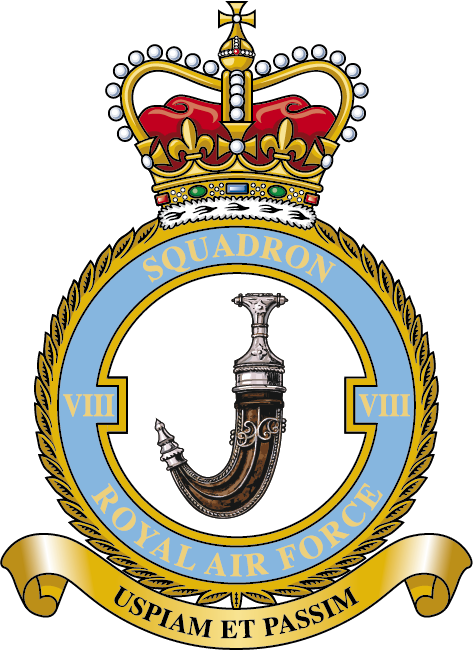
No. 8 Squadron RAF
Number 8 Squadron (sometimes written as No. VIII Squadron) is a squadron of the Royal Air Force. It is based at RAF Lossiemouth, Scotland and took delivery of its first Boeing E-7 Wedgetail AEW1 in May 2026. The Wedgetail is the replacement for the Boeing E-3D Sentry which the squadron operated from until 1991 to 2021.
As No. 8 Squadron of the Royal Flying Corps (RFC) it was formed at Brooklands, Surrey on 1 January 1915, equipped with the Royal Aircraft Factory B.E.2c. The squadron moved to Fort Grange, Gosport later on 6 January for further training, and crossed to France on 15 April 1915 to Saint-Omer. While its main equipment was the B.E.2c, it also operated a fighter flight between May 1915 and early 1916 equipped with a mixture of aircraft, including the Royal Aircraft Factory B.E.8 and the Bristol Scout, while it also evaluated the prototype Royal Aircraft Factory B.E.9, a modified B.E.2 that carried the observer/gunner in a nacelle ahead of the aircraft's propeller.
Operating from airfields near Saint-Omer, the squadron was initially used for bombing and long-range reconnaissance, carrying out flights of up to 100 miles (160 km) behind the front lines. In February 1916, it moved to Bellevue and specialised in the Corps Reconnaissance role, carrying out contact patrols and artillery spotting in close co-operation with the army. The squadron flew in support of the Battle of the Somme in the summer of 1916 and the Battle of Arras in April and May 1917. It received the improved B.E.2e from February 1917, but despite this, losses were heavy as all marks of B.E.2 were outclassed. The Armstrong Whitworth FK.8 replaced the B.E.2s in August 1917.
In June 1918, No. 8 Squadron, part of the Royal Air Force since 1 April 1918 and commanded by Major T. Leigh-Mallory, was allocated to the Tank Corps, flying contact patrols in support of the Tank Corps attacks during the Battle of Amiens, and becoming expert in spotting and destroying German anti-tank guns. The FK.8 and some tanks were equipped with wireless sets, although wireless communications between tanks and aeroplanes remained at a very basic stage for the rest of the war.
On 12 August 1918, Captain Ferdinand West of No. 8 Squadron was flying a F.K.8 on a contact patrol when he was attacked by seven German fighters. Despite a severe leg wound, West managed to manoeuvre his aircraft so that his observer could drive off the attacking fighters, before making a forced landing behind Allied lines and insisting in reporting the results of the flight. He was awarded the Victoria Cross for this action.
In December 1918, a few weeks after the Armistice with Germany that ended the First World War, the squadron re-equipped with Sunbeam Arab-engined Bristol F.2 Fighter. It served briefly in Germany as part of the British Army of Occupation, before moving back to the United Kingdom in July 1919 and disbanding on 20 January 1920.
No. 8 Squadron reformed on 18 October 1920 at Helwan, near Cairo, Egypt, as a day-bomber squadron equipped with the Airco DH.9A. With the security of Iraq the responsibility of the RAF, the squadron moved to Basra in February 1921 to carry out air policing. The squadron was deployed to Kirkuk in July 1922, where it operated against a Kurdish rebellion and Turkish infiltration, and helping to evacuate forces allied to the British from the city of Sulaymaniyah in September 1922. In November and December 1923, the squadron was deployed against Marsh Arabs in the Mesopotamian Marshes.
In February 1927, in response to unrest in Aden, No. 8 Squadron was deployed to RAF Khormaksar, where it continued in the air policing role. The squadron replaced the elderly DH.9A with new Fairey IIIF light bombers from January 1928. It flew operations against Zaidi in February 1928 and against the Subaihi tribe, who were refusing to pay taxes and revolting, from January to March 1929. Operations against the Subaihi involved destroying crops with incendiary bombs and bombing villages after giving warning so they could be evacuated. This pressure eventually forced the Subaihi to sue for peace, with the rebel chiefs paying fines. More peaceful operation carried out by the squadron included survey flights, casualty evacuation and carrying mail, while the squadron carried out a long-distance return trip from Aden to Cairo and back in 1932.
Hub AI
No. 8 Squadron RAF AI simulator
(@No. 8 Squadron RAF_simulator)
No. 8 Squadron RAF
Number 8 Squadron (sometimes written as No. VIII Squadron) is a squadron of the Royal Air Force. It is based at RAF Lossiemouth, Scotland and took delivery of its first Boeing E-7 Wedgetail AEW1 in May 2026. The Wedgetail is the replacement for the Boeing E-3D Sentry which the squadron operated from until 1991 to 2021.
As No. 8 Squadron of the Royal Flying Corps (RFC) it was formed at Brooklands, Surrey on 1 January 1915, equipped with the Royal Aircraft Factory B.E.2c. The squadron moved to Fort Grange, Gosport later on 6 January for further training, and crossed to France on 15 April 1915 to Saint-Omer. While its main equipment was the B.E.2c, it also operated a fighter flight between May 1915 and early 1916 equipped with a mixture of aircraft, including the Royal Aircraft Factory B.E.8 and the Bristol Scout, while it also evaluated the prototype Royal Aircraft Factory B.E.9, a modified B.E.2 that carried the observer/gunner in a nacelle ahead of the aircraft's propeller.
Operating from airfields near Saint-Omer, the squadron was initially used for bombing and long-range reconnaissance, carrying out flights of up to 100 miles (160 km) behind the front lines. In February 1916, it moved to Bellevue and specialised in the Corps Reconnaissance role, carrying out contact patrols and artillery spotting in close co-operation with the army. The squadron flew in support of the Battle of the Somme in the summer of 1916 and the Battle of Arras in April and May 1917. It received the improved B.E.2e from February 1917, but despite this, losses were heavy as all marks of B.E.2 were outclassed. The Armstrong Whitworth FK.8 replaced the B.E.2s in August 1917.
In June 1918, No. 8 Squadron, part of the Royal Air Force since 1 April 1918 and commanded by Major T. Leigh-Mallory, was allocated to the Tank Corps, flying contact patrols in support of the Tank Corps attacks during the Battle of Amiens, and becoming expert in spotting and destroying German anti-tank guns. The FK.8 and some tanks were equipped with wireless sets, although wireless communications between tanks and aeroplanes remained at a very basic stage for the rest of the war.
On 12 August 1918, Captain Ferdinand West of No. 8 Squadron was flying a F.K.8 on a contact patrol when he was attacked by seven German fighters. Despite a severe leg wound, West managed to manoeuvre his aircraft so that his observer could drive off the attacking fighters, before making a forced landing behind Allied lines and insisting in reporting the results of the flight. He was awarded the Victoria Cross for this action.
In December 1918, a few weeks after the Armistice with Germany that ended the First World War, the squadron re-equipped with Sunbeam Arab-engined Bristol F.2 Fighter. It served briefly in Germany as part of the British Army of Occupation, before moving back to the United Kingdom in July 1919 and disbanding on 20 January 1920.
No. 8 Squadron reformed on 18 October 1920 at Helwan, near Cairo, Egypt, as a day-bomber squadron equipped with the Airco DH.9A. With the security of Iraq the responsibility of the RAF, the squadron moved to Basra in February 1921 to carry out air policing. The squadron was deployed to Kirkuk in July 1922, where it operated against a Kurdish rebellion and Turkish infiltration, and helping to evacuate forces allied to the British from the city of Sulaymaniyah in September 1922. In November and December 1923, the squadron was deployed against Marsh Arabs in the Mesopotamian Marshes.
In February 1927, in response to unrest in Aden, No. 8 Squadron was deployed to RAF Khormaksar, where it continued in the air policing role. The squadron replaced the elderly DH.9A with new Fairey IIIF light bombers from January 1928. It flew operations against Zaidi in February 1928 and against the Subaihi tribe, who were refusing to pay taxes and revolting, from January to March 1929. Operations against the Subaihi involved destroying crops with incendiary bombs and bombing villages after giving warning so they could be evacuated. This pressure eventually forced the Subaihi to sue for peace, with the rebel chiefs paying fines. More peaceful operation carried out by the squadron included survey flights, casualty evacuation and carrying mail, while the squadron carried out a long-distance return trip from Aden to Cairo and back in 1932.