


Community hub
Recent from talks
Contribute something
Nothing was collected or created yet.
Basra
View on Wikipedia
Basra (Arabic: ٱلْبَصْرَة, romanized: al-Baṣrah) or Basrah is a port city in southern Iraq. It is the capital of the eponymous Basra Governorate, as well as the third largest city in Iraq overall, behind Baghdad and Mosul. Located near the Iran–Iraq border, the city is situated along the banks of the Shatt al-Arab that empties into the Persian Gulf. It is consistently one of the hottest cities in Iraq, with summer temperatures regularly exceeding 50 °C (122 °F).
Key Information


.jpg)


Built in 636 as a military camp, Basra played an important role as a regional hub of knowledge, trade and commerce during the Islamic Golden Age and is home to the first mosque built outside the Arabian Peninsula. It was a center of the slave trade in Mesopotamia, until the Zanj rebellion in 871. Historically, Basra is one of the ports from which the fictional Sinbad the Sailor embarked on his journeys. It has experienced numerous ruling shifts. In 1258, the city was sacked by the Mongols. Basra came under Portuguese control in 1526 and later fell under the control of the Ottomans as part of the Basra Eyalet, one of the provinces comprising Ottoman Iraq.[3][4] During World War I, British forces captured Basra in 1914. It was incorporated into Mandatory Iraq, under the framework Mandate for Mesopotamia after 1921, which later became the independent Kingdom of Iraq in 1932.
Since Iraq's independence, the wars Iraq has fought have made Basra an active battlefield due to its strategic location. During the Iran–Iraq War, the city was heavily shelled and besieged by Iranian forces. As a result of the war, half of the city's population fled. It suffered extensive damage again during the Gulf War due to coalition attacks. In 1991 and 1999, Basra was the site of two uprisings against Saddam Hussein. On April 6, 2003, the city was occupied by the United Kingdom and United States-led coalition, becoming the first city to be captured during the invasion of Iraq, enduring further devastation. During the war, it fell under the control of Shia factions such as Muqtada al-Sadr's Mahdi Army, who were later removed in 2008. Additionally, Basra was targeted by bombings in 2011 and 2012, and was impacted by the Islamist insurgency and the war with Islamic State from 2013 to 2017.
With its strategic location and abundant oil reserves, Basra has become one of the major industrial cities in the region. As the country’s only coastal region, along with its adjoining governorate, Basra serves as a crucial transport hub. After the Iraq war ended, Basra experienced a period of prosperity and development, with numerous reconstruction projects funded by foreign investments, including the Grand Faw Port, which have gained global attention. Today, the majority of its population consists of Arab Shia Muslims, with a large Sunni minority.
Etymology
[edit]
The city has had many names throughout history, Basrah being the most common. In Arabic, the word baṣrah means "the overwatcher", which may have been an allusion to the city's origin as an Arab military base against the Sassanids. Others have argued that the name is derived from the Aramaic word basratha, meaning "place of huts, settlement".[5]
History
[edit]
Foundation by the Rashidun Caliphate (636–661)
[edit]
The city was founded at the beginning of the Islamic era in 636 and began as a garrison encampment for Arab tribesmen constituting the armies of the Rashidun Caliph Umar.[6] The original site, which was a military site, is still marked by the Imam Ali Mosque about 15 kilometers SW of modern Basra.[7][8] While defeating the forces of the Sassanid Empire there, the Muslim commander Utbah ibn Ghazwan erected his camp on the site of an old Persian military settlement called Vaheštābād Ardašīr, which was destroyed by the Arabs.[9][10] While the name Al-Basrah in Arabic can mean "the overwatcher".[11]
In 639, Umar established this encampment as a city with five districts, and appointed Abu Musa al-Ash'ari as its first governor.[12][13] The city was built in a circular plan according to the Partho-Sasanian architecture.[14] Abu Musa led the conquest of Khuzestan from 639 to 642, and was ordered by Umar to aid Uthman ibn Abi al-As, then fighting Persia from a new, more easterly miṣr at Tawwaj.[15] In 650, the Rashidun Caliph Uthman reorganised the Persian frontier, installed ʿAbdullah ibn Amir as Basra's governor, and put the military's southern wing under Basra's control.[16] Ibn Amir led his forces to their final victory over Yazdegerd III, the Sassanid King of Kings.[17] In 656, Uthman was murdered and Ali was appointed Caliph.[18] Ali first installed Uthman ibn Hanif as Basra's governor, who was followed by ʿAbdullah ibn ʿAbbas.[18] These men held the city for Ali until the latter's death in 661.[18]
Basra's infrastructure was planned.[19] Why Basra was chosen as a site for the new city remains unclear.[19] The original site lay 15 km from the Shatt al-Arab and thus lacked access to maritime trade and, more importantly, to fresh water.[19] Additionally, neither historical texts nor archaeological finds indicate that there was much of an agricultural hinterland in the area before Basra was founded.[19]
Indeed, in an anecdote related by al-Baladhuri, al-Ahnaf ibn Qays pleaded to the caliph Umar that, whereas other Muslim settlers were established in well-watered areas with extensive farmland, the people of Basra had only "reedy salt marsh which never dries up and where pasture never grows, bounded on the east by brackish water and on the west by waterless desert. We have no cultivation or stock farming to provide us with our livelihood or food, which comes to us as through the throat of an ostrich."[20] Nevertheless, Basra overcame these natural disadvantages and rapidly grew into the second-largest city in Iraq, if not the entire Islamic world. Its role as a military encampment meant that the soldiers had to be fed, and since those soldiers were receiving government salaries, they had money to spend.[21]
Thus, both the government and private entrepreneurs invested heavily in developing a vast agricultural infrastructure in the Basra region.[21] These investments were made with the expectation of a profitable return, indicating the value of the Basra food market.[21] Although African Zanj slaves from the Indian Ocean slave trade were put to work on these construction projects, most of the labor was done by free men working for wages.[22] Governors sometimes directly supervised these projects, but usually they simply assigned the land while most of the financing was done by private investors.[20] The result of these investments was a massive irrigation system covering some 57,000 hectares between the Shatt al-Arab and the now-dry western channel of the Tigris.[23] This system was first reported in 962, when just 8,000 hectares of it remained in use, for the cultivation of date palms, while the rest had become desert.[23] This system consists of a regular pattern of two-meter-high ridges in straight lines, separated by old canal beds.[23] The ridges are extremely saline, with salt deposits up to 20 centimeters thick, and are completely barren.[23] The former canal beds are less salty and can support a small population of salt-resistant plants.[23]
Contemporary authors recorded how the Zanj slaves were put to work clearing the fields of salty topsoil and putting them into piles; the result was the ridges that remain today.[24] This represents an enormous amount of work: H.S. Nelson calculated that 45 million tons of earth were moved in total, and with his extremely high estimate of one man moving two tons of soil per day, this would have taken a decade of strenuous work by 25,000 men.[20] Ultimately, Basra's irrigation canals were unsustainable, because they were built at too little of a slope for the water flow to carry salt deposits away.[24] This required the clearing of salty topsoil by the Zanj slaves in order to keep the fields from becoming too saline to grow crops.[24] After Basra was sacked in by Zanj rebels in the late 800s and then by the Qarmatians in the early 900s, there was no financial incentive to invest in restoring the irrigation system, and the infrastructure was almost completely abandoned.[24] Finally, in the late 900s, the city of Basra was entirely relocated, with the old site being abandoned and a new one developing on the banks of the Shatt al-Arab, where it has remained ever since.[20]
Umayyad Caliphate: 661–750
[edit]The Sufyanids held Basra until Yazid I's death in 683.[25] The Sufyanids' first governor was Umayyad ʿAbdullah, a renowned military leader, commanding fealty and financial demands from Karballah, but poor governor.[26] In 664, Mu'awiya I replaced him with Ziyad ibn Abi Sufyan, often called "ibn Abihi" ("son of his own father"), who became infamous for his draconian rules regarding public order.[27] On Ziyad's death in 673, his son ʿUbayd Allah ibn Ziyad became governor. In 680, Yazid I ordered ʿUbayd Allah to keep order in Kufa as a reaction to Husayn ibn Ali's popularity as the grandson of the Islamic prophet Muhammad.[28] 'Ubayd Allah took over the control of Kufa.[28] Husayn sent his cousin as an ambassador to the people of Kufa, but ʿUbaydullah executed Husayn cousin Muslim ibn Aqil amid fears of an uprising.[28] ʿUbayd Allah amassed an army of thousands of soldiers and fought Husayn's army of approximately 70 in a place called Karbala near Kufa.[29] ʿUbayd Allah's army was victorious; Husayn and his followers were killed and their heads were sent to Yazid as proof.[29]
Ibn al-Harith spent his year in office trying to put down Nafi' ibn al-Azraq's Kharijite uprising in Khuzestan. In 685, Ibn al-Zubayr, requiring a practical ruler, appointed Umar ibn Ubayd Allah ibn Ma'mar[30] Finally, Ibn al-Zubayr appointed his own brother Mus'ab. In 686, the revolutionary al-Mukhtar led an insurrection at Kufa, and put an end to ʿUbaydullah ibn Ziyad near Mosul. In 687, Musʿab defeated al-Mukhtar with the help of Kufans who Mukhtar exiled.[31]
Abd al-Malik ibn Marwan reconquered Basra in 691, and Basra remained loyal to his governor al-Hajjaj during Ibn Ashʿath's mutiny (699–702). However, Basra did support the rebellion of Yazid ibn al-Muhallab against Yazid II during the 720s.
Abbasid Caliphate and its Golden Age: 750–1258
[edit]In the late 740s, Basra fell to as-Saffah of the Abbasid Caliphate. During the time of the Abbasids, Basra became an intellectual center and home to the elite Basra School of Grammar, the rival and sister school of the Kufa School of Grammar. Several outstanding intellectuals of the age were Basrans; Arab polymath Ibn al-Haytham, the Arab literary giant al-Jahiz, and the Sufi mystic Rabia Basri. The Zanj Rebellion by the agricultural slaves of the lowlands affected the area. In 871, the Zanj sacked Basra.[32] In 923, the Qarmatians, an extremist Muslim sect, invaded and devastated Basra.[32]
From 945 to 1055, the Iranian Buyid dynasty ruled Baghdad and most of Iraq. Abu al Qasim al-Baridis, who still controlled Basra and Wasit, were defeated and their lands taken by the Buyids in 947. Adud al-Dawla and his sons Diya' al-Dawla and Samsam al-Dawla were the Buyid rulers of Basra during the 970s, 980s and 990s. Sanad al-Dawla al-Habashi (c. 921–977), the brother of the Emir of Iraq Izz al-Dawla, was governor of Basra and built a library of 15,000 books.

The Oghuz Turk Tughril Beg was the leader of the Seljuks, who expelled the Shiite Buyid dynasty. He was the first Seljuk ruler to style himself Sultan and Protector of the Abbasid Caliphate.
The Great Friday Mosque was constructed in Basra. In 1122, Imad ad-Din Zengi received Basra as a fief.[33] In 1126, Zengi suppressed a revolt and in 1129, Dabis looted the Basra state treasury. A 1200 map "on the eve of the Mongol invasions" shows the Abbasid Caliphate as ruling lower Iraq and, presumably, Basra.
The Assassin Rashid-ad-Din-Sinan was born in Basra on or between 1131 and 1135.
Mongol rule and thereafter: 1258–1500s
[edit]In 1258, the Mongols under Hulegu Khan sacked Baghdad and ended Abbasid rule. By some accounts, Basra capitulated to the Mongols to avoid a massacre. The Mamluk Bahri dynasty map (1250–1382) shows Basra as being under their area of control, and the Mongol Dominions map (1300–1405) shows Basra as being under Mongol control. In 1290[34] fighting erupted at the Persian Gulf port of Basra among the Genoese, between the Guelph and the Ghibelline factions.
Ibn Battuta visited Basra in the 14th century, noting it "was renowned throughout the whole world, spacious in area and elegant in its courts, remarkable for its numerous fruit-gardens and its choice fruits, since it is the meeting place of the two seas, the salt and the fresh."[35] Ibn Battuta also noted that Basra consisted of three-quarters: the Hudayl quarter, the Banu Haram quarter, and the Iranian quarter (mahallat al-Ajam).[36] Fred Donner adds: "If the first two reveal that Basra was still predominantly an Arab town, the existence of an Iranian quarter clearly reveals the legacy of long centuries of intimate contact between Basra and the Iranian plateau."[36]
The Arab Al-Mughamis tribe established control over Basra in the early fifteenth century, however, they quickly fell under influence of the Kara Koyunlu and Ak Koyunlu, successively.[37][a] The Al-Mughamis' control of Basra had become nominal by 1436; de facto control of Basra from 1436 to 1508 was in the hands of the Moshasha.[37][b] In the latter year, during the reign of King (Shah) Ismail I (r. 1501–1524), the first Safavid ruler, Basra and the Moshasha became part of the Safavid Empire.[40][c] This was the first time Basra had come under Safavid suzerainty. In 1524, following Ismail I's death, the local ruling dynasty of Basra, the Al-Mughamis, resumed effective control over the city.[37] Twelve years later, in 1536, during the Ottoman–Safavid War of 1532–1555, the Bedouin ruler of Basra, Rashid ibn Mughamis, acknowledged Suleiman the Magnificent as his suzerain who in turn confirmed him as governor of Basra.[40] The Arab provinces of the Ottoman Empire exercised a great deal of independence, and they even often raised their own troops.[40] Though Basra had submitted to the Ottomans, the Ottoman hold over Basra was tenuous at the time.[39] This changed a decade later; in 1546, following a tribal struggle involving the Moshasha and the local ruler of Zakiya (near Basra), the Ottomans sent a force to Basra. This resulted in tighter (but still, nominal) Ottoman control over Basra.[39][42]

In 1523, the Portuguese under the command of António Tenreiro crossed from Aleppo to Basra. Nuno da Cunha took Basra in 1529.[43] In 1550, the local Kingdom of Basra and tribal rulers trusted the Portuguese against the Ottomans, from then on the Portuguese threatened to invoke an invasion and conquest of Basra several times. From 1595 the Portuguese acted as military protectors of Basra,[44] and in 1624 the Portuguese assisted the Ottoman Pasha of Basra in repelling a Persian invasion. The Portuguese were granted a share of the customs revenue and freedom from tolls. From about 1625 until 1668, Basra and the Delta marshlands were in the hands of local chieftains independent of the Ottoman administration at Baghdad.
Ottoman and British rule
[edit]
Basra was, for a long time, a flourishing commercial and cultural center. It was captured by the Ottoman Empire in 1668. It was fought over by Turks and Persians and was the scene of repeated attempts at resistance. From 1697 to 1701, Basra was once again under Safavid control.[45]
The Zand dynasty under Karim Khan Zand briefly occupied Basra after a long siege in 1775–9. The Zands attempted at introducing Usuli form of Shiism on a basically Akhbari Shia Basrans. The shortness of the Zand rule rendered this untenable.
In 1911, the Encyclopaedia Britannica reported "about 4000 Jews and perhaps 6000 Christians"[46] living in Basra Vilayet, but no Turks other than Ottoman officials. In 1884 the Ottomans responded to local pressure from the Shi'as of the south by detaching the southern districts of the Baghdad vilayet and creating a new vilayet of Basra.

During World War I, British forces captured Basra from the Ottomans, occupying the city on 22 November 1914. British officials and engineers (including Sir George Buchanan) subsequently modernized Basra's harbor, which due to the increased commercial activity in the area became one of the most important ports in the Persian Gulf, developing new mercantile links with India and East Asia.[citation needed]

The graves of around 5,000 men from WW1 both are at Basra War Cemetery and a further 40,000 with no known grave are commemorated at Basra Memorial. Both sites are suffering from neglect with the Commonwealth War Graves Commission having withdrawn from the country in 2007.
Modern era: 1921–2003
[edit]
During World War II (1939–1945), Basra was an important port through which flowed much of the equipment and supplies sent to the Soviet Union by other Allies of World War II.[47]

The population of Basra was 101,535 in 1947,[48] and reached 219,167 in 1957.[49] The University of Basrah was founded in 1964. By 1977, the population had risen to a peak population of some 1.5 million.[47] The population declined during the Iran–Iraq War, being under 900,000 in the late 1980s, possibly reaching a low point of just over 400,000 during the worst of the war.[47] The city was repeatedly shelled by Iran and was the site of many fierce battles, such as Operation Ramadan (1982) and the Siege of Basra (1987).[47]
After the war, Saddam erected 99 memorial statues to Iraqi military officers killed during the war along the bank of the Shatt-al-Arab river, all pointing their fingers towards Iran.[50] After the 1991 Gulf War a rebellion against Saddam erupted in Basra.[47] The widespread revolt was against the Iraqi government, which violently put down the rebellion, with much death and destruction inflicted on Basra.[51]
As part of the Iraqi no-fly zones conflict, United States Air Force fighter jets carried out two airstrikes against Basra on 25 January 1999.[47] The airstrikes resulted in missiles landing in the al-Jumhuriya neighborhood of Basra, killed 11 Iraqi civilians and wounding 59.[47] General Anthony Zinni, then commander of U.S. forces in the Persian Gulf, acknowledged that it was possible that "a missile may have been errant."[47] While such casualty numbers pale in comparison to later events, the bombing occurred one day after Arab foreign ministers, meeting in Egypt, refused to condemn four days of air strikes against Iraq in December 1998.[47] This was described by Iraqi information minister Human Abdel-Khaliq[d] as giving U.S.-led forces "an Arab green card" to continue their involvement in the conflict.[52]
A second revolt in 1999 led to mass executions by the Iraqi government in and around Basra. Subsequently, the Iraqi government deliberately neglected the city, and much commerce was diverted to Umm Qasr.[citation needed] These alleged abuses are to feature amongst the charges against the former regime to be considered by the Iraq Special Tribunal set up by the Iraq Interim Government following the 2003 invasion.[citation needed]
Post-Saddam period: 2003–present
[edit]
In March through to May 2003, the outskirts of Basra were the scene of some of the heaviest fighting in the beginning of the Iraq War in 2003.[53] The British forces, led by the 7th Armoured Brigade, captured the city on 6 April 2003.[53] This city was the first stop for the United States and the United Kingdom during the invasion of Iraq.[53]
On 21 April 2004, a series of bomb blasts ripped through the city, killing 74 people.[53] The Multi-National Division (South-East), under British command, was engaged in foreign internal defense missions in Basra Governorate and surrounding areas during this time.[53] Political groups centered in Basra were reported to have close links with political parties already in power in the Iraqi government, despite opposition from Iraqi Sunnis and the Kurds.[53] January 2005 elections saw several radical politicians gain office, supported by religious parties.[53] American journalist Steven Vincent, who had been researching and reporting on corruption and militia activity in the city, was kidnapped and killed on 2 August 2005.[54]
On 19 September 2005, two undercover British Special Air Service (SAS) soldiers were stopped by the Iraqi Police at a roadblock in Basra.[53] The two soldiers were part of an SAS operation investigating allegations of insurgent infiltration into the Iraqi Police.[53] When the police attempted to pull the soldiers out of their car, they opened fire on the officers, killing two.[53] The SAS soldiers attempted to escape before being beaten and arrested by the police, who took them to the Al Jameat Police Station.[53] British forces subsequently identified the location of the two soldiers and carried out a rescue mission, storming the police station and transporting them to a safe location.[53] A civilian crowd gathered around the rescue force during the incident and attacked it; three British soldiers were injured and two members of the crowd were purportedly killed.[53] The British Ministry of Defence initially denied carrying out the operation, which was criticised by Iraqi officials, before subsequently admitting it and claiming the two soldiers would have been executed if they were not rescued.[55][56]
The British transferred control of Basra province to the Iraqi authorities in 2007, four-and-a-half years after the invasion.[57] A BBC survey of local residents found that 86% thought the presence of British forces since 2003 had had an overall negative effect on the province.[58] Major-General Abdul Jalil Khalaf was appointed Police Chief by the central government with the task of taking on the militias.[53] He was outspoken against the targeting of women by the militias.[59] Talking to the BBC, he said that his determination to tackle the militia had led to almost daily assassination attempts.[60] This was taken as sign that he was serious in opposing the militias.[61]
In March 2008, the Iraqi Army launched a major offensive, code-named Charge of the White Knights (Saulat al-Fursan), aimed at forcing the Mahdi Army out of Basra.[47] The assault was planned by General Mohan Furaiji and approved by Iraqi Prime Minister Nouri al-Maliki.[47] In April 2008, following the failure to disarm militant groups, both Major-General Abdul Jalil Khalaf and General Mohan Furaiji were removed from their positions in Basra.[62]

Workers in Basra's oil industry have been involved in extensive organization and labour conflict.[citation needed] They held a two-day strike in August 2003, and formed the nucleus of the independent General Union of Oil Employees (GUOE) in June 2004. The union held a one-day strike in July 2005, and publicly opposes plans for privatizing the industry.[citation needed]
Basra was scheduled to host the 22nd Arabian Gulf Cup tournament in Basra Sports City, a newly built multi-use sports complex.[53] The tournament was shifted to Riyadh, Saudi Arabia, after concerns over preparations and security.[53] Iraq was also due to host the 2013 tournament, but that was moved to Bahrain.[53] At least 10 demonstrators died as they protested against the lack of clean drinking water and electrical power in the city during the height of summer in 2018.[53] Some protesters stormed the Iranian consulate in the city.[63] In 2023, the city hosted the long scheduled 25th Arabian Gulf Cup where the Iraqi team won.[53]
Geography
[edit]
Basra is located on the Shatt-Al-Arab waterway, downstream of which is the Persian Gulf.[64] The Shatt-Al-Arab and Basra waterways define the eastern and western borders of Basra, respectively.[64] It is located near to the borders of Iran and Kuwait.[64]
The city is penetrated by a complex network of canals and streams, vital for irrigation and other agricultural use.[64] These canals were once used to transport goods and people throughout the city, but during the last two decades, pollution and a continuous drop in water levels have made river navigation impossible in the canals.[64] Basra is roughly 110 km (68 mi) from the Persian Gulf.[64] The city is located along the Shatt al-Arab waterway, 55 kilometers (34 mi) from the Persian Gulf and 545 kilometers (339 mi) from Baghdad, Iraq's capital and largest city.[64]
Climate
[edit]Basra has a hot desert climate (Köppen climate classification BWh), like the rest of the surrounding region, though it receives slightly more precipitation than inland locations due to its location near the coast. During the summer months, from May to September, Basra is consistently one of the hottest cities on the planet, with temperatures regularly exceeding 50 °C (122 °F) between July and August. In winter Basra experiences mild and somewhat moist conditions with average high temperatures around 20 °C (68 °F). On some winter nights, minimum temperatures are below 0 °C (32 °F). High humidity – sometimes exceeding 90% – is common due to the proximity to the marshy Persian Gulf.
An all-time high temperature was recorded on 22 July 2016, when daytime readings soared to 53.9 °C (129.0 °F), which is the highest temperature that has ever been recorded in Iraq.[65][66] This is one of the hottest temperatures ever measured on the planet.[65] The following night, the night time low temperature was 38.8 °C (101.8 °F), which was one of the highest minimum temperatures on any given day, only outshone by Khasab, Oman, Dehloran, Iran and Death Valley, United States. The lowest temperature ever recorded in Basra was −4.7 °C (23.5 °F) on 22 January 1964.[67]
| Climate data for Basra (1991-2020) | |||||||||||||
|---|---|---|---|---|---|---|---|---|---|---|---|---|---|
| Month | Jan | Feb | Mar | Apr | May | Jun | Jul | Aug | Sep | Oct | Nov | Dec | Year |
| Record high °C (°F) | 34.0 (93.2) |
39.0 (102.2) |
42.6 (108.7) |
46.1 (115.0) |
50.0 (122.0) |
51.6 (124.9) |
53.9 (129.0) |
52.6 (126.7) |
50.7 (123.3) |
46.8 (116.2) |
39.7 (103.5) |
30.0 (86.0) |
53.9 (129.0) |
| Mean daily maximum °C (°F) | 18.7 (65.7) |
21.7 (71.1) |
26.8 (80.2) |
33.4 (92.1) |
40.3 (104.5) |
45.0 (113.0) |
47.0 (116.6) |
47.2 (117.0) |
43.3 (109.9) |
37.2 (99.0) |
27.0 (80.6) |
20.5 (68.9) |
34.0 (93.2) |
| Daily mean °C (°F) | 13.0 (55.4) |
15.5 (59.9) |
20.2 (68.4) |
26.6 (79.9) |
33.3 (91.9) |
37.4 (99.3) |
38.9 (102.0) |
38.5 (101.3) |
34.7 (94.5) |
28.8 (83.8) |
20.0 (68.0) |
14.4 (57.9) |
26.8 (80.2) |
| Mean daily minimum °C (°F) | 8.3 (46.9) |
10.1 (50.2) |
14.3 (57.7) |
20.1 (68.2) |
26.2 (79.2) |
29.1 (84.4) |
30.7 (87.3) |
29.9 (85.8) |
26.3 (79.3) |
21.7 (71.1) |
14.4 (57.9) |
9.6 (49.3) |
20.1 (68.1) |
| Record low °C (°F) | −4.7 (23.5) |
−4.0 (24.8) |
1.9 (35.4) |
2.8 (37.0) |
8.2 (46.8) |
18.2 (64.8) |
22.2 (72.0) |
20.0 (68.0) |
13.1 (55.6) |
6.1 (43.0) |
1.0 (33.8) |
−2.6 (27.3) |
−4.7 (23.5) |
| Average precipitation mm (inches) | 26.9 (1.06) |
17.7 (0.70) |
18.5 (0.73) |
12.8 (0.50) |
4.0 (0.16) |
0 (0) |
0 (0) |
0 (0) |
0 (0) |
6.6 (0.26) |
19.1 (0.75) |
25.2 (0.99) |
130.8 (5.15) |
| Average rainy days | 4 | 2 | 2 | 2 | 1 | 0 | 0 | 0 | 0 | 1 | 2 | 3 | 17 |
| Average relative humidity (%) | 66.3 | 56.8 | 47.0 | 38.6 | 26.8 | 20.5 | 21.8 | 23.6 | 27.2 | 38.5 | 53.8 | 66.1 | 40.6 |
| Mean monthly sunshine hours | 186 | 198 | 217 | 248 | 279 | 330 | 341 | 310 | 300 | 279 | 210 | 186 | 3,084 |
| Mean daily sunshine hours | 6 | 7 | 7 | 8 | 9 | 11 | 11 | 10 | 10 | 9 | 7 | 6 | 8 |
| Source 1: WMO,[68] Climate-Data.org[69] | |||||||||||||
| Source 2: Weather2Travel for rainy days and sunshine[70] Ogimet[71] Meteomanz[72] | |||||||||||||
Effect of climate change
[edit]The city of Basra was once well known for its agriculture, but that has since altered due to rising temperatures, increased water salinity, and desertification.[73]
Demographics
[edit]Basra Metropolitan Region comprises three towns—Basra city proper, Al-ʿAshar, and Al-Maʿqil—and several villages.[53] In Basra the vast majority of the population are ethnic Arabs of the Adnanite or the Qahtanite tribes. The tribes located in Basra include Bani Malik, Al-shwelat, Suwa'id, Al-bo Mohammed, Al-Badr, Al-Ubadi, Ruba'ah Sayyid tribes and other Marsh Arabs tribes.[citation needed]
There are also Feyli Kurds living in the eastern side of the city, they are mainly merchants. In addition to the Arabs, there is also a community of Afro-Iraqi peoples, known as Zanj.[53] The Zanj are an African Muslim ethnic group living in Iraq and are a mix of African peoples taken from the coast of the area of modern-day Kenya as slaves in the 900s.[53] They number around 1,500,000–2,000,000 in Iraq.[74]
Religion
[edit].jpg)
Basra is a major Shia city, with the old Akhbari Shiism progressively being overwhelmed by the Usuli Shiism.[75] It is known as the "Cradle of Islamic Culture".[76] The Sunni Muslim population is small and dropping in their percentage as more Iraqi Shias move into Basra for various job or welfare opportunities.[75] The satellite town of Az Zubayr in the direction of Kuwait was a Sunni majority town, but the burgeoning population of Basra has spilled over into Zubair, turning it into an extension of Basra with a slight Shia majority as well.[75]
Assyrians were recorded in the Ottoman census as early as 1911, and a small number of them live in Basra.[75][76][77] However, a significant number of the modern community are refugees fleeing persecution from ISIS in the Nineveh Plains, Mosul, and northern Iraq.[75] But ever since the victory of Iraq against the ISIS in 2017, many Christians have returned to their homeland in the Nineveh plains.[75] In 2018 there are about a few thousand Christians in Basra.[75] The Armenian Church in Basra, dates from 1736 but has been rebuilt three times.[75] The portrait of the Virgin Mary in the church was brought from India in 1882.[75]
One of the largest communities of pre-Islamic Mandaeans live in the city, whose headquarters was in the area formerly called Suk esh-Sheikh.[78] Basra is home to second highest concentration of the Mandaean community, after Baghdad.[78] As of recent estimates 350 Mandaean families are found in the city.[78] Dair al-Yahya is one of the most important Mandaean temples, located in Basra.[79] The temple is dedicated to John the Baptist, the chief prophet in Mandaeism, who also reverred by the Jews, Christians and Muslims.[79]
The city was also home to one of the oldest Jewish communities.[80] During the 1930s, the Jews constituted 9.8% of the total population.[80] However, most of them fled after a series of persecution, which began in 1941 and lasted till 1951.[80] Between 1968 and 2003, fewer than 300 Jews remained in the city.[80] After the 2003 invasion of Iraq, most of them emigrated to abroad.[80] The Tweig Synagogue in Basra, is currently abandoned.[80]
Genetics
[edit]Two genetic studies conducted by researchers at the University of Basrah have explored the paternal and maternal genetic diversity of the local population. A 2022 study analyzing Y-chromosome STR markers among 191 unrelated males found that the five most frequent Y-DNA haplogroups in Basra were R1b (20.5%), J2 (18.0%), E1b (15.5%), G2 (11.3%), and J1 (10.8%), lineages commonly found among the various ethnic groups of Iraq.[81] A 2020 study of Mitochondrial DNA (mtDNA) variation in 164 Basra women reported the most common haplogroups as H (17%), J (11%), U (9%), M (9%), and K (5%), with 19% classified as “Other”. These results reflect a complex population history, with paternal lineages showing strong affinities to ancient Mesopotamian ancestry, while maternal lineages also include a substantial proportion of native Mesopotamian haplogroups alongside broader genetic diversity linked to Basra’s historical role as a regional trade hub.[82]
Urban Landscape
[edit]
The Old Mosque of Basra is the first mosque in Islam outside the Arabian peninsula. Sinbad Island is located in the centre of Shatt Al-Arab, near the Miinaalmakl, and extends above the Bridge Khaled and is a tourist landmark. The Muhhmad Baquir Al-Sadr Bridge, at the union of the Tigris and Euphrates Rivers, was completed in 2017.[83] Sayab's House Ruins is the site of the most famous home of the poet Badr Shakir al-Sayyab. There is also a statue of Sayab, one of the statues in Basra done by the artist and sculptor Nada' Kadhum, located on al-Basrah Corniche; it was unveiled in 1972.[83]

Basra Sports City is the largest sport city in the Middle East, located on the Shatt al-Basra. Palm tree forests are largely located on the shores of Shatt-al Arab waterway, especially in the nearby village of Abu Al-Khasib.[83] Corniche al-Basra is a street which runs on the shore of the Shatt al-Arab; it goes from the Lion of Babylon Square to the Four Palaces.[83] Basra International Hotel (formally known as Basra Sheraton Hotel) is located on the Corniche street.[83] The first five star hotel in the city, it is notable for its Shanasheel style exterior design.[83] The hotel was heavily looted during the Iraq War, and it has been renovated recently.[83]
Sayyed Ali al-Musawi Mosque, also known as the Mosque of the Children of Amer, is located in the city centre, on Al-Gazear Street, and it was built for Shia Imami's leader Sayyed Ali al-Moussawi, whose followers lived in Iraq and neighbouring countries. The Fun City of Basra, which is now called Basra Land, is one of the oldest theme-park entertainment cities in the south of the country, and the largest involving a large number of games giants. It was damaged during the war, and has been rebuilt. Akhora Park is one of the city's older parks. It is located on al-Basra Street.
There are four formal presidential palaces in Basra, built by Saddam Hussein. One of them has been converted into the Basrah Museum. The Latin Church is located on 14 July Street.[83] Indian Market (Amogaiz) is one of the main bazaars in the city.[83] It is called the Indian Market, since it had Indian vendors working there at the beginning of the last century.[83] Hanna-Sheikh Bazaar is an old market; it was established by the powerful and famous Hanna-Sheikh family.[83]
-
 Muhhmad Baquir Al-Sadr Bridge
 -

-


Economy
[edit].jpg)
Basra is known as "Iraq's economic and industrial capital".[84] Its strategic location has made the city an important hub of trade and commerce.[85] Basra's economy is largely dependent on the oil and heavy industry. In the early 1970s, Basra was chosen as a nodal point for Iraq's development. A number of projects were launched during this period, such as oil refineries and chemical plants.[86] In April 2017, the Iraqi Parliament recognized Basra as Iraq's economic capital.[87]
Iraq has the world's 4th largest oil reserves, estimated to be more 115 billion barrels (18.3×10⁹ m3).[85] Some of Iraq's largest oil fields are located in the province, and most of Iraq's oil exports leave from Al Basrah Oil Terminal.[85] The Basra Oil Company, formerly the South Oil Company, has its headquarters in the city.[88] Basra has emerged as an important commercial and industrial center for the country, as the city is home to a large number of manufacturing industries ranging from petrochemical to water treatment.[88]
Substantial economic activity in Basra is centred around the petrochemical industry, which includes the Southern Fertilizer Company and The State Company for Petrochemical Industries (SCPI).[88] The Southern Fertilizer Company produces ammonia solution, urea and nitrogen gas, while the SCPI focus on such products as ethylene, caustic/chlorine, vinyl chloride monomer (VCM), polyvinyl chloride (PVC), low-density polyethylene, and high-density polyethylene.[88]
Basra is in a fertile agricultural region, with major products including rice, maize corn, barley, pearl millet, wheat, dates, and livestock. For a long time, Basra was known for the superior quality of its dates.[46] Basra was known in the 1960s for its sugar market, a fact that figured heavily in the English contract law remoteness of damages case The Heron II [1969] 1 AC 350. Fishing was an important business before the oil boom.
Transport
[edit]
Shipping, logistics and transport are also major industries in Basra. Basra is home to all of Iraq's six ports; Umm Qasr is the main deep-water port with 22 platforms, some of which are dedicated to specific goods (such as sulphur, seeds, lubricant oil, etc.) The other five ports are smaller in scale and more narrowly specialized. The city also has an international airport, with service into Baghdad with Iraqi Airways—the national airline, as well as international flights on several internationally top-ranked Middle Eastern airline companies.
Seaport
[edit]Basra is Iraq's main port, although it does not have deep water access, which is handled at the port of Umm Qasr. However, construction of the Grand Faw Port on the southeastern coast of Basra Governorate, which is considered a national project for Iraq, is expected to strengthen Iraq's geopolitical position by giving the country the largest port in the Middle East and one of the largest in the world.[89][90][91][92] Furthermore, Iraq is planning to establish a large naval base in the Faw peninsula.
Sports
[edit]

The city is home to the largest sports stadium in Iraq, the Basra International Stadium, which hosts several matches of the Iraq national football team. The city is also home to sports team Al-Minaa, that uses Al-Minaa Olympic Stadium as its home venue.[93] Its basketball division is among the elite Arab teams that compete at the Arab Club Basketball Championship.
Notable people
[edit]- Rabi'a al-'Adawiyya, known as Rabia of Basra, early Muslim mystic
- Ibn al-Haytham, a medieval mathematician, astronomer, and physicist.
- Saadi Youssef, poet from Basra
- Sean Polley, English cricketer, 1981 born in Basra
- Reham Yacoub, female activist
- Farid Allawerdi, composer
- Hussein Jabur, footballer
- Rahma Riad, singer and actress
Twin towns and sister cities
[edit]Basra is twinned with:[citation needed]


In fiction
[edit]- In Voltaire's Zadig "Bassora" is the site of an international market where the hero meets representatives of all the world religions and concludes that "the world is one large family which meets at Bassora."
- The city of Basra has a major role in H. G. Wells's 1933 future history "The Shape of Things to Come", where the "Modern State" is at the centre of a world state emerging after a collapse of civilization, and becomes in effect the capital of the world.
- In the 1940 film The Thief of Bagdad, Ahmad and Abu flee to the city from Bagdad. Ahmad falls in love with the sultan's beautiful daughter, who is also desired by his enemy, and former Grand Vizier, Jaffar.
- In Scott K. Andrews' "Operation Motherland", the second book in the post-apocalyptic "Afterblight Chronicles", the character Lee Keegan crash lands his plane in the streets of Basra during the opening chapter.
- In Prince of Persia 2: The Shadow and the Flame, the protagonist travels to a city called Basra in a flying carpet, explores its ruins, and finds a throne room where he receives a vision that he is of royal lineage and is the only survivor of a massacre in the area after his parents sacrificed their lives to save him.
See also
[edit]Notes
[edit]- ^ The Al-Mughamis were a branch of the Banu'l-Muntafiq who inhabited the area between Kufa and Basra.[37]
- ^ The Moshasha were a tribal confederation of radical Shi'ites found mainly on the edges of the marshes alongside the Safavid province of Arabestan (present-day Khuzestan). They often acted as Safavid proxies and were led by a Safavid governor. They participated in campaigns against the Arabs of southern Iraq and Basra. Matthee notes that even though they were nominal Safavid subjects, they had a broad scope of autonomy, and their territory served as a buffer between the Ottomans and the Iranians.[38][39]
- ^ according to Floor (2008), a certain Shaykh Afrasiyab (the local ruler of Basra, not to be mistaken with the later Afrasiyab of Basra) came to Shiraz in 1504 to pledge his allegiance to Ismail I.[41] Ismail I in turn confirmed him in his possessions and position as governor (vali) of Basra.[41] Thus, Floor's stance differs slightly.
- ^ His proper name and position description appears to be in error, in that he appears to have held a more junior role at the time. Humam Abd al-Khaliq Abd al-Ghafur was Iraqi Information Minister between 1997 and 2001. The Iraqi Information Minister between 1991 and 1996 was Hamid Yusuf Hammadi. See List of Iraqi Information Ministers.
References
[edit]- ^ Sam Dagher (18 September 2007). "In the 'Venice of the East,' a history of diversity". The Christian Science Monitor. Retrieved 2 January 2014.
- ^ "Basra, Iraq Metro Area Population 1950-2024". macrotrends.net. Retrieved 5 June 2024.
- ^ Musul – Kerkük ile İlgili Arşiv Belgeleri (1525–1919) (in Turkish). Ankara: T.C. Başbakanlık Devlet Arşivleri Genel Müdürlüğü. 1993. p. 306.
- ^ Ceylan, Ebubekir (2011). The Ottoman Origins of Modern Iraq: Political Reform, Modernization and Development in the Nineteenth Century Middle East. London: I.B. Tauris. p. 219.
- ^ Abdullah, Thabit (1 January 2001). Merchants, Mamluks, and Murder: The Political Economy of Trade in Eighteenth-Century Basra. SUNY Press. ISBN 9780791448083 – via Google Books.
- ^ "Basra, Iraq". meherbabatravels jimdo page!. Retrieved 24 March 2025.
- ^ "David Shepherd, military, Basra". www.davidshepherd.com. Retrieved 24 March 2025.
- ^ Petersen, A., 2023, Discovering Early Islamic Basra: the Origins and Development of Iraq's Southern Metropolis, Journal of Material Cultures of the Muslim World, p 119-142, DOI 10.1163/26666286-12340042
- ^ Encyclopædia Iranica, E. Yarshater, Columbia University, p851
- ^ "Utbah ibn Ghazwan | Companion of the Prophet | Islamic History | Sahaba Story". www.alim.org. Retrieved 24 March 2025.
- ^ "البَصْرَة: تعريف و شرح و معنى فی قاموس النور". qamus.inoor.ir (in Arabic). Retrieved 10 October 2025.
- ^ "erickbonnier-pictures - Iraq - Basra souk". www.erickbonnier-pictures.com (in French). Retrieved 24 March 2025.
- ^ "Utbah ibn Ghazwan (ra) | The Humble Governor | The Firsts Shorts". Yaqeen Institute for Islamic Research. Retrieved 24 March 2025.
- ^ Arce, Ignacio (1 January 2008). "Umayyad Building Techniques and the Merging of Roman-Byzantine and Partho-Sassanian Traditions: Continuity and Change". Late Antique Archaeology. 4 (1): 494–495. doi:10.1163/22134522-90000099. ISSN 1570-6893.
- ^ Robinson, Chase F. (15 May 2017), "The Conquest of Khūzistān: A Historiographical Reassessment", The Expansion of the Early Islamic State, Routledge, pp. 287–312, doi:10.4324/9781315239767-18, ISBN 978-1-315-23976-7, retrieved 17 May 2025
- ^ Morony, Michael G. (2005). Iraq After the Muslim Conquest by Michael G. Morony citing Baladhuri, Jahshiyari, and Tabari. Gorgias Press. ISBN 9781593333157. Archived from the original on 18 November 2015.
- ^ "Abdallah ibn Amir ibn Kurayz ibn Rabi'a ibn Habib ibn Abd Shams" (in Arabic). Archived from the original on 5 August 2020. Retrieved 2 April 2021.
- ^ a b c Edu, World History (5 February 2025). "Ali: The 4th Caliph of the Rashidun Caliphate". World History Edu. Retrieved 17 May 2025.
- ^ a b c d Petersen, Andrew; Northedge, Alastair; Stremke, Frank; Bates, Martin; Edwards, Ifan (30 November 2023). "Discovering Early Islamic Basra: the Origins and Development of Iraq's Southern Metropolis". Journal of Material Cultures in the Muslim World. 4 (1): 119–142. doi:10.1163/26666286-12340042. ISSN 2666-6278.
- ^ a b c d Kennedy, Hugh (2011). "The Feeding of the five Hundred Thousand: Cities and Agriculture in Early Islamic Mesopotamia". Iraq. 73: 177–199. doi:10.1017/S0021088900000152.
- ^ a b c Petersen, Andrew; Northedge, Alastair; Stremke, Frank; Bates, Martin; Edwards, Ifan (30 November 2023). "Discovering Early Islamic Basra: the Origins and Development of Iraq's Southern Metropolis". Journal of Material Cultures in the Muslim World. 4 (1): 119–142. doi:10.1163/26666286-12340042. ISSN 2666-6278.
- ^ Richardson, Seth (2023), Pargas, Damian A.; Schiel, Juliane (eds.), "Mesopotamian Slavery", The Palgrave Handbook of Global Slavery throughout History, Cham: Springer International Publishing, pp. 17–39, doi:10.1007/978-3-031-13260-5_2, ISBN 978-3-031-13260-5
- ^ a b c d e Development of Water Rating Curve in Basra River
- ^ a b c d Winterhalter, Elizabeth (4 February 2021). "What Was the Zanj Rebellion?". JSTOR Daily. Retrieved 17 May 2025.
- ^ J, Nabeela (9 October 2018). "Was Rabi'a Basri – The Single Most Influential Sufi Woman – A Feminist?". Feminism in India. Retrieved 17 May 2025.
- ^ "Basra, Iraq". meherbabatravels jimdo page!. Retrieved 17 May 2025.
- ^ "Muawiya: The Ramadan series about an early Islamic ruler that's causing a stir". Middle East Eye. Retrieved 17 May 2025.
- ^ a b c "IRAQ i. IN THE LATE SASANID AND EARLY ISLAMIC ERAS". Encyclopaedia Iranica. Retrieved 17 May 2025.
- ^ a b Khan, Syed Muhammad (9 December 2020). "Battle of Karbala". World History Encyclopedia. Retrieved 17 May 2025.
- ^ (Madelung p. 303–04)
- ^ (Brock p.66)
- ^ a b Andre Wink, Al-Hind: The Making of the Indo-Islamic World, Vol.2, 17.
- ^ Penny Encyclopedia
- ^ Buscarello de Ghizolfi
- ^ Battutah, Ibn (2002). The Travels of Ibn Battutah. London: Picador. p. 60. ISBN 9780330418799.
- ^ a b Donner, F.M. (1988). "BASRA". Encyclopaedia Iranica, Vol. III, Fasc. 8. pp. 851–855.
- ^ a b c d Matthee 2006a, p. 57.
- ^ Matthee 2006a, p. 55.
- ^ a b c Matthee 2006b, pp. 556–560, 561.
- ^ a b c Longrigg & Lang 2015.
- ^ a b Floor 2008, p. 165.
- ^ Matthee 2006a, p. 53.
- ^ Livermore, H. V. (1947). A History of Portugal. University Press. p. 236.
- ^ Foundation, Encyclopaedia Iranica. "Welcome to Encyclopaedia Iranica". iranicaonline.org.
- ^ Matthee, Rudi (2006). "IRAQ iv. RELATIONS IN THE SAFAVID PERIOD". Encyclopaedia Iranica (Vol. XIII, Fasc. 5 and Vol. XIII, Fasc. 6). pp. 556–560, 561.
- ^ a b . Encyclopædia Britannica. Vol. 3 (11th ed.). 1911. p. 489.
- ^ a b c d e f g h i j k Glanz, James (27 March 2008). "Iraqi Army's Assault on Militias in Basra Stalls". The New York Times. Archived from the original on 11 December 2008. Retrieved 27 March 2008.
- ^ "Population of capital city and cities of 100,000 or more inhabitants". Demographic Yearbook 1955. New York: Statistical Office of the United Nations.
- ^ "National Intelligence Survey. Iraq. Section 41, Population" (PDF). Central Intelligence Agency. 1960. Archived from the original (PDF) on 23 January 2017.
- ^ Makiya, Kanan (as Samir al-Khalil). The Monument: Art, Vulgarity, and Responsibility in Iraq. University of California Press, 1991, pp. 48-50
- ^ Goldstein, Eric (June 1992). Endless Torment: The 1991 Uprising in Iraq and Its Aftermath. New York, N.Y.: Human Rights Watch. p. 48. ISBN 1-56432-069-3.
- ^ Paul Koring (26 January 1999). "USAF air strikes kill 11, injure 59: Iraq". The Globe and Mail. Toronto. p. A8.
These air strikes, by British and USAF warplanes and U.S. cruise missiles, were said to be in response to a release of a report by UN weapons inspectors stating that, as of 1998, the government of Iraq was obstructing their inspection work. Following the four days of bombing in December, the Iraqi government commenced challenging the "no fly zones" unilaterally imposed on the country by the United States, following the 1991 Persian Gulf war. During the month of January 1999, there were more than 100 incursions by Iraqi aircraft and 20 instances of Iraqi surface-to-air missiles being filed. The January bombing of Basra occurred in the context of retaliatory attacks by the United States.
- ^ a b c d e f g h i j k l m n o p q r s t u v "Basra". Britannica Kids. Retrieved 29 September 2024.
- ^ "Steven Vincent". Committee to Protect Journalists. 2005.
- ^ "UK soldiers 'freed from militia'". BBC. 20 September 2005. Retrieved 17 March 2012.
- ^ "British smash jail walls to free 2 arrested soldiers". San Francisco Chronicle. 20 September 2005. Retrieved 17 March 2012.
- ^ "UK troops return Basra to Iraqis". BBC News. 16 December 2007. Retrieved 1 January 2010.
- ^ "Basra residents blame UK troops". BBC News. 14 December 2007. Retrieved 1 January 2010.
- ^ "Basra militants targeting women". BBC News. 15 November 2007. Retrieved 1 January 2010.
- ^ "Basra: The Legacy". BBC News. 17 December 2007. Retrieved 1 January 2010.
- ^ "Uncertainty follows Basra exit". BBC News. 15 December 2007. Retrieved 1 January 2010.
- ^ "Basra security leaders removed". BBC News. 16 April 2008. Retrieved 1 January 2010.
- ^ "Unrest intensifies in Iraq as Iranian consulate and oil facility stormed". Reuters. 8 September 2018.
- ^ a b c d e f g Foundation, Encyclopaedia Iranica. "Welcome to Encyclopaedia Iranica". iranicaonline.org. Retrieved 11 February 2025.
- ^ a b Samenow, Jason (22 July 2016). "Two Middle East locations hit 129 degrees, hottest ever in Eastern Hemisphere, maybe the world". The Washington Post. Archived from the original on 23 July 2016. Retrieved 23 July 2016.
- ^ Tapper, James (23 July 2016). "Think you're hot? Spare a thought for Kuwait, as mercury hits record 54C". The Guardian. Archived from the original on 23 October 2016. Retrieved 22 October 2016.
- ^ "Iraqi Meteorological Department, 1970" (PDF). Iraqi Meteorological Department. 1970. Archived from the original (PDF) on 17 June 2019. Retrieved 17 November 2018.
- ^ "World Meteorological Organization Climate Normals for 1991–2020: Basra" (CSV). National Oceanic and Atmospheric Administration. Retrieved 2 August 2023.
- ^ "Climate: Basra – Climate graph, Temperature graph, Climate table". Climate-Data.org. Retrieved 22 August 2013.
- ^ "Basra Climate and Weather Averages, Iraq". Weather2Travel. Retrieved 22 August 2013.
- ^ "40689: Basrah-Hussen (Iraq)". ogimet.com. OGIMET. 19 June 2022. Retrieved 20 June 2022.
- ^ "BASRAH INT. AIRPORT – Weather data by month". meteomanz. Retrieved 28 June 2024.
- ^ Al-Rubaie, Azhar. "From palm trees to homes: Iraqi agricultural land lost to desert". Al Jazeera. Retrieved 27 May 2022.
- ^ "World Directory of Minorities and Indigenous Peoples - Iraq : Black Iraqis". Refworld. Retrieved 27 April 2025.
- ^ a b c d e f g h i Foundation, Encyclopaedia Iranica. "Welcome to Encyclopaedia Iranica". iranicaonline.org. Retrieved 29 September 2024.
- ^ a b "Basra, cradle of Islamic culture. An analysis of the urban area that was the early home of Islamic Studies". Pluriel. Retrieved 29 September 2024.
- ^ SyriacPress (26 January 2024). "Christians in Basra, Iraq, extend invitation to those who emigrated: 'Come home to peace and security'". SyriacPress. Retrieved 29 September 2024.
- ^ a b c "Ethnic Mandaeans Killed In Iraqi Jewelry Store Robberies". Radio Free Europe/Radio Liberty. 23 September 2009. Retrieved 29 September 2024.
- ^ a b "Home". bhaktikalpa.com. Retrieved 29 September 2024.
- ^ a b c d e f "Basra". www.jewishvirtuallibrary.org. Retrieved 29 September 2024.
- ^ Ohied, Bassim Muften; Al-Badran, Adnan Issa (2 February 2022). "Y-chromosome variation in Basrah population". Journal of Medicine and Life. 15 (2): 202–207. doi:10.25122/jml-2021-0281. PMC 8999105. PMID 35419101.
- ^ Ohied, Bassim Muften; Al-Badran, Adnan Issa (11 April 2020). "Mitochondrial DNA (hypervariable region I) diversity in Basrah population - Iraq". Genomics. 112 (5): 3560–3564. doi:10.1016/j.ygeno.2020.04.004. PMID 32289467.
- ^ a b c d e f g h i j k "Maeg – Building ideas". Maeg SpA.
- ^ https://presidency.iq/EN/Details.aspx?id=922 [bare URL]
- ^ a b c Basra Urban Profile (PDF).
- ^ "العراق يخطط لإنشاء قاعدة عسكرية بحرية كبيرة". الشرق الأوسط (in Arabic). Retrieved 19 December 2021.
- ^ "Iraqi parliament recognizes Basra as economic capital". 27 April 2017.
- ^ a b c d "After restructuring, South Oil Company is renamed". 5 April 2017.
- ^ "Iraq's Al Faw port to become largest in Middle East". Global Construction Review. 21 September 2021. Retrieved 19 December 2021.
- ^ "Iraq to sign $2.625 billion Grand Faw port contract with S.Korea's Daewoo". Reuters. 23 December 2020. Retrieved 19 December 2021.
- ^ "PM lays Foundation Stone for next phase of Grand Faw Port | Iraq Business News". 14 April 2021. Retrieved 19 December 2021.
- ^ "PM Kadhimi lays foundation stone of Basra's Grand Faw port". rudaw.net. Retrieved 19 December 2021.
- ^ "Basrah International Stadium". gpsmartstadium.com. Retrieved 8 October 2021.
- ^ "City of Houston eGovernment Center > Sister Cities". www.houstontx.gov. Retrieved 10 October 2025.
- ^ "Twin-cities of Azerbaijan". Azerbaijans.com. Retrieved 9 August 2013.
Bibliography
[edit]- Floor, Willem M. (2008). Titles and Emoluments in Safavid Iran: A Third Manual of Safavid Administration, by Mirza Naqi Nasiri. Washington, DC: Mage Publishers. ISBN 978-1933823232.
- Hallaq, Wael. The Origins and Evolution of Islamic Law. Cambridge University Press, 2005
- Hawting, Gerald R. The First Dynasty of Islam. Routledge. 2nd ed, 2000
- Longrigg, Steven Helmsley; Lang, Katherine H. (2015). "Basra from the Mongol conquest to modern period". In Fleet, Kate; Krämer, Gudrun; Matringe, Denis; Nawas, John; Rowson, Everett (eds.). Encyclopaedia of Islam (3rd ed.). Brill Online. doi:10.1163/1573-3912_ei3_COM_23813. ISSN 1873-9830.
- Madelung, Wilferd. "Abd Allah b. al-Zubayr and the Mahdi" in the Journal of Near Eastern Studies 40. 1981. pp. 291–305.
- Matthee, Rudi (2006a). "Between Arabs, Turks and Iranians: The Town of Basra, 1600-1700". Bulletin of the School of Oriental and African Studies, University of London. 69 (1): 53–78. doi:10.1017/S0041977X06000036. JSTOR 20181989. S2CID 159935186.
- Matthee, Rudi (2006b). "IRAQ iv. RELATIONS IN THE SAFAVID PERIOD". Encyclopaedia Iranica (Vol. XIII, Fasc. 5 and Vol. XIII, Fasc. 6). pp. 556–560, 561.
- Tillier, Mathieu. Les cadis d'Iraq et l'Etat abbasside (132/750-334/945). Institut Français du Proche-Orient, 2009
- Vincent, Stephen. Into The Red Zone: A Journey into the Soul of Iraq. ISBN 1-890626-57-0.
External links
[edit]

- . Encyclopædia Britannica. Vol. 3 (11th ed.). 1911.
- Iraq Inter-Agency Information & Analysis Unit Reports, Maps and Assessments of Iraq's Governorates from the UN Inter-Agency Information & Analysis Unit
- Iraq Image – Basra Satellite Observation Archived 19 April 2009 at the Wayback Machine
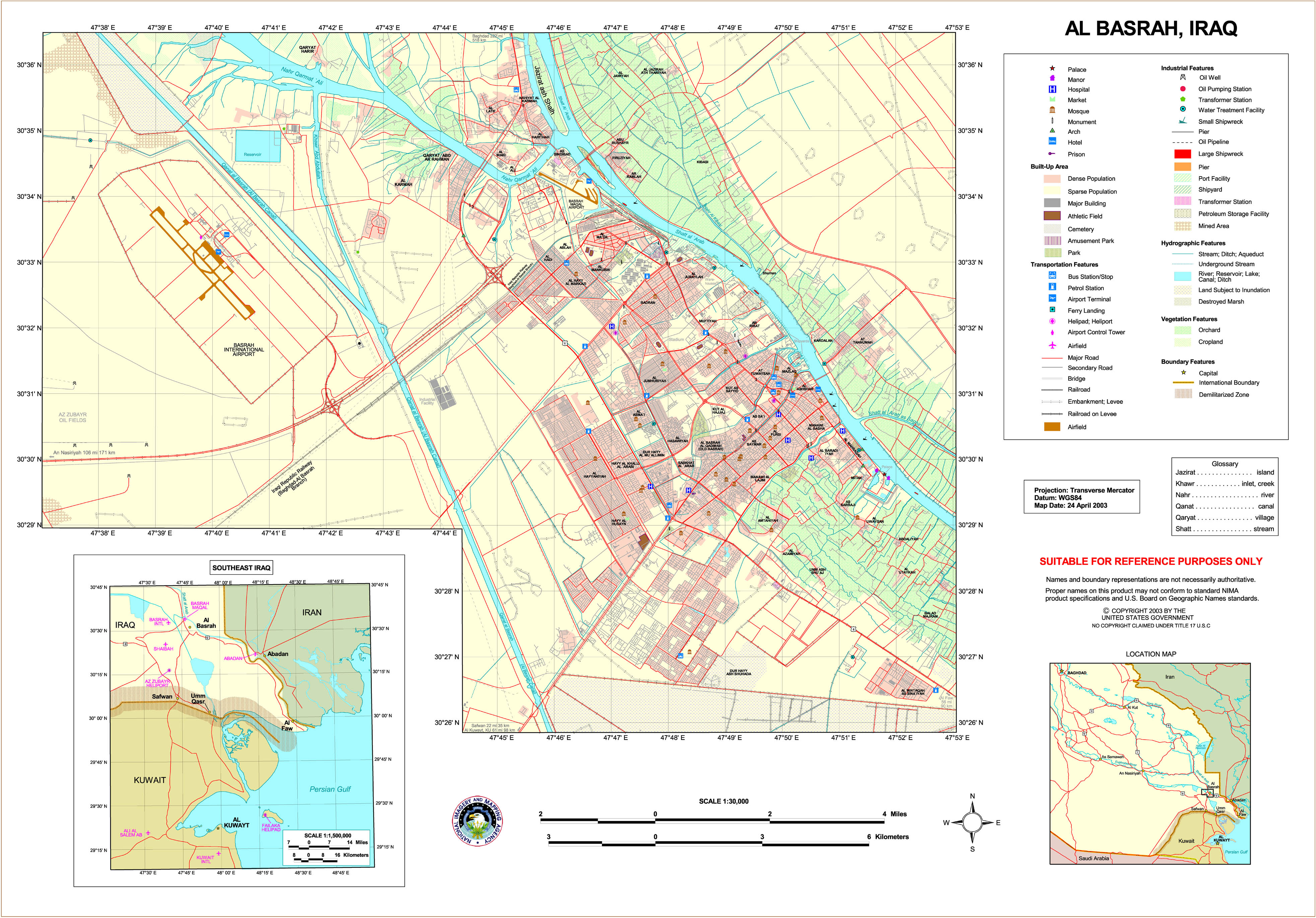
- 2003 Basra map (NIMA)
- Boomtown Basra
- Muhammad and the Spread of Islam by Sanderson Beck Archived 13 August 2009 at the Wayback Machine
- The Textual History of the Qur'an, Arthur Jeffery, 1946
- Codex of Abu Musa al-Ashari, Arthur Jeffery, 1936

| International | |
|---|---|
| National | |
| Geographic | |
| Other | |

Basra
View on GrokipediaBasra is a port city in southern Iraq situated on the western bank of the Shatt al-Arab waterway, formed by the confluence of the Tigris and Euphrates rivers, approximately 90 kilometers from the Persian Gulf.[1] It functions as the capital of Basra Governorate and Iraq's primary seaport, facilitating the export of petroleum products that constitute over 99% of the country's export revenues.[2] The city was established in 636 CE by Caliph Umar ibn al-Khattab as a military encampment to consolidate Muslim control over former Sassanid territories in the region.[1] With an estimated urban population of 1.075 million as of 2023, Basra ranks as Iraq's third-largest city after Baghdad and Mosul. The governorate encompassing the city holds approximately 70% of Iraq's proven oil reserves, underpinning its economic significance through upstream production, refining, and export facilities that drive national GDP contributions from hydrocarbons.[3] Historically, Basra emerged as a vibrant center of commerce, Islamic scholarship, and poetry during the Abbasid era, fostering intellectual movements amid its role in Indian Ocean trade routes.[1] In the modern period, the discovery and exploitation of oil transformed Basra into a strategic asset, yet it has faced severe disruptions from conflicts including the 1980–1988 Iran-Iraq War, which devastated infrastructure, and post-2003 instability marked by insurgent attacks on oil installations producing over two-thirds of Iraq's output.[4] These events, compounded by rapid oil development, have led to environmental controversies such as elevated cancer rates near extraction sites, groundwater salinization, and resource mismanagement exacerbating water scarcity in the Mesopotamian marshes.[5] Recent investments, including a $3.75 billion refinery upgrade aimed at gasoline self-sufficiency, signal efforts to bolster energy security amid ongoing challenges from over-reliance on oil revenues.[6]
Etymology
Name Derivation and Historical Variants
The name Basra derives from the Arabic al-Baṣra (البصرة), rooted in the verb baṣara (بصر), meaning "to see" or "to perceive," hence denoting "the lookout" or "the overseer." This interpretation aligns with the city's location at the Shatt al-Arab, where the Tigris and Euphrates converge, offering vantage over vital maritime and riverine passages.[7][8] Alternative derivations, such as a Persian bas-rah signifying "where many paths meet," have been suggested to highlight Basra's function as a trade nexus, though these lack the linguistic primacy of the Arabic root.[9] Historical variants encompass al-Baṣrah in classical Arabic chronicles, Baṣra in Ottoman Turkish script, and European adaptations like Basora in Portuguese navigational records from the late 16th century and Bussorah or Busora in early modern English accounts.[10] These forms reflect phonetic transliterations across languages, with earliest attestations in Arabic sources from the mid-7th century CE, coinciding with the site's development as a garrison overlooking Persian Gulf access.[8] A folk etymology linking Baṣra to "black pebbles" appears in some medieval texts but stems from surface features rather than core morphology.[10]History
Pre-Islamic Context and Foundation (636 CE)
The territory surrounding the site of future Basra, in southern Mesopotamia, fell under Sassanid Persian dominion as part of the empire's core agricultural and maritime provinces, encompassing the lower Euphrates, Tigris delta, and Shatt al-Arab waterway. This region featured the port of Ubullah (ancient Apologos), a critical commercial outlet for Sassanid trade with India, East Africa, and the Far East, supporting irrigation-based farming in the surrounding alluvial plains and marshes. Local demographics comprised Persian officials, Aramaic-speaking peasants, Nestorian Christian communities, and Zoroastrian elites, overlaid with semi-nomadic Arab tribes such as Bakr ibn Wa'il, Abd al-Qays, and elements of Tamim, who inhabited the fringes, engaged in herding, raiding, and occasional alliances as frontier auxiliaries against nomadic incursions or Byzantine influences.[11] Amid the Rashidun Caliphate's campaigns against the debilitated Sassanid Empire—following the Muslim victory at the Battle of al-Qadisiyyah in November 636 CE—Caliph Umar ibn al-Khattab dispatched Utba ibn Ghazwan al-Mazini, a companion of Muhammad, with a contingent of around 2,000 to 4,000 warriors to subdue the southern approaches. Utba captured Ubullah circa 637 CE after overcoming its Sassanid defenders, securing naval access and tribute from the Persian Gulf littoral. He then founded Basra in 14 AH (635–636 CE) as a temporary military encampment (misr) approximately 15 kilometers southwest of Ubullah, in an arid zone shielded by palm groves and canals, to consolidate gains and deter remnants of Sassanid forces from Khuzistan.[12][13] Basra's initial establishment prioritized military exigencies, housing garrison troops primarily from Yemeni-origin Arab tribes including Azd, Bajilah, and Kindah, who received land allotments (iqta') and stipends from caliphal revenues to maintain discipline and loyalty. This setup addressed logistical challenges of dispersing conquest veterans, prevented tribal feuds by segregating factions from northern camps like Kufa, and established an administrative nucleus for taxing the Sawad's dihqan landowners and channeling resources northward. The camp's rudimentary structures—tents, reed mosques, and defensive ditches—evolved into a fortified hub, underscoring its role in stabilizing Rashidun authority amid ongoing skirmishes with Persian holdouts.[14]Early Islamic Caliphates (661–1258)
During the Umayyad Caliphate (661–750 CE), Basra operated as a key provincial capital in southern Iraq, where shurta chiefs enforced order, provided security, and supported regional governors in consolidating administrative control amid tribal dynamics.[15] Agricultural productivity in its hinterland relied on engineered canal systems, including Nahr Ma‘qil (operational by the mid-seventh century) and Nahr Ibn ‘Umar (built c. 744 CE), which channeled water from the Shatt al-Arab and marshes for tidal irrigation, enabling cultivation of dates and grains on the floodplain by 674 CE.[16] The Abbasid takeover in 750 CE preserved Basra's role as a southern trade entrepôt, with its port facilitating Indian Ocean commerce in spices, textiles, and slaves incoming from India and East Africa, while exporting dates and grains, bolstered by over 100,000 waterways including 20,000 navigable channels.[14] Kharaj land taxes on non-Muslim-held agricultural plots, fixed per unit area and adapted from Sassanid precedents, funded caliphal operations and reflected the region's output, though rates varied with soil fertility and crop yields.[17] Intellectually, Basra contributed to early translation efforts, with scholars like Nestorian physicians rendering Greek medical texts into Arabic, influencing Abbasid scientific patronage centered in Baghdad.[18] Literary output peaked with figures such as Bashshār ibn Burd (d. 784 CE), a blind poet of Persian descent whose satirical and descriptive verses, composed in Basra's vibrant milieu, marked the shift from Umayyad restraint to Abbasid expressiveness in Arabic poetry.[19] The city also nurtured grammarians like Sībawayh (d. 796 CE), foundational to Arabic linguistics, amid a population estimated at 200,000 to 600,000 by the medieval era, driven by commercial influxes and agricultural surpluses.[14]Mongol Invasions and Intermediary Periods (1258–1534)
In 1258, Basra surrendered without resistance to the Mongol forces of Hülegü Khan during his campaign against the Abbasid Caliphate, avoiding direct sacking but falling under Ilkhanid control as part of the conquered territories in Iraq.[8] The city, already diminished from earlier internal conflicts and environmental challenges by the mid-13th century, experienced further urban decay under Mongol overlordship, with infrastructure neglect contributing to population decline and reduced prominence as a regional hub.[8] The Ilkhanate (1256–1335), established by Hülegü and his successors, administered Basra as a peripheral outpost within its Mesopotamian domains, prioritizing developments in northwestern Iran and Baghdad over southern ports, which limited any significant rebuilding or investment.[8] Following the Ilkhanate's fragmentation after the death of Abū Saʿīd in 1335, the Jalayirid dynasty, a Mongol successor state, asserted control over Iraq including Basra from the late 1330s under rulers like Ḥasan-e Bozorg (r. 1336–1356) and Šayḵ Ovays (r. 1356–1374), maintaining nominal authority amid ongoing tribal and factional instability but recording no major restorative efforts in the city.[20][8] Jalayirid rule persisted until the dynasty's eclipse by the Qara Qoyunlu Turkmen confederation around 1411, when the latter captured Baghdad and extended influence southward, followed by intermittent Aq Qoyunlu oversight in the late 15th century; these transitions exacerbated political fragmentation, yet Basra's port facilities sustained limited maritime trade with the Indian Ocean, particularly in spices and textiles, providing economic continuity despite governance volatility.[8] By 1495, chronic water scarcity from canal silting prompted abandonment of the original urban site, with inhabitants relocating to a new settlement upstream, signaling deepened infrastructural ruin independent of immediate conquests.[8] From 1508 to 1534, Safavid forces under Shah Ismaʿil I briefly incorporated Basra into their domain during expansions into Iraq, enforcing Shiʿi administrative ties but facing local Arab tribal resistance that hindered stabilization; this era marked a transitional interlude of Iranian-oriented rule before Ottoman reconquest, with the city's recovery efforts remaining minimal amid broader regional rivalries.[8]Ottoman Dominion and Decline (1534–1914)
The Ottoman Empire incorporated Basra as part of its conquest of Iraq in 1534, when Suleiman the Magnificent captured Baghdad and advanced toward the Persian Gulf, establishing control over key ports including Basra by 1538.[21][22] Basra was organized as an eyalet, with pashas appointed as governors by 1546 to manage administration, collect revenues, and supervise trade routes connecting the interior to the Gulf.[22] These officials prioritized defense against Safavid Persia, which repeatedly contested the eastern frontier, including occupations and raids that necessitated fortifications and military campaigns.[23] Pashas in Basra balanced trade facilitation with frontier security, exporting commodities such as dates from the Euphrates orchards and pearls harvested from Gulf waters, which were shipped to markets in India, Europe, and the Ottoman heartlands.[24][25] Records indicate Basra's pearl trade remained significant into the late Ottoman period, as noted in provincial almanacs listing high-quality varieties for export.[24] During conflicts like the 1623–1639 Ottoman-Safavid War, the Basra pasha allied with Portuguese forces to repel Safavid advances led by Imam Quli Khan, preserving Ottoman hold on the port amid naval threats.[23] Such defenses underscored Basra's strategic role as a bulwark against Persian expansionism. By the 18th century, Basra's prosperity waned amid Ottoman decentralization, with weakened central authority allowing tribal confederations like the Montafeq to launch repeated assaults on the city, eroding administrative control and disrupting commerce.[8] Plagues and endemic diseases further depopulated the region, compounding economic stagnation as trade volumes declined relative to earlier peaks.[22] The redirection of pilgrimage and caravan routes toward interior Shia centers like Karbala shifted some commerce away from Basra's maritime focus, while prolonged wars with Safavid successors exacerbated fiscal strains on local pashas.[8] In the 19th century, the eyalet was subordinated to Baghdad under Mamluk influence before Tanzimat reforms reimposed direct imperial oversight, yet persistent tribal revolts and border skirmishes with Qajar Persia hindered recovery.[26] Efforts to centralize administration through appointed governors aimed to revive trade in dates and pearls, but inefficiencies and external pressures, including European naval presence in the Gulf, limited Basra's resurgence until the eve of World War I.[27] This period marked a transition from Basra's earlier vitality as an Ottoman frontier hub to relative peripheral status within the empire.[22]British Occupation and Mandate Era (1914–1932)
British forces, primarily Indian troops under Anglo-Indian command, captured Basra from Ottoman control on November 23, 1914, following naval advances up the Shatt al-Arab and clashes at nearby positions like Sahil and Qurna.[28] This occupation secured the port's strategic value for protecting oil shipping routes from Persia and establishing a base for further Mesopotamian advances.[29] During World War I, British administration focused on military logistics, expanding port facilities at Ashar Creek and constructing temporary railways to support troop movements and supply lines northward.[30] Following the Ottoman surrender in 1918, Britain formalized control through the League of Nations Mandate for Mesopotamia in 1920, administering the region—including Basra—as a territory prepared for self-rule while retaining influence over defense and foreign affairs.[31] Infrastructural investments included dredging and modernizing Basra's port to handle increased trade volumes, extending rail networks from the port inland for efficient goods transport, and initiating irrigation projects to drain marshes and expand cultivable land in southern Iraq.[32] These efforts boosted agricultural output in reclaimed areas and facilitated export of dates and grains, though primarily aligned with British commercial interests in regional connectivity.[33] Critics, including contemporary observers and later historians, highlighted the mandate's prioritization of resource extraction, particularly oil concessions granted to British firms like the Turkish Petroleum Company, which secured exploration rights in southern fields near Basra to fuel imperial needs.[34] Such arrangements ensured preferential access to Iraq's petroleum reserves, with pipeline routes planned southward to Basra's port, often at the expense of local economic autonomy and revenue sharing.[35] Local resistance peaked in the 1920 revolt, triggered by perceptions of indefinite British dominance and cultural imposition, with tribal leaders and Shi'i clerics in southern areas mobilizing against tax policies and administrative overreach.[36] While Basra remained under firm garrison control, unrest in adjacent Euphrates regions underscored governance strains, prompting Britain to deploy air policing tactics and suppress the uprising by October 1920 at a cost of over 2,000 British casualties and tens of thousands Iraqi deaths.[37] The revolt accelerated negotiations for limited self-government, culminating in Iraq's nominal independence in 1932 under a treaty preserving British military privileges.[31]Monarchical and Republican Iraq (1932–1990)
Upon Iraq's achievement of formal independence in 1932, Basra emerged as the nation's principal port, handling the bulk of imports and exports, including petroleum shipments from southern fields discovered in the preceding decade.[38] The monarchical government prioritized infrastructural enhancements, with Basra's docklands undergoing incremental expansions to accommodate rising trade volumes, though comprehensive overhauls were deferred until later decades.[33] Agricultural output in the Basra region, dominated by date palm cultivation, constituted a vital export commodity, generating significant revenue prior to the intensification of oil dependency in the 1950s.[39] The 1958 military coup that abolished the Hashemite monarchy ushered in a decade of republican turbulence, marked by successive overthrows and power struggles primarily centered in Baghdad, yet Basra retained its role as an economic anchor amid national uncertainty.[40] Regimes oscillated between pan-Arab nationalists and socialists, with military factions dominating governance except briefly in 1963, but localized disruptions in Basra were minimal compared to capital-centric instability.[40] Ba'athist ascendancy following the 1968 coup facilitated the 1972 nationalization of the Iraq Petroleum Company, encompassing the Basrah Petroleum Company that exploited reserves in Basra's vicinity, such as the Rumaila field.[41] This move dramatically escalated state oil revenues—from approximately 20% royalty shares to full control—channeling funds into centralized infrastructure and industrialization, though it diminished foreign investment and localized decision-making in Basra's oil sector.[42] By 1975, remaining foreign stakes in Basrah operations were fully expropriated, solidifying Iraq's fiscal autonomy but tying Basra's economy more tightly to Baghdad's directives.[43] The outbreak of the Iran-Iraq War in September 1980 transformed Basra into a strategic flashpoint, with Iranian forces mounting offensives to capture the city, including Operation Ramadan in July 1982—the war's largest ground engagement, involving human-wave assaults that penetrated Iraqi defenses near the Shatt al-Arab.[44] Iraqi counteroffensives incorporated chemical agents, such as mustard gas and tabun, deployed against Iranian troops advancing on Basra's outskirts to halt penetrations that reached within 15 kilometers of the city center.[44] Prolonged artillery barrages devastated urban areas, rendering parts of Basra a near-ghost town by 1984 through evacuation and destruction, while port infrastructure suffered repeated strikes, curtailing maritime operations.[45] The conflict displaced thousands from frontline villages into Basra, straining resources amid ongoing hostilities that persisted until the 1988 ceasefire.[46]Saddam Hussein Regime and Gulf Wars (1990–2003)
Under Saddam Hussein's Ba'athist regime, Basra experienced intensified repression targeting its predominantly Shia population, including arbitrary arrests, executions, and cultural suppression as part of broader efforts to maintain Sunni-dominated control. The regime's security apparatus documented and prohibited thousands of Shia names and practices, enforcing loyalty through fear and eliminating perceived threats.[47] This persecution escalated following Iraq's invasion of Kuwait on August 2, 1990, which prompted international condemnation and the UN-imposed economic sanctions under Resolution 661, isolating Iraq's economy—including Basra's vital oil infrastructure—and attributing the subsequent hardships directly to the regime's aggressive foreign policy.[48] The 1991 Gulf War, triggered by the Kuwait invasion, culminated in a US-led coalition expulsion of Iraqi forces by February 28, 1991, severely damaging Basra's infrastructure, including bridges and port facilities critical for oil exports. In the war's aftermath, Shia-led uprisings erupted across southern Iraq starting in Basra on March 1, 1991, where rebels briefly seized control amid regime troop withdrawals to the north; however, Saddam's Republican Guard swiftly recaptured the city within days, using tanks and heavy artillery to bombard positions, resulting in mass killings estimated in the tens of thousands in the south alone.[49][48] The regime's retaliation included systematic persecution of Shia communities in Basra, with enforced disappearances and village razings, framing the revolt as Iranian-influenced sedition to justify collective punishment.[48] As reprisal for the uprisings, Saddam ordered the drainage of the southern Mesopotamian Marshes adjacent to Basra beginning in 1991, redirecting the Tigris and Euphrates rivers via canals and dams to create a "Third River" bypass, shrinking the wetlands from over 20,000 square kilometers to less than 10 percent of their extent by the late 1990s. This ecological devastation displaced up to 200,000 Marsh Arabs—mostly Shia—who had sheltered rebels, rendering traditional livelihoods in fishing and reed farming impossible and forcing mass migration to urban fringes like Basra.[50][51][52] UN sanctions, sustained through the 1990s, exacerbated Basra's economic collapse, with hyperinflation reaching annual rates exceeding 300 percent by the mid-1990s due to currency devaluation and import restrictions, while state rationing failed to meet basic needs, fostering a parallel black-market economy reliant on smuggling.[53] The regime evaded sanctions by smuggling oil, particularly through Basra's Khor Abd Allah waterway to the Persian Gulf, generating illicit revenues estimated at $2 billion annually by the early 2000s, though precise 1990s figures for this route remain opaque; operations involved truck pipelines and small vessel transfers to Jordan, Syria, and Turkey, sustaining elite patronage networks amid widespread poverty.[54][55][56]Post-2003 Insurgency, Reconstruction, and Stabilization Efforts (2003–Present)
British-led coalition forces captured Basra in late March to early April 2003 during the initial invasion, rapidly overthrowing Saddam Hussein's regime in the city with minimal sustained resistance from Iraqi forces.[57] The operation ended local Ba'athist control, which had suppressed Basra's Shia majority through repression, including the brutal crushing of 1991 uprisings, thereby dismantling the institutional apparatus of tyranny that enforced loyalty via fear and purges.[58] However, the swift collapse triggered widespread looting of public infrastructure, exacerbating immediate postwar disorder as coalition priorities shifted from combat to stabilization amid unsecured sites.[59] From 2004 to 2007, Basra descended into intense insurgency dominated by Shia militias, including the Mahdi Army of Muqtada al-Sadr and Iranian-supported groups like the Badr Organization, which vied for dominance over oil smuggling, territorial control, and public sector jobs.[60] [61] These factions, often funded and armed by Iran via the Islamic Revolutionary Guard Corps, infiltrated police forces and launched attacks on coalition troops, rival groups, and oil infrastructure, including pipelines and export terminals, crippling economic output and fueling sectarian violence.[62] [63] The 2007 Siege of Basra by Mahdi forces highlighted militia entrenchment, prompting British withdrawal to bases and eventual handover to Iraqi security forces after Iraqi-led operations with coalition air support restored partial order.[64] Stabilization efforts post-2007 focused on building Iraqi capacity, with multinational training programs enhancing local police and army units, though persistent militia influence and corruption undermined gains.[65] Reconstruction initiatives, including U.S. and international funding, targeted infrastructure repair, but security threats and graft diverted resources, limiting progress in power and water systems.[66] By 2023–2025, foreign investments like TotalEnergies' Gas Growth Integrated Project (GGIP) advanced, encompassing Ratawi oilfield redevelopment to reach 210,000 barrels per day by 2028, associated gas recovery from southern fields, and new water supply and power generation facilities to address shortages.[67] [68] Southern Iraq's oil output, centered in Basra fields, contributed to national production exceeding 4 million barrels per day in 2025, yet revenues failed to translate into reliable services due to elite capture.[69] [70] Governance failures persisted, with widespread protests in Basra from 2019 onward decrying corruption that siphons oil wealth—estimated at billions annually—into militia-linked networks and politicians, leaving residents without adequate electricity, jobs, or clean water.[5] [71] The water crisis, intensified by upstream dam mismanagement, industrial pollution from oil operations, and salinity intrusion, reached acute levels in 2018, hospitalizing thousands and exposing decades of neglect post-2003, including failed desalination projects and illegal diversions.[72] [73] Despite oil-driven fiscal surpluses, systemic graft and factional patronage perpetuated underinvestment, fostering public disillusionment with both central authorities and local Shia powerbrokers.[74][75]Geography
Location, Topography, and Hydrology
Basra is situated in southeastern Iraq at approximately 30°30′ N latitude and 47°47′ E longitude, on the western bank of the Shatt al-Arab waterway, which forms from the confluence of the Tigris and Euphrates rivers near Al-Qurnah, about 120 kilometers upstream.[76][77] The city lies roughly 100 kilometers inland from the Persian Gulf, where the Shatt al-Arab discharges, positioning Basra as Iraq's primary port gateway despite silting and navigational challenges.[78] This strategic location at the deltaic outlet has historically facilitated maritime trade and settlement, though tidal influences extend upstream, affecting hydrology and exposing the area to Gulf water dynamics.[79] The topography of Basra consists of a low-lying alluvial plain, with surface elevations ranging from 5 to 26 meters above sea level, averaging around 5 meters, rendering the terrain predominantly flat and featureless except for levees and canals shaped by fluvial deposition.[80] This flatness, derived from millennia of sediment accumulation from the Tigris-Euphrates system, promotes expansive urban and agricultural development but heightens vulnerability to inundation, as minor river level rises can submerge large areas without natural barriers.[81] Hydrologically, Basra's setting is dominated by the Shatt al-Arab, which carries combined discharges from the Tigris and Euphrates, sustaining irrigation and the adjacent Mesopotamian marshes—expansive wetlands historically covering thousands of square kilometers south and east of the city.[82] These marshes, with depths varying from 0.5 to 2 meters seasonally, were extensively drained in the 1990s through canalization and embankment construction under Saddam Hussein's regime to suppress insurgencies, reducing their extent by over 90 percent and exacerbating downstream salinity intrusion into the Shatt al-Arab.[83] Partial reflooding occurred post-2003 via breached dykes and restored inflows, yet persistent high salinity—averaging over 2,500 ppm in Basra waters due to upstream damming, reduced freshwater volumes, and tidal saltwater encroachment—continues to degrade water quality for agriculture and ecosystems.[84] Flood risks remain elevated from Tigris-Euphrates overflows, as evidenced by severe inundations in 2018-2019 that submerged Basra farmlands and infrastructure, compounded by the region's minimal elevation gradient and dependence on river regulation.[85] Seismic activity in the vicinity is low, given Basra's position on the stable Arabian Plate margin away from the active Zagros thrust zone, though distant tectonic events can indirectly influence sediment loads and fluvial stability.[86]Climate Characteristics and Variability
Basra's climate is classified as a hot desert climate (BWh) under the Köppen-Geiger system, featuring extreme summer temperatures, mild winters, and scant annual precipitation concentrated in the cooler months. Average annual temperatures range from 24°C to 27°C, with July marking the peak at an average high of 46°C (115°F) and low of 28°C (83°F), while January sees averages around 15°C (59°F).[87][88] Extremes routinely surpass 45°C during summer heatwaves, driven by intense solar insolation and low cloud cover.[89] Precipitation averages 150–161 mm annually, falling mostly between November and March, with negligible amounts in summer; this aridity stems from the region's position in a subtropical high-pressure belt.[90] Relative humidity remains elevated year-round due to proximity to the Persian Gulf, often exceeding 60% in mornings and contributing to muggy conditions despite the desert classification.[87] Variability is pronounced through seasonal shamal winds—strong northwesterly gusts originating from high-pressure systems over the Arabian Peninsula—which peak from March to August and frequently spawn dust storms by mobilizing loose sediments from Mesopotamian floodplains and Syrian Desert sources.[91] Historical records from 1980–2015 document over 1,000 dust events in Iraq, with Basra experiencing heightened frequency during spring shamals linked to pressure gradient variability rather than uniform trends.[92] Drought cycles correlate with fluctuations in Euphrates-Tigris inflows, influenced by upstream dam operations and natural runoff variability, as evidenced by multi-decadal precipitation dips independent of localized wind shifts.[93]Demographics
Population Trends and Migration Patterns
The population of Basra city has grown substantially over the past seven decades, rising from 115,708 residents in 1950 to an estimated 1,525,000 in 2025, reflecting a compound annual growth rate exceeding 4% in earlier decades before moderating to approximately 2.5% in recent years.[94] This demographic expansion has been propelled by the post-1950s boom in the local oil sector, which generated employment and drew internal migrants to the region as Iraq's primary energy hub.[95] Urbanization rates in Basra have outpaced national averages, with the metro area's population increasing by 2.56% from 2023 to 2024 alone, amid Iraq's overall annual growth of about 2.3%.[96][97] Key migration drivers include persistent rural-to-urban inflows from southern Iraq's agrarian provinces, exacerbated by chronic water shortages, salinization of farmland, and drought conditions that have rendered agriculture unsustainable for many households since the early 2000s.[98] These environmental pressures, compounded by upstream water diversions from Turkey and Iran, have prompted an estimated 20% rise in urban-bound migrants to Basra over the past decade, often informal and low-skilled, straining housing and services.[99] Conflict-induced displacements have further boosted inflows, particularly during the Iran-Iraq War (1980–1988) and the 2003 U.S.-led invasion aftermath, when Basra absorbed internally displaced persons fleeing violence in central and northern Iraq, though many later returned or relocated amid post-2003 stabilization.[99] Outflows have been more episodic, with spikes in emigration following the 2018 protests against government corruption, power outages, and contaminated water supplies, which killed dozens and prompted skilled youth to seek opportunities in Gulf states like the UAE and Kuwait amid high unemployment rates exceeding 20% in Basra.[100] Despite such exits, net migration remains inward, sustaining population density pressures in the urban core, where informal settlements have proliferated without corresponding infrastructure investment.[95] Iraq's absence of a comprehensive census since 1987 complicates precise tracking, relying instead on extrapolations from household surveys and satellite data, which indicate Basra's growth outstripping national trends due to its economic pull.[95]Ethnic and Linguistic Makeup
Basra's population is overwhelmingly ethnic Arab, comprising an estimated 90-95% of residents, reflecting the broader demographic patterns of southern Iraq where Arab communities predominate in urban and rural areas.[101] This Arab majority includes both Shia and Sunni subgroups, though precise breakdowns for Basra remain limited due to the absence of ethnicity-specific data in recent national censuses, such as the November 2024 Iraqi census which focused on total population without ethnic enumeration.[102] Small ethnic minorities persist, including Mandaeans (also known as Sabians), whose historical communities in the Basra marshes and waterways have dwindled to a few thousand nationwide amid post-2003 violence and emigration; Armenians, numbering around 10,000 across Iraq with a minor presence in Basra; and groups of Persian (Ajam) descent, estimated at up to 100,000 nationally, often integrated through Shia affiliations but maintaining distinct cultural ties to Iran.[103][104] Linguistically, Iraqi Arabic in its Basrawi dialect dominates daily communication, belonging to the Mesopotamian (gilit) subgroup with phonological features like the realization of /q/ as and morphological variations in verb forms that differentiate it from northern Iraqi dialects centered on Mosul.[105] This southern variant, centered in Basra, incorporates loanwords from Persian—such as terms for trade goods and administration—stemming from centuries of Gulf commerce and Safavid-era influences, alongside minor Aramaic substrates from ancient Semitic layers.[106] English serves as a secondary language in professional contexts, particularly within the oil and gas sector, where international firms employ expatriates and local staff trained in technical terminology, though its use remains confined to elite and commercial spheres rather than widespread vernacular adoption.[107] Following the 2003 U.S.-led invasion, ethnic dynamics shifted due to sectarian displacements, with reports of Sunni Arab departures from Basra amid militia activities and insurgent violence, reducing their proportional presence and reinforcing the Shia Arab core amid broader national patterns of ethno-sectarian realignment.[108] These changes, while not quantified precisely for Basra, align with Iraq-wide trends where conflict accelerated homogenization in Shia-majority southern provinces, exacerbating vulnerabilities for minorities like Mandaeans who faced targeted persecution and further diaspora.Religious Composition
The religious composition of Basra Governorate is overwhelmingly Twelver Shia Muslim, with adherents forming the vast majority of the population amid Iraq's broader Shia-majority southern regions.[109] Sunni Muslim Arabs constitute a minority, often concentrated in specific neighborhoods, while non-Muslim groups including Christians and Sabians (Mandaeans) comprise negligible shares, each under 1%.[110] These demographics reflect historical Arab settlement patterns and post-Ottoman migrations, with Shia dominance reinforced by the region's marshlands and proximity to Shia holy cities like Najaf and Karbala. Christian communities, mainly Chaldean Catholics and Assyrians, have persisted in Basra since ancient Mesopotamian roots but faced sharp declines due to targeted violence and economic pressures, reducing their presence to scattered families numbering in the hundreds.[111] Sabians, followers of an ancient gnostic baptismal faith indigenous to southern Iraq's riverine areas, maintain a small enclave around Basra's waterways, though nationwide estimates post-2003 place survivors at 3,000–5,000 after mass emigration from persecution by Islamist militias who view their pacifist creed as heretical.[112] No organized Zoroastrian or other pre-Islamic Sassanid remnants endure, despite the city's origins under Sassanid rule. Post-2003 sectarian tensions, exacerbated by power vacuums, peaked in Basra during 2006–2008 with intra-Shia clashes between rival militias and assaults on Sunni and minority enclaves, resulting in hundreds of deaths and enabling armed groups to impose parallel governance through extortion, checkpoints, and social control.[113] This violence, often triggered by retaliatory cycles rather than centralized directives, entrenched militia authority by filling state security gaps, as groups like Jaysh al-Mahdi leveraged religious rhetoric to mobilize fighters and deter rivals.[114] Such dynamics diminished Sunni visibility and accelerated minority flight, solidifying Shia hegemony while fostering localized distrust across sects.[115]Genetic and Anthropological Insights
Genetic studies of the Basra region's population, particularly among Arab inhabitants and related Marsh Arab groups in southern Iraq, reveal a predominant Y-chromosome haplogroup J1-M267, with frequencies reaching 81.1% in Marsh Arabs, a subclade J1-Page08 showing local expansion approximately 4,000 years ago.[116] This haplogroup's prevalence aligns with Semitic paternal lineages originating in the Middle East, as J1 subclades like P58 are associated with early expansions in the Arabian Peninsula and Mesopotamia.[117] In urban Basra samples, J1 remains significant alongside E1b1b, G2a, and R1b, with about 30% of lineages indicating male-mediated gene flow from distant regions, potentially reflecting historical Persian Gulf interactions.[118] Mitochondrial DNA analyses in Basra populations show West Eurasian haplogroups dominating at around 78%, led by H (17%), J (11%), and U (9%), with minor contributions from African (e.g., L clades at 5%) and South-West Asian lineages (e.g., M and U7 at 10-12%).[119] These patterns suggest maternal continuity with regional ancient groups, tempered by limited admixtures likely from trade routes across the Gulf and Indian Ocean, as evidenced by elevated Asian mtDNA components compared to northern Iraqis.[116] Genomic surveys from the 2010s indicate substantial continuity between modern southern Iraqi Arabs and ancient Mesopotamian populations, with high J1 frequencies and low external inputs supporting autochthonous development despite invasions; Marsh Arabs, in particular, exhibit weak South-West Asian and African influences, implying resilience in core genetic structure over millennia.[120][121] Such data refute notions of major population replacements, emphasizing endogenous expansions in the region.[120]Government and Administration
Administrative Structure and Local Governance
Basra functions as the capital of Basra Governorate, Iraq's southernmost province, which encompasses seven administrative districts: Al-Basrah (the city itself), Abu al-Khaseeb, Al-Faw, Al-Midaina, Al-Qurna, Al-Zubair, and Shatt al-Arab.[122] This structure aligns with Iraq's decentralized framework under the Law of Governorates Not Incorporated into a Region (No. 21 of 2008), which delineates provincial boundaries and local administrative units while subordinating them to federal oversight.[123] Local governance operates through an elected provincial council, comprising 25 to 41 members depending on population size, with Basra's council holding 35 seats as of the December 2023 elections.[124] The council, elected via proportional representation in multi-member districts, holds legislative authority over provincial budgets, service delivery, and development plans, subject to federal approval for matters like security and fiscal policy.[125] The council selects the governor and deputies by absolute majority vote, typically from the largest bloc or through coalitions; in Basra, Asaad al-Eidani of the State of Law Coalition has held the governorship since October 2017, reaffirmed post-2023 polls amid coordination framework alliances.[126] Executive powers include implementing council decisions, managing local services such as water and electricity distribution, and coordinating with district sub-councils, though implementation often hinges on federal funding transfers.[127] Fiscal relations with the federal government center on oil revenue distribution, given Basra's status as Iraq's primary producing governorate, accounting for over 70% of national crude output.[128] The 2023-2025 Federal Budget Law mandates a formula under which producing provinces receive a share—initially codified at 5% of oil and gas revenues via 2021 amendments to Law No. 21/2008, with Basra allocated approximately 250 billion Iraqi dinars (about $190 million USD) annually for infrastructure, though actual disbursements have lagged due to Baghdad's centralized control over exports and pricing.[123] [129] Persistent disputes arise from Basra's demands for enhanced local investment authority, including direct contracting for fields like Rumaila and West Qurna, contrasting with federal insistence on unified hydrocarbon management under the unratified 2007 Oil Law.[130] These tensions underscore provincial dependency, as the governorate relies on federal allocations for 90% of its budget despite generating disproportionate national wealth.[127] Security governance features a hybrid model post-ISIS territorial defeat in 2017, with local police forces under the Ministry of Interior handling routine law enforcement and traffic, numbering around 20,000 personnel in Basra as of 2021.[131] Federal military units, including Iraqi Army divisions and Popular Mobilization Forces (PMF) brigades certified under federal command, maintain bases and patrols for border protection and oil facility security, reflecting Baghdad's retention of strategic oversight amid lingering insurgency risks.[132] Provincial authorities coordinate via joint operations centers but lack independent command over federal assets, leading to frictions in rapid response to protests or tribal disputes, as evidenced in 2019 unrest where PMF involvement escalated local tensions.[133] This division preserves federal primacy while granting locals input on community policing initiatives.[131]Political Dynamics, Corruption, and Federal Relations
Basra's political landscape is characterized by entrenched patronage networks linked to Shia political parties and Iran-backed militias within the Popular Mobilization Forces (PMF), which exert significant influence over local governance and economic resources, often prioritizing factional interests over administrative reforms. These networks facilitate the allocation of public sector jobs and contracts to loyalists, undermining merit-based systems and perpetuating inefficiency in service delivery. PMF-affiliated groups, such as those under Asa'ib Ahl al-Haq, maintain de facto control over ports and oil infrastructure in Basra, using smuggling operations and protection rackets to generate revenue that bolsters their autonomy from provincial oversight.[134][135] This militia entrenchment has stalled efforts to professionalize security and bureaucracy, as factional vetoes block anti-corruption drives and infrastructure projects that threaten their economic fiefdoms.[136] Corruption in Basra governance manifests acutely through the embezzlement and mismanagement of oil revenues, which constitute over 90% of provincial income, with systemic graft diverting funds intended for public services. Iraq's national Corruption Perceptions Index score of 26 out of 100 in 2024, ranking it 140th globally, reflects pervasive public sector bribery and nepotism, particularly pronounced in oil-rich southern provinces like Basra where unchecked procurement scams and fuel smuggling by militias drain billions annually.[137][138] The 2019 protests in Basra spotlighted specific instances of embezzlement, including the diversion of oil export proceeds—estimated at hundreds of millions of dollars—through falsified contracts and ghost employees in the provincial oil directorate, exacerbating water and electricity shortages despite Basra's contribution of 80% of Iraq's crude output.[139] Recovery of such funds remains elusive, with judicial probes often stalled by political interference from Baghdad-aligned elites.[140] Relations between Basra's provincial authorities and the federal government in Baghdad are strained by disputes over resource allocation and fiscal autonomy, with Basra frequently shortchanged despite its outsized oil contributions. In October 2025, Basra Governor Asaad Al-Eidani publicly accused the federal government of neglecting the province and failing to execute commitments under the 2023-2025 triennial budget, warning of legal action amid delays in infrastructure funding that have left critical projects unfinished.[130] These tensions stem from Baghdad's centralized control over oil revenues, which allocates only a fraction of Basra's production share back to the province, fueling accusations of deliberate underinvestment to maintain federal leverage over southern Shia heartlands.[141] Budget delays in 2025, including lawsuits against Prime Minister Mohammed Shia al-Sudani for postponing fiscal tables, have intensified provincial grievances, highlighting a pattern where federal priorities favor national patronage over regional development needs.[142]Economy
Oil and Gas Sector Dominance
Iraq's proven crude oil reserves stand at 145 billion barrels, ranking fifth globally, with the majority concentrated in the Basra region, including supergiant fields such as Rumaila and West Qurna.[143] The Rumaila field, discovered in 1953 and located southwest of Basra, holds initial recoverable reserves estimated at over 17 billion barrels, while the adjacent West Qurna fields collectively contain around 43 billion barrels of recoverable oil, making them among the world's largest.[144] These fields underpin Basra's role as Iraq's primary oil-producing hub, accounting for the bulk of the country's southern output.[145] Oil extraction in Basra is managed by the state-owned Basra Oil Company under Iraq's Ministry of Oil, following the nationalization of foreign concessions in June 1972, which transferred control of the Iraq Petroleum Company assets to the Iraq National Oil Company.[146] Since then, production has relied on technical service contracts with international oil companies, providing expertise and investment in exchange for fees rather than equity stakes. In 2023, Iraq signed a $27 billion multi-energy deal with TotalEnergies, encompassing oil field developments like Ratawi, aimed at boosting output to 210,000 barrels per day by full field development phases.[147] As of mid-2025, federal oil production from southern fields, predominantly in Basra, averaged approximately 4.5 million barrels per day, representing over 80% of Iraq's total crude output and driving national revenues despite OPEC+ quotas.[69] This dominance has induced Dutch disease effects, where oil rents appreciate the real exchange rate, erode non-oil tradable sectors like agriculture and manufacturing, and foster fiscal dependence, as evidenced by empirical analyses showing volatility in oil revenues correlating with structural economic imbalances in Iraq.[148] Such resource curse dynamics prioritize extractive efficiency over diversification, perpetuating vulnerability to price fluctuations.[149]Port-Based Trade and Logistics
Umm Qasr and Khor Al Zubair ports constitute the core of Basra's commercial maritime infrastructure, enabling the export of non-oil commodities and supporting logistics for Iraq's southern oil sector. Umm Qasr, Iraq's largest deep-water facility, primarily handles containerized goods, general cargo, and bulk shipments, while Khor Al Zubair specializes in dry bulk such as grains and agricultural products. Although dedicated offshore terminals like Al Basrah Oil Terminal manage most crude loadings, these ports facilitate ancillary activities including the export of gas condensates from Khor Al Zubair and refined oil products, contributing to the Basra complex's role in channeling over 97% of Iraq's crude volumes via southern Gulf infrastructure.[150][151] Following the 2003 invasion, reconstruction initiatives revitalized these ports amid wartime neglect and silting. Umm Qasr underwent phased expansions starting in 2014, adding container terminals and berths to boost annual capacity toward 20 million tons by 2016's first phase completion, with further developments ongoing into 2025 to accommodate larger vessels. Khor Al Zubair similarly benefited from dredging and quay rehabilitations, reopening fully in 2019 after security-related closures, enhancing its throughput for bulk exports. These upgrades addressed pre-2003 decay from sanctions-era underinvestment, though inefficiencies persisted due to corruption and fragmented management.[152][153][154] Trade volumes underscore their export significance, with Khor Al Zubair processing 9.7 million tons of cargo in the first half of 2025—predominantly bulk goods like imported grains for domestic consumption and exported dates from Basra's orchards, Iraq's leading producer. Umm Qasr managed 5.4 million tons in the same period, focusing on container traffic that includes date shipments and other agro-exports. Bottlenecks from channel sedimentation hamper efficiency, as unchecked siltation reduces draft depths, requiring frequent dredging to sustain access for Panamax vessels; Umm Qasr's approaches, for instance, demand annual maintenance to counter Arabian Gulf currents.[155][156] During the 1990s UN sanctions and early 2000s instability, both ports facilitated extensive smuggling, evading embargo controls on oil derivatives and consumer goods. Khor Al Zubair emerged as a conduit for fuel smuggling to Iran, with pipelines and dhow transfers diverting condensates and refined products, generating billions in illicit revenue for regime insiders and militias. Umm Qasr saw similar abuses, including hidden cargo in general shipments, exacerbated by lax oversight until post-2003 naval patrols and international monitoring curtailed flows, though sporadic incidents continue.[157][158][159]Unemployment, Diversification Attempts, and Economic Mismanagement
Unemployment in Basra remains elevated, particularly among youth, exacerbating social tensions in the oil-rich governorate. As of late 2024, youth unemployment (ages 18-35) nationwide exceeded 36%, with Basra's rates likely higher due to limited non-oil job creation and influx of foreign labor in energy projects. Local estimates for Basra placed overall unemployment at around 22% in 2021, surpassing the national average of 16.5%, though recent data indicate persistent stagnation amid inadequate vocational training and private sector growth. This joblessness persists despite Basra's role in producing over 70% of Iraq's oil, highlighting a disconnect between resource wealth and local employment opportunities.[160][161][162] Iraq's heavy reliance on oil revenues—accounting for approximately 90% of government income in 2023—has entrenched a rentier economy in Basra, where state patronage and oil rents discourage broader private enterprise and innovation. Post-2003, Iraqi governments pledged economic diversification through initiatives like private sector incentives and non-oil investment laws, yet implementation faltered, with oil still comprising over 40% of GDP and non-oil sectors showing minimal expansion by 2024. In Basra, diversification rhetoric has yielded few tangible shifts; structural barriers, including bureaucratic hurdles and insecurity, have limited progress in agriculture, manufacturing, and services, perpetuating vulnerability to oil price fluctuations.[143][163][164] Economic mismanagement, driven by entrenched corruption, has further undermined diversification and job creation efforts. High-profile scandals, such as irregularities in Basra Oil Company contracts with international firms revealed in 2023, illustrate systemic graft siphoning funds from potential infrastructure and training programs. Protests in Basra since 2018 have decried this corruption, which fuels unemployment by prioritizing elite capture over equitable growth, with billions in public funds lost annually to embezzlement. Recent energy projects offer partial mitigation: in 2025, General Electric signed for a 3 GW combined-cycle gas plant in Basra, and TotalEnergies advanced a 1 GW solar farm with initial operations by year-end, potentially creating construction jobs but failing to address root dependency on hydrocarbons. These developments, while steps toward energy self-sufficiency, have not reversed the stifling effects of patronage politics on non-oil sectors.[165][100][166][167]Infrastructure and Transport
Maritime Ports and Waterways
Umm Qasr Port, situated about 70 kilometers south of Basra, functions as Iraq's principal deep-water facility and primary entry point for seaborne commerce, with channel depths reaching approximately 12.5 meters to support mid-sized vessels.[168][169] Managed through public-private partnerships, it handles diverse general cargo via multiple terminals operated by private entities equipped for storage and processing of bulk and containerized goods.[170] Limitations from shallower berths currently restrict ships to around 25,000 tons, prompting ongoing deepening initiatives to 20-25 meters for larger traffic.[171] Navigation to Basra's inland ports relies on the Shatt al-Arab waterway, formed by the confluence of the Tigris and Euphrates rivers, which extends 200 kilometers to the Persian Gulf and has fueled persistent territorial and navigational conflicts with Iran since the 19th century.[172] Rooted in unequal treaties like the 1937 agreement granting Iraq predominant control, disputes intensified during the 1980-1988 Iran-Iraq War, leading to blockades and attacks that severely impaired access; post-war, no formal boundary resolution has been achieved, with episodic tensions continuing to affect shipping freedom despite bilateral navigation pacts.[173][174] War-induced silting and destruction necessitated extensive dredging from the late 1980s onward, with rehabilitation accelerating after 2003 to clear channels and restore viability for commercial transit.[175] In the 2020s, Umm Qasr has seen targeted expansions, including the Basra Gateway Terminal's upgrades by International Container Terminal Services Inc., enabling handling of 16,000 TEU vessels and boosting container throughput to over 1.5 million TEU in 2023.[176][177] Plans announced in 2025 aim to quadruple annual container capacity to four million TEU through infrastructure enhancements and deeper drafts.[178] Complementing Umm Qasr, Khor Al-Zubair Port has emerged as a high-volume handler, processing 9.7 million tons in the first half of 2025 alone, while overall Iraqi port operations recorded over 22 million tons in the same period, reflecting robust recovery and growth in non-oil maritime logistics.[179][155] These facilities, accessed via Gulf approaches and internal waterways, underscore Basra's role in regional trade despite geopolitical frictions.[172]Road, Rail, and Air Connectivity
Basra's primary road connections link the city northward to Baghdad via a major highway corridor spanning approximately 550 kilometers, forming part of Iraq's key north-south transport artery that supports the movement of goods and personnel, including those in the oil sector.[180] Southward, Highway 80 extends from the Kuwaiti border through Safwan to Basra, facilitating cross-border trade and access despite historical damage from conflicts like the 1991 Gulf War.[181] The ongoing Development Road project, initiated in 2023, aims to upgrade and expand this network with a 1,200-kilometer highway from Basra's al-Faw area through the city to Baghdad and beyond to Turkey, potentially alleviating bottlenecks by integrating multimodal logistics for oil exports and worker transit.[182] However, severe traffic congestion persists due to rapid vehicle imports—636,000 in 2023 alone—and inadequate infrastructure maintenance, ranking Iraq 115th globally in logistics performance as of 2023.[183][184] The railway system in Basra connects to Baghdad via the Iraqi Republic Railways' southern line, which remains operational for freight and passengers but operates at reduced capacity after decades of neglect and war-related disruptions.[185] Extensions toward the Syrian border, historically linking through northern Iraq, have been severely hampered by conflicts including the ISIS insurgency, with key segments like those near Baiji non-functional for years and main lines unmaintained since the mid-20th century.[186] Recent initiatives under the Development Road include parallel rail upgrades from Basra to the Turkish border, while a separate Shalamcheh-Basra line to Iran advanced in 2025 to boost freight, yet overall bottlenecks from outdated tracks and rolling stock limit reliability for oil logistics.[187][188] Basra International Airport serves as the main air hub, handling domestic flights to Baghdad and international routes to destinations like the UAE and Turkey, with expansions since 2018 including terminal renovations, runway repairs, and additional aero-bridges to accommodate growing passenger traffic tied to the oil industry.[189] Capacity enhancements align with Iraq's broader aviation push, including planned fleet additions by 2027, enabling efficient mobility for expatriate oil workers and cargo.[190] Air connectivity faces challenges from airspace constraints and regional instability, though daily Iraqi airspace traffic reached 600-650 flights by early 2025, underscoring potential for Basra's role in southern logistics.[191]Energy Production, Water Supply, and Utilities Challenges
Basra, despite its status as Iraq's primary oil-producing region, experiences chronic electricity shortages, with residents enduring up to 20 hours of daily blackouts during peak summer demand in 2025.[192] A nationwide grid collapse on August 11, 2025, caused widespread outages across southern Iraq, including Basra, due to overloaded transmission lines and loss of 6,000 MW capacity amid record heat exceeding 50°C.[193] These disruptions persist despite Basra's oil wealth, stemming from aging infrastructure, heavy reliance on imported natural gas from Iran (disrupted by U.S. sanctions), and insufficient domestic generation capacity, which fails to meet demand peaking at over 25,000 MW nationally.[128][194] To address these gaps, Iraq's Ministry of Electricity signed a deal on October 19, 2025, with General Electric for a 3 GW combined-cycle gas turbine plant at Al-Faw in Basra, featuring four gas turbines and two steam units powered by associated gas from nearby fields.[195] The facility, Iraq's largest such project, aims to boost local capacity and reduce import dependence, incorporating seawater desalination for operational needs, though construction timelines remain uncertain amid past delays in similar initiatives.[166] Mismanagement, including corruption in procurement and maintenance neglect, exacerbates these issues, as funds allocated for upgrades—such as GE Vernova's 2025 turbine modernizations adding 250 MW—often yield limited results due to embezzlement and political interference.[196][197] Water supply challenges compound utilities woes, highlighted by the 2018 crisis when saline and toxin-laden water from the Shatt al-Arab River—exacerbated by upstream damming in Turkey and Iran, reduced Euphrates-Tigris flows, and untreated industrial effluents—led to over 118,000 Basra residents seeking treatment for acute renal failure, diarrhea, and other waterborne illnesses.[72] Desalination plants, intended to mitigate salinity, operated at far below capacity due to chronic power shortages, equipment failures, and inadequate chlorine dosing, with government promises of upgrades stalling from corruption and poor oversight.[73] Local authorities' failure to enforce pipeline protections or invest in alternative sources, prioritizing short-term political gains over long-term infrastructure, perpetuated vulnerabilities, as evidenced by recurring salinity spikes and bacterial contamination.[198] Utilities mismanagement underscores causal links between governance failures and service deficits, with billions in oil revenues diverted through bribery and nepotistic contracts rather than directed toward grid reinforcements or desalination expansions.[199] In Basra, intertwined energy-water dependencies—desalination requiring reliable power—amplify outages' impacts, as pumps falter during blackouts, forcing reliance on contaminated groundwater or expensive trucking.[200] Recent 2025 assessments indicate persistent underinvestment, with only partial progress on modular desalination units, leaving the population exposed to health risks from unpotable tap water averaging 5-10 times salinity norms.[201]Urban Development and Environment
City Districts, Architecture, and Urban Planning
Basra's urban core lies in Central Basra, including the historic neighborhoods of Madina Al Basra Qadima (the old city), Al Rabaat, and Al Khaleej Al Araby, within the Markaz Al Basrah nahia. The Ashar district forms the traditional commercial center, centered around the Ashar creek and featuring old souks that historically facilitated trade via wooden bridges and waterways.[95][202] The city's architecture reflects Ottoman and British Mandate influences, with shanasheel houses predominant in the old city; these feature protruding wooden lattice balconies (mashrabiya) designed for natural ventilation, shading, and visual privacy in the hot-humid climate, with construction peaking before the mid-20th century. Many such structures, along with British-era mansions from the 1930s, have deteriorated or been demolished for roads and commercial developments, compounded by damages from the Iran-Iraq War (1980-1988) near the Shatt al-Arab and intense fighting during the 2003 invasion.[95][203][204] Urban planning efforts include the expired 1970-2000 master plan and the subsequent 2010-2035 plan, which envisions controlled expansions north and south while navigating constraints from oil fields and heritage zones, though high costs and weak enforcement have limited implementation. Post-2003, Basra underwent rapid linear sprawl along the Shatt al-Arab, with over 84,000 housing units built on agricultural land between 2010 and 2019, shifting to generic concrete block construction in peripheral areas.[95][205] Informal settlements constitute a major planning shortfall, housing approximately 30% of the population in around 24,755 dwelling units within the city as of 2019 satellite analysis, typically on plots of 150-450 m² without services, often on public or converted farmland. The 2017 Old Basra Conservation Plan proposed heritage zoning and rehabilitation for areas like Al Ashar, but abandonment of housing projects—such as only 40% completion of planned units by 2019—highlights persistent governance gaps in formalizing sprawl.[95][95]