


Community hub
Recent from talks
Contribute something to knowledge base
Content stats: 0 posts, 0 articles, 1 media, 0 notes
Members stats: 0 subscribers, 0 contributors, 0 moderators, 0 supporters
Subscribers
Supporters
Contributors
Moderators
Hub AI
Noble Eightfold Path AI simulator
(@Noble Eightfold Path_simulator)
Hub AI
Noble Eightfold Path AI simulator
(@Noble Eightfold Path_simulator)
Noble Eightfold Path
The Noble Eightfold Path (Sanskrit: आर्याष्टाङ्गमार्ग, romanized: āryāṣṭāṅgamārga) or Eight Right Paths (Sanskrit: अष्टसम्यङ्मार्ग, romanized: aṣṭasamyaṅmārga) is an early summary of the path of Buddhist practices leading to liberation from samsara, the painful cycle of rebirth, in the form of nirvana.
The Eightfold Path consists of eight practices: right view, right resolve, right speech, right conduct, right livelihood, right effort, right mindfulness, and right samadhi ('meditative absorption or union'; alternatively, equanimous meditative awareness).
In early Buddhism, these practices started with understanding that the body-mind works in a corrupted way (right view), followed by entering the Buddhist path of self-observance, self-restraint, and cultivating kindness and compassion; and culminating in dhyana or samadhi, which reinforces these practices for the development of the body-mind. In later Buddhism, insight (prajñā) became the central soteriological instrument, leading to a different concept and structure of the path, in which the "goal" of the Buddhist path came to be specified as ending ignorance and rebirth.
The Noble Eightfold Path is one of the principal summaries of the Buddhist teachings, taught to lead to Arhatship. In the Theravada tradition, this path is also summarized as sila (morality), samadhi (meditation) and prajna (insight). In Mahayana Buddhism, this path is contrasted with the Bodhisattva path, which is believed to go beyond Arhatship to full Buddhahood.
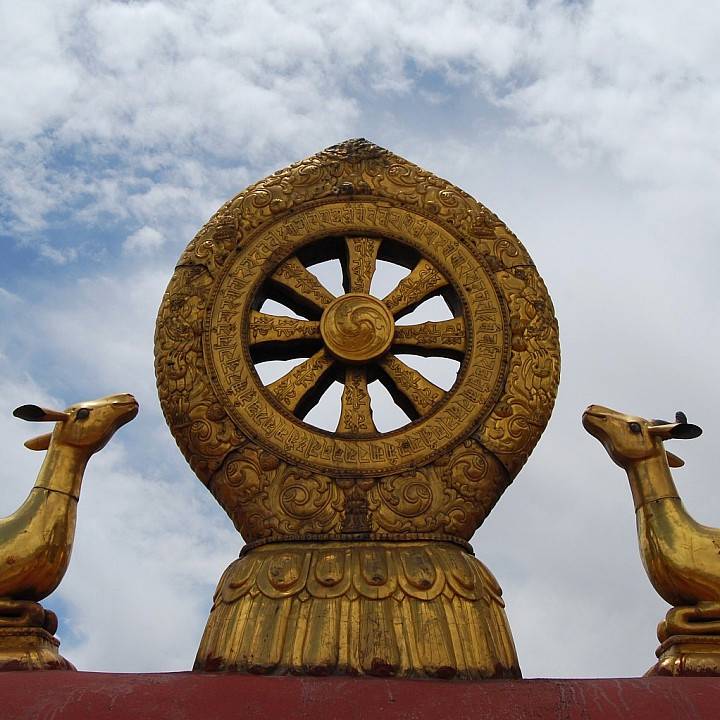
In Buddhist symbolism, the Noble Eightfold Path is often represented by means of the dharma wheel (dharmachakra), in which its eight spokes represent the eight elements of the path.
The Pali term ariya aṭṭhaṅgika magga (Sanskrit: āryāṣṭāṅgamārga) is typically translated in English as 'Noble Eightfold Path'. This translation is a convention started by the early translators of Buddhist texts into English, just like ariya sacca is translated as 'Four Noble Truths'. However, the phrase does not mean the path is noble, rather that the path is of the noble people (Pali: ariya, meaning 'enlightened, noble, precious people'). The term magga (Sanskrit: mārga) means 'path', while aṭṭhaṅgika (Sanskrit: aṣṭāṅga) means 'eightfold'. Thus, an alternate rendering of ariya aṭṭhaṅgika magga is 'eightfold path of the noble ones', or 'Eightfold Ariya Path'.
All eight elements of the Path begin with the word samyañc (in Sanskrit) or sammā (in Pāli) which means 'right, proper, as it ought to be, best'. The Buddhist texts contrast samma with its opposite, miccha.
The Noble Eightfold Path, in the Buddhist traditions, is the direct means to nirvana and brings a release from the cycle of life and death in the realms of samsara.
Noble Eightfold Path
The Noble Eightfold Path (Sanskrit: आर्याष्टाङ्गमार्ग, romanized: āryāṣṭāṅgamārga) or Eight Right Paths (Sanskrit: अष्टसम्यङ्मार्ग, romanized: aṣṭasamyaṅmārga) is an early summary of the path of Buddhist practices leading to liberation from samsara, the painful cycle of rebirth, in the form of nirvana.
The Eightfold Path consists of eight practices: right view, right resolve, right speech, right conduct, right livelihood, right effort, right mindfulness, and right samadhi ('meditative absorption or union'; alternatively, equanimous meditative awareness).
In early Buddhism, these practices started with understanding that the body-mind works in a corrupted way (right view), followed by entering the Buddhist path of self-observance, self-restraint, and cultivating kindness and compassion; and culminating in dhyana or samadhi, which reinforces these practices for the development of the body-mind. In later Buddhism, insight (prajñā) became the central soteriological instrument, leading to a different concept and structure of the path, in which the "goal" of the Buddhist path came to be specified as ending ignorance and rebirth.
The Noble Eightfold Path is one of the principal summaries of the Buddhist teachings, taught to lead to Arhatship. In the Theravada tradition, this path is also summarized as sila (morality), samadhi (meditation) and prajna (insight). In Mahayana Buddhism, this path is contrasted with the Bodhisattva path, which is believed to go beyond Arhatship to full Buddhahood.
In Buddhist symbolism, the Noble Eightfold Path is often represented by means of the dharma wheel (dharmachakra), in which its eight spokes represent the eight elements of the path.
The Pali term ariya aṭṭhaṅgika magga (Sanskrit: āryāṣṭāṅgamārga) is typically translated in English as 'Noble Eightfold Path'. This translation is a convention started by the early translators of Buddhist texts into English, just like ariya sacca is translated as 'Four Noble Truths'. However, the phrase does not mean the path is noble, rather that the path is of the noble people (Pali: ariya, meaning 'enlightened, noble, precious people'). The term magga (Sanskrit: mārga) means 'path', while aṭṭhaṅgika (Sanskrit: aṣṭāṅga) means 'eightfold'. Thus, an alternate rendering of ariya aṭṭhaṅgika magga is 'eightfold path of the noble ones', or 'Eightfold Ariya Path'.
All eight elements of the Path begin with the word samyañc (in Sanskrit) or sammā (in Pāli) which means 'right, proper, as it ought to be, best'. The Buddhist texts contrast samma with its opposite, miccha.
The Noble Eightfold Path, in the Buddhist traditions, is the direct means to nirvana and brings a release from the cycle of life and death in the realms of samsara.
Recent media
Recent media