Hubbry Logo
NoboriNoboriMain
Open search
Nobori
Community hub
Nobori
logo
8 pages, 0 posts
0 subscribers
Be the first to start a discussion here.
Nobori
Nobori
from Wikipedia

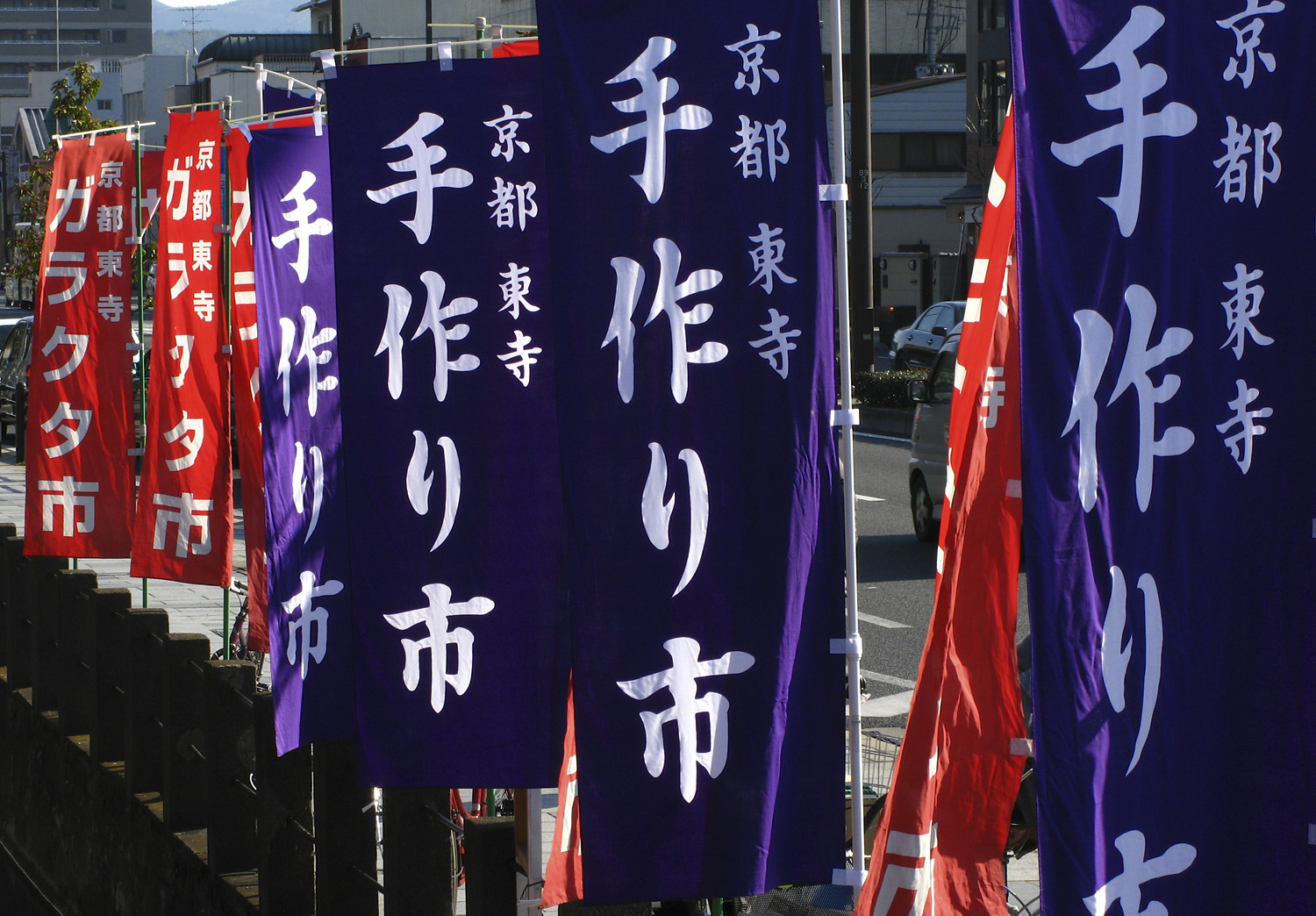
These colorful nobori outside Tō-ji announce a bazaar being held within the grounds of the temple.

Nobori () is a type of Japanese banner. They are long, narrow canvas flags, attached length-wise to a pole.[1] A cross-rod holds the fabric straight out to prevent it from furling around the rod; this way, the field is always visible and identifiable.

History of use

[edit]

The nobori were significant on the battlefields of feudal Japan. Nobori of the time were used to denote units within an army; they became much more common in the Sengoku period and were used alongside the earlier hata-jirushi. Though usually used to represent different divisions within an army, nobori were sometimes made identical, so as to produce an impressive and intimidating display of warrior flags.

Today, nobori are a common sight in Japan. Often, they are used for making announcements and advertising sales, products, or the name of a business; and can frequently be found outside retail stores, restaurants, and other businesses. Political parties also use nobori to identify themselves during election campaigns. In festivals and sports events, nobori are used in a similar fashion to the way banners and signs are used in Western sporting events. Shinto shrines or Buddhist temples may line walkways, fences or walls with nobori, frequently bearing the names of donors or deceased parishioners. In recent years, nobori influenced flags are gaining popularity around the world.[citation needed]

[edit]

See also

[edit]

References

[edit]
[edit]
Revisions and contributorsEdit on WikipediaRead on Wikipedia
from Grokipedia
Nobori (幟) are long, narrow vertical banners traditional to , typically made of canvas or fabric and mounted lengthwise on poles with a cross-rod to extend the material perpendicularly for visibility. Originating in the feudal era, nobori served as identifiers for units during battles, displaying symbols or to coordinate troops amid the chaos of combat. By the (1615–1868), their use expanded to civilian contexts, including festivals, processions, and celebrations such as the birth of a son, where they featured dynamic imagery like dancing figures to convey vitality and joy. In contemporary , nobori have evolved into a staple of outdoor advertising, prominently displayed outside shops, petrol stations, and events to promote goods like chilled noodles or conferences, leveraging their tall, eye-catching form for high visibility along streets and pathways. This enduring design, often 60 cm wide and up to several meters in height, embodies a blend of historical symbolism—rooted in the term's connotation of "rising" or ascending—and practical utility in both cultural rituals and commercial promotion.

Definition and Design

Physical Structure and Dimensions

Nobori banners feature a long, narrow rectangular form, designed for vertical suspension to maximize visibility from a distance. The fabric is oriented lengthwise along a central pole, with the width typically measuring 60 to 90 centimeters and the length ranging from 150 to 300 centimeters in standard configurations. This elongated shape allows the banner to flutter in the wind while maintaining a prominent profile, distinguishing it from broader flags or horizontal banners. Attachment occurs along the entire vertical edge to a pole, secured via reinforced tabs, loops, or pockets at the top and bottom for durability. A horizontal cross-rod at the upper end extends the fabric perpendicular to the pole, holding it outstretched to resist folding and ensure display even in low wind conditions. This structural element enhances aerodynamic stability, preventing the banner from wrapping around the pole. Size variations accommodate diverse applications, with compact models at 45 by 150 centimeters suitable for individual or indoor displays, while extended versions can exceed 600 centimeters for larger communal or ceremonial setups. These dimensions reflect adaptations for portability, wind exposure, and viewing scale, without altering the core narrow profile essential to the nobori's function.

Materials and Manufacturing Techniques

Traditional nobori were primarily constructed from fabric, transitioning from expensive imported varieties to domestically produced ones by the mid-Edo period, with early examples occasionally using and later instances employing for larger banners up to 5 meters in length. These materials provided durability suitable for outdoor display, though without modern synthetic treatments. Specialized variants like Honzome Koshu musha-nobori used plain fabrics dyed with Nara sumi ink mixed with for colorfastness. Manufacturing techniques emphasized resist-dyeing methods such as nori-zome or tsutsugaki, where flour and bran were kneaded into a paste, applied to sketched outlines on the fabric to create resists, and dried for several days before layering dyes and with Edo-style brushes for vivid, three-dimensional effects. Post-dyeing, the fabric underwent washing to remove paste residues, thorough sun drying to set colors and enhance longevity, and perimeter hemming reinforced with stitching to avert fraying and enable secure pole attachment. Designs favored bold, simple motifs applied via direct or brushes to ensure visibility at distance. Contemporary nobori shift to synthetic fabrics like knitted (typically 110–230 ) or vinyl, prized for inherent tear resistance, water repellency, and UV protection that prevents fading and structural degradation under prolonged exposure. These materials undergo or thermal dye sublimation for double-sided, fade-resistant graphics optimized for bold legibility. Assembly incorporates inner hemming along the vertical edge for pole sleeve insertion, reinforced edge stitching for wind stability, and horizontal slots or loops for cross-rod integration, which tensions the banner to preclude sagging or furling in breezes.

Historical Origins and Evolution

Early Development in Feudal

The nobori banner emerged during the (1336–1573), evolving from earlier flag forms such as the nagarebata, a freely hanging streamer that proved insufficiently stable for reliable signaling in combat. This transition addressed the practical demands of warfare amid Japan's fragmented feudal landscape, where forces required swift visual markers to distinguish units and commanders in dense, chaotic engagements involving and mounted warriors. The defining structural innovation of the nobori involved securing the banner's top edge and leading side directly to a central pole, augmented by a horizontal cross-rod to hold the narrow rectangular fabric taut and extended against wind resistance. Typically measuring around 3 to 6 meters in length and 30 to 60 centimeters in width, these early banners prioritized portability, allowing attachment to lances or dedicated staffs for mobile deployment across varied terrain, unlike bulkier continental designs. Initial designs were rudimentary, often featuring solid-color fields emblazoned with a single mon (heraldic crest) in contrasting for rapid identification at distances up to several hundred meters. Although rooted in broader East Asian signaling traditions, the nobori's adaptations emphasized causal effectiveness over ceremonial elaboration, reflecting Japan's emphasis on tactical realism in pre-gunpowder warfare. Period records, including military chronicles from the era, attest to their role in organizing foot soldiers and bannermen, laying the groundwork for standardized unit cohesion before the intensified conflicts of the Sengoku extension.

Military Applications During Sengoku and Edo Periods

During the Sengoku period (1467–1603), nobori banners served essential functions in battlefield logistics and command, primarily by denoting specific army units, marking commander positions, and signaling allegiances amid dense infantry engagements. Attached lengthwise to poles with a crossarm for rigidity, these narrow vertical flags enabled rapid visual identification across smoky, disordered fields, facilitating troop coordination and morale through standardized displays often bearing clan crests (mon). Warlords like Oda Nobunaga utilized distinctive nobori designs to differentiate their contingents, enhancing operational cohesion in major conflicts where melee tactics predominated. The prevalence of nobori increased as warfare intensified, with standard-bearers deploying them at (jin) and along front lines to guide reinforcements and intimidate foes via massed formations. Their role extended to psychological effects, projecting unity and resolve; historical accounts note rows of nobori delineating allied forces in assemblies numbering tens of thousands. In the (1603–1868), following Tokugawa unification and the cessation of widespread conflict, nobori transitioned from active combat tools to elements of pageantry, appearing in daimyo processions under the alternate attendance system and routine training maneuvers. This retention preserved hierarchical symbolism and visual discipline among retainer bands, though their practical utility waned with the adoption of firearms—exemplified at battles like Nagashino in 1575—and the shift to centralized, less decentralized armies reliant on linear tactics rather than clan-based signaling. By mid-century, production emphasized ornamental quality for parades over battlefield durability.

Traditional and Ceremonial Uses

Battlefield and Unit Identification

Nobori banners functioned as critical visual signals for unit and identification during feudal Japanese battles, enabling forces to maintain cohesion in the midst of dust, noise, and combat. Their tall, vertical design, often adorned with clan crests (mon) or distinctive colors, allowed warriors to spot allied units and leaders from afar, reducing disorientation on sprawling fields where thousands clashed. Typically borne by foot soldiers on long poles or spear shafts, nobori were deployed in multiples per unit to provide redundancy against losses from enemy fire or environmental factors like fog, ensuring persistent visibility for tactical coordination. This infantry-centric carrying method emphasized their role in signaling at the regimental or divisional level, distinct from personal back banners () worn by individuals. Compared to the larger, horse-mounted uma-jirushi standards reserved for and senior retainers, nobori offered empirical advantages in mobility and widespread deployment, as their lighter construction permitted rapid repositioning by foot troops without encumbering or command elements. Massed arrays of nobori thus supported broader orientation, aiding maneuvers like flanking or reinforcement rallies.

Festive, Religious, and Social Celebrations

During the (1603–1868), nobori banners shifted from battlefield roles to civic applications, including festivals, processions, and celebrations of male births. Families hoisted nobori featuring energetic dancing figures or auspicious motifs to announce a son's birth, embodying wishes for vigor and success. This practice, rooted in traditions, extended to common households by the late era, where carp-themed variants symbolized perseverance and prosperity on Boys' Day, observed around May 5. In religious settings, Shinto shrines and Buddhist temples deployed nobori to line walkways during processions and pilgrimages, often displaying donor names or protective symbols to invoke deities for communal well-being. These banners, believed to purify spaces and ward off malevolent forces, marked transitions from profane to sacred realms in rituals. Festival examples include civic displays of figures like Shōki the Demon Queller, adapted for public events to promote harmony and protection. Socially, nobori signified household milestones beyond births, such as community gatherings depicted in period art, reinforcing social bonds through visible emblems of achievement and continuity. Ukiyo-e woodblock prints from the 1700s to early 1800s captured urban festivities where rooftops and streets bristled with nobori, illustrating their role in collective celebrations like the "Feast of Banners." This adaptation preserved nobori's signaling function, evolving from martial identity to markers of familial and societal pride.

Modern Commercial and Cultural Applications

Advertising and Branding in

After , nobori banners transitioned from ceremonial and historical roles to widespread commercial applications, serving as an economical promotional tool for small businesses amid 's postwar economic recovery. Their vertical design and ability to flutter in the wind provided high visibility at low cost, making them ideal for shopfront displays and local events where digital alternatives were scarce or expensive. In rural areas and during festivals, nobori became staples for local enterprises, such as food stalls and retail outlets, specials like seasonal goods or grand openings to attract passersby. Custom-printed with business names, logos, or product promotions on lightweight , these banners—standardly 60 cm wide by 180 cm tall—offer durability against weather while enabling quick setup and removal. This postwar adaptation persists into the , with nobori supporting branding for small-scale operations in a dominated by larger chains, leveraging their cultural familiarity and motion-induced attention without reliance on or complex .

Adoption in Automotive and Global Subcultures

In (JDM) automotive subcultures, nobori flags emerged as popular decorative items from the late onward, often displayed in garages to emulate the banners of teams and tuning workshops. Enthusiasts replicated traditional designs with modern motifs, incorporating logos from brands to signify affiliation with high-performance modifications and heritage. Vendors specializing in JDM memorabilia offer these flags in durable , typically measuring 60 cm by 180 cm, for indoor wall hangs or event setups. The global dissemination of nobori flags accelerated in the alongside the expansion of drift racing communities and , where imports via enthusiast networks and platforms facilitated their use at car meets and track events. Custom-printed versions, affixed to vehicles or poles during drifts, enhance visual spectacle by fluttering to trace slide paths, drawing from Japanese precedents while adapting to local scenes. Online marketplaces report consistent availability, with listings for JDM-inspired flags surging in categories tied to import tuning, reflecting demand from international collectors. Contemporary variations preserve the vertical format and pole-mounted structure but include shorter iterations for compact indoor spaces and themed prints featuring automotive tuners or event-specific graphics, such as drift club insignias. These adaptations prioritize weather-resistant materials like for outdoor durability, enabling prolonged exposure at global gatherings without deviating from the elongated central to nobori .

Cultural Significance and Symbolism

Representations in Art and Iconography

Nobori appear frequently in 19th-century woodblock prints, capturing their role in festive scenes and symbolizing cultural vibrancy through elongated forms fluttering amid crowds. Utagawa (1797–1858), in works like the print depicting Suidōbashi Bridge and Surugadai from his One Hundred Famous Views of series (c. 1856–1858), portrayed vertical nobori banners bearing celebratory inscriptions and portraits of Shōki, the demon-quelling deity, to illustrate urban processions and seasonal events. These depictions emphasize the banners' dynamic verticality and bold motifs, which artists rendered with fluid lines to evoke movement and communal energy. Iconographic features of nobori in artistic representations prioritize legibility and impact, featuring oversized script, heraldic crests, or figurative elements such as mythical guardians and warriors executed in primary colors on plain fabric grounds. Designs evolved from samurai-era mon (family crests) to include promotional pictograms, yet retained stark simplicity for distant visibility, as seen in preserved artifacts that mirror print . A 1827 Edo-period nobori in the collection, composed of , , , and measuring approximately 338 x 27.5 inches, exemplifies this with its central image of an energetically dancing figure, a motif recurring in festival-themed art for its auspicious connotations. Preservation in institutional collections reveals the enduring efficacy of nobori's iconographic conventions, with minimal stylistic shifts from the 17th to 19th centuries underscoring their adaptation for visual signaling. The holds an Edo-period example in imported red wool with appliquéd warrior regalia, reflecting motifs of martial prowess that parallel those in battle or procession scenes. Such artifacts, corroborated by print evidence, affirm nobori's consistent portrayal as emblems of identity and spectacle in Japanese . Nobori banners differ from sashimono in scale and mounting: while sashimono consist of compact rectangular flags affixed directly to a warrior's backplate for individual identification amid the chaos of combat, nobori are elongated flags secured lengthwise to a dedicated pole with a cross-rod to extend the fabric perpendicularly, enabling visibility for entire squads or divisions from afar. This in nobori facilitated static or processional displays during advances, contrasting the portable, armor-integrated design of sashimono, which prioritized personal allegiance over group signaling. In comparison to uma-jirushi, nobori exhibit a more standardized vertical emphasis suited to foot troops, whereas uma-jirushi were oversized, often triangular or swallow-tailed heraldic standards carried by multiple attendants or lashed to horseback for oversight, underscoring command hierarchy rather than subunit cohesion. Nobori's hoist-to-pole attachment and crossarm bracing allowed for efficient deployment in linear formations, diverging from the bulkier, mobile orientation of uma-jirushi that demanded equine or human relays for sustained presence. Nobori also contrast with koinobori, the carp-shaped windsocks flown horizontally on poles during celebrations to evoke aspirational motifs of overcoming adversity; nobori's taut, planar form resists wind-furling via internal rods, prioritizing emblematic clarity over the dynamic, tubular inflation of koinobori. Despite overlaps in materials such as dyed silk or cotton bearing familial mon crests, nobori's dimensions—typically 60 cm wide by several meters tall—exceed the variable, streamer-like proportions of koinobori, with the former's cross-rod mechanism absent in the latter's flexible, vented construction.

References

Add your contribution
Related Hubs
User Avatar
No comments yet.