


Community hub
Recent from talks
Contribute something
Nothing was collected or created yet.
Shinto shrine
View on Wikipedia
| Part of a series on |
| Shinto |
|---|
 |

A Shinto shrine (神社, jinja; archaic: shinsha, meaning: 'kami shrine')[1] is a structure whose main purpose is to house ("enshrine") one or more kami, the deities of the Shinto religion.[2]
The main hall (本殿, honden)[note 1] is where a shrine's patron kami is or are enshrined.[2][3] The honden may be absent in cases where a shrine stands on or near a sacred mountain, tree, or other object which can be worshipped directly or in cases where a shrine possesses either an altar-like structure, called a himorogi, or an object believed to be capable of attracting spirits, called a yorishiro, which can also serve as direct bonds to a kami.[4] There may be a hall of worship (拝殿, haiden) and other structures as well.
Although only one word ("shrine") is used in English, in Japanese, Shinto shrines may carry any one of many different, non-equivalent names like gongen, -gū, jinja, jingū, mori, myōjin, -sha, taisha, ubusuna, or yashiro. Miniature shrines (hokora) can occasionally be found on roadsides. Large shrines sometimes have on their precincts miniature shrines, sessha (摂社) or massha (末社).[note 2] Mikoshi, the palanquins which are carried on poles during festivals (matsuri), also enshrine kami and are therefore considered shrines.
In 927 CE, the Engi-shiki (延喜式; lit. 'Procedures of the Engi Era') was promulgated. This work listed all of the 2,861 Shinto shrines existing at the time, and the 3,131 official-recognized and enshrined kami.[5] In 1972, the Agency for Cultural Affairs placed the number of shrines at 79,467, mostly affiliated with the Association of Shinto Shrines (神社本庁).[6] Some shrines, such as the Yasukuni Shrine, are totally independent of any outside authority.[7] The number of Shinto shrines in Japan is estimated to be around 100,000.[8]
Since ancient times, the Shake (社家) families dominated Shinto shrines through hereditary positions, and at some shrines the hereditary succession continues to present day.
The Unicode character representing a Shinto shrine (for example, on maps) is U+26E9 ⛩ SHINTO SHRINE.
Etymology
[edit]
Jinja (神社) is the most general word for a Shinto shrine.[9] Any place that has a honden (本殿) is a jinja.[2] The word jinja used to have two more readings, kamu-tsu-yashiro and mori, both of which are kun'yomi readings and mean 'kami grove'.[10] Both of these older readings can be found, for example, in the Man'yōshū.[10]
Sha (社), the second character in jinja (神社) by itself, was not initially a secular term. Historically, in Chinese, it could refer to a Tudigong or 'soil god', a kind of tutelary deity seen as subordinate to the City Gods.[11] Such deities are also often called shèshén (社神) or shénshè (神社).[11] The kun'yomi reading of sha, yashiro, is a generic term for a Shinto shrine, much like jinja.[2][10] Sha or, occasionally, ja can also be used as a suffix, as in Shinmei-sha or Tenjin-ja. As a suffix, this indicates a minor shrine that has received a kami from a more important shrine through the kanjō process.[9]
Mori (杜; lit. 'grove') are places where kami are present.[2] These places can therefore be shrines and, in fact, 神社, 社 and 杜 can all be read as mori.[10] This reading reflects the fact that the first shrines were simply sacred groves or forests where kami were present.[10]
Hokora or hokura (神庫) are extremely small shrines like the ones that can be found, for example, along country roads.[12] The term hokora (祠), believed to have been one of the first words for a Shinto shrine, evolved from the word hokura (神庫; lit. 'kami repository'). This fact seems to indicate that the first shrines were huts built to house yorishiro.[13][note 3]
-gū (宮) indicates a shrine enshrining an imperial prince. However, there are many instances where it is used simply as a tradition.[9] The word gū (宮), often found at the end of shrine names such as Hachimangū, Tenmangū, or Jingū (神宮), comes from the Chinese word gong (宮), meaning 'a palace or a temple to a high deity'.
A jingū (神宮) is a shrine of particularly high status that has a deep relationship with the Imperial household or enshrines an Emperor. This is the case for both Ise Jingū and Meiji Jingū.[9] Jingū alone, however, only refers to Ise Jingū, whose official name is just that.[9] It is a formulation close to jinja (神社), with the character sha (社) being replaced with gū (宮) to emphasize its high rank.
Miya (宮), the kun'yomi reading of -gū, indicates a shrine that is enshrining a special kami or a member of the Imperial household like the Empress. However, there are many examples, much like with -gū, in which it is used simply as a tradition.[2] During the period of state regulation, many shrines changed the -miya in their names to jinja.
A taisha or ōyashiro (大社; lit. 'great shrine') is a shrine that was classified as such under the old system of shrine ranking, the shakaku (社格), which was abolished in 1946.[2][14] Many shrines carrying that shōgō or 'title' adopted it only after the war.[9]
A chinjusha (鎮守社・鎮社; tutelary shrine) is a shrine housing a tutelary kami that protects a given area, village, building, or Buddhist temple. The word chinjusha comes from the words chinju (鎮守・鎮; guardian) and sha (社; shrine).
Setsumatsusha (摂末社)[15] is a combination of two words: sessha (摂社; auxiliary shrine) and massha (末社; undershrine).[16] They are also called eda-miya (枝宮; branch shrines).[16]
During the Japanese Middle Ages, shrines started being called gongen (権現), a term of Buddhist origin.[17] For example, in Eastern Japan, there are still many Hakusan shrines where the shrine itself is called gongen.[17] Because it represents the application of Buddhist terminology to Shinto kami, its use was legally abolished by the Meiji government with the Shinto and Buddhism Separation Order (神仏判然令, Shin-butsu Hanzenrei), and shrines began to be called jinja.[17]
History
[edit]Early origins
[edit]
Ancestors are kami to be worshipped. Yayoi period village councils sought the advice of ancestors and other kami, and developed instruments, yorishiro (依り代; lit. 'approach substitute'), to evoke them.[18] These were conceived to attract the kami and allow them physical space, thus making kami accessible to human beings.[18]
Village council sessions were held in quiet spots in the mountains or in forests near great trees or other natural objects that served as yorishiro.[18] These sacred places and their yorishiro gradually evolved into today's shrines, whose origins can be still seen in the Japanese words for "mountain" and "forest", which can also mean "shrine".[18] Many shrines have on their grounds one of the original great yorishiro: a big tree, surrounded by a sacred rope called a shimenawa (標縄・注連縄・七五三縄).[18][note 4]
The first buildings at places dedicated to worship were hut-like structures built to house some yorishiro.[18] A trace of this origin can be found in the term hokura (神庫; lit. 'deity storehouse'), which evolved into hokora (written identically) and is considered to be one of the first words for shrine.[18][note 5]
First temporary shrines
[edit]True shrines arose with the beginning of agriculture, when the need arose to attract kami to ensure good harvests.[19] These were, however, just temporary structures built for a particular purpose, a tradition of which's traces can be found in some rituals.[19][clarification needed]
Hints of the first shrines can still be found.[18] Ōmiwa Shrine in Nara, for example, contains no sacred images or objects because it is believed to serve the mountain on which it stands—images or objects are therefore unnecessary.[18][20] For the same reason, it has a worship hall, a haiden (拝殿), but no place to house the kami, a shinden (神殿).[18] Archeology confirms that, during the Yayoi period, the most common shintai (神体), a yorishiro actually housing the enshrined kami, in the earliest shrines were nearby mountain peaks that supplied stream water to the plains where people lived.[21]
Besides Ōmiwa Shrine, another important example is Mount Nantai, a phallus-shaped mountain in Nikko which constitutes Futarasan Shrine's shintai.[21] The name Nantai (男体) means 'man's body'.[21] The mountain provides water to the rice paddies below and has the shape of the phallic stone rods found in pre-agricultural Jōmon sites.[21]
First known shrine
[edit]The first known Shinto shrine was built in roughly 478.[22]
Rites and ceremonies
[edit]In 905 CE, Emperor Daigo ordered a compilation of Shinto rites and rules. Previous attempts at codification are known to have taken place, but, neither the Konin nor the Jogan Gishiki[23] survive. Initially under the direction of Fujiwara no Tokihira, the project stalled at his death in April 909. Fujiwara no Tadahira, his brother, took charge and, in 927,[24] the Engi-shiki (延喜式; lit. 'Procedures of the Engi Era') was promulgated in fifty volumes.
This, the first formal codification of Shinto rites and Norito (liturgies and prayers) to survive, became the basis for all subsequent Shinto liturgical practice and efforts.[25] In addition to the first ten volumes of this fifty volume work, which concerned worship and the Department of Worship, sections in subsequent volumes addressing the Ministry of Ceremonies (治部省) and the Ministry of the Imperial Household (宮内省) regulated Shinto worship and contained liturgical rites and regulation.[26] In 1970, Felicia Gressitt Brock published a two-volume annotated English language translation of the first ten volumes with an introduction entitled Engi-shiki; procedures of the Engi Era.
Arrival and influence of Buddhism
[edit]The arrival of Buddhism in Japan in around the sixth century introduced the concept of a permanent shrine.[19] A great number of Buddhist temples were built next to existing shrines in mixed complexes called jingū-ji (神宮寺; lit. 'shrine temple') to help priesthood deal with local kami, making those shrines permanent. Some time in their evolution, the word miya (宮), meaning 'palace', came into use, indicating that shrines had, by then, become the imposing structures of today.[18]
Once the first permanent shrines were built, Shinto revealed a strong tendency to resist architectural change, a tendency which manifested itself in the so-called shikinen sengū-sai (式年遷宮祭), the tradition of rebuilding shrines faithfully at regular intervals, adhering strictly to their original design. This custom is the reason ancient styles have been replicated throughout the centuries to the present day, remaining more or less intact.[19]
Ise Grand Shrine, still rebuilt every 20 years, is its best extant example. In Shinto, it has played a particularly significant role in preserving ancient architectural styles.[19] Izumo Taisha, Sumiyoshi Taisha, and Nishina Shinmei Shrine each represent a different style whose origin is believed to predate Buddhism in Japan. These three styles are known respectively as taisha-zukuri, sumiyoshi-zukuri, and shinmei-zukuri.
Shrines show various influences, particularly that of Buddhism, a cultural import which provided much of Shinto architecture's vocabulary. The rōmon (楼門, tower gate),[note 6] the haiden, the kairō (回廊, corridor), the tōrō, or 'stone lantern', and the komainu, or 'lion dogs', are all elements borrowed from Buddhism.
Shinbutsu shūgō and the jingūji
[edit]
Until the Meiji period (1868–1912), shrines as they exist today were rare. With very few exceptions like Ise Grand Shrine and Izumo Taisha, they were just a part of a temple-shrine complex controlled by Buddhist clergy.[27] These complexes were called jingū-ji (神宮寺; lit. 'shrine temple'), places of worship composed of a Buddhist temple and of a shrine dedicated to a local kami.[28]
The complexes were born when a temple was erected next to a shrine to help its kami with its karmic problems. At the time, kami were thought to be also subjected to karma, and therefore in need of a salvation only Buddhism could provide. Having first appeared during the Nara period (710–794), the jingū-ji remained common for over a millennium until, with few exceptions, they were destroyed in compliance with the new policies of the Meiji administration in 1868.
Shinbutsu bunri
[edit]The Shinto shrine went through a massive change when the Meiji administration promulgated a new policy of separation of kami and foreign Buddhas (shinbutsu bunri) with the Kami and Buddhas Separation Order (神仏判然令, Shinbutsu Hanzenrei). This event triggered the haibutsu kishaku, a violent anti-Buddhist movement which in the final years of the Tokugawa shogunate and during the Meiji Restoration caused the forcible closure of thousands of Buddhist temples, the confiscation of their land, the forced return to lay life of monks, and the destruction of books, statues and other Buddhist property.[29]
Until the end of Edo period, local kami beliefs and Buddhism were intimately connected in what was called shinbutsu shūgō (神仏習合), up to the point where even the same buildings were used as both Shinto shrines and Buddhist temples.
After the law, the two would be forcibly separated. This was done in several stages. At first, an order issued by the Jingijimuka in April 1868 ordered the defrocking of shasō and bettō (shrine monks performing Buddhist rites at Shinto shrines).[30] A few days later, the Daijōkan banned the application of Buddhist terminology such as gongen to Japanese kami and the veneration of Buddhist statues in shrines.[31]
The third stage consisted of the prohibition against applying the Buddhist term Daibosatsu (Great Bodhisattva) to the syncretic kami Hachiman at the Iwashimizu Hachiman-gū and Usa Hachiman-gū shrines.[31] In the fourth and final stage, all the defrocked bettō and shasō were told to become "shrine priests" (kannushi) and return to their shrines.[31] Monks of the Nichiren sect were told not to refer to some deities as kami.[31]
After a short period in which it enjoyed popular favor, the process of separation of Buddhas and kami however stalled and is still only partially completed. To this day, almost all Buddhist temples in Japan have a small shrine (chinjusha) dedicated to its Shinto tutelary kami, and vice versa Buddhist figures (e.g. goddess Kannon) are revered in Shinto shrines.[32]
Shintai
[edit]
The defining features of a shrine are the kami it enshrines and the shintai (or go-shintai if the honorific prefix go- is used) that houses it. While the name literally means 'body of a kami', shintai are physical objects worshiped at or near Shinto shrines because a kami is believed to reside in them.[33] Shintai are not themselves part of kami, but rather just symbolic repositories which make them accessible to human beings for worship;[34] the kami inhabits them.[35] Shintai are also of necessity yorishiro, that is objects by their very nature capable of attracting kami.
The most common shintai are objects like mirrors, swords, jewels (for example comma-shaped stones called magatama), gohei (wands used during religious rites), and sculptures of kami called shinzō (神像),[note 7] but they can be also natural objects such as rocks, mountains, trees, and waterfalls.[33] Mountains were among the first, and are still among the most important, shintai, and are worshiped at several famous shrines. A mountain believed to house a kami, as for example Mount Fuji or Mount Miwa, is called a shintai-zan (神体山).[36] In the case of a man-made shintai, a kami must be invited to reside in it.[35]
The founding of a new shrine requires the presence of either a pre-existing, naturally occurring shintai (for example a rock or waterfall housing a local kami), or of an artificial one, which must therefore be procured or made to the purpose. An example of the first case are the Nachi Falls, worshiped at Hiryū Shrine near Kumano Nachi Taisha and believed to be inhabited by a kami called Hiryū Gongen.[37]
The first duty of a shrine is to house and protect its shintai and the kami which inhabits it.[35] If a shrine has more than one building, the one containing the shintai is called the honden; because it is meant for the exclusive use of the kami, it is always closed to the public and is not used for prayer or religious ceremonies. The shintai leaves the honden only during festivals (matsuri), when it is put in portable shrines (mikoshi) and carried around the streets among the faithful.[35] The portable shrine is used to physically protect the shintai and to hide it from sight.[35]
Re-enshrinement
[edit]Often, the opening of a new shrine will require the ritual division of a kami and the transferring of one of the two resulting spirits to the new location, where it will animate the shintai. This process is called kanjō, and the divided spirits bunrei (分霊; lit. 'divided spirit'), go-bunrei (御分霊), or wakemitama (分霊).[38] This process of propagation, described by the priests, in spite of this name, not as a division but as akin to the lighting of a candle from another already lit, leaves the original kami intact in its original place and therefore does not alter any of its properties.[38] The resulting spirit has all the qualities of the original and is therefore "alive" and permanent.[38] The process is used often—for example during Shinto festivals (matsuri) to animate temporary shrines called mikoshi.[39]
The transfer does not necessarily take place from a shrine to another: the divided spirit's new location can be a privately owned object or an individual's house.[40] The kanjō process was of fundamental importance in the creation of all of Japan's shrine networks (Inari shrines, Hachiman shrines, etc.).
Shake families
[edit]The shake (社家) are families and the former social class that dominated Shinto shrines through hereditary positions within a shrine. The social class was abolished in 1871, but many shake families still continue hereditary succession until present day and some were appointed hereditary nobility (Kazoku) after the Meiji Restoration.[41]
Some of the most well-known shake families include:
- Arakida and Watarai of Ise Grand Shrine[42]
- Senge and Kitajima of Izumo Taisha[42]
- Ōnakatomi of Kasuga Taisha[42]
- Urabe of Yoshida Shrine[42]
Famous shrines and shrine networks
[edit]Those worshiped at a shrine are generally Shinto kami, but sometimes they can be Buddhist or Taoist deities, as well as others not generally considered to belong to Shinto.[note 8] Some shrines were established to worship living people or figures from myths and legends. An example is the Tōshō-gū shrines erected to enshrine Tokugawa Ieyasu, or the many shrines dedicated to Sugawara no Michizane, like Kitano Tenman-gū.

Often, the shrines which were most significant historically do not lie in a former center of power like Kyoto, Nara, or Kamakura. For example, Ise Grand Shrine, the Imperial household's family shrine, is in Mie prefecture. Izumo-taisha, one of the oldest and most revered shrines in Japan, is in Shimane Prefecture.[44] This is because their location is that of a traditionally important kami, and not that of temporal institutions.
Some shrines exist only in one locality, while others are at the head of a network of branch shrines (分社, bunsha).[45] The spreading of a kami can be evoked by one or more of several different mechanisms. The typical one is an operation called kanjō, a propagation process through which a kami is invited to a new location and there re-enshrined. The new shrine is administered completely independent from the one it originated from.
However, other transfer mechanisms exist. In Ise Grand Shrine's case, for example, its network of Shinmei shrines (from Shinmei (神明), another name for Amaterasu) grew due to two concurrent causes. During the late Heian period the cult of Amaterasu, worshiped initially only at Ise Grand Shrine, started to spread to the shrine's possessions through the usual kanjō mechanism.[45]
Later, branch shrines started to appear further away. The first evidence of a Shinmei shrine far from Ise is given by the Azuma Kagami, a Kamakura-period text which refers to Amanawa Shinmei-gū's appearance in Kamakura, Kanagawa. Amaterasu began to be worshiped in other parts of the country because of the so-called tobi shinmei (飛び神明, flying Shinmei) phenomenon, the belief that she would fly to other locations and settle there.[45] Similar mechanisms have been responsible for the spreading around the country of other kami.
Notable shrines
[edit]
The Ise Grand Shrine in Mie prefecture is, with Izumo-taisha, the most representative and historically significant shrine in Japan.[46] The kami the two enshrine play fundamental roles in the Kojiki and Nihon Shoki, two texts of great importance to Shinto.[46] Because its kami, Amaterasu, is an ancestor of the Emperor, Ise Grand Shrine is the Imperial Household's family shrine. Ise Grand Shrine is dedicated specifically to the emperor. In the past, even his mother, wife and grandmother needed his permission to worship there.[47] Its traditional and mythological foundation date goes back to 4 BCE, but historians believe it was founded around the 3rd to 5th century CE.
Izumo Taisha in Shimane Prefecture is so old that no document about its origin survives, and the year of foundation is unknown. The shrine is the center of a series of sagas and myths.[46] The kami it enshrines, Ōkuninushi, created Japan before it was populated by Amaterasu's offspring, the Emperor's ancestors.[46] Because of its physical remoteness, in historical times Izumo has been eclipsed in fame by other sites, but there is still a widespread belief that in October all Japanese gods meet there.[46] For this reason, October is also known as the "Month Without Gods" (神無月, Kannazuki; one of its names in the old lunar calendar), while at Izumo Taisha alone it is referred to as the Month With Gods (神在月・神有月, Kamiarizuki).[48]
.jpg)
Fushimi Inari Taisha is the head shrine of the largest shrine network in Japan, which has more than 32,000 members, about a third of the total. Inari Okami worship started here in the 8th century and has continued ever since, expanding to the rest of the country. Located in Fushimi-ku, Kyoto, the shrine sits at the base of a mountain also named Inari and includes trails up the mountain to many smaller shrines. Another very large example is the Yūtoku Inari Shrine in Kashima City, Saga Prefecture.
Ōita Prefecture's Usa Shrine, called in Japanese Usa Jingū or Usa Hachiman-gū, is together with Iwashimizu Hachiman-gū, the head of the Hachiman shrine network.[49] Hachiman worship started here at least as far back as the Nara period (710–794). In 860, the kami was divided and brought to Iwashimizu Hachiman-gū in Kyoto, which became the focus of Hachiman worship in the capital.[50] Located on top of Mount Otokoyama, Usa Hachiman-gū is dedicated to Emperor Ōjin, his mother Empress Jingū, and female kami Hime no Okami.[51]
Itsukushima Shrine is, together with Munakata Taisha, at the head of the Munakata shrine network. Remembered for its torii raising from the waters, it is a UNESCO World Heritage Site. The shrine is dedicated to the three daughters of Susano-o no Mikoto, kami of seas and storms and brother of the great sun kami.
Kasuga Taisha is a Shinto shrine in the city of Nara, in Nara Prefecture, Japan. Established in 768 AD and rebuilt several times over the centuries, it is the shrine of the Fujiwara family. The interior is noted for its many bronze lanterns, as well as the many stone lanterns that lead up the shrine. The architectural style Kasuga-zukuri takes its name from Kasuga Taisha's honden.

The Kumano Sanzan shrine complex, head of the Kumano shrine network, includes Kumano Hayatama Taisha (Wakayama Prefecture, Shingu), Kumano Hongu Taisha (Wakayama Prefecture, Tanabe), and Kumano Nachi Taisha (Wakayama Prefecture, Nachikatsuura).[52] The shrines lie between 20 and 40 kilometres (12 and 25 mi) one from the other.[52] They are connected by the pilgrimage route known as Kumano Sankeimichi (熊野参詣道). The great Kumano Sanzan complex also includes two Buddhist temples, Seiganto-ji and Fudarakusan-ji.[note 9][52]
The religious significance of the Kumano region goes back to prehistoric times and predates all modern religions in Japan.[52] The area was, and still is, considered a place of physical healing.
Yasukuni shrine, in Tokyo, is dedicated to the soldiers and others who died fighting on behalf of the Emperor of Japan.
San Marino Shrine in Serravalle, San Marino, is the first official Shinto shrine in Europe supported by the Jinja Honcho.
Shrine networks
[edit]There are an estimated 80,000 shrines in Japan.[53] The majority of Shinto shrines are associated with a shrine network.[8] This number includes only shrines with resident priests. If smaller shrines, such as roadside or household shrines are included, the number would be twice the amount. These are highly concentrated.[54] Over one-third, 30,000, are associated with Inari. The top six networks comprise over 90% of all shrines. There are at least 20 networks with over 200 shrines.
The next ten largest networks contain between 2,000 branches down to about 200 branches, and include the networks headed by Matsunoo-taisha, Kibune Shrine, and Taga-taisha, among others.
Inari shrines
[edit]The number of branch shrines gives an approximate indication of their religious significance, and neither Ise Grand Shrine nor Izumo-taisha can claim the first place.[44] By far the most numerous are shrines dedicated to Inari, tutelary kami of agriculture popular all over Japan, which alone constitute almost a third of the total.[45] Inari protects fishing, commerce, and productivity in general. Many modern Japanese corporations have shrines dedicated to Inari on their premises. Inari shrines are usually very small and easy to maintain, but can be very large, as in the case of Fushimi Inari Taisha, the head shrine of the network. The kami is enshrined in some Buddhist temples.[44]
The entrance to an Inari shrine is usually marked by one or more vermilion torii and two white foxes. This red color has come to be identified with Inari because of the prevalence of its use among Inari shrines and their torii.[55] The kitsune statues are at times mistakenly believed to be a form assumed by Inari, and they typically come in pairs, representing a male and a female, although sex is usually not obvious.[56] These fox statues hold a symbolic item in their mouths or beneath a front paw—most often a jewel and a key, but a sheaf of rice, a scroll, or a fox cub are common. Almost all Inari shrines, no matter how small, will feature at least a pair of these statues, usually flanking, on the altar, or in front of the main sanctuary.[56]
Hachiman shrines
[edit]
A syncretic entity worshiped as both a kami and a Buddhist daibosatsu, Hachiman is intimately associated with both learning and warriors.[45] In the sixth or seventh century, Emperor Ōjin and his mother Empress Jingū came to be identified together with Hachiman.[57] First enshrined at Usa Hachiman-gū in Ōita Prefecture, Hachiman was deeply revered during the Heian period. According to the Kojiki, it was Ōjin who invited Korean and Chinese scholars to Japan, and for this reason he is the patron of writing and learning.
Because as Emperor Ōjin he was an ancestor of the Minamoto clan, Hachiman became the tutelary kami (氏神, ujigami) of the Minamoto samurai clan[45] of Kawachi (Osaka). After Minamoto no Yoritomo became shōgun and established the Kamakura shogunate, Hachiman's popularity grew, and he became by extension the protector of the warrior class the shōgun had brought to power. For this reason, the shintai of a Hachiman shrine is usually a stirrup or a bow.[57]
During the Japanese medieval period, Hachiman worship spread throughout Japan among samurai and the peasantry. There are 25,000 shrines in Japan dedicated to him, the second most numerous after those of the Inari network.[45] Usa Hachiman-gū is the network's head shrine together with Iwashimizu Hachiman-gū. However, Hakozaki Shrine and Tsurugaoka Hachiman-gū are historically no less significant shrines and are more popular.
Shinmei shrines
[edit]While the ritsuryō legal system was in use, visits by commoners to Ise were forbidden.[45] With its weakening during the Heian period, commoners started being allowed in the shrine. The growth of the Shinmei shrine network was due to two concomitant causes. During the late Heian period, goddess Amaterasu, worshiped initially only at Ise Grand Shrine, started to be re-enshrined in branch shrines in Ise's own possessions through the typical kanjō mechanism. The first evidence of a Shinmei shrine elsewhere is given by the Azuma Kagami, a Kamakura period text which refers to Amanawa Shinmei-gū's appearance in Kamakura.[45] Amaterasu spread to other parts of the country because of the so-called tobi shinmei (飛び神明; lit. 'flying Shinmei') phenomenon, the belief that Amaterasu flew to other locations and settled there.[45]
Tenjin shrines
[edit]The Tenjin shrine network enshrines 9th-century scholar Sugawara no Michizane. Sugawara had originally been enshrined to placate his spirit, not to be worshiped.[58] Michizane had been unjustly exiled in his life, and it was necessary to somehow placate his rage, believed to be the cause of a plague and other disasters. Kitano Tenman-gū was the first of the shrines dedicated to him. Because in life he was a scholar, he became the kami of learning, and during the Edo period schools often opened a branch shrine for him.[45] Another important shrine dedicated to him is Dazaifu Tenman-gū.
Munakata shrines
[edit]Headed by Kyūshū's Munakata Taisha and Itsukushima Shrine, shrines in this network enshrine the Three Female Kami of Munakata (宗像三女神, Munakata Sanjoshin), namely Chikishima Hime-no-Kami, Tagitsu Hime-no-Kami, and Tagori Hime-no-Kami.[59] The same three kami are enshrined elsewhere in the network, sometimes under a different name. However, while Munakata Taisha enshrines all three in separate islands belonging to its complex, branch shrines generally do not. Which kami they enshrine depends on the history of the shrine and the myths tied to it.[59]
Suwa Shrines
[edit]Suwa Shrines are branch shrines of Suwa Taisha.
Hiyoshi shrines
[edit]Hiyoshi shrines are branch shrines of Hiyoshi Taisha. They have origins in Sannō Ichijitsu Shintō and worship Oyamakui no Kami.
Kumano shrines
[edit]Kumano shrines enshrine the three Kumano mountains: Hongū, Shingū, and Nachi (the Kumano Gongen (熊野権現)).[60] The point of origin of the Kumano cult is the Kumano Sanzan shrine complex, which includes Kumano Hayatama Taisha (熊野速玉大社) (Wakayama Prefecture, Shingu), Kumano Hongu Taisha (Wakayama Prefecture, Tanabe), and Kumano Nachi Taisha (Wakayama Prefecture, Nachikatsuura).[52] There are more than 3,000 Kumano shrines in Japan.
Gion Shrines
[edit]Gion shrines are branch shrines of Tsushima Shrine, Yasaka Shrine or Hiromine Shrine. Historically associated with Gozu Tenno, they became dedicated to Susanoo during the separation of Shinto and Buddhism.
Structure
[edit]
The following is a list and diagram illustrating the most important parts of a Shinto shrine:
- Torii – Shinto gate
- Stone stairs
- Sandō – the approach to the shrine
- Chōzuya or temizuya – place of purification to cleanse one's hands and mouth
- Tōrō – decorative stone lanterns
- Kagura-den – building dedicated to Noh or the sacred kagura dance
- Shamusho – the shrine's administrative office
- Ema – wooden plaques bearing prayers or wishes
- Sessha and massha – small auxiliary shrines
- Komainu – the so-called "lion dogs", guardians of the shrine
- Haiden – oratory or hall of worship
- Tamagaki – fence surrounding the honden
- Honden – main hall, enshrining the kami
- On the roof of the haiden and honden are visible chigi (forked roof finials) and katsuogi (short horizontal logs), both common shrine ornamentations.
The general blueprint of a Shinto shrine is Buddhist in origin.[18] The presence of verandas, stone lanterns, and elaborate gates is an example of this influence. The composition of a Shinto shrine is extremely variable, and none of its many possible features is necessarily present. Even the honden can be missing if the shrine worships a nearby natural shintai.
Since its grounds are sacred, they are usually surrounded by a fence made of stone or wood called tamagaki. Access is made possible by an approach called sandō. The entrances are straddled by gates called torii, which are usually the simplest way to identify a Shinto shrine.

A shrine may include within its grounds several structures, each built for a different purpose.[61] Among them are the honden or sanctuaries, where the kami are enshrined, the heiden or hall of offerings, where offers and prayers are presented, and the haiden or hall of worship, where there may be seats for worshippers.[61] The honden is the building that contains the shintai, literally, 'the sacred body of the kami'.[note 11]
Of these, only the haiden is open to the laity. The honden is usually located behind the haiden and is often much smaller and unadorned. Other notable shrine features are the temizuya, the fountain where visitors cleanse their hands and mouth, and the shamusho (社務所), the office which oversees the shrine.[61] Buildings are often adorned by chigi and katsuogi, variously oriented poles which protrude from their roof.
Before the Meiji Restoration it was common for a Buddhist temple to be built inside or next to a shrine, or vice versa.[63] If a shrine housed a Buddhist temple, it was called a jingūji (神宮寺). Analogously, temples all over Japan adopted tutelary kami (鎮守・鎮主, chinju) and built temple shrines (寺社, jisha) to house them.[64] After the forcible separation of Buddhist temples and Shinto shrines (shinbutsu bunri) ordered by the new government in the Meiji period, the connection between the two religions was officially severed, but continued nonetheless in practice and is still visible today.[63]
Architectural styles
[edit]Shrine buildings can have many different basic layouts, usually named either after a famous shrine's honden (e.g. hiyoshi-zukuri, named after Hiyoshi Taisha), or a structural characteristic (e.g., irimoya-zukuri, after the hip-and gable roof it adopts. The suffix -zukuri in this case means 'structure'.)
The honden's roof is always gabled, and some styles have a veranda-like aisle called hisashi (a 1-ken wide corridor surrounding one or more sides of the core of a shrine or temple). Among the factors involved in the classification, important are the presence or absence of:
- hirairi or hirairi-zukuri (平入・平入造) – a style of construction in which the building has its main entrance on the side which runs parallel to the roof's ridge (non gabled-side). The shinmei-zukuri, nagare-zukuri, hachiman-zukuri, and hie-zukuri belong to this type.[65]
- tsumairi or tsumairi-zukuri (妻入・妻入造) – a style of construction in which the building has its main entrance on the side which runs perpendicular to the roof's ridge (gabled side). The taisha-zukuri, sumiyoshi-zukuri, ōtori-zukuri and kasuga-zukuri belong to this type.[65]
Proportions are important. A building of a given style often must have certain proportions measured in ken (the distance between pillars, a quantity variable from one shrine to another or even within the same shrine).
The oldest styles are the tsumairi shinmei-zukuri, taisha-zukuri, and sumiyoshi-zukuri, believed to predate the arrival of Buddhism.[65]
The two most common are the hirairi nagare-zukuri and the tsumairi kasuga-zukuri.[66] Larger, more important shrines tend to have unique styles.
Most common styles
[edit]The following are the two most common shrine styles in Japan.
Nagare-zukuri
[edit]
The flowing style (流造, nagare-zukuri) or flowing gabled style (流破風造, nagare hafu-zukuri) is a style characterized by a very asymmetrical gabled roof or kirizuma-yane (切妻屋根), projecting outwards on the non-gabled side, above the main entrance, to form a portico.[66]
This is the feature which gives the style its name, the most common among shrines all over Japan. Sometimes the basic layout consisting of an elevated core (母屋, moya) partially surrounded by a veranda called hisashi (all under the same roof) is modified by the addition of a room in front of the entrance.[66]
The honden varies in roof ridge length from 1 to 11 ken, but is never 6 or 8 ken.[67] The most common sizes are 1 and 3 ken. The oldest shrine in Japan, Uji's Ujigami Shrine, has a honden of this type. Its external dimensions are 5×3 ken, but internally it is composed of three sanctuaries (内殿, naiden) measuring 1 ken each.[67]
Kasuga-zukuri
[edit]
Kasuga-zukuri (春日造) as a style takes its name from Kasuga Taisha's honden. It is characterized by the extreme smallness of the building, just 1×1 ken in size. In Kasuga Taisha's case, this translates in 1.9 by 2.6 metres (6.2 ft × 8.5 ft).[68] The roof is gabled with a single entrance at the gabled end, decorated with chigi and katsuogi, covered with cypress bark and curved upwards at the eaves. Supporting structures are painted vermillion, while the plank walls are white.[68]
After the Nagare-zukuri, this is the most common style, with most instances in the Kansai region around Nara.[66]
Styles predating the arrival of Buddhism
[edit]The following four styles predate the arrival in Japan of Buddhism.
Primitive shrine layout with no honden
[edit]Unique in that the honden is missing, it is believed shrines of this type are reminiscent of what shrines were like in prehistorical times. The first shrines had no honden because the shintai, or object of worship, was the mountain on which they stood. An extant example is Nara's Ōmiwa Shrine, which still has no honden.[66] An area near the haiden or hall of worship, sacred and taboo, replaces it for worship. Another prominent example of this style is Futarasan Shrine near Nikkō, whose shintai is Mount Nantai.
Shinmei-zukuri
[edit]
Shinmei-zukuri (神明造) is an ancient style typical of, and most common at, Ise Grand Shrine, the holiest of Shinto shrines.[66] It is most common in Mie prefecture.[69] Characterized by an extreme simplicity, its basic features can be seen in Japanese architecture from the Kofun period (250–538 CE) onwards and it is considered the pinnacle of Japanese traditional architecture. Built in planed, unfinished wood, the honden is either 3×2 ken or 1×1 ken in size, has a raised floor, a gabled roof with an entry on one of the non-gabled sides, no upward curve at the eaves, and decorative logs called chigi and katsuogi protruding from the roof's ridge.[69] The oldest extant example is Nishina Shinmei Shrine.[65]
Sumiyoshi-zukuri
[edit]Sumiyoshi-zukuri (住吉造) takes its name from Sumiyoshi Taisha's honden in Ōsaka. The building is 4 ken wide and 2 ken deep and has an entrance under the gable.[65] Its interior is divided in two sections, one at the front (外陣, gejin) and one at the back (内陣, naijin) with a single entrance at the front.[70] Construction is simple, but the pillars are painted in vermilion and the walls in white.
The style is supposed to have its origin in old palace architecture.[70] Another example of this style is Sumiyoshi Jinja, part of the Sumiyoshi Sanjin complex in Fukuoka Prefecture.[70] In both cases, as in many others, there is no veranda.
Taisha-zukuri
[edit]
Taisha-zukuri or Ōyashiro-zukuri (大社造) is the oldest shrine style, takes its name from Izumo Taisha and, like Ise Grand Shrine's, has chigi and katsuogi, plus archaic features like gable-end pillars and a single central pillar (shin no mihashira).[66] Because its floor is raised on stilts, it is believed to have its origin in raised-floor granaries similar to those found in Toro, Shizuoka prefecture.[71]
The honden normally has a 2×2 ken footprint (12.46 by 12.46 metres (40.9 ft × 40.9 ft) in Izumo Taisha's case), with an entrance on the gabled end. The stairs to the honden are covered by a cypress bark roof. The oldest extant example of the style is Kamosu Jinja's honden in Shimane Prefecture, built in the 16th century.
Other styles
[edit]Many other architectural styles exist, most of them rare.
Interpreting shrine names
[edit]
Shrine nomenclature has changed considerably since the Meiji period. Until then, the vast majority of shrines were small and had no permanent priest.[27] With very few exceptions, they were just a part of a temple-shrine complex controlled by Buddhist clergy.[27]
They usually enshrined a local tutelary kami, so they were called with the name of the kami followed by terms like gongen; ubusuna (産土), short for ubusuna no kami, or guardian deity of one's birthplace; or great kami (明神, myōjin). The term jinja (神社), now the most common, was rare.[27] Examples of this kind of pre-Meiji use are Tokusō Daigongen and Kanda Myōjin.
Today, the term "Shinto shrine" in English is used in opposition to "Buddhist temple" to mirror in English the distinction made in Japanese between Shinto and Buddhist religious structures. This single English word translates several non-equivalent Japanese words, including jinja (神社) as in Yasukuni Jinja; yashiro (社) as in Tsubaki Ōkami Yashiro; miya (宮) as in Watarai no Miya; -gū (宮) as in Iwashimizu Hachiman-gū; jingū (神宮) as in Meiji Jingū; taisha (大社) as in Izumo Taisha;[61] mori (杜); and hokora or hokura (神庫).
Shrine names are descriptive. A problem in dealing with them is understanding exactly what they mean. Although there is a lot of variation in their composition, it is usually possible to identify in them two parts. The first is the shrine's name proper, or meishō (名称), the second is the so-called shōgō (称号), or 'title'.[9]
Meishō
[edit]The most common meishō is the location where the shrine stands, as for example in the case of Ise Jingū, the most sacred of shrines, which is located in the city of Ise, Mie prefecture.[72]
Very often the meishō will be the name of the kami enshrined. An Inari Shrine for example is a shrine dedicated to kami Inari. Analogously, a Kumano Shrine is a shrine that enshrines the three Kumano mountains. A Hachiman Shrine enshrines kami Hachiman. Tokyo's Meiji Shrine enshrines the Meiji Emperor. The name can also have other origins, often unknown or unclear.
Shōgō
[edit]The second part of the name defines the status of the shrine.
- Jinja (神社) is the most general word for a Shinto shrine.[9] Any place that has a honden (本殿) is a jinja.[2] The word jinja used to have two more readings, kamu-tsu-yashiro and mori, both of which are kun'yomi readings and mean 'kami grove'.[10] Both of these older readings can be found, for example, in the Man'yōshū.[10]
- Yashiro (社) is a generic term for Shinto shrine, much like jinja.[2][10]
- Mori (杜; lit. 'grove') are places where kami are present.[2] These places can therefore be shrines and, in fact, 神社, 社 and 杜 can all be read as mori.[10] This reading reflects the fact that the first shrines were simply sacred groves or forests where kami were present.[10]
- The suffix -sha or -ja, as in Shinmei-sha or Tenjin-ja indicates a minor shrine that has received a kami from a more important shrine through the kanjō process.
- Hokora or hokura (神庫) are extremely small shrines like the ones that can be found, for example, along country roads.[12]
- A jingū (神宮) is a shrine of particularly high status that has a deep relationship with the Imperial household or enshrines an Emperor. This is the case for, both, Ise Jingū and Meiji Jingū.[9] Jingū alone, however, only refers to Ise Jingū, whose official name is just that.[9]
- Miya (宮) indicates a shrine that is enshrining a special kami or a member of the Imperial household like the Empress. However, there are many examples, much like with -gū, in which it is used simply as a tradition.[2] During the period of state regulation, many shrines changed the -miya in their names to jinja.
- -gū (宮) indicates a shrine enshrining an imperial prince. However, there are many instances where it is used simply as a tradition.[9]
- A taisha or ōyashiro (大社; lit. 'great shrine') is a shrine that was classified as such under the old system of shrine ranking, the shakaku (社格), which was abolished in 1946.[2][14] Many shrines carrying that shōgō or 'title' adopted it only after the war.[9]
- During the Japanese Middle Ages, shrines started being called gongen (権現), a term of Buddhist origin.[17] For example, in Eastern Japan, there are still many Hakusan shrines where the shrine itself is called gongen.[17] Because it represents the application of Buddhist terminology to Shinto kami, its use was legally abolished by the Meiji government with the Shinto and Buddhism Separation Order (神仏判然令, Shin-butsu Hanzenrei), and shrines began to be called jinja.[17]
These names are not equivalent in terms of prestige: a taisha is more prestigious than a -gū, which is more important than a jinja.
Etiquette at shrines
[edit].jpg)

At shrines there is a relatively standardized system of visit ettiquette that is called Two bows, two claps, one bow. It goes roughly as follows:[73][74]
- Bow once before entering the torii.[73][74] Walking through the center of the torii is reserved for deities.[74]
- Purify the hands and mouth with the chōzuya.[73][74]
- Put money in the offering box.[75][76]
- Ring the bell 2 to 3 times if present.[77][76]
- Bow twice.[73][74][76]
- Clap twice.[73][74][76]
- Bow once.[73][74] This bow is deeper than the others,[78] at a 90-degree angle.[76]
- When exiting the shrine, turn around and bow once at the torii.[79]
There are rare exceptions to this system. For example, at Usa Jingū and Izumo-taisha, it is correct etiquette to clap four times in front of the offering box rather than the usual twice.[80][81]
Shrines with structures designated as National Treasures
[edit]Shrines that are part of a World Heritage Site are marked with a dagger (†).
- Tōhoku region
- Kantō region
- Chūbu region
- Kansai region
- Onjō-ji (Ōtsu, Shiga)
- Hiyoshi Taisha (Ōtsu, Shiga)
- Mikami Shrine (Yasu, Shiga)
- Ōsasahara Shrine (Yasu, Shiga)
- Tsukubusuma Shrine (Nagahama, Shiga)
- Namura Shrine (Ryūō, Shiga)
- Kamo Shrine† (Kyoto, Kyoto)
- Daigo-ji† (Kyoto, Kyoto)
- Toyokuni Shrine (Kyoto, Kyoto)
- Kitano Tenman-gū (Kyoto, Kyoto)
- Ujigami Shrine† (Uji, Kyoto)
- Sumiyoshi Taisha (Osaka, Osaka)
- Sakurai Shrine (Sakai, Osaka)
- Kasuga Shrine† (Nara, Nara)
- Enjō-ji (Nara, Nara)
- Isonokami Shrine (Tenri, Nara)
- Udamikumari Shrine (Uda, Nara)
- Chūgoku region
- Shikoku region
- Kyūshū region
Officiants
[edit]Kannushi
[edit]
A kannushi (神主; lit. 'kami master') or shinshoku (神職; lit. 'kami employee') is a priest responsible for the maintenance of a shrine, as well as for leading worship of a given kami.[61] These two terms were not always synonyms. Originally, a kannushi was a holy man who could work miracles and who, thanks to purification rites, could work as an intermediary between kami and man, but the term later evolved such that it was synonymous with shinshoku, a term for a man who works at a shrine and holds religious ceremonies there.[2][82] Women can become kannushi, and it is common for widows to succeed their husbands.[83]
Miko
[edit]A miko (巫女) is a shrine maiden who has trained for and taken up several duties at a shrine including assistance of shrine functions such as but not limited to: tidying the premises every day, performing the sacred kagura dances on certain occasions, and performing the sale of sacred goods, including amulets known as omamori, paper talismans known as ofuda, and wood tablets known as ema.
Gallery
[edit]-
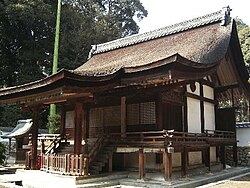 Hirairi style: entrance on the non-gabled side
 -
 Tsumairi style: entrance on the gabled side
 -
 Some setsumassha
 -
 A hokora
 -
![Yasuzumi Jinja [ja] is famous not only for praying for safe childbirth, but also as a motorcycle shrine.](//upload.wikimedia.org/wikipedia/commons/thumb/7/7a/%E5%AE%89%E4%BD%8F%E7%A5%9E%E7%A4%BE%28%E3%83%90%E3%82%A4%E3%82%AF%E7%A5%9E%E7%A4%BE%29.jpg/250px-%E5%AE%89%E4%BD%8F%E7%A5%9E%E7%A4%BE%28%E3%83%90%E3%82%A4%E3%82%AF%E7%A5%9E%E7%A4%BE%29.jpg) Yasuzumi Jinja is famous not only for praying for safe childbirth, but also as a motorcycle shrine.
Yasuzumi Jinja is famous not only for praying for safe childbirth, but also as a motorcycle shrine.


_massha.jpg)

![Yasuzumi Jinja [ja] is famous not only for praying for safe childbirth, but also as a motorcycle shrine.](https://en.wikipedia.org/wiki/File:%E5%AE%89%E4%BD%8F%E7%A5%9E%E7%A4%BE(%E3%83%90%E3%82%A4%E3%82%AF%E7%A5%9E%E7%A4%BE).jpg)
See also
[edit]Notes
[edit]Footnotes
[edit]- ^ Also called the shinden (神殿).
- ^ Because the sessha and massha once had different meanings but are now synonymous, these shrines are sometimes called setsumatsusha (摂末社), a neologism that fuses the two old names.
- ^ Yorishiro (依り代; lit. 'approach substitute') were tools conceived to attract the kami and give them a physical space to occupy, thus making them accessible to human beings.
- ^ Many other sacred objects (mirrors, swords, comma-shaped jewels called magatama) were originally yorishiro, and only later became kami by association
- ^ Today, a hokora is an extremely small shrine, like those seen on the sides of many roads.
- ^ The rōmon, or 'tower gate', is a gate which looks like a two-story gate, but in fact is only one story.
- ^ Kami are, as a rule, not represented in anthropomorphic or physical terms, however numerous paintings and statues representing them have appeared under Buddhist influence.
- ^ The opposite can also happen. Toyokawa Inari is a Buddhist temple of the Sōtō sect in Toyokawa, Aichi Prefecture and, with its Akasaka branch, one of the centers of Inari's cult.[43]
- ^ The presence of Buddhist temples within a Shinto shrine complex is due to an integration of Buddhism and Shinto (Shinbutsu shūgō) which used to be normal before the Meiji restoration and is still common. The kami which inhabits the Nachi Falls within the Kumano Sanzan shrine complex, the already mentioned Hiryū Gongen, is itself syncretic.
- ^ Alongside Hiromine shrine the three share a tradition of the Gion cult. If grouped together they would be the 6th largest shrine network
- ^ In spite of its name, the shintaiis actually a temporary repository of the enshrined kami.[62]
Citations
[edit]- ^ Stuart D. B. Picken, 1994. p. xxiii
- ^ a b c d e f g h i j k l m Iwanami Kōjien (広辞苑) Japanese dictionary
- ^ Bernhard Scheid. "Religiöse Bauwerke in Japan" (in German). University of Vienna. Retrieved 27 June 2010.
- ^ Mori Mizue
- ^ "Engishiki" in Stuart D. B. Pecken, ed., Historical Dictionary of Shinto. Second edition. (Lanham, MD, USA: Scarecrow Press, Inc., 2011) p. 92.
- ^ Japanese Religion: A Survey by the Agency for Cultural Affairs. Abe Yoshiya and David Reid, translators. (Tokyo: Kodansha International Ltd., 1972) p. 239.
- ^ "The Yasukuni Shrine Problem in the East Asian Context: Religion and Politics in Modern Japan: Foundation" (PDF). Retrieved 1 January 2014.
- ^ a b Breen, Teeuwen in Breen, Teeuwen (2000:1)
- ^ a b c d e f g h i j k l Shinto Online Network Association Jinja no Shōgō ni Tsuite Oshiete Kudasai Archived 2014-10-19 at the Wayback Machine
- ^ a b c d e f g h i j Sonoda Minoru in Breen, Teeuwen (2000:43)
- ^ a b Theobald, Ulrich. "Sheshen 社神, Local Deities (www.chinaknowledge.de)". chinaknowledge.de. Retrieved 2023-04-01.
- ^ a b Basic Terms of Shinto, Hokora retrieved on July 1, 2008
- ^ Tamura, Yoshiro (2000). "The Birth of the Japanese nation". Japanese Buddhism - A Cultural History (First ed.). Tokyo: Kosei Publishing Company. p. 232 pages. ISBN 4-333-01684-3.
- ^ a b Myōjin taisha, Encyclopedia of Shinto, retrieved on July 2, 2008
- ^ Mure, Jin. "Sessha, massha" (in Japanese). Shokagukan. Archived from the original on 19 December 2012. Retrieved 9 March 2010.
- ^ a b Iwanami Kōjien (広辞苑) Japanese dictionary, 6th Edition (2008), DVD version.
- ^ a b c d e f Encyclopedia of Shinto, Gongen shinkō, accessed on October 5, 2008
- ^ a b c d e f g h i j k l Tamura, page 21
- ^ a b c d e Fujita, Koga (2008:20-21)
- ^ "English | Ohmiwa Jinja Shrine | 大神神社(おおみわじんじゃ)". April 17, 2014.
- ^ a b c d Cambridge History of Japan (1993:524)
- ^ Bohan, Elise; Dinwiddie, Robert; Challoner, Jack; Stuart, Colin; Harvey, Derek; Wragg-Sykes, Rebecca; Chrisp, Peter; Hubbard, Ben; Parker, Phillip; et al. (Writers) (February 2016). Big History. Foreword by David Christian (1st American ed.). New York: DK. p. 382. ISBN 978-1-4654-5443-0. OCLC 940282526.
- ^ "Jogan Gishiki" in Stuart D. B. Pecken, ed., Historical Dictionary of Shinto. Second edition. (Lanham, MD, USA: Scarecrow Press, Inc., 2011) p. 139.
- ^ Nussbaum, Louis-Frédéric. (2005). "Engi-shiki" in Japan Encyclopedia, p. 178.
- ^ " Engishiki" in Stuart D. B. Pecken, ed., Historical Dictionary of Shinto. Second edition. (Lanham, MD, USA: Scarecrow Press, Inv, 2011) p. 92.
- ^ Philippi, Donald L. (1990). Norito: A Translation of the Ancient Japanese Ritual Prayers. Princeton University Press. p. 1. ISBN 978-0691014890.
- ^ a b c d Hardacre (1986:31)
- ^ Satō, Masato: "Jingūji". Encyclopedia of Shinto, Kokugakuin University, retrieved on February 28, 2007
- ^ "Haibutsukishaku", Encyclopedia of Shinto.
- ^ Burkman, The Urakami Incidents and the Struggle for Religious Toleration in Early Meiji Japan, p. 175.
- ^ a b c d "Shinbutsu Bunri", Encyclopedia of Shinto.
- ^ Scheid, Grundbegriffe, Shinto.
- ^ a b Shintai, Encyclopedia of Shinto
- ^ Smeyers, page 44
- ^ a b c d e Bernhard Scheid. "Schreine" (in German). University of Vienna. Retrieved 27 March 2010..
- ^ Ono, Woodard (2004:100)
- ^ Kamizaka, Jirō. "Hiryū Gongen" (in Japanese). Ministry of Land, Infrastructure and Transport - Kinki Regional Development Bureau. Retrieved 28 March 2010.
- ^ a b c Smyers (1999:235)
- ^ Sonoda (1975:12)
- ^ Smyers (1999: 156–160)
- ^ Encyclopedia Nipponica. Shogakukan. 2001. Shake (社家). OCLC 14970117.
- ^ a b c d Gibney, Frank B (1991). Britannica International Encyclopædia. TBS Britannica. Shake (社家). OCLC 834589717.
- ^ Smyers 1999:26, 34
- ^ a b c Scheid, Bernhard. "Bekannte Schreine" (in German). University of Vienna. Retrieved 23 March 2010.
- ^ a b c d e f g h i j k l Motegi, Sadazumi. "Shamei Bunpu (Shrine Names and Distributions)" (in Japanese). Encyclopedia of Shinto. Retrieved 23 March 2010.
- ^ a b c d e Scheid, Bernhard. "Ise und Izumo" (in German). University of Vienna. Retrieved 31 March 2010.
- ^ "Ise Shinkō". Encyclopedia of Shinto. Retrieved 31 March 2010.
- ^ Iwanami Kōjien (広辞苑) Japanese dictionary, 6th Edition (2008), DVD version
- ^ "Yuisho" (in Japanese). Usa Jingū. Archived from the original on 7 December 2017. Retrieved 1 April 2010.
- ^ "Hachiman Shinkō". Encyclopedia of Shinto. Kokugakuin University. Retrieved 5 April 2010.
- ^ "Iwashimizu Hachimangu Shrine". Kansai Institute of Information Systems and Industrial. Retrieved 1 April 2010.
- ^ a b c d e Sacred site "Kumano Sanzan" Archived 2009-03-03 at the Wayback Machine accessed on June 12, 2008
- ^ Karan, Pradyumna. (2010). Japan in the 21st Century: Environment, Economy, and Society, p. 72; (1997). Living Religions: An Encyclopaedia of the World's Faiths, p. 191.
- ^ a b "Nationwide numbers of Emanation Branches(bunsha) of Famous Shrine", from "Shamei Bunpu (Shrine Names and Distributions)"
- ^ Smyers (1999:60, 177)
- ^ a b Smyers (1999:93)
- ^ a b Ashkenazy, Michael (November 5, 2003). Handbook of Japanese Mythology (World Mythology) (Hardcover). ABC-CLIO. ISBN 978-1-57607-467-1.
- ^ John Breen; Mark Teeuwen, eds. (July 2000). Shinto in History: Ways of the Kami. Honolulu: University of Hawaii Press. ISBN 978-0-8248-2363-4. OCLC 43487317.
- ^ a b "Munakata Shinkō". Encyclopedia of Shinto. Retrieved 5 April 2010.
- ^ Encyclopedia of Shinto, Kumano Shinkō, accessed on April 1, 2010
- ^ a b c d e The History of Shrines
- ^ Smyers, page 44
- ^ a b See the Shinbutsu shūgō article.
- ^ Mark Teeuwen in Breen and Teeuwen (2000:95-96)
- ^ a b c d e Jinja Kenchiku, Shogakukan Nihon Daihyakka Zensho, accessed on November 29, 2009
- ^ a b c d e f g History and Typology of Shrine Architecture, Encyclopedia of Shinto accessed on November 29, 2009
- ^ a b JAANUS, Nagare-zukuri, accessed on December 1, 2009
- ^ a b JAANUS, Kasuga-zukuri, accessed on December 1, 2009
- ^ a b JAANUS, Shinmei-zukuri accessed on December 1, 2009
- ^ a b c JAANUS, Sumiyoshi-zukuri, accessed on December 1, 2009
- ^ JAANUS, Taisha-zukuri, accessed on December 1, 2009
- ^ Ise, the Holiest Shrine Archived 2008-07-04 at the Wayback Machine, Berkeley University ORIAS site accessed on August 10, 2008
- ^ a b c d e f "Do you know? Shrine manners and their meanings | Feel Fukuoka Japan". 2015-08-21. Retrieved 2023-02-12.
- ^ a b c d e f g "Japanese Customs and Etiquette|Dive deeper into Yakult —the Probiotic…". Archived from the original on 2023-04-08.
- ^ "Learn about Shinto - How to behave in a shinto shrine". 供TOMO ONLINE STORE. 7 June 2021. Retrieved 2023-02-12.
- ^ a b c d e "二礼二拍一礼は参拝の基本。その歴史と考え方とは。|葬儀・家族葬なら【よりそうお葬式】". www.yoriso.com (in Japanese). Retrieved 2023-02-11.
- ^ Japanistry (2016-11-06). "Visiting Shrines & Temples in Japan: Etiquette & Customs". japanistry.com. Retrieved 2023-04-08.
- ^ "Pray|Ise Jingu". Ise Jingu. Retrieved 2023-02-12.
- ^ "Etiquette For Worship" retrieved May 31 2024.
- ^ "Usa Jingu - About Worship" retrieved May 31 2024.
- ^ "Izumo-Taisha - Frequently Asked Questions" retrieved May 31 2024.
- ^ Moriyasu, Jin. "Kannushi". Nihon Hyakka Zensho (in Japanese). Shogakukan. Archived from the original on 2012-12-09. Retrieved 2009-10-16.
- ^ "Shinshoku". Encyclopædia Britannica Online. Retrieved 2009-10-16.
References
[edit]- Breen, John; Mark Teeuwen, eds. (July 2000). Shinto in History: Ways of the Kami. Honolulu: University of Hawaii Press. ISBN 978-0-8248-2363-4.
- Brown, Delmer M. (1993). The Early Evolution of Historical Consciousness in "Cambridge History of Japan", Vol. 1. Cambridge, New York & Victoria: Cambridge University Press. ISBN 978-0-521-22352-2.
- Burkman, Thomas W. (June–September 1974). "The Urakami Incidents and the Struggle for Religious Tolerance in Early Meiji Japan" (PDF). Japanese Journal of Religious Studies. 1 (2–3): 143–216. doi:10.18874/jjrs.1.2-3.1974.143-216. Retrieved 2008-07-17.[permanent dead link]
- Fujita Masaya; Koga Shūsaku, eds. (April 10, 1990). Nihon Kenchiku-shi (in Japanese) (September 30, 2008 ed.). Shōwa-dō. ISBN 978-4-8122-9805-3.
- Hardacre, Helen (1986). "Creating State Shinto: The Great Promulgation Campaign and the New Religions". Journal of Japanese Studies. 12 (1): 29–63. doi:10.2307/132446. JSTOR 132446.
- Havens, Norman; Inoue, Nobutaka (translated by Norman Havens and Helen Hardacre), eds. (2004). "Jinja (Encyclopedia of Shinto, vol. 2)" [Shrines]. Encyclopedia of Shinto. Institute for Japanese Culture and Classics, Kokugakuin University. ISBN 978-4-905853-12-1.
- Mori, Mizue (2005-06-02). "Honden". Encyclopedia of Shinto. Kokugakuin University. Retrieved 2008-12-19.
- Sokyo Ono; William Woodard (2004). Shinto: The Kami Way. Tuttle Publishing. ISBN 978-0-8048-3557-2.
- Picken, Stuart D. B. (1994). Essentials of Shinto: An Analytical Guide to Principal Teachings. Greenwood. ISBN 0313264317.
- Smyers, Karen Ann (1999). The Fox and the Jewel: Shared and Private Meanings in Contemporary Japanese Inari Worship. Honolulu: University of Hawaii Press. ISBN 978-0-8248-2102-9.
- The History of Shrines, Encyclopedia of Shinto, retrieved on June 10, 2008
- Metevelis, Peter (1994). "Shinto Shrines or Shinto Temples?" (PDF). Asian Folklore Studies. 53 (2): 337–345. doi:10.2307/1178650. JSTOR 1178650. Archived from the original (PDF) on 31 March 2018. Retrieved 29 October 2025.
- Shrine Architecture. Encyclopedia of Shinto, retrieved on 29 October 2025.
- "Overview of a Shinto Shrine", a detailed visual introduction to the structure of a Shinto shrine, Encyclopedia of Shinto. Retrieved on 29 October 2025.
- Jinja no Shōgō ni Tsuite Oshiete Kudasai; Archived 2014-10-19 at the Wayback Machine (in Japanese), Shinto Online Network Association, retrieved on July 2, 2008
- Tamura, Yoshiro (2000). "The Birth of the Japanese nation and the Ascent of Buddhism". Japanese Buddhism: A Cultural History. Translated by Hunter, Jeffrey (First ed.). Tokyo: Kosei Publishing Co. pp. 23–34. ISBN 978-4-333-01684-6.
Further reading
[edit]- Cluzel, Jean-Sébastien (October 2008). Architecture éternelle du Japon - De l'histoire aux mythes. Dijon: Editions Faton. ISBN 978-2-87844-107-9.
- The Herbert Offen Research Collection of the Phillips Library at the Peabody Essex Museum; Archived 2010-01-30 at the Wayback Machine
- Scheid, Bernhard; Teeuwen, Mark (2006). The Culture of Secrecy in Japanese Religion. London: Routledge. ISBN 978-0-415-38713-2. OCLC 63679956.
- Shimizu, Karli. Overseas Shinto Shrines: Religion, Secularity and the Japanese Empire (Bloomsbury Academic, 2022)
External links
[edit]
- Encyclopedia of Shinto, Kokugakuin University
- Jinja and Shinto, site of the Shinto Online Network Association
- Jinja Honchō, the Association of Shinto Shrines
- Kokugakuin University Shinto Jinja Database (in Japanese)
- Shinto Shrine types
Baháʼí Faith  | |
|---|---|
Buddhism  | |
Christianity  | |
Hinduism  | |
Jainism  | |
Judaism  | |
Islam  | |
Mandaeism  | |
Paganism & modern paganism  | |
Shintoism  | |
Sikhism  | |
Taoism  | |
Zoroastrianism  | |
| Varying religions and beliefs | |
Note: Sorted alphabetically except the last one | |
| International | |
|---|---|
| National | |

Shinto shrine
View on GrokipediaDefinition and Core Concepts
Etymology and Terminology
The Japanese term jinja (神社), commonly translated as "Shinto shrine," combines the characters jin (神), meaning "god" or "spirit" (kami), with ja or sha (社), denoting a "place" or "altar" associated with worship. This etymology reflects the function of such sites as locations for housing or summoning kami, the divine spirits central to Shinto practice. The compound appears influenced by Chinese linguistic roots, where shénshè (神社) similarly referred to deity altars, adapted into Japanese usage by at least the medieval period, though its widespread standardization as the primary designation for Shinto worship sites occurred during the Meiji Restoration in 1868, when the government formalized Shinto as a state religion distinct from Buddhism.[4][5] Prior to this, archaic terms like shinsha (神舎, "god's dwelling") were used interchangeably, and regional variations such as miya (宮, "palace") or yashiro (社, "sacred site") described similar structures, often tied to imperial or local traditions. In modern terminology, jinja serves as the generic label for any Shinto shrine possessing a honden (本殿), the main hall enshrining the kami. Distinctions arise through suffixes indicating historical rank or imperial association, established largely in the early 20th century by the Association of Shinto Shrines (Jinja Honchō): taisha (大社, "grand shrine") denotes nationally significant sites, such as the 17 promoted in 1871; jingu or jingū (神宮, "divine palace") is reserved for imperial shrines like Ise Jingū, dedicated to Amaterasu; gū (宮) appears in older or regional names, evoking archaic prestige; and miya signifies ancient, palace-like shrines. These terms reflect not inherent superiority but administrative hierarchies from the Meiji era's shrine ranking system, abolished post-World War II yet retained in nomenclature.[6][2][7]Fundamental Beliefs and Distinctions from Other Traditions
Shinto posits the existence of kami, spiritual entities or essences that permeate natural forces, landscapes, animals, ancestors, and even human endeavors, viewing the world as animated by these presences rather than created by a singular transcendent deity.[8][9] Shrines (jinja) function as localized abodes or portals for particular kami, where adherents perform rituals to invoke their benevolence, express gratitude, and restore ritual purity (harae), which counters spiritual pollution (kegare) accumulated from death, illness, or moral lapses.[8][10] This emphasis on purity underscores Shinto's core orientation toward maintaining cosmic harmony (wa) between humans, nature, and kami, prioritizing experiential participation in seasonal cycles and communal festivals (matsuri) over abstract theological speculation.[10][11] In distinction from Buddhism, which arrived in Japan around 538 CE and focuses on doctrines of suffering, impermanence, and liberation from rebirth cycles through enlightenment, Shinto lacks soteriological aims or canonical scriptures dictating personal salvation, instead addressing worldly prosperity, health, and communal stability through kami appeasement.[12][13] Historically syncretized with Buddhism—wherein kami were reinterpreted as manifestations of Buddhas (honji suijaku)—Shinto's shrine-based practices remained oriented toward this-life rituals, such as harvest thanksgivings or new year purifications, without Buddhism's monastic vows or meditative paths to nirvana.[12] Unlike Abrahamic traditions like Christianity, which center on faith in a monotheistic creator God, original sin, and eschatological judgment, Shinto features no dualistic moral framework of inherent human fallenness or eternal afterlife rewards; pollution is situational and remediable via rites, not indelible guilt requiring divine atonement.[14][15] Polytheistic and immanent, Shinto's kami are not omnipotent or jealous but fallible and context-bound, demanding respect through orthopraxy—precise gestures like hand-washing at shrine basins or bowing before altars—rather than creedal adherence.[16][1] This ritual-centric ethos aligns Shinto with broader animistic traditions by attributing agency to the environment, yet it institutionalizes these impulses in architecturally standardized shrines with sacred enclosures (tamagaki) and symbolic gateways (torii), fostering national continuity amid Japan's archipelago geography and agrarian history.[11] Empirical observations of Shinto practice, such as the annual renewal of Ise Grand Shrine's structures since at least the 7th century, reflect a causal realism: periodic rebuilding symbolizes impermanence and renewal, mirroring natural cycles without invoking supernatural intervention beyond kami influence.[8] While lacking a founder or enforced dogma, Shinto's endurance—evidenced by over 80,000 registered shrines as of 2023—stems from its adaptability to empirical human needs like disaster aversion, contrasting rigid theodicies in monotheistic faiths that grapple with evil through unfalsifiable metaphysics.[8][17]Historical Evolution
Prehistoric and Ancient Foundations
The prehistoric foundations of Shinto shrine practices emerged from animistic beliefs in Japan during the Jōmon period (c. 14,000–300 BCE), where communities conducted rituals honoring spirits in natural landscapes, evidenced by dogū figurines—clay statuettes often depicting pregnant figures or shaman-like intermediaries—unearthed at sites such as the Sannai-Maruyama settlement in Aomori Prefecture, suggesting fertility cults and spiritual mediation that prefigure kami veneration.[18] These artifacts, numbering over 10,000 across Jōmon sites, indicate communal ceremonies tied to hunting, gathering, and seasonal cycles, with no permanent structures but reliance on temporary sacred enclosures or natural features like rock outcrops for worship.[19] Archaeological interpretations link these practices to an enduring animism, where mountains, trees, and animals embodied vital forces, forming the causal bedrock for later shrine demarcation of holy spaces without evidence of doctrinal codification.[20] The Yayoi period (c. 300 BCE–250 CE) marked a transition to agrarian societies with wet-rice farming introduced from the Asian continent, fostering more organized rituals at communal sites, as seen in the burial of bronze dōtaku bells—over 200 discovered nationwide, often clustered near settlements like Yoshinogari in Saga Prefecture—used in agricultural ceremonies to invoke prosperity and avert calamity.[21] These bells, imported or crafted locally from Korean influences around 300 BCE, were ritually interred rather than played, pointing to sacrificial rites honoring earth and water kami, with early evidence of marked sacred precincts through postholes or earthen altars distinguishing profane from divine realms.[22] Such practices, supported by pollen analysis showing intensified rice cultivation by 100 BCE, reflect causal adaptations to settled life, where ritual efficacy was tied to communal harmony and harvest yields, laying groundwork for shrine-like veneration of localized deities.[23] In the ancient Kofun period (c. 250–538 CE), proto-shrine elements appeared amid elite tomb construction, with worship extending to ancestral kami at natural and built sites, including altars in pit dwellings like the sixth-century Takatsuki Minami example in Shiga Prefecture, featuring stone arrangements for offerings along walls.[24] Rituals invoked mountain, sea, and river spirits for protection, as inferred from haniwa clay figures atop keyhole-shaped kofun mounds—over 100,000 documented, symbolizing guards or mediators—indicating formalized ancestor cults that influenced shrine priesthood.[25] The earliest verifiable links to modern shrines date to the late fourth century, with excavations at Munakata Taisha revealing contemporaneous ritual deposits of mirrors and swords, suggesting hereditary clans maintained sacred grounds for imperial forebears, evolving from outdoor himorogi enclosures to elevated halls housing kami symbols.[26] This period's evidence, drawn from stratified tomb goods and pollen records of sacred groves, underscores a realist progression from ad hoc nature worship to institutionalized sites, driven by political consolidation under Yamato rulers rather than imported doctrines.[27]Classical Period: Emergence of Permanent Shrines
The transition to permanent Shinto shrines occurred primarily during the Nara (710–794) and Heian (794–1185) periods, as centralized imperial authority under the ritsuryō system formalized kami worship and incorporated architectural influences from continental Buddhism, shifting from transient ritual sites to enduring structures housing resident deities. Prior to this, worship relied on temporary setups like sacred groves or himorogi (temporary enclosures marked by trees or poles), reflecting a view of kami as transient visitors rather than fixed inhabitants.[28][29] By the early 8th century, select imperial shrines began erecting dedicated buildings, with only 11 sites designated as miya (permanent palace-like abodes for kami) by the early Heian era, as recorded in the Engishiki (927), which enumerated 2,861 shrine sites overall but implied many retained impermanent forms.[28] Pioneering examples include the Grand Shrines of Ise and Izumo Taisha, where permanent structures emerged earliest, adapting ancient granary and dwelling prototypes into shrine architecture. Ise's shinmei-zukuri style, characterized by elevated floors, gabled roofs with chigi (forked finials) and katsuogi (crosswise logs), originated as a simple housing for Amaterasu Ōmikami, with records from 804 detailing multiple auxiliary buildings alongside the core shōden (main hall).[28][23] Izumo's taisha-zukuri, featuring massive pillars and a raised floor evoking prehistoric elevated storehouses, similarly predated widespread permanence but solidified in classical reconstructions.[28] These styles prioritized impermanence through periodic rebuilding—every 20 years at Ise—to maintain ritual purity, contrasting with Buddhism's durable temples yet enabling fixed sacred precincts.[23] In the Nara period, state-sponsored shrines like Kasuga Taisha (established 709, with buildings added by 768) exemplified this emergence, integrating Shinto halls with emerging Buddhist complexes under shinbutsu shūgō (syncretism).[28] Heian innovations produced diverse typologies, such as nagare-zukuri at the Kamo shrines (gabled roofs with porticos on the long side) and kasuga-zukuri at Kasuga (gabled ends with pent roofs over stairs), incorporating curved roofs, verandas, and ornamental gates borrowed from Chinese-derived Buddhist designs to enhance ceremonial scale.[30] These developments reflected causal adaptations: imperial rituals demanded reliable venues amid urban capitals like Heian-kyō, while syncretic influences provided technical precedents without supplanting indigenous wooden, unpainted aesthetics or outdoor purification rites.[30][23] By the late Heian, permanent complexes with honden (inner sanctuaries) and haiden (worship halls) became normative for major sites, embedding Shinto in the court's socio-political fabric.[30]Medieval Syncretism with Buddhism
During the medieval period (approximately 1185–1600), Shinto shrines increasingly integrated with Buddhism through shinbutsu-shūgō, a syncretic framework that positioned kami as provisional manifestations (suijaku) of Buddhas or bodhisattvas, whose true essence (honji) lay in Buddhist enlightenment. This doctrine, formalized via honji suijaku theory, evolved from earlier Heian-era precedents but proliferated amid the rise of esoteric Buddhism and warrior culture, enabling shrines to adopt salvific Buddhist elements while retaining kami-centric rituals. Shrines constructed jingū-ji (temple complexes within shrine precincts) to facilitate kami conversion and protection of the dharma, with over 80% of major shrines featuring such attachments by the Kamakura period (1185–1333).[31][32] ![Hakusan Gongen shrine, representing medieval kami-Buddha fusion][float-right] Gongen shrines emerged as a hallmark of this era, designating kami avatars like those at Hakusan or Kumano as enlightened provisional forms, often depicted in Buddhist iconography such as shinzō statues blending native and continental styles. For instance, Hachiman kami, enshrined at sites like Tsurugaoka, were recast as monk-like guardians of the Lotus Sutra, with shrine-temple complexes hosting joint festivals and esoteric rites by the 13th century. Goryō cults further syncretized vengeful kami—such as Gozu Tennō at Gion Shrine—with Buddhist expiation practices, addressing epidemics through hybrid processions documented in 12th-century records.[31][33][34] This fusion extended to Shugendō ascetic traditions, where shrine-linked mountains like Dewa Sanzan integrated kami worship with yamabushi (mountain monk) initiations invoking both deities and Buddhas, peaking in the Muromachi period (1336–1573) with networks of over 200 affiliated sites. While empowering shrine economies through pilgrimage and imperial patronage—evidenced by edicts like those of Emperor Go-Daigo (1318–1339) favoring syncretic Hachiman—such developments subordinated pure Shinto to Buddhist ontology until Meiji-era separations.[31][32][35]Edo Period: Scholarly Revival and Administrative Changes
During the Edo period (1603–1868), the Tokugawa shogunate's policies fostered a scholarly revival of Shinto through the Kokugaku (National Learning) movement, which emphasized philological study of ancient Japanese texts to reconstruct pre-Buddhist practices and purge foreign influences.[36] Scholars like Kamo no Mabuchi (1697–1769) initiated this by critiquing Confucian and Buddhist accretions in poetry and rituals, advocating a return to the emotional authenticity of ancient Shinto worship centered on kami at shrines.[37] Motoori Norinaga (1730–1801) advanced this with his exhaustive commentary on the Kojiki (712 CE), interpreting Shinto as Japan's indigenous path of kami veneration, distinct from doctrinal religions, which inspired shrine priests to revive rituals like those at Iwashimizu Hachiman Shrine's Hōjō-e fire-release ceremony.[38] [36] Hirata Atsutane (1776–1843) extended Kokugaku's influence by integrating ethnographic and afterlife concepts, positing a "hidden world" (kakuriyo) where souls interact with kami post-death, thereby imbuing Shinto with greater religious depth and motivating priests to assert shrine autonomy from Buddhist oversight.[39] This revival galvanized the shrine priesthood as a social force, promoting separation from syncretic Buddhist complexes (miyadera) that had dominated most shrines, though full disengagement awaited the Meiji era.[40] Kokugaku's textual focus yielded practical outcomes, such as restored shrine observances and new enshrinements, aligning with the era's relative stability that boosted pilgrimages to sites like Ise Grand Shrine.[38] Administratively, the shogunate exerted centralized control over shrines while deferring to court-linked rituals, reforming oversight to integrate them into the feudal hierarchy under daimyo domains.[38] This included deifying Tokugawa Ieyasu (d. 1616) at shrines like Nikkō Tōshō-gū, established in 1617, which exemplified state-sanctioned kami worship to legitimize rule.[41] Enhanced transportation networks and peace enabled mass shrine visits, with the shogunate regulating temple-shrine relations to curb Buddhist dominance, though many shrines remained under monk administration until later reforms.[38] Hereditary priests (kannushi) gained scholarly legitimacy through Kokugaku, fostering proto-nationalist sentiments that elevated shrine roles beyond local cults.[37]Meiji Era: State Shinto and Ideological Separation
The Meiji Restoration in 1868 initiated policies to centralize authority under the emperor, positioning Shinto shrines as instruments of national unification by severing longstanding Buddhist influences. This ideological separation, termed shinbutsu bunri, was formalized through a March 28, 1868, decree from the Council of State mandating the distinct administration of shrines and temples, effectively ending over a millennium of syncretism.[42] The policy prompted widespread destruction of Buddhist elements within shrine precincts, including the relocation or smashing of statues and sutras, as shrine officials reclaimed spaces for exclusive kami veneration.[43] State Shinto emerged as a government-directed framework, subordinating shrines to bureaucratic oversight to cultivate imperial reverence. By 1871, the Shrine and Temple Bureau classified approximately 190,000 shrines into 13 ranks, from imperial shrines like Ise Grand Shrine to unranked local ones, with higher tiers receiving state funding for rituals and reconstruction.[44] This nationalization transformed many shrines into sites for civic education, where participation in festivals and emperor-related rites reinforced social cohesion amid rapid modernization. Between 1868 and 1945, the government supported the construction of 237 new shrines, often dedicated to war dead or imperial ancestors, embedding Shinto in state expansionism.[43] Ideologically, State Shinto propagated the kokutai concept, portraying the emperor as a living descendant of Amaterasu and the unbroken sovereign of a divine polity, distinct from foreign religions.[45] Shrine protocols evolved to symbolize this hierarchy, with mandatory pilgrimages and oaths of allegiance linking kami worship to patriotic duty, though officials maintained Shinto's non-religious status to comply with emerging constitutional freedoms.[44] This separation not only purified Shinto practices but also served causal ends of ideological mobilization, prioritizing empirical loyalty over doctrinal universality, as evidenced by the era's shrine attendance mandates for schoolchildren and officials.[45]Postwar Disestablishment and Contemporary Continuity
Following Japan's surrender in 1945, the Supreme Commander for the Allied Powers issued the Shinto Directive on December 15, 1945, which prohibited governmental sponsorship, support, perpetuation, control, and dissemination of Shinto doctrines as a state ideology.[46] This measure targeted the wartime fusion of Shinto with ultranationalism, requiring the abolition of state funding for shrines, the removal of Shinto elements from public education and military training, and the reclassification of shrine activities as private religious practice rather than civic duty.[47] Accompanying legislation, including the Religious Corporations Law enacted on December 28, 1945, allowed shrines to reorganize as independent religious juridical persons, severing their prior administrative ties to the state and enabling self-governance through private donations and ritual fees.[47] The 1947 Constitution reinforced this disestablishment through Article 20, which enshrined freedom of religion while explicitly barring the state from engaging in religious education or patronizing any religion, thereby constitutionalizing the separation of Shinto from governmental authority.[47] In response, the Association of Shinto Shrines (Jinja Honchō) was established in February 1946 as a voluntary federation to coordinate shrine administration, doctrinal preservation, and ritual standardization across approximately 80,000 member shrines, representing the majority of Japan's Shinto institutions.[48] This organization has since maintained a conservative orientation, advocating for the cultural and spiritual continuity of shrine practices amid secular pressures, including opposition to certain legal reinterpretations of religious neutrality.[49] Contemporary Shinto shrines exhibit strong continuity in core rituals and architectural traditions, with over 80,000 operating nationwide and drawing tens of millions of visitors annually for events like New Year's hatsumōde (first shrine visit) and local matsuri festivals.[50] Practices such as shikinen sengū—the periodic rebuilding of structures using traditional methods—persist, as exemplified by the Ise Grand Shrine's 62nd reconstruction completed in 2013, underscoring a commitment to renewal and impermanence rooted in prewar customs.[51] While financial independence has led some smaller shrines to consolidate or adapt through tourism and community roles, larger ones sustain hereditary priesthoods and kami enshrinement, with Jinja Honchō overseeing training and certification to preserve orthodoxy.[49] Political sensitivities linger, particularly at shrines like Yasukuni that enshrine war dead, but these do not disrupt the broader operational resilience of shrine networks, which integrate into modern Japanese life without state compulsion.[52]Sacred Objects and Practices
Kami Worship and Shintai
Kami in Shinto shrines are sacred entities encompassing natural forces, ancestral spirits, and deific figures, invoked through rituals emphasizing purity, gratitude, and harmony rather than supplication for favors. Worship practices involve offerings of rice, sake, fish, and salt, symbolizing sustenance and purification, presented by priests (kannushi) in the haiden or before the honden where the kami's presence is believed to manifest. These rites, conducted twice daily at most shrines, draw from ancient precedents documented in texts like the Nihon Shoki (720 CE), which describe imperial ancestors presenting similar tributes to appease and honor kami.[15] Central to this worship is the shintai, a physical object serving as a temporary vessel for the kami's spirit, distinct from mere symbols by enabling direct ritual engagement without anthropomorphic depiction. Typically enshrined in the honden's innermost chamber, inaccessible to lay visitors, shintai include artifacts like bronze mirrors (kagami), swords (tsurugi), or natural elements such as sacred trees (shinboku) or mountains, chosen for their perceived inherent sanctity. For instance, at Ise Jingū, the primary shintai is a mirror linked to Amaterasu Ōmikami, ritually renewed every 20 years in the shikinen sengū rebuilding cycle to maintain vitality.[53][54][55] Priests invoke the kami's descent (kami oroshi) into the shintai during festivals via norito invocations, fostering a localized presence for communal participation, as opposed to permanent indwelling. This practice underscores Shinto's animistic ontology, where kami inhabit transient loci rather than fixed icons, contrasting with iconographic traditions elsewhere. Historical examples include Mount Fuji as a shintaizan (mountain-body) for Konohanasakuya-hime at Fujisan Hongū Sengen Taisha, revered since at least the 8th century for its volcanic symbolism. Empirical observations from shrine records confirm shintai's role in averting calamities, with documented increases in offerings post-rituals correlating to community cohesion in agrarian societies.[53][15]Re-enshrinement and Ritual Renewal
Re-enshrinement, known as sengū (遷宮), refers to the ceremonial transfer of a shrine's kami (deity) from an existing structure to a newly constructed one, ensuring the continued vitality and purity of the sacred presence. This practice is integral to Shinto's emphasis on renewal and impermanence, distinguishing it from static religious architectures in other traditions. At the Ise Grand Shrine (Ise Jingū), the most prominent example, this occurs as part of the Shikinen Sengū (式年遷宮), a comprehensive rebuilding cycle conducted every 20 years.[56] The process maintains the shrine's wooden structures, which are inherently temporary due to material decay and ritual requirements for freshness.[51] The Shikinen Sengū originated in 690 CE during the reign of Empress Jitō, with the first recorded renewal for the shrine's inner precinct (Naikū).[57] Over 62 cycles have since taken place, with the most recent completed in 2013 and preparations for the 63rd underway as of 2025, culminating in a 2033 transfer ritual.[56][58] The rite involves 33 festivals and ceremonies, beginning with the ritual felling of sacred cypress (hinoki) timber under priestly supervision, followed by construction adhering to ancient specifications without metal nails or modern tools.[51] The new buildings are erected on adjacent grounds, ritually purified before the kami—embodied in the shintai (sacred object)—is solemnly relocated via the Onamisogi no Miōnoe ceremony.[59] While Ise's scale is unparalleled, similar renewal practices occur at other major shrines to combat wood's susceptibility to fire, rot, and time, with rebuildings typically every 20 to 50 years depending on resources and tradition.[60] For instance, Izumo Taisha undergoes a sengū every 60 years, involving a five-year preparation period, as seen in the 2014–2019 cycle.[60] These rituals preserve artisanal knowledge, such as yosegi-zukuri joinery, and reinforce communal bonds through participation in timber sourcing and construction oversight.[61] The underlying principle reflects Shinto's animistic view of nature's cycles, where periodic destruction and rebirth symbolize eternal renewal rather than mere maintenance.[57]Hereditary and Administrative Roles
Shake Families and Priestly Lineages
![A Shinto guji, or head priest][float-right] The shake (社家), or shrine families, refer to hereditary lineages that traditionally held priestly positions (shinshoku) at specific Shinto shrines, managing rituals, maintenance, and transmission of shrine-specific traditions across generations.[62] These families, also known as shashika in some contexts, emerged as dominant groups controlling shrine operations through inherited roles, distinct from non-hereditary priests.[62] In ancient Japan, shrines often lacked fixed priesthoods, with rituals performed by local leaders or imperially appointed officials, but by the mid-Heian period (circa 794–1185 CE), hereditary families had assumed control over most major shrines, solidifying their administrative and spiritual authority.[62] Shake lineages preserved and transmitted kaden Shintō, or house-specific Shinto practices, which included unique ritual protocols, esoteric knowledge, and interpretations of kami worship tailored to individual shrines.[63] Prominent examples include the Yoshida and Shirakawa houses, which extended influence beyond single shrines to broader Shinto scholarship and administration during the medieval and Edo periods (1185–1868 CE), often securing shogunal recognition for their roles in ritual standardization and oversight of other priestly families.[64] These families resided both within shrine precincts and externally, maintaining residences that served as centers for priestly training and lineage continuity, with ranks varying from guji (head priests) to lower shinshoku.[65] The Meiji government's restoration efforts in 1868 CE led to the abolition of hereditary priesthood on May 14, 1871, replacing shake monopolies with a state-sanctioned system of appointed priests to centralize Shinto under imperial authority and align it with national ideology.[66] This decree dismantled private shrine ownership and lineage privileges, though enforcement varied, and many shake families retained de facto control through local customs and expertise.[66] Post-World War II disestablishment of State Shinto in 1945 further formalized non-hereditary appointments under the Association of Shinto Shrines (Jinja Honcho), yet approximately 80% of shrine priesthoods remain effectively hereditary as of the early 21st century, reflecting persistent cultural preference for lineage continuity over merit-based selection alone.[67] This continuity underscores the tension between modern administrative reforms and traditional familial ties in sustaining shrine operations and ritual authenticity.[66]Architectural and Structural Features
General Layout and Components
Shinto shrines, known as jinja, generally follow a layout that demarcates progressively sacred zones, starting from the outer torii gate, which symbolizes the boundary between profane and sacred realms.[30] The torii, often constructed of wood or stone in vermilion paint, varies in form but universally serves as the initial marker, with multiple gates sometimes present along the approach.[30] Following the torii is the sando, a gravel or stone-paved path leading to the shrine grounds, which may include stone lanterns (toro) for illumination during rituals.[68] Upon entering the grounds, visitors encounter the chozuya or temizuya, a stone basin with ladles for ritual purification by rinsing hands and mouth to remove impurities before worship.[68] Flanking paths or entrances often feature komainu, paired lion-dog statues that ward off evil spirits, positioned with one mouth open and the other closed to symbolize the start and end of all things.[68] The core structures include the haiden, the open worship hall where devotees offer prayers, bow, and clap in reverence to the kami (deities), and the honden, the inner sanctuary housing the shintai, the sacred object embodying the kami, which is inaccessible to the public.[69][70] An optional heiden, or hall of offerings, may connect the haiden and honden for presenting ritual items like food or cloth.[69] The entire complex is typically enclosed by fences or walls, with auxiliary buildings such as the kaguraden for sacred dances or shamusho (shrine office) supporting administrative and ceremonial functions.[71] While layouts vary by shrine rank and style, minimal configurations require at least a torii, purification basin, honden, haiden, and office to qualify as a jinja.[71] Wood, particularly hinoki cypress, dominates construction, emphasizing natural materials aligned with Shinto's animistic reverence for nature.[72]Major Architectural Styles and Their Origins
Shinto shrine architecture encompasses several distinct styles, primarily applied to the honden (main sanctuary hall), known as zukuri. These styles originated from indigenous Japanese building traditions predating Buddhist arrival in the 6th century CE, often featuring elevated wooden structures on pillars to ward off ground moisture and vermin, with gabled roofs of thatch or cypress bark emphasizing simplicity and impermanence.[72] [23] Early forms mimicked granaries and storehouses from the Yayoi (c. 300 BCE–300 CE) and Kofun (c. 300–710 CE) periods, using post-and-lintel construction without nails or mortar.[72] [30] The following table outlines major styles, their key features, historical origins, and representative shrines:| Style | Characteristics | Origins/Development Period | Example Shrine |
|---|---|---|---|
| Shinmei-zukuri | Simple rectangular form, elevated floor, gabled thatched roof, free-standing pillars, chigi (forked finials) and katsuogi (crossbeams); no decorative brackets. | Derived from Kofun period (c. 300–710 CE) architecture; preserved through periodic rebuildings. | Ise Grand Shrine (Naikū) |
| Taisha-zukuri | Massive scale with central "heart pillar," stepped veranda, double-layered gabled roof; emphasizes grandeur. | Pre-7th century CE; documented in Heian-era records with original height estimated at 48 meters. | Izumo Taisha |
| Nagare-zukuri | Asymmetrical gabled roof with extended front slope forming a canopy over entrance portico; most widespread style. | Emerged in Nara–Heian periods (710–1185 CE), evolving from shinmei-zukuri prototypes. | Kamo Shrines (Kyoto), Fushimi Inari Taisha |
| Kasuga-zukuri | Compact rectangular hall, gabled roof with pentagonal roof extension (moya), often in vermilion; suited for clustered halls. | Developed c. 768 CE for Fujiwara clan shrine; second most common after nagare-zukuri. | Kasuga Taisha (Nara) |
| Sumiyoshi-zukuri | Straight gabled roof without curvature, vermilion-painted pillars, elevated structure; minimal ornamentation. | Pre-Nara period (before 710 CE); retains archaic straight-roof form. | Sumiyoshi Taisha (Osaka) |
Shrine Networks and Exemplars
Organizational Networks
The primary organizational network for Shinto shrines in Japan is the Association of Shinto Shrines (Jinja Honchō), established in February 1946 as a voluntary union in response to the postwar separation of shrines from state control under the 1945 Shinto Directive.[49] This body unites approximately 80,000 shrines—encompassing the vast majority of Japan's roughly 100,000 total Shinto shrines—through administrative guidance, ritual standardization, priest training programs, and promotion of festivals (matsuri) while upholding the operational independence of individual shrines.[49] [73] Jinja Honchō's activities include disseminating educational materials on Shinto practices, coordinating national events, and advocating for cultural preservation, thereby fostering interconnectedness among member shrines for resource sharing and tradition maintenance.[49] Jinja Honchō operates a hierarchical structure with its national headquarters in Tokyo directing 47 prefectural Jinjachō offices, each responsible for local administration, shrine promotion, and oversight of district-level branches that further connect smaller groups of shrines within regions.[49] These prefectural and district entities handle practical coordination, such as joint ritual preparations, priest certification, and responses to local challenges like maintenance funding, enabling a decentralized yet unified network that supports shrine operations without central doctrinal imposition.[49] While Jinja Honchō dominates shrine networks, a minority of shrines remain unaffiliated, including some major sites like Ise Grand Shrine, which maintains its own independent administrative office, or those aligned with sectarian Shinto groups emphasizing distinct regional or folk traditions outside the association's framework.[73] These independents often form ad hoc or localized networks based on shared enshrinements (e.g., clusters of Hachiman or Inari shrines) rather than formal national affiliation, reflecting Shinto's historically decentralized character.[49]Prominent Shrines and Their Significance
The Ise Grand Shrine (Ise Jingū), located in Mie Prefecture, stands as the foremost Shinto shrine in Japan, dedicated to Amaterasu Ōmikami, the sun goddess regarded as the ancestral deity of the Imperial family.[74] Tradition attributes its founding to around 4 BCE during the reign of Emperor Suinin, with the shrine complex encompassing the Inner Shrine (Naikū) housing Amaterasu and the Outer Shrine (Gekū) dedicated to Toyouke no Ōmikami, goddess of agriculture.[75] Its significance lies in embodying Shinto's emphasis on renewal and purity, as the main halls undergo periodic reconstruction every 20 years—a practice known as shikinen sengū—with the latest completed in 2013 to maintain the structures' sanctity and craftsmanship using ancient techniques.[76] This rite underscores the shrine's role as the spiritual epicenter of Japan, drawing pilgrims seeking national tranquility and personal prosperity. Izumo Taisha in Shimane Prefecture ranks among Japan's oldest and most revered shrines, enshrining Ōkuninushi no Ōkami, the kami associated with nation-building, marriage, and good relationships in Shinto mythology.[77] Archaeological evidence points to worship at the site dating back to the Yayoi period (circa 300 BCE–300 CE), with the current structures reflecting taisha-style architecture featuring massive shimenawa ropes and distinctive four-clap rituals during visits, differing from the standard two claps at other shrines to invoke marital harmony.[78] The shrine's prominence stems from its mythological centrality in the Kojiki and Nihon Shoki texts, where Ōkuninushi cedes the land to Amaterasu's lineage, symbolizing the foundational transfer of sovereignty; it attracts visitors for blessings in partnerships and is considered a counterpart to Ise in regional spiritual influence.[79] Fushimi Inari Taisha in Kyoto serves as the head shrine for over 30,000 Inari shrines nationwide, honoring Inari, the kami of rice harvests, agriculture, and mercantile success, often depicted with fox messengers.[80] Established in 711 CE by the Hata clan, it gained imperial patronage under Emperor Kōbun and expanded with vermilion torii gates donated by businesses, forming the iconic 4-kilometer trail up Mount Inari.[81] Its cultural significance manifests in annual festivals like the Sennichi-mairi pilgrimage, believed to grant merit equivalent to 100,000 visits, and its appeal to entrepreneurs reflects Shinto's integration with economic life, though modern tourism has amplified its visibility without altering core rituals.[82] Yasukuni Shrine in Tokyo, founded in 1869 by Emperor Meiji, functions to enshrine and appease the spirits (goryō) of approximately 2.47 million individuals who perished in conflicts from the Boshin War onward in service to Japan, adhering to Shinto principles of honoring the war dead irrespective of rank or nationality.[83] Unlike typical shrines focused on specific kami, Yasukuni's collective enshrinement emphasizes national gratitude and spiritual pacification through annual rites like the Spring and Autumn Festivals; however, the 1978 inclusion of 14 Class-A war criminals has sparked international disputes, particularly with China and Korea, framing it as militaristic despite shrine administrators maintaining its non-political, religious purpose rooted in Shinto veneration of the departed.[84] Itsukushima Shrine on Miyajima Island, Hiroshima, exemplifies Shinto's harmony with nature, dedicated to the three daughters of Susano-o no Mikoto—Ichikishima-hime, Tagori-hime, and Tagitsuhime no Mikoto—for protection against sea perils and warfare, with construction traced to 593 CE and major rebuilding in 1168 CE under Taira no Kiyomori.[85] Designated a UNESCO World Heritage Site in 1996 for its "floating" torii gate and pier-like halls that blend with tidal rhythms, the shrine's architectural ingenuity using setsumatsusha auxiliary structures highlights Heian-period engineering, preserving tidal rituals that symbolize impermanence and divine immanence in the landscape.[86]Rituals, Officiation, and Participant Etiquette
Roles of Kannushi and Miko
Kannushi, or Shinto priests (also termed shinshoku), serve as the primary officiants in shrine rituals, acting as mediators between humans and kami (deities or spirits). Their core duties encompass conducting purification ceremonies (harae), presenting offerings (hōbei) such as rice, sake, and salt during invocations, and leading festivals (matsuri) that mark seasonal or communal events.[87] These priests undergo formal training through institutions affiliated with the Association of Shinto Shrines, including examinations certifying their ability to perform rites while adhering to purificatory practices that maintain ritual purity.[88] In larger shrines, a hierarchy exists with the gūji as head priest overseeing operations, while assistant kannushi handle daily maintenance, such as tending sacred grounds and artifacts, and counseling visitors on spiritual matters.[10] Miko, traditionally unmarried female shrine attendants, support kannushi in both ritual and practical capacities, often performing kagura—sacred dances invoking kami through rhythmic movements and music during ceremonies.[88] Historically linked to shamanic roles involving spirit possession (kamigakari) and oracles, miko today primarily assist in visitor interactions, such as distributing protective talismans (omamori), drawing fortune slips (omikuji), and managing shrine shops or cleaning duties.[89] Unlike kannushi, miko roles do not require ordination or exams; they are typically part-time positions held by women aged 18–25, reflecting a blend of hereditary tradition and modern employment, with an emphasis on grace and purity symbolized by their white kosode robes and red hakama skirts.[88] In some contexts, miko participate in purification rites by waving gohei (paper wands) or chanting, underscoring their auxiliary yet vital function in sustaining shrine vitality.[89]Standard Rituals and Visitor Protocols
Visitors to Shinto shrines follow a standardized sequence of actions known as reihaishi or worship etiquette to approach the kami respectfully. Upon nearing the torii gate, which delineates the sacred precinct, individuals pass along the side paths to avoid the central axis reserved for the divine, often bowing slightly upon entry to acknowledge the transition into holy ground.[90] This practice maintains the purity of the path symbolically traversed by the kami.[91] Purification precedes prayer at the temizuya or chozuya, a stone basin with ladles for rinsing. The procedure starts by filling a ladle with water to wash the left hand, then the right; water is then poured over the left hand to cup and rinse the mouth indirectly, followed by a final rinse of the right hand and the ladle's handle to restore it.[92] This misogi-inspired ablution removes impurities (kegare) accumulated in daily life, a core Shinto principle emphasizing ritual cleanliness before communing with deities.[8] At the haiden (hall of worship), visitors contribute a coin—traditionally a 5-yen piece, as its pronunciation evokes "good fortune"—into the saisenbako offering box before performing nirei-nihakushu-ichirei: two profound bows (approximately 90 degrees) with hands at sides, two sharp claps to summon the kami's attention, a silent prayer with hands clasped (gassho), and a final bow.[91] [93] In some traditions, the prayer includes verbally stating one's name, origin, and purpose to the kami.[90] These acts constitute the basic ritual of adoration and supplication, adaptable for personal vows, gratitude, or seasonal observances but uniform across most shrines. Additional protocols include maintaining silence or low voices, refraining from eating, drinking (except water for purification), smoking, or photography in restricted areas like the honden (main hall), and departing with a backward bow to the shrine without turning one's back directly.[90] Those in mourning, ill, or with open wounds traditionally abstain from visits to preserve shrine sanctity.[90] While kannushi may lead formal rites such as norito recitations or offerings of rice wine (omiki) and food, visitor participation centers on these self-directed protocols, fostering individual harmony with the kami.[92]Sociopolitical Dimensions and Controversies
Integration with Japanese Governance and Nationalism
During the Meiji Restoration in 1868, the Japanese government elevated Shinto to a central role in state ideology, establishing State Shinto as a mechanism to unify the nation under imperial authority.[94] Shrines were classified into a hierarchy of imperial, national, and local levels, with funding and administration directly controlled by the state to promote rituals emphasizing the emperor's divine descent from Amaterasu, the sun goddess.[68] This system, formalized by 1900, transformed shrine priests into civil servants by 1913, integrating Shinto practices into education and civic life to foster loyalty and national identity.[95] State Shinto served as a tool for nationalism by linking the emperor's mythical lineage—traced unbroken from Emperor Jimmu, Amaterasu's great-grandson—to modern governance, justifying expansionist policies.[47] Shrines like Ise, dedicated to Amaterasu and considered the emperor's ancestral home, hosted rituals reinforcing this divine sovereignty, while new shrines honored war dead and imperial figures to bolster militaristic fervor.[47] By the early 20th century, mandatory shrine visits and Shinto-infused ceremonies supplanted Buddhist influences, aligning religious observance with state goals of cultural homogeneity and imperial reverence.[95] Following Japan's defeat in World War II, the 1945 Shinto Directive under Allied occupation disestablished State Shinto, mandating separation of religion and state per Article 20 of the 1947 Constitution.[47] Shrines became private religious corporations, yet residual ties persist through official participation in events like the emperor's enthronement rites at imperial shrines.[47] Yasukuni Shrine exemplifies ongoing nationalist dimensions, enshrining over 2.4 million war dead since 1868, including 14 Class-A war criminals added in 1978, with prime ministerial visits—such as Shinzo Abe's in 2013 and ministerial tributes in 2025—drawing international criticism for evoking militarism while defended domestically as honoring sacrifices.[96][97]Criticisms, Defenses, and International Disputes
Shinto shrines have faced criticism for their historical role in State Shinto, a Meiji-era (1868–1945) governmental construct that elevated the emperor to divine status and propagated imperial ideology through shrine networks, contributing to Japanese militarism and expansionism leading into World War II.[98][99] State Shinto rituals emphasized loyalty to the emperor as a living kami, fostering a worldview that justified conquests in Asia as a divine mission, with shrines serving as centers for patriotic education and mobilization.[47] Postwar Allied occupation authorities, via the 1945 Shinto Directive, dismantled this system, attributing Japan's aggression partly to Shinto's ultranationalist distortions, though some scholars argue the directive conflated voluntary shrine practices with coercive state ideology.[100] A focal point of contention is Yasukuni Shrine in Tokyo, established in 1869 to enshrine spirits of war dead, which secretly included 14 Class A war criminals in 1978, prompting accusations of glorifying atrocities like the Nanjing Massacre and comfort women system.[101] Critics, including historians and Asian governments, view Yasukuni's enshrinement practices—treating all deceased soldiers as meritorious kami regardless of actions—as denying individual culpability and perpetuating revisionism.[102] Defenders, including shrine officials and conservative politicians, maintain that enshrinement is a religious act of spiritual pacification (tamashii no yukue), not political judgment, honoring sacrifices for the nation without endorsing war crimes, and argue separation of religion and state under Japan's 1947 constitution protects such practices.[101][47] They contend prewar State Shinto was an aberration, not inherent to Shinto's animistic traditions, which emphasize harmony with nature over conquest.[47] International disputes arise primarily from official Japanese visits to Yasukuni, interpreted by China and South Korea as unrepentant nationalism reviving imperial ghosts. Prime Minister Junichiro Koizumi's annual visits from 2001 to 2006 elicited diplomatic protests and boycotts, while Shinzo Abe's 2013 visit drew condemnations from Beijing and Seoul as glorifying invaders responsible for millions of deaths in Asia.[103][102] These nations cite enshrinement of criminals convicted at the 1946–1948 Tokyo Trials, linking shrine veneration to stalled reconciliation over forced labor, territorial claims, and historical textbooks.[104] Japanese responses emphasize Yasukuni as private religious observance, with visits expressing gratitude to the fallen rather than endorsement of war, and note that similar memorials exist globally without equivalent outrage.[101] Tensions persist, as evidenced by cabinet ministers' 2022 visits coinciding with Korea's Independence Day, underscoring unresolved grievances from Japan's 1910–1945 occupations.[104]Modern Preservation and Adaptations
Ongoing Traditions like Shikinen Sengu
![Ise Shrine building during Shikinen Sengu][float-right]Shikinen Sengū (式年遷宮), the periodic renewal ritual of the Ise Grand Shrine (Ise Jingū), entails the complete dismantling and rebuilding of its primary structures every 20 years, preserving Shinto emphases on impermanence, purification, and cyclical renewal. This tradition, documented since the first recorded execution for the Naikū (Inner Shrine) in 690 CE during Emperor Jitō's reign, underscores the shrine's role as Japan's most sacred site dedicated to Amaterasu Ōmikami. The process spans approximately eight years, encompassing over 30 sub-rituals, from timber procurement to the ceremonial transfer (Onamesai) of sacred regalia and treasures to the newly constructed edifices.[56][57] Construction adheres strictly to ancient yuiitsu architectural style, employing hinoki cypress wood felled from sacred forests and joined via traditional joinery techniques without metal fasteners, thereby transmitting artisanal knowledge across generations amid modern technological advances. The dual-site alternation—between eastern and western grounds—ensures continuous veneration while the prior structures are demolished, symbolizing the rejection of decay and affirmation of vitality. The 62nd Shikinen Sengū concluded in 2013, with the ensuing cycle's preparations, including sacred wood selection, initiating in 2025 and culminating in the 2033 transfer ceremony.[105][106][57] While uniquely formalized at Ise Jingū, analogous renewal practices persist at select other Shinto shrines, such as periodic refurbishments at Izumo Taisha or subsidiary Ise structures, to uphold ritual purity and structural integrity against natural wear. These efforts counter secular pressures by fostering community involvement in carpentry guilds (miyadaiku) and ritual participation, sustaining esoteric knowledge despite Japan's postwar economic shifts and urbanization. Official shrine records and carpentry associations affirm the tradition's unbroken continuity, with costs now borne by voluntary donations rather than imperial decree, reflecting adaptive resilience in contemporary Japan.[56][107]