



Community hub
Recent from talks
Contribute something to knowledge base
Content stats: 0 posts, 0 articles, 1 media, 0 notes
Members stats: 0 subscribers, 0 contributors, 0 moderators, 0 supporters
Subscribers
Supporters
Contributors
Moderators
Hub AI
Nuclear explosion AI simulator
(@Nuclear explosion_simulator)
Hub AI
Nuclear explosion AI simulator
(@Nuclear explosion_simulator)
Nuclear explosion
A nuclear explosion is an explosion that occurs as a result of the rapid release of energy from a high-speed nuclear reaction. The driving reaction may be nuclear fission or nuclear fusion or a multi-stage cascading combination of the two, though to date all fusion-based weapons have used a fission device to initiate fusion, and a pure fusion weapon remains a hypothetical device. Nuclear explosions are used in nuclear weapons and nuclear testing.
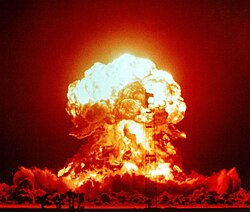
Nuclear explosions are extremely destructive compared to conventional (chemical) explosives, because of the vastly greater energy density of nuclear fuel compared to chemical explosives. They are often associated with mushroom clouds, since any large atmospheric explosion can create such a cloud. Nuclear explosions produce high levels of ionizing radiation and radioactive debris that is harmful to humans and can cause moderate to severe skin burns, eye damage, radiation sickness, radiation-induced cancer and possible death depending on how far a person is from the blast radius. Nuclear explosions can also have detrimental effects on the climate, lasting from months to years. A small-scale nuclear war could release enough particles into the atmosphere to cause the planet to cool and cause crops, animals, and agriculture to disappear across the globe—an effect named nuclear winter.
The first manmade nuclear explosion occurred on July 16, 1945, at 5:50 am on the Trinity test site near Alamogordo, New Mexico, in the United States, an area now known as the White Sands Missile Range. The event involved the full-scale testing of an implosion-type fission atomic bomb. In a memorandum to the U.S. Secretary of War, General Leslie Groves describes the yield as equivalent to 15,000 to 20,000 tons of TNT. Following this test, a uranium-gun type nuclear bomb (Little Boy) was dropped on the Japanese city of Hiroshima on August 6, 1945, with a blast yield of 15 kilotons; and a plutonium implosion-type bomb (Fat Man) on Nagasaki on August 9, 1945, with a blast yield of 21 kilotons. Fat Man and Little Boy are the only instances in history of nuclear weapons being used as an act of war.
On August 29, 1949, the USSR became the second country to successfully test a nuclear weapon. RDS-1, dubbed "First Lightning" by the Soviets and "Joe-1" by the US, produced a 20 kiloton explosion and was essentially a copy of the American Fat Man plutonium implosion design.
The first explosion involving thermonuclear fusion was the 1951 US Greenhouse George test, using a deuterium-tritium mixture. The United States' first two-stage thermonuclear weapon, Ivy Mike, was detonated on 1 November 1952 at Enewetak Atoll and yielded 10 megatons of explosive force. The first thermonuclear weapon tested by the USSR, RDS-6s (Joe-4), was detonated on August 12, 1953, at the Semipalatinsk Test Site in Kazakhstan and yielded about 400 kilotons. RDS-6s' design, nicknamed the Sloika, was remarkably similar to a version designed for the U.S. by Edward Teller nicknamed the "Alarm Clock", in that the nuclear device was a two-stage weapon: the first explosion was triggered by fission and the second more powerful explosion by fusion. The Sloika core consisted of a series of concentric spheres with alternating materials to help boost the explosive yield.
In the years following World War II, eight countries have conducted nuclear tests with 2475 devices fired in 2120 tests. In 1963, the United States, Soviet Union, and United Kingdom signed the Limited Test Ban Treaty, pledging to refrain from testing nuclear weapons in the atmosphere, underwater, or in outer space. The treaty permitted underground tests. Many other non-nuclear nations acceded to the Treaty following its entry into force; however, France and China (both nuclear weapons states) have not.[citation needed]
The primary application to date has been military (i.e. nuclear weapons), and the remainder of explosions include the following:
With the 1996 signing of the Comprehensive Nuclear-Test-Ban Treaty, underground nuclear testing ceased globally, with the exception of 1998 tests by India and Pakistan.
Nuclear explosion
A nuclear explosion is an explosion that occurs as a result of the rapid release of energy from a high-speed nuclear reaction. The driving reaction may be nuclear fission or nuclear fusion or a multi-stage cascading combination of the two, though to date all fusion-based weapons have used a fission device to initiate fusion, and a pure fusion weapon remains a hypothetical device. Nuclear explosions are used in nuclear weapons and nuclear testing.
Nuclear explosions are extremely destructive compared to conventional (chemical) explosives, because of the vastly greater energy density of nuclear fuel compared to chemical explosives. They are often associated with mushroom clouds, since any large atmospheric explosion can create such a cloud. Nuclear explosions produce high levels of ionizing radiation and radioactive debris that is harmful to humans and can cause moderate to severe skin burns, eye damage, radiation sickness, radiation-induced cancer and possible death depending on how far a person is from the blast radius. Nuclear explosions can also have detrimental effects on the climate, lasting from months to years. A small-scale nuclear war could release enough particles into the atmosphere to cause the planet to cool and cause crops, animals, and agriculture to disappear across the globe—an effect named nuclear winter.
The first manmade nuclear explosion occurred on July 16, 1945, at 5:50 am on the Trinity test site near Alamogordo, New Mexico, in the United States, an area now known as the White Sands Missile Range. The event involved the full-scale testing of an implosion-type fission atomic bomb. In a memorandum to the U.S. Secretary of War, General Leslie Groves describes the yield as equivalent to 15,000 to 20,000 tons of TNT. Following this test, a uranium-gun type nuclear bomb (Little Boy) was dropped on the Japanese city of Hiroshima on August 6, 1945, with a blast yield of 15 kilotons; and a plutonium implosion-type bomb (Fat Man) on Nagasaki on August 9, 1945, with a blast yield of 21 kilotons. Fat Man and Little Boy are the only instances in history of nuclear weapons being used as an act of war.
On August 29, 1949, the USSR became the second country to successfully test a nuclear weapon. RDS-1, dubbed "First Lightning" by the Soviets and "Joe-1" by the US, produced a 20 kiloton explosion and was essentially a copy of the American Fat Man plutonium implosion design.
The first explosion involving thermonuclear fusion was the 1951 US Greenhouse George test, using a deuterium-tritium mixture. The United States' first two-stage thermonuclear weapon, Ivy Mike, was detonated on 1 November 1952 at Enewetak Atoll and yielded 10 megatons of explosive force. The first thermonuclear weapon tested by the USSR, RDS-6s (Joe-4), was detonated on August 12, 1953, at the Semipalatinsk Test Site in Kazakhstan and yielded about 400 kilotons. RDS-6s' design, nicknamed the Sloika, was remarkably similar to a version designed for the U.S. by Edward Teller nicknamed the "Alarm Clock", in that the nuclear device was a two-stage weapon: the first explosion was triggered by fission and the second more powerful explosion by fusion. The Sloika core consisted of a series of concentric spheres with alternating materials to help boost the explosive yield.
In the years following World War II, eight countries have conducted nuclear tests with 2475 devices fired in 2120 tests. In 1963, the United States, Soviet Union, and United Kingdom signed the Limited Test Ban Treaty, pledging to refrain from testing nuclear weapons in the atmosphere, underwater, or in outer space. The treaty permitted underground tests. Many other non-nuclear nations acceded to the Treaty following its entry into force; however, France and China (both nuclear weapons states) have not.[citation needed]
The primary application to date has been military (i.e. nuclear weapons), and the remainder of explosions include the following:
With the 1996 signing of the Comprehensive Nuclear-Test-Ban Treaty, underground nuclear testing ceased globally, with the exception of 1998 tests by India and Pakistan.
Recent media
Recent media