



Community hub
Recent from talks
Contribute something to knowledge base
Content stats: 0 posts, 0 articles, 1 media, 0 notes
Members stats: 0 subscribers, 0 contributors, 0 moderators, 0 supporters
Subscribers
Supporters
Contributors
Moderators
Hub AI
Pyroclastic flow AI simulator
(@Pyroclastic flow_simulator)
Hub AI
Pyroclastic flow AI simulator
(@Pyroclastic flow_simulator)
Pyroclastic flow
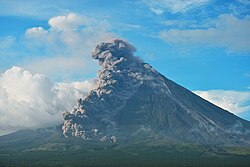
A pyroclastic flow (also known as a pyroclastic density current or a pyroclastic cloud) is a fast-moving current of hot gas and volcanic matter (collectively known as tephra) that flows along the ground away from a volcano at average speeds of 100 km/h (30 m/s; 60 mph; 90 ft/s) but is capable of reaching speeds up to 700 km/h (190 m/s; 430 mph; 640 ft/s). The gases and tephra can reach temperatures of about 1,000 °C (1,800 °F).
Pyroclastic flows are the deadliest of all volcanic hazards and are produced as a result of certain explosive eruptions; they normally touch the ground and hurtle downhill or spread laterally under gravity. Their speed depends upon the density of the current, the volcanic output rate, and the gradient of the slope.
The word pyroclast is derived from the Greek πῦρ (pýr), meaning "fire", and κλαστός (klastós), meaning "broken in pieces". A name for pyroclastic flows that glow red in the dark is nuée ardente (French, "burning cloud"); this was notably used to describe the disastrous 1902 eruption of Mount Pelée on Martinique, a French island in the Caribbean.
Pyroclastic flows that contain a much higher proportion of gas to rock are known as "fully dilute pyroclastic density currents" or pyroclastic surges. The lower density sometimes allows them to flow over higher topographic features or water such as ridges, hills, rivers, and seas. They may also contain steam, water, and rock at less than 250 °C (480 °F); these are called "cold" compared with other flows, although the temperature is still lethally high. Cold pyroclastic surges can occur when the eruption is from a vent under a shallow lake or the sea. Fronts of some pyroclastic density currents are fully dilute; for example, during the eruption of Mount Pelée in 1902, a fully dilute current overwhelmed the city of Saint-Pierre and killed nearly 30,000 people.
A pyroclastic flow is a type of gravity current; in scientific literature, it is sometimes abbreviated to PDC (pyroclastic density current).
Several mechanisms can produce a pyroclastic flow:
Flow volumes range from a few hundred cubic meters to more than 1,000 cubic kilometres (240 cu mi). Larger flows can travel for hundreds of kilometres, although none on that scale has occurred for several hundred thousand years. Most pyroclastic flows are around one to ten cubic kilometres (1⁄4–2+1⁄2 cu mi) and travel for several kilometres. Flows usually consist of two parts: the basal flow hugs the ground and contains larger, coarse boulders and rock fragments, while an extremely hot ash plume lofts above it because of the turbulence between the flow and the overlying air, admixing and heating cold atmospheric air causing expansion and convection. Flows can deposit less than 1 meter to 200 meters in depth of loose rock fragment.
The kinetic energy of the moving cloud will flatten trees and buildings in its path. The hot gases and high speed make them particularly lethal, as they will quickly incinerate living organisms or turn them into carbonized fossils:
Pyroclastic flow
A pyroclastic flow (also known as a pyroclastic density current or a pyroclastic cloud) is a fast-moving current of hot gas and volcanic matter (collectively known as tephra) that flows along the ground away from a volcano at average speeds of 100 km/h (30 m/s; 60 mph; 90 ft/s) but is capable of reaching speeds up to 700 km/h (190 m/s; 430 mph; 640 ft/s). The gases and tephra can reach temperatures of about 1,000 °C (1,800 °F).
Pyroclastic flows are the deadliest of all volcanic hazards and are produced as a result of certain explosive eruptions; they normally touch the ground and hurtle downhill or spread laterally under gravity. Their speed depends upon the density of the current, the volcanic output rate, and the gradient of the slope.
The word pyroclast is derived from the Greek πῦρ (pýr), meaning "fire", and κλαστός (klastós), meaning "broken in pieces". A name for pyroclastic flows that glow red in the dark is nuée ardente (French, "burning cloud"); this was notably used to describe the disastrous 1902 eruption of Mount Pelée on Martinique, a French island in the Caribbean.
Pyroclastic flows that contain a much higher proportion of gas to rock are known as "fully dilute pyroclastic density currents" or pyroclastic surges. The lower density sometimes allows them to flow over higher topographic features or water such as ridges, hills, rivers, and seas. They may also contain steam, water, and rock at less than 250 °C (480 °F); these are called "cold" compared with other flows, although the temperature is still lethally high. Cold pyroclastic surges can occur when the eruption is from a vent under a shallow lake or the sea. Fronts of some pyroclastic density currents are fully dilute; for example, during the eruption of Mount Pelée in 1902, a fully dilute current overwhelmed the city of Saint-Pierre and killed nearly 30,000 people.
A pyroclastic flow is a type of gravity current; in scientific literature, it is sometimes abbreviated to PDC (pyroclastic density current).
Several mechanisms can produce a pyroclastic flow:
Flow volumes range from a few hundred cubic meters to more than 1,000 cubic kilometres (240 cu mi). Larger flows can travel for hundreds of kilometres, although none on that scale has occurred for several hundred thousand years. Most pyroclastic flows are around one to ten cubic kilometres (1⁄4–2+1⁄2 cu mi) and travel for several kilometres. Flows usually consist of two parts: the basal flow hugs the ground and contains larger, coarse boulders and rock fragments, while an extremely hot ash plume lofts above it because of the turbulence between the flow and the overlying air, admixing and heating cold atmospheric air causing expansion and convection. Flows can deposit less than 1 meter to 200 meters in depth of loose rock fragment.
The kinetic energy of the moving cloud will flatten trees and buildings in its path. The hot gases and high speed make them particularly lethal, as they will quickly incinerate living organisms or turn them into carbonized fossils:
Recent media
Recent media