Hubbry Logo
Pyroclastic flowPyroclastic flowMain
Open search
Pyroclastic flow
Community hub
Pyroclastic flow
logo
8 pages, 0 posts
0 subscribers
Be the first to start a discussion here.
Contribute something
Pyroclastic flow
Pyroclastic flow
from Wikipedia
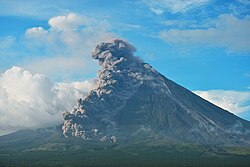
Pyroclastic flows sweep down the flanks of Mayon Volcano, Philippines, in 2018

A pyroclastic flow (also known as a pyroclastic density current or a pyroclastic cloud)[1] is a fast-moving current of hot gas and volcanic matter (collectively known as tephra) that flows along the ground away from a volcano at average speeds of 100 km/h (30 m/s; 60 mph; 90 ft/s) but is capable of reaching speeds up to 700 km/h (190 m/s; 430 mph; 640 ft/s).[2] The gases and tephra can reach temperatures of about 1,000 °C (1,800 °F).

Pyroclastic flows are the deadliest of all volcanic hazards[3] and are produced as a result of certain explosive eruptions; they normally touch the ground and hurtle downhill or spread laterally under gravity. Their speed depends upon the density of the current, the volcanic output rate, and the gradient of the slope.

Origin of term

[edit]
Pyroclastic rocks from the Bishop tuff; uncompressed with pumice (on left), compressed with fiamme (on right)

The word pyroclast is derived from the Greek πῦρ (pýr), meaning "fire", and κλαστός (klastós), meaning "broken in pieces".[4][5] A name for pyroclastic flows that glow red in the dark is nuée ardente (French, "burning cloud"); this was notably used to describe the disastrous 1902 eruption of Mount Pelée on Martinique, a French island in the Caribbean.[6][note 1]

Pyroclastic flows that contain a much higher proportion of gas to rock are known as "fully dilute pyroclastic density currents" or pyroclastic surges. The lower density sometimes allows them to flow over higher topographic features or water such as ridges, hills, rivers, and seas. They may also contain steam, water, and rock at less than 250 °C (480 °F); these are called "cold" compared with other flows, although the temperature is still lethally high. Cold pyroclastic surges can occur when the eruption is from a vent under a shallow lake or the sea. Fronts of some pyroclastic density currents are fully dilute; for example, during the eruption of Mount Pelée in 1902, a fully dilute current overwhelmed the city of Saint-Pierre and killed nearly 30,000 people.[7]

A pyroclastic flow is a type of gravity current; in scientific literature, it is sometimes abbreviated to PDC (pyroclastic density current).

Causes

[edit]

Several mechanisms can produce a pyroclastic flow:

  • Fountain collapse of an eruption column from a Plinian eruption (e.g. Mount Vesuvius' destruction of Herculaneum and Pompeii in 79 AD). In such an eruption, the material forcefully ejected from the vent heats the surrounding air and the turbulent mixture rises, through convection, for many kilometers. If the erupted jet is unable to heat the surrounding air sufficiently, convection currents will not be strong enough to carry the plume upwards and it falls, flowing down the flanks of the volcano.[citation needed]
  • Fountain collapse of an eruption column associated with a Vulcanian eruption (e.g., Montserrat's Soufrière Hills volcano has generated many of these deadly pyroclastic flows and surges). The gas and projectiles create a cloud that is denser than the surrounding air and becomes a pyroclastic flow.
  • Frothing at the mouth of the vent during degassing of the erupted lava. This can lead to the production of a rock called ignimbrite. This occurred during the eruption of Novarupta in 1912.
  • Gravitational collapse of a lava dome or spine, with subsequent avalanches and flows down a steep slope (e.g., Montserrat's Soufrière Hills volcano, which caused nineteen deaths in 1997).
  • The directional blast (or jet) when part of a volcano collapses or explodes (e.g., the eruption of Mount St. Helens on May 18, 1980). As distance from the volcano increases, this rapidly transforms into a gravity-driven current.

Size and effects

[edit]
Building remnant in Francisco Leon destroyed by pyroclastic surges and flows during eruption of El Chichon volcano in Mexico in 1982. Reinforcement rods in the concrete were bent in the direction of the flow.
A scientist examines pumice blocks at the edge of a pyroclastic flow deposit from Mount St. Helens
The casts of some victims in the so-called "Garden of the Fugitives", Pompeii

Flow volumes range from a few hundred cubic meters to more than 1,000 cubic kilometres (240 cu mi). Larger flows can travel for hundreds of kilometres, although none on that scale has occurred for several hundred thousand years. Most pyroclastic flows are around one to ten cubic kilometres (142+12 cu mi) and travel for several kilometres. Flows usually consist of two parts: the basal flow hugs the ground and contains larger, coarse boulders and rock fragments, while an extremely hot ash plume lofts above it because of the turbulence between the flow and the overlying air, admixing and heating cold atmospheric air causing expansion and convection.[8] Flows can deposit less than 1 meter to 200 meters in depth of loose rock fragment.[9]

The kinetic energy of the moving cloud will flatten trees and buildings in its path. The hot gases and high speed make them particularly lethal, as they will quickly incinerate living organisms or turn them into carbonized fossils:

  • The Ancient Roman cities of Pompeii and Herculaneum (now in Italy), for example, were engulfed by pyroclastic surges of Mount Vesuvius in AD 79 with many lives lost.[10]
  • The 1902 eruption of Mount Pelée destroyed the Martinique town of St. Pierre. Despite signs of impending eruption, the government deemed St. Pierre safe due to hills and valleys between it and the volcano, but the pyroclastic flow charred almost the entirety of the city, killing all but three of its 30,000 residents.[citation needed]
  • A pyroclastic surge killed volcanologists Harry Glicken and Katia and Maurice Krafft and 40 other people on Mount Unzen, in Japan, on June 3, 1991. The surge started as a pyroclastic flow and the more energised surge climbed a spur on which the Kraffts and the others were standing; it engulfed them, and the corpses were covered with about 5 mm (14 in) of ash.[11]
  • On June 25, 1997, a pyroclastic flow travelled down Mosquito Ghaut on the Caribbean island of Montserrat.[12] A large, highly energized pyroclastic surge developed. This flow could not be restrained by the Ghaut and spilled out of it, killing 19 people who were in the Streatham village area (which was officially evacuated). Several others in the area suffered severe burns.

Interaction with water

[edit]

Testimonial evidence from the 1883 eruption of Krakatoa, supported by experimental evidence,[13] shows that pyroclastic flows can cross significant bodies of water. However, that might be a pyroclastic surge, not flow, because the density of a gravity current means it cannot move across the surface of water.[13] One flow reached the Sumatran coast as far as 48 kilometres (26 nautical miles) away.[14]

A 2006 BBC documentary film, Ten Things You Didn't Know About Volcanoes,[15] demonstrated tests by a research team at Kiel University, Germany, of pyroclastic flows moving over the water.[16] When the reconstructed pyroclastic flow (stream of mostly hot ash with varying densities) hit the water, two things happened: the heavier material fell into the water, precipitating out from the pyroclastic flow and into the liquid; the temperature of the ash caused the water to evaporate, propelling the pyroclastic flow (now only consisting of the lighter material) along on a bed of steam at an even faster pace than before.

During some phases of the Soufriere Hills volcano on Montserrat, pyroclastic flows were filmed about 1 km (12 nmi) offshore. These show the water boiling as the flow passes over it. The flows eventually built a delta, which covered about 1 km2 (250 acres). Another example was observed in 2019 at Stromboli when a pyroclastic flow traveled for several hundreds of meters above the sea.[17]

A pyroclastic flow can interact with a body of water to form a large amount of mud, which can then continue to flow downhill as a lahar. This is one of several mechanisms that can create a lahar.[citation needed]

On other celestial bodies

[edit]

In 1963, NASA astronomer Winifred Cameron proposed that the lunar equivalent of terrestrial pyroclastic flows may have formed sinuous rilles on the Moon. In a lunar volcanic eruption, a pyroclastic cloud would follow local relief, resulting in an often sinuous track. The Moon's Schröter's Valley offers one example.[18][non-primary source needed] Some volcanoes on Mars, such as Tyrrhenus Mons and Hadriacus Mons, have produced layered deposits that appear to be more easily eroded than lava flows, suggesting that they were emplaced by pyroclastic flows.[19]

See also

[edit]

References

[edit]

Notes

[edit]
[edit]
Revisions and contributorsEdit on WikipediaRead on Wikipedia
from Grokipedia
A pyroclastic flow is a fast-moving, ground-hugging of hot volcanic matter, consisting of a dense mixture of rock fragments, , , and superheated gases that surges down the slopes of a at speeds exceeding 80 km/h (50 mph). These flows typically form through the of an eruptive column during explosive volcanic eruptions, the destabilization of a , or the front of a thick lava flow, resulting in a turbulent current that follows valleys and low-lying terrain. With temperatures ranging from 200°C to over 800°C (390°F to 1,500°F), pyroclastic flows incinerate everything in their path and can travel distances of 5 to 20 km or more, leaving behind thick deposits of . The composition of a pyroclastic flow includes a basal layer of coarse, dense fragments—such as lava blocks and —overlain by a more dilute, turbulent ash cloud rich in fine particles and gases, which enhances its mobility and destructive reach. These currents are denser than surrounding air, allowing them to hug the ground and accelerate rapidly, often reaching velocities of tens to hundreds of meters per second, which makes evasion nearly impossible for anything in their trajectory. Formation mechanisms vary: events produce widespread, pumice-rich flows from column , while dome collapses generate block-and-ash flows that are more localized but intensely hazardous due to larger rock fragments. The flows' behavior is influenced by , with channeling in valleys amplifying speed and confinement, potentially leading to surges that leap topographic barriers. Pyroclastic flows represent one of the most lethal volcanic hazards, capable of demolishing , forests, and while causing immediate fatalities through burns, of scorching , and from impacts. Their extreme heat and speed suffocate victims and ignite fires, with historical eruptions demonstrating their toll: the 1902 Mont Pelée event in unleashed a flow that razed the city of Saint-Pierre, killing nearly 30,000 people. Secondary effects exacerbate risks, as flows can melt snow and ice to trigger lahars—volcanic mudflows—or dam rivers, causing downstream flooding; for instance, the 1982 eruption in produced flows that contributed to about 2,000 deaths through direct and indirect impacts. Monitoring and evacuation zones around active volcanoes, such as those established for in , underscore the need for preparedness given the flows' unpredictability and rapid onset.

Definition and Terminology

Core Definition

A pyroclastic flow is a fast-moving, ground-hugging avalanche consisting of hot mixed with and rock fragments known as pyroclasts. These flows originate from volcanic vents and travel rapidly down slopes, often following valleys due to their high and low position relative to surrounding air. Pyroclasts include juvenile fragments like , which are vesicular pieces of solidified , and lithic fragments, which are denser blocks broken from the volcano's walls or surrounding rock. Unlike pyroclastic surges, which are more dilute, turbulent, and airborne mixtures of gas and particles that can expand laterally over , pyroclastic flows remain dense and confined close to the ground surface. They also differ from lahars, which are water-saturated mixtures of volcanic and that behave like fast-moving slurries but lack the extreme of dry pyroclastic currents. These distinctions highlight the unique mechanics of pyroclastic flows as dense, gravity-driven avalanches powered primarily by volcanic gases. The phenomenon was first scientifically recognized during the 1902 eruption of Mount Pelée in Martinique, where a pyroclastic flow devastated the town of Saint-Pierre, killing nearly 30,000 people and prompting detailed study of such events. Observations from this eruption established pyroclastic flows as a major , distinct from other eruptive products.

Etymology and Classification

The term "pyroclastic" originates from the Greek roots pyr (πῦρ), meaning "," and klastos (κλαστός), meaning "broken," referring to fragmented materials formed by volcanic heat and fragmentation processes. This etymological foundation was first applied in geological contexts in the mid-19th century, with the word "pyroclastic" appearing in English scientific literature around 1862, introduced by geologist Joseph Beete Jukes to describe volcanic fragmental rocks. The specific terminology for pyroclastic flows evolved significantly in the early 20th century following the catastrophic 1902 eruption of Mount Pelée in Martinique, which produced fast-moving, incandescent avalanches that devastated Saint-Pierre. French geologist Alfred Lacroix, in his seminal 1904 publication La Montagne Pelée et ses éruptions, coined the term nuée ardente (French for "glowing cloud" or "burning cloud") to describe these ground-hugging, high-temperature currents of gas, ash, and rock fragments. Lacroix's detailed observations and reports established nuée ardente as the foundational descriptor for such phenomena, emphasizing their luminous, cloud-like appearance and destructive mobility, and marking a shift from earlier vague references to volcanic "clouds" or "avalanches" in historical accounts. Over subsequent decades, the term was anglicized and integrated into broader English volcanological nomenclature, evolving into "pyroclastic flow" by the mid-20th century to encompass a wider range of similar events while retaining the core emphasis on fiery fragmentation. In contemporary volcanology, the term "pyroclastic density current" (PDC) is often used to describe the full spectrum of these phenomena, including both dense flows and dilute surges. Pyroclastic flows are classified primarily by their density and particle composition, distinguishing between dense, concentrated variants and more dilute, gas-rich forms often termed pyroclastic surges. Dense pyroclastic flows, the classic type, feature high concentrations of solid material (on the order of tens of volume percent by volume) in a turbulent matrix of hot gas, enabling them to hug the ground and travel rapidly along slopes. Within dense flows, two major subtypes are recognized based on origin and clast content: block-and-ash flows, which arise from the of lava domes or thick flows and consist predominantly of angular blocks, lithic fragments, and fine without significant ; and flows, generated by the partial collapse of tall eruption columns during Plinian-style events, characterized by abundant lightweight clasts that form widespread, welded or unwelded deposits upon cooling. These classifications, refined through post-1902 studies, highlight how flow type influences mobility and depositional patterns, with block-and-ash flows typically more localized and flows capable of extensive areal coverage.

Generation Processes

Primary Volcanic Mechanisms

Pyroclastic flows are primarily generated through direct volcanic eruption processes involving the explosive release of magmatic material, where and dynamic forces lead to the emplacement of hot, dense currents of gas, ash, and fragments. These mechanisms are distinct from post-eruptive instabilities and focus on the initial during active venting. Key styles include highly explosive column collapses and gravitational failures of viscous extrusions, often amplified by internal gas dynamics. In Plinian and Pelean eruption styles, pyroclastic flows arise from the collapse of high-velocity eruption columns, producing radial density currents that spread outward from the vent. Plinian eruptions, characterized by silicic magmas and sustained plumes reaching tens of kilometers into the , generate these flows when the column's upper portions cool and become denser than ambient air, leading to partial or full collapse under gravity. This process forms pumice-rich flows that can travel tens of kilometers, as exemplified by the 1912 eruption in , where a column exceeding 30 km in height collapsed to produce voluminous ignimbrites covering approximately 120 km². Pelean eruptions, involving andesitic to dacitic magmas, similarly initiate flows through column instability but are often associated with initial nuée ardente surges from vent-clearing explosions, transitioning to denser currents as material accumulates. The 1902 eruption of Mount Pelée in demonstrated this, with a collapsing column and subsequent surges devastating Saint-Pierre and killing nearly 30,000 people. In both styles, the radial dispersal is driven by the momentum inherited from the collapsing fountain, creating low-concentration leading edges followed by denser bodies. Dome extrusion and collapse represent another core mechanism, where gravitational instability of viscous lava domes releases confined pyroclasts in block-and-ash flows. During , high-viscosity forms steep-sided domes that grow unstable due to oversteepening or internal pressure buildup, leading to partial failures that mobilize talus and fresh material into avalanches. These flows are typically confined to proximal areas but can extend several kilometers, incorporating angular blocks up to several meters in size within a fine matrix. A representative case is the 1902–1905 activity at , where repeated dome growth and collapse generated multiple pyroclastic flows, including slow-moving block-and-ash events that filled valleys on the volcano's flanks. Similarly, the 2006 eruption of in featured frequent dome collapses during rapid growth phases, producing north-flank flows up to 20 m thick with levees of large blocks. Caldera-forming eruptions produce pyroclastic flows through large-scale column failure, often linked to evacuation and ring-fracture venting. These supereruptions involve the partial emptying of shallow chambers, causing widespread while explosive plumes collapse to feed extensive sheets. The mechanics involve initial Plinian-style ascent followed by progressive vent widening, which destabilizes the column and generates valley-filling flows that surmount topographic barriers. For instance, the climactic phase of the eruption in the saw column collapse emplace about 5.5 km³ of pyroclastic-flow deposits, contributing to caldera formation. The 640,000-year-old eruption at exemplified this on a grander scale, with flows covering 15,500 km² from a collapsing column tied to 1,000 km³ of erupted material. Gas expansion and play a in the initial emplacement of pyroclastic flows across these mechanisms, providing the impulsive energy for fragmentation and acceleration. Exsolved volatiles within the create overpressurized conditions in the conduit, driving decompression that fragments the melt and entrains pyroclasts into a gas-particle . This overpressure, often exceeding 100 bars, facilitates lateral expansion of jets at the vent, gas to solids and promoting column or direct flow generation. In dome collapses, residual overpressure from incompletely degassed interiors can enhance flow mobility upon failure, as observed in experiments where specific from gas release (calculated as ΔP × V / m) thresholds determine versus sustained . Overall, these dynamics ensure the high velocities (up to 100 m/s) and densities that characterize primary emplacement.

Secondary Triggers and Instability

Secondary triggers of pyroclastic flows arise from instabilities in volcanic structures or deposits following initial eruptive activity, often involving gravitational or external perturbations that remobilize hot, fragmented material into density currents. These events differ from primary eruptive mechanisms by occurring post-eruption, where accumulated stresses or environmental factors destabilize pre-existing volcanic features, leading to sudden releases of pyroclastic material. Such triggers are critical in understanding non-eruptive hazards at active volcanoes, as they can generate flows comparable in destructiveness to those from direct explosions. Cryptodome and lava dome failures represent key secondary triggers, where structural weakening from internal pressure buildup compromises dome integrity, resulting in partial or total collapse and the generation of pyroclastic flows. Cryptodomes, subsurface intrusions that bulge the edifice, induce oversteepening of slopes and reduce rock mass strength through prolonged deformation, often over months, culminating in sector-like collapses that decompress pressurized and trigger fragmentation. Similarly, , formed by viscous extrusion, develop hidden mechanical weaknesses from buried high-porosity hydrothermal alteration zones, where acid alteration reduces rock strength by up to a factor of 10 due to mineralogical changes like natroalunite and formation, exacerbated by pore increases from ongoing . These failures release hot, gas-charged material that fragments and flows as high-velocity pyroclastic density currents, with initial speeds exceeding 100 m/s in some cases. Sector collapses on stratovolcanoes provide another prominent secondary pathway, driven by flank instability that mobilizes large volumes of hot, altered volcanic material into pyroclastic flows. These events stem from gravitational disequilibrium, amplified by hydrothermal alteration, fracturing, and magmatic loading, which weaken the edifice and promote lateral failures, often along structural discontinuities. In stratovolcanic settings, such collapses can incorporate juvenile hot fragments if magmatic intrusion is involved, leading to directed blasts or density currents that propagate downslope, with volumes ranging from small-scale (<1 km³) repetitive failures to infrequent large-scale events (tens of km³). The resulting instability often forms horseshoe-shaped scars, increasing vulnerability to future collapses by altering slope geometry and exposing weaker substrates. Remobilization of eruption deposits constitutes a widespread secondary trigger, where external agents like rainfall or seismic activity destabilize unconsolidated pyroclastic material, initiating hot avalanches that evolve into secondary pyroclastic flows. Heavy monsoon or typhoon rains erode and saturate thick ignimbrite layers, promoting avalanching through increased pore pressure and reduced cohesion, while earthquakes can further trigger failures by shaking loose valley-ponded deposits. These processes generate dry, gas-fluidized flows from fines-depleted material, with volumes typically 0.01–0.05 km³ and runouts up to 10 km, as the entrained gases from residual heat sustain laminar, high-concentration currents. Such remobilization is particularly hazardous in tropical volcanic regions, where seasonal rains routinely transform static deposits into dynamic hazards. While sector collapses and related instabilities occur rarely in non-volcanic geological settings—such as landslides on steep, altered slopes in sedimentary basins—these analogs lack the hot, fragmented, gas-rich components essential for true pyroclastic flows, underscoring the dominance of volcanic processes in their generation.

Physical Properties

Composition and Temperature

Pyroclastic flows are composed of a turbulent mixture of solid pyroclasts and volcanic gases, with the solid fraction typically including both juvenile material derived directly from erupting magma and lithic fragments entrained from conduit walls or surrounding country rock. The pyroclasts vary in size and are classified as ash (particles <2 mm in diameter), lapilli (2–64 mm), and blocks or bombs (>64 mm), often forming a dense, unsorted matrix that can include pumice, crystals, and glass shards depending on the magma composition. The gas phase, which drives the flow's mobility, is primarily composed of superheated water vapor (H₂O), carbon dioxide (CO₂), and sulfur dioxide (SO₂), with minor contributions from other volatiles like hydrogen sulfide and hydrogen chloride. Temperatures within pyroclastic flows generally range from 100°C to 800°C, though core regions and entrained molten clasts can exceed 1000°C, varying with factors such as eruption style and type. Block-and-ash flows, often generated by collapse, tend to maintain higher sustained temperatures due to their denser, more cohesive nature compared to more dilute ignimbrite-forming flows. These thermal conditions enable phase changes, including the incandescence of partially molten clasts and the of hot ash particles upon deposition, while post-emplacement cooling occurs rapidly at the surface (rates up to several hundred degrees per hour initially) but more slowly in the interior due to insulation by the deposit. Direct measurement of flow temperatures is challenging due to their speed and danger, but emplacement temperatures are estimated using thermocouples inserted into fresh deposits shortly after halting, yielding values from 200°C to over 700°C in the matrix and higher in clasts. Fourier transform infrared (FTIR) spectroscopy is employed to analyze gas compositions remotely or in samples, identifying dominant species like H₂O, CO₂, and SO₂ through their absorption spectra.

Velocity and Density

Pyroclastic flows exhibit a wide range of , typically spanning 10 to 700 km/h, depending on the flow type, initial conditions, and environmental factors. Dense block-and-ash flows often initiate at lower speeds around 10-50 km/h before accelerating, while dilute surges can rapidly attain velocities exceeding 100 km/h and up to 700 km/h due to their lower resistance and turbulent . Acceleration occurs as flows descend slopes, with observed profiles showing initial exit velocities of approximately 120-190 m/s (432-684 km/h) at vents, decreasing with distance as energy dissipates. Most pyroclastic flows operate in turbulent regimes, where chaotic motion dominates particle and gas interactions, though basal layers in dense flows may exhibit more laminar-like granular flow characteristics. Density in pyroclastic flows varies significantly between dilute surges and dense undercurrents, reflecting differences in particle concentration and phase interactions. Dilute surges, which behave as turbulent suspensions, have bulk densities ranging from 10 to 100 kg/m³, enabling high mobility and wide dispersal. In contrast, dense flows feature bulk densities of approximately 1,000-1,500 kg/m³ in their basal regions, where high particle concentrations (volume fractions of 0.4-0.6) create a fluidal-to-granular transition. These density gradients arise partly from compositional factors, such as the proportion of ash versus lithic fragments, which influence overall mass per unit volume. The transfer within pyroclastic flows is heavily influenced by particle concentration, which governs and flow longevity. Higher concentrations in dense undercurrents enhance through inter-particle collisions, allowing distances exceeding 100 km in large-volume events by sustaining flow against frictional losses. In dilute regimes, entrainment of ambient particles via splash mechanisms increases concentration progressively, potentially extending by an compared to non-entraining flows, as amplifies without proportional drag increase. Measurement of velocity and density relies on a combination of remote sensing, geophysical instrumentation, and computational models. Radar systems, such as dual-pulse repetition frequency (PRF) Doppler radar, provide real-time velocity profiles by analyzing echo shifts from moving particles, capturing downslope speeds up to 190 m/s during plume collapses. Seismic and infrasound sensors detect ground vibrations and pressure waves from passing flows, enabling velocity estimates through signal timing and amplitude analysis across sensor arrays. Numerical modeling tools like TITAN2D simulate depth-averaged flows using depth-integrated equations for mass and momentum, incorporating variable densities and friction to predict velocity fields and runout, validated against historical deposits for hazard assessment.

Dynamics and Behavior

Flow Mechanics

Pyroclastic flows are complex multiphase systems comprising gas, , and larger clasts, whose motion is governed by approximations to the Navier-Stokes equations adapted for non-homogeneous mixtures. These models treat the flow as interpenetrating continua, solving conservation equations for mass, momentum, and energy across phases while accounting for interphase interactions such as drag and . Numerical solutions, often using finite volume or finite element methods, enable simulations of transient, multidimensional dynamics over scales of kilometers. For the dense undercurrents, Bagnold's granular flow theory provides a foundational framework, emphasizing shear-induced particle collisions that generate dispersive pressures proportional to the square of the , which support the flow against in high-concentration regimes. This kinetic theory has been applied to model the resistance and mobility of block-and-ash flows, where particle interactions dominate over drag. Energy within pyroclastic flows partitions between kinetic, thermal, and potential forms, with significant conversion from kinetic to thermal energy occurring through frictional heating and particle collisions during transport. In far-traveled flows, the basal kinetic energy can exceed available thermal energy, driving further entrainment of ambient air that dilutes the mixture and enhances turbulence. Entrainment rates, typically 0.1–1 times the flow velocity, introduce cooler air, reducing density and temperature while increasing volume, which prolongs runout but promotes sedimentation as the flow expands. This partitioning influences flow longevity, with thermal energy from hot particles (often >500°C) contributing to buoyancy in the overriding cloud, while kinetic dissipation in the dense base generates seismic signals. Runout distance in pyroclastic flows is modeled using principles, adapting equations to account for initial , , and frictional losses. A simplified form for maximum runout height drop hh on an is given by h=V22g,h = \frac{V^2}{2g}, where VV is the initial and gg is ; this derives from equating initial to potential energy loss, modified for granular in volcanic contexts. More advanced depth-averaged models, such as those based on shallow-water equations, incorporate volume-dependent fall height-to-runout ratios (e.g., ΔH/L0.1V0.08\Delta H / L \approx 0.1 V^{-0.08}) to predict distances exceeding 10–100 km for large-volume . Sedimentation in pyroclastic flows involves particle segregation driven by differential velocities, size, and , leading to vertical and lateral grading in deposits. Larger, denser clasts settle preferentially at the flow base, forming coarse basal layers, while finer ash remains suspended longer in the turbulent upper regions, resulting in inverse or normal grading upon deceleration. In polydisperse mixtures, Rouse numbers (comparing to turbulent ) exceeding 2.5 promote rapid segregation, with buoyant delaying deposition and creating bidensity currents. These processes are amplified by flow expansion, where reduced velocity enhances gravitational sorting without significant topographic influence.

Topographic Interactions

Pyroclastic density currents (PDCs) often become channelized when confined within valleys or topographic depressions, which can significantly enhance their velocity and erosive power. On moderate slopes of 5–15°, PDCs initiate self-channelization through basal erosion, forming broad scours that deepen and narrow downstream, as evidenced by ground-penetrating radar imaging of the 1980 Mount St. Helens deposits. This process confines the flow, increasing speeds by up to several times the unchannelized rate and promoting runout distances exceeding 10 km, with eroded volumes reaching ~1.6 × 10⁶ m³ in single channels. Channelization also incorporates substrate material, altering the flow's composition and amplifying downstream hazards. Flow partitioning occurs as PDCs interact with varying slopes, separating into a dense basal underflow that hugs the terrain and a dilute turbulent override that decouples and overruns obstacles. On steep proximal slopes up to 25°, the underflow remains confined to valleys, depositing coarse lithic-rich layers, while the override generates dune bedforms on interfluves through traction and hydraulic jumps. Marginal shearing and grain-size segregation further contribute to levee formation, where coarser particles advect laterally and deposit as elevated margins due to reduced mobility from cooling and frictional losses. Experimental simulations confirm this segregation at rates of ~3.5 cm/s for coarse grains, leading to levees several meters high that stabilize the flow channel. Such partitioning was observed in the 2006 Tungurahua eruption, where dense flows filled valleys and dilute surges mantled ridges. Topographic barriers, such as ridges or escarpments, profoundly affect PDC propagation by causing deflection, ponding, and surge generation. On the stoss side of obstacles, flows compress and accelerate, with velocities doubling or tripling (e.g., from 10 m/s to 20–30 m/s), before ponding occurs if the barrier fully blocks the underflow, leading to rapid sedimentation rates up to 180 mm/s and mass loss exceeding 90%. Deflection around barriers can redirect flows laterally, while overflow generates detached turbulent surges in the lee side, forming finger-like instabilities and tractional deposits. Analog experiments replicating these interactions mirror natural examples, such as the 2012 Te Maari eruption, where ridge interactions produced surge lobes beyond the main flow path. Post-flow remobilization of PDC deposits is strongly influenced by rugged terrain, particularly steep slopes and incised channels, which reshape deposit morphology through slumping and granular flow. In areas with gradients >10–15°, fresh surge layers rapidly homogenize via soft-sediment deformation, forming massive, poorly sorted beds that pond in topographic lows or extend as low-profile fans up to 1 km into valleys. Rugged landscapes strip thinner deposits on crests while preserving thicker accumulations in gulches, resulting in irregular, channeled morphologies that reflect ongoing instability. This process, documented in the Ubehebe Crater phreatic eruption, highlights how terrain controls long-term deposit evolution, independent of initial flow dynamics.

Hazards and Impacts

Destructive Effects

Pyroclastic flows exert devastating thermal effects on life, infrastructure, and the environment due to their extreme temperatures, typically ranging from 200°C to 700°C, though some can reach up to 800°C. These high temperatures cause severe burns to exposed and ignite , forests, and combustible structures such as wooden buildings and crops in their path. exposure to temperatures exceeding 250°C, even for brief durations such as seconds at the flow's periphery, can result in instant death from heat-induced fulminant shock or of bodily fluids, with survival limits generally below 200°C for short exposures. The mechanical forces of pyroclastic flows contribute to widespread physical destruction through high-velocity movement, often exceeding 80 km/h, which allows them to knock down trees, shatter , and carry away . Large ballistic blocks and dense particle loads within the flow generate impact forces capable of demolishing structures, as observed in historical events where flows bent steel rods. Additionally, the flows deposit thick layers of hot volcanic material, burying landscapes under meters to tens of meters of —up to 200 m in extreme cases—which suffocates underlying infrastructure and alters terrain permanently. Respiratory hazards from pyroclastic flows primarily arise from the of superheated and gases at the flow margins, leading to immediate asphyxiation as particles form plugs in the airways and cause burns to the and . These acute effects can result in fatal laryngeal or , with survivors often experiencing secondary infections or long-term scarring. In the longer term, fine containing crystalline silica inhaled during or after the event increases the risk of , a progressive that impairs and can lead to over years. Vulnerable populations, including those with pre-existing conditions, face heightened risks from these irritants. Pyroclastic flows disrupt ecosystems by sterilizing through intense heat that kills microorganisms, seeds, and root systems, effectively rendering affected areas barren and preventing immediate regrowth. This leads to widespread as mature trees and vegetation are incinerated or uprooted, creating landscapes with sparse cover that are highly susceptible to and . Recovery timelines for such ecosystems often span decades to centuries, with initial like grasses and shrubs colonizing deposits slowly, followed by forest regeneration depending on , nutrient replenishment, and . These alterations can persist, reducing and altering local for extended periods.

Aquatic Interactions

When pyroclastic flows enter water bodies, they often trigger phreatomagmatic explosions due to the rapid interaction between hot particles and , generating that fragments the material further and expands the radius beyond what would occur on land. These explosions are particularly intense when ash temperatures exceed 200°C, producing fountains of wet and dry along with buoyant plumes that propagate the surge over surfaces. The poor size sorting of pyroclastic flows exacerbates this process by facilitating efficient to , enhancing the explosive potential and increasing the reach of the resulting base surges. Upon immersion, the flows undergo significant transformation, including densification where hot material (>250°C) initially skims the surface while cooler components mix underwater to form currents, and induced by that can lead to partial or complete conversion into water-supported flows. This ingestion of alters the flow's and mobility, often generating base surges—radially expanding, dilute pyroclastic clouds—or tsunamis through displacement of volumes and explosive energy release. The of the incoming flow and its are critical parameters controlling these outcomes, with denser, high-flux flows more likely to produce propagating waves across water bodies. Subaqueous emplacement of these transformed flows results in distinctive ignimbrite deposits characterized by unique fabrics, such as normally with coarse basal layers from initial impact and finer upper layers from fallout, often including rafts in cooler flows. can occur in shallow-water settings if emplacement happens rapidly at temperatures above 500°C, preserving high-temperature microstructures like fused glass shards without significant chilling by ambient water. However, wholly submerged deposits typically show limited due to , instead featuring water-supported mass-flow structures that distinguish them from subaerial ignimbrites. In cases where pyroclastic flows enter lakes or seas, the mechanics involve initial sediment waves generated by the flow's impact and disruption, followed by extended underwater runout as transformed debris currents travel farther than their equivalents. Experimental observations demonstrate that these runouts can extend over 100 cm in scaled models, producing slumps and currents that redistribute material across basin floors. Such interactions highlight the role of water depth and flow temperature in modulating runout distance and deposit morphology; for example, during the 2021 La Soufrière eruption in Saint Vincent, pyroclastic flows reached coastal waters, generating base surges that extended hazards offshore.

Extraterrestrial Occurrences

Martian Examples

The Medusae Fossae Formation (MFF) represents one of the most extensive volcanic deposits on Mars, interpreted as ancient ignimbrites resulting from pyroclastic flows associated with Tharsis volcanism during the Hesperian-Amazonian periods. Stretching over 5,000 km along the Martian dichotomy boundary between 140°E and 240°E, the formation covers approximately 2.5 × 10^6 km² with an estimated volume exceeding 1.4 × 10^6 km³, dwarfing many terrestrial volcanic edifices and indicating multiple large-scale explosive eruptions. These deposits exhibit fine-grained, low-density materials consistent with pyroclastic emplacement, showing similarities in composition and texture to terrestrial ignimbrites from the Central Andes, though adapted to Martian conditions. High-resolution images from the instrument on the reveal flow-like features within the MFF, including lobate margins and marginal levees that suggest the dynamics of dense, granular pyroclastic currents navigating varied . These structures, with runout distances extending up to hundreds of kilometers, highlight the influence of Mars' low (about 0.38 times 's) and thin atmosphere (surface pressure ~6 mbar), which reduce drag and gravitational settling, enabling longer flow propagation compared to Earth analogs—potentially reaching 500 km in favorable scenarios. The deposits' morphologies, with aspect ratios of 20:1 to 50:1 and steep slopes up to 80°, further support a welded or indurated pyroclastic origin, as has sculpted the once-fluid flows into aligned ridges. Recent analyses of MARSIS radar data, acquired post-2020, indicate subsurface interfaces within the MFF at depths up to 3.7 km, revealing layered structures with low dielectric constants suggestive of ice-rich volatiles incorporated during or after emplacement. These findings imply that pyroclastic flows may have interacted with ancient atmospheric or ground , enhancing deposit volatility and contributing to the formation's exceptional preservation and production potential.

Other Celestial Bodies

On Jupiter's moon Io, pyroclastic flows are characterized by sulfur-rich materials ejected from cryovolcanic eruptions, often forming extensive dark deposits associated with plume activity. These flows, observed during the Voyager 1 flyby in 1979 and later detailed by the Galileo spacecraft from 1995 to 2003, exhibit temperatures ranging from approximately 140°C to 180°C for sulfur lavas, enabling fluid-like emplacement over tens of kilometers despite Io's lack of atmosphere. Recent observations by NASA's Juno spacecraft in 2023–2025 have revealed ongoing volcanic activity, including large eruptions producing pyroclastic deposits, such as a December 2024 event covering approximately 65,000 km². A notable example is the 400-km-diameter dark pyroclastic deposit near the Pillan volcano, identified through Galileo's Solid State Imaging (SSI) observations, which highlights the interaction of hot silicate lavas vaporizing surface sulfur frost to produce gas-rich plumes and particulate flows. Venus hosts potential pyroclastic flows inferred from radar-bright, diffuse deposits on shield volcanoes, detected by NASA's Magellan mission in the early , which suggest ground-hugging, dense flows distributing debris over large areas under the planet's thick CO₂ atmosphere. These deposits, often diffuse with irregular margins spanning hundreds of square kilometers, are interpreted as products of explosive silicate volcanism, where high atmospheric pressure (about 92 times Earth's) may suppress plume heights but enhance flow density and runout compared to terrestrial analogs. For instance, features near and other coronae exhibit radar backscatter properties consistent with fine-grained pyroclastics, indicating recent eruptive renewal. On Mercury, pyroclastic deposits in the Caloris Basin, imaged by the spacecraft from 2011 to 2015, point to explosive volcanism producing flow remnants around irregular vents, with over 50 such features identified based on their bright, red-sloped spectral signatures in visible and near-infrared wavelengths. These deposits, typically 20–50 km in diameter and less than 100 m thick, likely formed from volatile-driven eruptions involving magmatic gases, emplacing low-density flows in Mercury's tenuous atmosphere and low (0.38 times 's), allowing greater dispersion than on . The Caloris Basin examples, dated to the late Calorian period (around 3.7–3.5 billion years ago), show diminished spectral slopes toward deposit edges, matching surrounding plains and confirming their volcanic origin. Pyroclastic flows on these bodies differ from Earth's primarily due to variations in , atmospheric , and material composition, which alter flow mobility, cooling rates, and interaction dynamics. Io's near-vacuum environment and promote sulfur-dominated, low-viscosity flows without atmospheric drag, contrasting Earth's water-influenced, silicate-heavy events; Venus's dense atmosphere likely increases flow and limits vertical dispersion; while Mercury's low facilitates longer runouts for volatile-poor pyroclastics, emphasizing explosive rather than effusive styles. These adaptations highlight how reduced water content and extreme conditions yield thinner, more widespread deposits without the base surges or surges seen in terrestrial settings.

Historical and Modern Examples

Ancient Events

One of the most well-documented ancient pyroclastic flows occurred during the eruption of in 79 AD, which buried the Roman city of Pompeii under a sequence of pyroclastic density current (PDC) deposits known as nuées ardentes. The event began with a phase that deposited up to 3 meters of fall, followed by multiple surges and flows that added several meters of hot ash and , resulting in total burial depths of 4-6 meters at Pompeii. These flows, traveling at speeds exceeding 100 km/h and temperatures around 250-300°C, caused instantaneous death by thermal shock and asphyxiation for many inhabitants. Eyewitness accounts from , in his letters to , describe the dark cloud and ground tremors preceding the flows, providing the earliest detailed observations of such phenomena. Approximately 1,800 years ago, around 232 AD, the in produced one of the largest known s from a pyroclastic flow during its , classified as VEI 7. This event generated a massive PDC that deposited the Taupō Ignimbrite over an area of about 20,000 km², with thicknesses up to 100 meters near the vent and thinning to centimeters distally, devastating forests and creating a barren landscape visible in geological records. The eruption's total volume was approximately 120 km³ (Taupō Ignimbrite ~35 km³), making it the most explosive eruption in the last 5,000 years, with the filling river valleys and altering regional . Roughly 640,000 years ago, the experienced a supereruption that emplaced the through extensive pyroclastic flows, forming a widespread sheet. These flows, with a total volume of about 1,000 km³, traveled up to 100 km from the vent in multiple lobes, covering over 7,500 km² and welding into thick, rheomorphic deposits in places. The event reshaped the landscape, collapsing the caldera and leaving stratified tuff layers that record the flow's high-energy emplacement. Archaeological evidence from these ancient flows, particularly at Pompeii, reveals preserved human artifacts and casts of victims in upright positions, indicating the sudden and overwhelming onset of the PDCs that allowed no time for escape. Tools, frescoes, and household items entombed in the fine ash layers demonstrate the flows' ability to rapidly encase structures without significant , offering insights into prehistoric human-volcano interactions. Similar preservation in Taupō's suggests abrupt burial of paleoenvironments, though human presence there predates the event.

20th-21st Century Eruptions

The in produced one of the earliest well-documented pyroclastic flows, known as a nuée ardente, which devastated the city of Saint-Pierre approximately 8 km from the . This ground-hugging current of hot gas, , and volcanic fragments traveled at speeds up to 100 m/s, incinerating nearly all structures and causing over 29,000 deaths in just minutes. The event marked the first detailed scientific study of such a flow, highlighting its rapid propagation and extreme temperatures exceeding 400°C, which provided foundational insights into pyroclastic density current dynamics. In 1980, the cataclysmic eruption of in Washington, , generated multiple pyroclastic flows as part of a lateral blast that reshaped the volcano's north flank. These flows, consisting of hot ash, , and gas, descended the flanks at speeds of 80–130 km/h and extended up to 25 km from the crater, burying landscapes under thick deposits and contributing to 57 total fatalities from the eruption. The event's extensive monitoring, including seismic and eyewitness accounts, revealed how sector collapses can trigger far-reaching flows, influencing modern hazard zoning. The 1991 eruption of in featured repeated block-and-ash flows from a growing , with approximately 9,400 such events recorded between 1991 and 1995. On June 3, 1991, a major flow accompanied by an ash-cloud surge traveled over 4 km down the Mizunashi Valley, reaching speeds of 50–100 km/h and killing 43 people, including volcanologists, due to its unexpected reach beyond evacuation zones. These flows demonstrated the hazards of dome instability in steep terrain, prompting refined predictive models based on seismic tremor patterns. From 1995 to 2010, the ongoing eruption of volcano on generated numerous pyroclastic flows through repeated lava dome collapses, particularly intense during episodes in 1997 and 2003. Notable events, such as the June 25, 1997, collapse, produced flows extending 5–10 km into populated areas like the Valley, destroying infrastructure and necessitating the evacuation of over 7,000 residents from the southern two-thirds of the island. Despite 19 confirmed deaths early in the eruption, successful monitoring and mitigated further losses, showcasing effective long-term hazard management. The 2010 eruption of in involved explosive dome collapses that triggered pyroclastic flows reaching up to 16 km down drainages like the Gendol River, at velocities exceeding 100 km/h. These events displaced approximately 19,000 people initially, with total evacuations expanding to over 350,000 as flows and surges threatened villages, resulting in 353 deaths primarily from burns and asphyxiation. The crisis underscored the value of rapid response, as timely alerts based on seismic and visual observations saved tens of thousands of lives. The December 2021 eruption of volcano in featured a lava dome collapse that generated pyroclastic flows extending up to 16 km down the southeastern flanks, reaching speeds of over 100 km/h and burying villages under hot ash and debris. The event caused 51 deaths, over 100 injuries from burns, and displaced thousands, with lahars from remobilized deposits adding to the hazards in the weeks following. Advanced monitoring using seismic networks and webcams allowed for partial evacuations, but the sudden onset highlighted challenges in predicting dome failures; as of November 2025, continues intermittent pyroclastic flows with no recent fatalities. Modern observations of pyroclastic flows have advanced through technologies like drones for high-resolution imaging of unstable domes and real-time seismicity monitoring to detect flow initiation. At volcanoes such as Merapi, drones equipped with thermal cameras have mapped surface changes preceding collapses, while seismic networks identify characteristic long-period tremors associated with flow propagation, enabling earlier warnings. These tools, integrated since the , enhance predictive accuracy and support evacuations during active eruptions.

References

Add your contribution
Related Hubs
Contribute something
User Avatar
No comments yet.