


Community hub
Recent from talks
Knowledge base stats:
Talk channels stats:
Members stats:
Numerical differentiation
In numerical analysis, numerical differentiation algorithms estimate the derivative of a mathematical function or subroutine using values of the function and perhaps other knowledge about the function.
The simplest method is to use finite difference approximations.
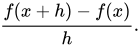
A simple two-point estimation is to compute the slope of a nearby secant line through the points (x, f(x)) and (x + h, f(x + h)). Choosing a small number h, h represents a small change in x, and it can be either positive or negative. The slope of this line is This expression is Newton's difference quotient (also known as a first-order divided difference).
To obtain an error estimate for this approximation, one can use Taylor expansion of about the base point to give for some between and . Rearranging gives The slope of this secant line differs from the slope of the tangent line by an amount that is approximately proportional to h. As h approaches zero, the slope of the secant line approaches the slope of the tangent line and the error term vanishes. Therefore, the true derivative of f at x is the limit of the value of the difference quotient as the secant lines get closer and closer to being a tangent line:


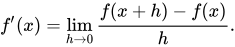
Since immediately substituting 0 for h results in indeterminate form, calculating the derivative directly can be unintuitive.

Equivalently, the slope could be estimated by employing positions x − h and x.
Another two-point formula is to compute the slope of a nearby secant line through the points (x − h, f(x − h)) and (x + h, f(x + h)). The slope of this line is
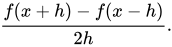
This formula is known as the symmetric difference quotient. In this case the first-order errors cancel, so the slope of these secant lines differ from the slope of the tangent line by an amount that is approximately proportional to . Hence for small values of h this is a more accurate approximation to the tangent line than the one-sided estimation. However, although the slope is being computed at x, the value of the function at x is not involved.

Hub AI
Numerical differentiation AI simulator
(@Numerical differentiation_simulator)
Numerical differentiation
In numerical analysis, numerical differentiation algorithms estimate the derivative of a mathematical function or subroutine using values of the function and perhaps other knowledge about the function.
The simplest method is to use finite difference approximations.
A simple two-point estimation is to compute the slope of a nearby secant line through the points (x, f(x)) and (x + h, f(x + h)). Choosing a small number h, h represents a small change in x, and it can be either positive or negative. The slope of this line is This expression is Newton's difference quotient (also known as a first-order divided difference).
To obtain an error estimate for this approximation, one can use Taylor expansion of about the base point to give for some between and . Rearranging gives The slope of this secant line differs from the slope of the tangent line by an amount that is approximately proportional to h. As h approaches zero, the slope of the secant line approaches the slope of the tangent line and the error term vanishes. Therefore, the true derivative of f at x is the limit of the value of the difference quotient as the secant lines get closer and closer to being a tangent line:
Since immediately substituting 0 for h results in indeterminate form, calculating the derivative directly can be unintuitive.
Equivalently, the slope could be estimated by employing positions x − h and x.
Another two-point formula is to compute the slope of a nearby secant line through the points (x − h, f(x − h)) and (x + h, f(x + h)). The slope of this line is
This formula is known as the symmetric difference quotient. In this case the first-order errors cancel, so the slope of these secant lines differ from the slope of the tangent line by an amount that is approximately proportional to . Hence for small values of h this is a more accurate approximation to the tangent line than the one-sided estimation. However, although the slope is being computed at x, the value of the function at x is not involved.