Recent from talks
Nothing was collected or created yet.
Indeterminate form
View on WikipediaIn calculus, it is usually possible to compute the limit of the sum, difference, product, quotient or power of two functions by taking the corresponding combination of the separate limits of each respective function. For example,
and likewise for other arithmetic operations; this is sometimes called the algebraic limit theorem. However, certain combinations of particular limiting values cannot be computed in this way, and knowing the limit of each function separately does not suffice to determine the limit of the combination. In these particular situations, the limit is said to take an indeterminate form, described by one of the informal expressions

among a wide variety of uncommon others, where each expression stands for the limit of a function constructed by an arithmetical combination of two functions whose limits respectively tend to or as indicated.[1]
A limit taking one of these indeterminate forms might tend to zero, might tend to any finite value, might tend to infinity, or might diverge, depending on the specific functions involved. A limit which unambiguously tends to infinity, for instance is not considered indeterminate.[2] The term was originally introduced by Cauchy's student Moigno in the middle of the 19th century.

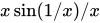
The most common example of an indeterminate form is the quotient of two functions each of which converges to zero. This indeterminate form is denoted by . For example, as approaches the ratios , , and go to , , and respectively. In each case, if the limits of the numerator and denominator are substituted, the resulting expression is , which is indeterminate. In this sense, can take on the values , , or , by appropriate choices of functions to put in the numerator and denominator. A pair of functions for which the limit is any particular given value may in fact be found. Even more surprising, perhaps, the quotient of the two functions may in fact diverge, and not merely diverge to infinity. For example, .
So the fact that two functions and converge to as approaches some limit point is insufficient to determine the limit
An expression that arises by ways other than applying the algebraic limit theorem may have the same form of an indeterminate form. However it is not appropriate to call an expression "indeterminate form" if the expression is made outside the context of determining limits. An example is the expression . Whether this expression is left undefined, or is defined to equal , depends on the field of application and may vary between authors. For more, see the article Zero to the power of zero. Note that and other expressions involving infinity are not indeterminate forms.
Some examples and non-examples
[edit]Indeterminate form 0/0
[edit]-
Fig. 1: y = x/x
-
Fig. 2: y = x2/x
-
Fig. 3: y = sin x/x
-
Fig. 4: y = x − 49/√x − 7 (for x = 49)
-
Fig. 5: y = ax/x where a = 2
-
Fig. 6: y = x/x3
The indeterminate form is particularly common in calculus, because it often arises in the evaluation of derivatives using their definition in terms of limit.
As mentioned above,
while
This is enough to show that is an indeterminate form. Other examples with this indeterminate form include
and
Direct substitution of the number that approaches into any of these expressions shows that these are examples correspond to the indeterminate form , but these limits can assume many different values. Any desired value can be obtained for this indeterminate form as follows:
The value can also be obtained (in the sense of divergence to infinity):
Indeterminate form 00
[edit]The following limits illustrate that the expression is an indeterminate form:
Thus, in general, knowing that and is not sufficient to evaluate the limit
If the functions and are analytic at , and is positive for sufficiently close (but not equal) to , then the limit of will be .[3] Otherwise, use the transformation in the table below to evaluate the limit.
Expressions that are not indeterminate forms
[edit]The expression is not commonly regarded as an indeterminate form, because if the limit of as exists then there is no ambiguity as to its value, as it always diverges. Specifically, with the constraint that approaches and approaches we may choose and so that:
- approaches
- approaches
- The limit fails to exist.
In each case the absolute value approaches , and so the quotient must diverge, in the sense of the extended real numbers (in the framework of the projectively extended real line, the limit is the unsigned infinity in all three cases[4]). Similarly, any expression of the form with (including and ) is not an indeterminate form, since a quotient giving rise to such an expression will always diverge.
The expression is not an indeterminate form. The expression obtained from considering gives the limit provided that remains nonnegative as approaches . The expression is similarly equivalent to ; if as approaches , the limit comes out as .
To see why, let where and By taking the natural logarithm of both sides and using we get that which means that
Evaluating indeterminate forms
[edit]The adjective indeterminate does not imply that the limit does not exist, as many of the examples above show. In many cases, algebraic elimination, L'Hôpital's rule, or other methods can be used to manipulate the expression so that the limit can be evaluated.
Equivalent infinitesimal
[edit]When two variables and converge to zero at the same limit point and , they are called equivalent infinitesimal (equiv. ).
Moreover, if variables and are such that and , then:
Here is a brief proof:
Suppose there are two equivalent infinitesimals and .
For the evaluation of the indeterminate form , one can make use of the following facts about equivalent infinitesimals (e.g., if x becomes closer to zero):[5]
For example:
In the 2nd equality, where as y become closer to 0 is used, and where is used in the 4th equality, and is used in the 5th equality.
L'Hôpital's rule
[edit]L'Hôpital's rule is a general method for evaluating the indeterminate forms and . This rule states that (under appropriate conditions)
where and are the derivatives of and . (Note that this rule does not apply to expressions , , and so on, as these expressions are not indeterminate forms.) These derivatives will allow one to perform algebraic simplification and eventually evaluate the limit.
L'Hôpital's rule can also be applied to other indeterminate forms, using first an appropriate algebraic transformation. For example, to evaluate the form 00:
The right-hand side is of the form , so L'Hôpital's rule applies to it. Note that this equation is valid (as long as the right-hand side is defined) because the natural logarithm (ln) is a continuous function; it is irrelevant how well-behaved and may (or may not) be as long as is asymptotically positive. (the domain of logarithms is the set of all positive real numbers.)
Although L'Hôpital's rule applies to both and , one of these forms may be more useful than the other in a particular case (because of the possibility of algebraic simplification afterwards). One can change between these forms by transforming to .
List of indeterminate forms
[edit]The following table lists the most common indeterminate forms and the transformations for applying l'Hôpital's rule.
| Indeterminate form | Conditions | Transformation to | Transformation to |
|---|---|---|---|
—
|
|||
—
| |||
See also
[edit]References
[edit]Citations
[edit]- ^ Varberg, Purcell & Rigdon (2007), p. 423, 429, 430, 431, 432.
- ^ Weisstein, Eric W. "Indeterminate". Wolfram MathWorld. Retrieved 2019-12-02.
- ^ Rotando, Louis M.; Korn, Henry (January 1977). "The indeterminate form 00". Mathematics Magazine. 50 (1): 41–42. doi:10.2307/2689754. JSTOR 2689754.
- ^ "Undefined vs Indeterminate in Mathematics". Cut The Knot. Retrieved 2019-12-02.
- ^ "Table of equivalent infinitesimals" (PDF). Vaxa Software.
Bibliographies
[edit]- Varberg, Dale E.; Purcell, Edwin J.; Rigdon, Steven E. (2007). Calculus (9th ed.). Pearson Prentice Hall. ISBN 978-0131469686.
Indeterminate form
View on GrokipediaBasic Concepts
Definition
In calculus, an indeterminate form is an undefined mathematical expression arising from an operation between two quantities that does not resolve to a single numerical value or to infinity upon direct substitution in a limit.[4] Such forms typically emerge when evaluating limits as a variable approaches a specific value, where the expression's structure—such as or —fails to provide a definitive outcome without additional analysis.[4] This indeterminacy stems from the fact that the limit can evaluate to any real number, diverge to positive or negative infinity, or fail to exist entirely, depending on the particular functions involved.[1] The concept of indeterminate forms is rooted in the foundational theory of limits in calculus, which describes the behavior of a function as its input approaches a certain point, even if the function is undefined there.[1] Limits provide the rigorous framework for understanding continuity, derivatives, and integrals, and indeterminate forms highlight situations where naive substitution yields ambiguity, necessitating deeper investigation into the function's asymptotic behavior.[4] The term "indeterminate form" was coined in the mid-19th century by François Napoléon Marie Moigno, a student of Augustin-Louis Cauchy, during the era of establishing rigorous foundations for calculus.[5] This development built on Cauchy's earlier work in the 1820s, which emphasized precise limit definitions to resolve ambiguities in earlier, less formal approaches to the calculus.[5]Context in Calculus
Indeterminate forms arise in calculus primarily during the evaluation of limits as a variable approaches a specific value, often leading to ambiguous expressions like 0/0 or ∞/∞ that require additional techniques for resolution. These forms are integral to foundational concepts such as derivatives, which represent instantaneous rates of change and are defined as limits of difference quotients; integrals, which accumulate quantities through limiting sums; and optimization problems, where limits help identify maxima and minima by analyzing function behavior near critical points.[1][6] Such occurrences highlight the need for limits to provide precise values where direct substitution fails, forming the backbone of analytical computations in calculus.[7] In applied contexts, indeterminate forms frequently surface in physics when modeling dynamic processes involving rates of change, such as accelerations or forces at instantaneous moments. In engineering, they emerge in studies of asymptotic behavior, where systems approach equilibrium or extreme conditions, necessitating limit evaluations to predict long-term stability or performance. These applications underscore the practical utility of resolving indeterminate forms to derive meaningful quantitative insights from theoretical models.[8][9] The handling of indeterminate forms also ties closely to notions of continuity and differentiability: an unresolved indeterminate form in a limit may indicate a discontinuity, where the function value does not match the limit, or a point of non-differentiability, as the derivative limit itself becomes indeterminate. This connection emphasizes how proper resolution ensures functions exhibit the smoothness required for advanced analysis. Historically, early treatments by Isaac Newton and Gottfried Wilhelm Leibniz in the 17th century approached these forms intuitively through infinitesimals and fluxions, laying the groundwork for calculus without full rigor. Rigorous frameworks emerged in the 19th century with Augustin-Louis Cauchy's introduction of limit definitions in 1821 and Karl Weierstrass's subsequent refinements using epsilon-delta arguments, transforming indeterminate forms into precisely analyzable entities within modern analysis.[10][11][12]Examples of Indeterminate Forms
The 0/0 Form
The 0/0 indeterminate form arises in the evaluation of a limit of the form , where and . This situation occurs because direct substitution of yields the undefined expression , providing no immediate information about the limit's value. Such forms are common in calculus, particularly when analyzing behaviors near points where both the numerator and denominator vanish simultaneously.[13] This form is indeterminate because the limit can assume any real value, infinity, or fail to exist, depending on the specific functions involved. For instance, , while , and , all of which produce the 0/0 form upon substitution but resolve to different outcomes through simplification. These examples illustrate that the rates at which the numerator and denominator approach zero determine the result, highlighting the ambiguity inherent in the form.[14] A classic example is , where both the sine function and approach 0, yet the limit is a finite non-zero value that reflects the geometric ratio of arc length to chord length in a unit circle as the angle shrinks. Similarly, demonstrates how the form can yield the derivative of at , again resolving to a positive finite limit despite the initial indeterminacy. These cases show that 0/0 expressions often conceal well-defined limits tied to fundamental calculus concepts.[1][15] Geometrically, the 0/0 form relates to the slope of a tangent line at a point where secant lines collapse to the origin in the plane. As approaches the critical value, the secant slope (with ) approaches the tangent's slope at that point, providing an intuitive link between indeterminate quotients and instantaneous rates of change.[16]The ∞/∞ Form
The ∞/∞ indeterminate form arises in limits of quotients where both the numerator and denominator tend to positive or negative infinity, often as the variable approaches infinity or a point of divergence. This situation is common in rational functions or expressions involving unbounded growth, such as where and .[1] The form is indeterminate because the ratio can converge to any real number, diverge to infinity, or approach zero, depending on the relative growth rates of the numerator and denominator. For example, since the linear term grows faster than the logarithm, while as the exponential outpaces the linear growth. In contrast, , yielding a finite limit due to matching dominant terms. These varying outcomes illustrate how the ∞/∞ form masks the true limit without further scrutiny of function behaviors.[17] A key example involves polynomials in rational functions, where comparing degrees provides insight into asymptotic behavior at infinity. If the degree of the numerator exceeds that of the denominator, such as in , the limit diverges; equality of degrees, as in , results in the ratio of leading coefficients; and a lower degree in the numerator, like , approaches zero. This degree-based prediction underscores the indeterminacy, as initial ∞/∞ appearances require analyzing leading terms for resolution.[18] Asymptotic analysis of rational functions at infinity further emphasizes this form's variability by focusing on dominant behaviors over long ranges, revealing how subtle differences in polynomial structure dictate whether the function approaches a horizontal asymptote, the x-axis, or diverges unboundedly.[19]The 0^0 Form
The indeterminate form arises in the evaluation of limits of the type , where both and as the variable approaches a certain value.[20] In such cases, the expression does not simplify to a unique value because the behavior depends on the specific functions involved; the limit can assume any non-negative real number or even infinity, rendering the form indeterminate.[21] For instance, consider , where the base and exponent both approach 0 from the positive side; this limit equals 1. The indeterminate nature is further illustrated by examples where the limit differs from 1. A classic case is , in which the base approaches 0 faster than any positive power of , while the exponent approaches 0; rewriting as , the limit is .[22] Such variability underscores why cannot be assigned a fixed value in limit contexts, contrasting with the direct evaluation of itself, which remains undefined in standard real analysis to avoid inconsistencies.[20] Historically, the status of has sparked debate among mathematicians. Leonhard Euler advocated defining in his 1748 Introductio in analysin infinitorum and 1770 Elements of Algebra, arguing from the consistency of power series expansions where the constant term requires this convention.[20] Earlier explorations appeared in the 1830s by Guglielmo Libri, who examined its properties in several papers, while Augustin-Louis Cauchy later classified as undefined alongside forms like .[20] Modern conventions in mathematical analysis treat as indeterminate specifically in limits, though it is often conveniently set to 1 in discrete contexts like combinatorics or power series to preserve continuity and simplify formulas.[23] In the context of series expansions, the form plays a crucial role, particularly in Taylor series where the zeroth-order term is ; defining this as ensures the series evaluates correctly at , avoiding discontinuity. Euler relied on this convention to develop infinite series representations, such as the binomial theorem extended to non-integer exponents, where terms involving must align with the overall expansion's behavior at the origin.[20] This practical resolution highlights how the indeterminate form is managed in applied settings without resolving its foundational ambiguity.Other Forms
Beyond the quotient forms like 0/0 and ∞/∞, additional indeterminate forms include differences of infinities, products of zero and infinity, and exponential configurations where the base and exponent approach specific boundary values in conflicting ways. These forms are indeterminate because the limiting behavior depends critically on the relative rates of approach of the components, which can lead to different outcomes for varying functions exhibiting the same apparent form.[1] The ∞ − ∞ form arises in the difference of two expressions each diverging to infinity, creating ambiguity without further analysis or rewriting. A representative example is , where both terms approach infinity but their difference requires transformation, such as into a quotient, to evaluate. The 0 ⋅ ∞ form occurs when one factor approaches 0 while the other approaches infinity, yielding conflicting tendencies toward 0 or divergence. For instance, , which is resolved by rewriting as a quotient to apply further techniques.[1] The 1^∞ form involves a base approaching 1 raised to an exponent approaching infinity, where the base's deviation from 1 interacts with the growing exponent in unpredictable ways. A classic example is , often evaluated using the natural logarithm to convert to a ∞/∞ form.[24] The ∞^0 form emerges when a base tends to infinity and the exponent to 0, balancing growth against diminution. An example is , which again benefits from logarithmic transformation to clarify the limit.[24]Non-Indeterminate Expressions
Definite Forms
Definite forms in the context of limits refer to expressions where the limit value—whether finite, zero, or infinite—can be determined directly from the structural behavior of the components without requiring algebraic manipulation or advanced techniques. These forms arise when the limiting behaviors of the individual parts do not conflict in a way that creates ambiguity, allowing immediate evaluation. For instance, in quotients, a numerator approaching 0 while the denominator approaches a non-zero finite constant results in a limit of 0, as the infinitesimal numerator is overwhelmed by the constant denominator.[25] A representative example is , where direct substitution confirms the outcome regardless of the specific linear function in the numerator, provided it approaches 0. Similarly, when the numerator approaches infinity and the denominator a non-zero finite constant, the limit is infinity, exemplified by , as the growing numerator dominates the fixed denominator. These cases are predictable because the dominant term's behavior unequivocally dictates the overall limit.[1] In contrast, a denominator approaching 0 while the numerator approaches a non-zero finite constant leads to a limit of , depending on the direction and signs involved. For example, , where the constant numerator is divided by an infinitesimal positive denominator, consistently producing divergence to positive infinity from the right. This form is definite because the singularity in the denominator forces unbounded growth without oscillation or cancellation.[25] When both the numerator and denominator approach non-zero finite values in a quotient, the limit is simply their ratio, yielding a finite non-zero value. An illustration is , where substitution directly provides the result, as neither component introduces zero or infinity to alter the outcome. The definiteness here stems from the absence of competing infinities or zeros, ensuring the limit mirrors the constant ratio.[26] These definite forms stand in opposition to indeterminate forms, where such direct resolution is impossible due to balanced ambiguities like 0/0 or .[25]Distinguishing Features
To distinguish indeterminate forms from definite forms during the evaluation of a limit, one must first assess the behavior of the individual components of the expression as the independent variable approaches the specified value. A limit is indeterminate if the separate limits of these components result in ambiguous configurations such as 0/0 or ∞/∞ for quotients, 0·∞ for products, or 1^∞, 0^0, and ∞^0 for powers, where the overall limit cannot be determined solely from the form without further analysis.[27] In contrast, definite forms arise when the components yield unambiguous outcomes, such as finite non-zero over finite non-zero yielding a finite value, or ∞ + ∞ yielding ∞.[28] A common pitfall in this identification process occurs when algebraic manipulation of an expression inadvertently introduces or conceals indeterminacy; for instance, simplifying an ∞/∞ quotient might transform it into an ∞ - ∞ difference, which is itself indeterminate and requires reevaluation of sub-limits.[29] Similarly, overlooking the limits of exponents or bases in power expressions can lead to misclassification, as apparent definite forms may mask underlying conflicts upon closer inspection of component behaviors.[27] For practical assessment, a checklist begins with evaluating the limits of the primary components—numerator and denominator for quotients, factors for products, and base and exponent for powers—independently before combining them. If these sub-limits produce one of the standard indeterminate pairings, additional techniques are warranted; otherwise, the form is definite and resolvable directly.[28] This preliminary step plays a crucial role in computation, as recognizing definite forms allows immediate determination of the limit value, thereby conserving analytical effort that would otherwise be expended on unnecessary manipulations.[29]Evaluation Methods
L'Hôpital's Rule
L'Hôpital's rule is a fundamental theorem in calculus for evaluating limits of quotients that yield indeterminate forms of or . The rule states that if is of the form or , where and are differentiable on an open interval containing (except possibly at ), for all in that interval except possibly at , and if exists (either as a finite number or ), then . These conditions ensure the functions behave appropriately near the limit point, allowing the derivatives to resolve the indeterminacy without introducing singularities in the denominator's derivative.[16] If the limit of the derivatives is still indeterminate (again or ), the rule can be applied repeatedly to higher-order derivatives until the limit is determinate, provided the conditions hold at each step.[16] This iterative application, known as higher-order L'Hôpital's rule, extends the method's utility for more complex limits.[30] A representative example is evaluating , which takes the indeterminate form . Applying L'Hôpital's rule, differentiate the numerator and denominator to obtain . Since , the limit is 1. This derivation confirms the well-known result that the derivative of at 0 is 1, illustrating the rule's role in foundational calculus limits. The rule was first published in 1696 by French mathematician Guillaume de l'Hôpital in his treatise Analyse des Infiniment Petits pour l'Intelligence des Lignes Courbes, the earliest comprehensive textbook on differential calculus.[31] However, it originated from work by Swiss mathematician Johann Bernoulli, who developed the theorem in 1694 and sold its publication rights to l'Hôpital under a secret agreement.[31] Bernoulli's contributions, including the higher-order extensions, were integral to the rule's formulation, though l'Hôpital received sole credit in the text.[16]Equivalent Infinitesimals
The method of equivalent infinitesimals provides a technique for evaluating limits involving indeterminate forms by replacing functions with their leading-order asymptotic approximations near the point of indeterminacy, thereby simplifying the expression while preserving the limit value. Two infinitesimals and are equivalent, denoted , if as approaches the limit point . This equivalence holds for common functions near zero, such as , , and .[32][33] In the context of the indeterminate form, equivalent infinitesimals allow direct substitution of approximations into the numerator and denominator to resolve the limit. For instance, consider . Using the equivalence derived from the Taylor expansion's leading term, the numerator becomes equivalent to , so the limit simplifies to . This approach avoids differentiation and focuses on the dominant infinitesimal behavior.[32][33] For the form, the method often involves a substitution to transform the problem into a case, followed by applying equivalents near zero. A representative example is . Substituting yields as , rewriting the limit as . Since as , this becomes , using the known limit . More precisely, . This substitution leverages small- equivalents to handle large- behavior.[32][34] The advantages of this method lie in its intuitiveness for asymptotic analysis, enabling quick approximations without full series expansions or repeated differentiations, making it particularly suitable for identifying dominant terms in complex expressions. Historically, the concept of equivalent infinitesimals finds rigorous foundations in non-standard analysis, pioneered by Abraham Robinson in the 1960s, which formalizes infinitesimals within hyperreal numbers and equates functions if their difference is infinitesimal, thus providing a logical basis for these approximations in limit evaluations.[35]Algebraic and Series Techniques
Algebraic methods provide a way to resolve indeterminate forms that are not quotients, such as ∞ - ∞ and 0 ⋅ ∞, by rewriting them into equivalent expressions amenable to direct evaluation or further simplification. For the ∞ - ∞ form, a common technique involves multiplying by a conjugate to create a difference of squares or similar structure, transforming the expression into a quotient. Consider the limit , which appears as ∞ - ∞ upon direct substitution. Multiplying and dividing by the conjugate yields . Factoring x out of the denominator gives .[36] Similarly, for expressions like , factoring out the dominant term x shows the limit diverges to ∞, as is bounded while x grows without bound.[18] The 0 ⋅ ∞ form can be resolved by rewriting the product as a quotient, either to obtain 0/0 or to obtain ∞/∞. For instance, in , which is 0 ⋅ (-∞), rewrite as , a ∞/∞ form after considering the signs. Algebraic simplification or substitution, such as letting t = 1/x, can then evaluate it to 0.[1] This conversion is particularly useful when the original product involves functions where one approaches zero and the other infinity, allowing subsequent algebraic handling. For exponential indeterminate forms like 1^∞, ∞^0, and 0^0, a standard substitution involves taking the natural logarithm to linearize the expression. Set y = f(x)^{g(x)}, where f(x) → 1 and g(x) → ∞ (or similar for other cases), then , which often reduces to a 0 ⋅ ∞ or 0/0 form resolvable algebraically. For example, consider , a 1^∞ form. Let y = (1 + x)^{1/x}, so , a 0/0 form. Simplifying via known limits or series gives , hence y → e^1 = e.[1] For 0^0, such as , rewrite as e^{x \ln x}; since x \ln x → 0 (via the above rewriting), the limit is e^0 = 1.[4] Taylor series expansions are effective for resolving indeterminate forms near a point, especially when algebraic methods yield 0/0 or similar, by providing asymptotic approximations. For the 1^∞ form , the series for \ln(1 + x) = x - x^2/2 + O(x^3) gives , so the limit is e^1 = e. Alternatively, express (1 + x)^{1/x} = e^{\ln(1 + x)/x} and approximate the exponent using the series, yielding e^{1 - x/2 + O(x^2)} ≈ e \cdot e^{-x/2}, which approaches e as x → 0.[1] For 0^0 or ∞^0 forms, series expansions of the base and exponent similarly resolve the ambiguity by revealing leading-order behavior. These techniques are particularly suited for forms unsuitable for direct differentiation, such as differences, products, or powers, and for sequences where continuous analogs like L'Hôpital's rule do not apply. The Stolz-Cesàro theorem extends algebraic ideas to sequences, analogous to L'Hôpital for quotients of sequences in ∞/∞ or 0/0 forms. For sequences {a_n} and {b_n} with b_n strictly increasing and unbounded, if , then . An example is , rewritten via differences to yield 2/3.Properties and List
Key Properties
Indeterminate forms exhibit invariance under certain algebraic transformations, meaning that manipulations of the expression often result in another indeterminate form rather than a determinate value. For instance, the form can be rewritten as or , yielding or , both of which remain indeterminate.[37][1] This property underscores the need for careful rewriting to apply evaluation techniques, as the underlying limit behavior persists across equivalent forms.[13] The value of a limit involving an indeterminate form can depend on the direction of approach, particularly in one-sided limits, where left-hand and right-hand evaluations may yield different results or one may not exist. For the form, such as , the right-hand limit as approaches 1, but the left-hand limit as is not defined in the real numbers due to issues with negative bases raised to non-integer powers.[37][1] This directional dependence highlights that indeterminate forms do not guarantee a unique limit without specifying the path or side of approach. Indeterminate forms frequently arise at points of removable discontinuities, where the limit exists but the function value is undefined or mismatched, often manifesting as when direct substitution into a quotient yields zeros in both numerator and denominator.[38] In such cases, the indeterminate expression signals a "hole" in the graph that can be filled by redefining the function at that point to match the limit, restoring continuity.[39] This connection emphasizes how indeterminate forms reveal potential simplifications through factorization or cancellation.[40] In the extended real number system, which adjoins and to the reals, some indeterminate forms may resolve to depending on the specific functions involved, but most require case-by-case analysis without a universal resolution.[41] Forms like or remain indeterminate even here, as arithmetic operations involving infinity do not always yield consistent results across different limiting behaviors.[42] Thus, no single value can be assigned to these forms without further investigation, reinforcing their role as prompts for deeper limit evaluation.[37]Complete List of Forms
The standard indeterminate forms in calculus consist of seven primary types that emerge when evaluating limits through direct substitution, resulting in expressions whose values cannot be determined without additional analysis: , , , , , , and .[1] These forms represent situations where competing tendencies, such as approaching zero from opposite directions or infinite growth at varying rates, lead to ambiguity. In extensions to sequences, analogous indeterminate forms occur, such as and , often addressed via the Stolz-Cesàro theorem, which applies difference quotients to resolve limits of quotients of sequences.[43] Additionally, in complex analysis, these forms manifest in limits over the complex plane, where paths of approach can yield varying results, similar to real-variable cases.[44] The following table enumerates the primary forms, their possible limit behaviors upon resolution, and brief origins in typical limit scenarios:| Form | Typical Limit Behaviors | Brief Origin |
|---|---|---|
| Finite value, , or oscillation | Limits of quotients where numerator and denominator both approach 0.[1] | |
| Finite value, , or oscillation (includes variant) | Limits of quotients where numerator and denominator both approach .[1] | |
| Finite value, , or oscillation | Products where one factor approaches 0 and the other .[1] | |
| Finite value, , or oscillation | Differences where both terms approach .[1] | |
| Finite value (often 1), 0, or oscillation | Exponential limits where base approaches 0 and exponent approaches 0. | |
| Finite value, 0, , or oscillation | Exponential limits where base approaches and exponent approaches 0.[1] | |
| Finite value (often e or 1), , or oscillation | Exponential limits where base approaches 1 and exponent approaches . |