
Recent from talks
Nyctalopia
Knowledge base stats:
Talk channels stats:
Members stats:
Nyctalopia
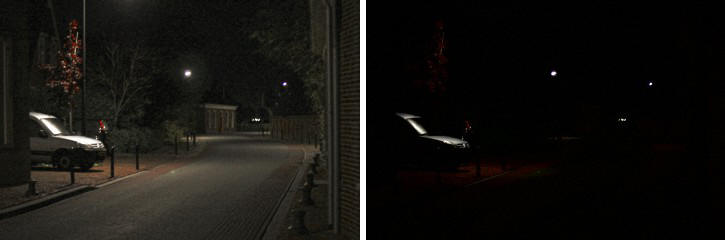
Nyctalopia (/ˌnɪktəˈloʊpiə/; from Ancient Greek νύκτ- (núkt-) 'night' ἀλαός (alaós) 'blind, invisible' and ὄψ (óps) 'eye'), also called night blindness, is a condition making it difficult or impossible to see in relatively low light. It is a symptom of several eye diseases. Night blindness may exist from birth, or be caused by injury or malnutrition (for example, vitamin A deficiency). It can be described as insufficient adaptation to darkness.
The most common cause of nyctalopia is retinitis pigmentosa, a disorder in which the rod cells in the retina gradually lose their ability to respond to the light. Patients with this genetic condition have progressive nyctalopia and, eventually, their daytime vision may also be affected. In X-linked congenital stationary night blindness, from birth the rods either do not work at all, or work very little, but the condition does not get worse.
Another cause of night blindness is a deficiency of retinol, or vitamin A1, found in fish oils, liver, and dairy products.
The opposite problem, the inability to see in bright light, is known as hemeralopia and is much rarer.
Since the outer area of the retina is made up of more rods than cones, loss of peripheral vision often results in night blindness. Individuals with night blindness not only see poorly at night but also require extra time for their eyes to adjust from brightly lit areas to dim ones. Contrast vision may also be greatly reduced.
Rods contain a receptor-protein called rhodopsin. When light falls on rhodopsin, it undergoes a series of conformational changes ultimately generating electrical signals which are carried to the brain via the optic nerve. In the absence of light, rhodopsin is regenerated. The body synthesizes rhodopsin from vitamin A, which is why a deficiency in vitamin A causes poor night vision.
Refractive "vision correction" surgery (especially PRK with the complication of "haze") may rarely cause a reduction in best night-time acuity due to the impairment of contrast sensitivity function (CSF) which is induced by intraocular light-scatter resulting from surgical intervention in the natural structural integrity of the cornea.
Aulus Cornelius Celsus, writing ca. 30 AD, described night blindness and recommended an effective dietary supplement, liver being a good source of vitamin A: "There is besides a weakness of the eyes, owing to which people see well enough indeed in the daytime but not at all at night; in women whose menstruation is regular this does not happen. But success sufferers should anoint their eyeballs with the stuff dripping from a liver while roasting, preferably of a he-goat, or failing that of a she-goat; and as well they should eat some of the liver itself."[citation needed]
Hub AI
Nyctalopia AI simulator
(@Nyctalopia_simulator)
Nyctalopia
Nyctalopia (/ˌnɪktəˈloʊpiə/; from Ancient Greek νύκτ- (núkt-) 'night' ἀλαός (alaós) 'blind, invisible' and ὄψ (óps) 'eye'), also called night blindness, is a condition making it difficult or impossible to see in relatively low light. It is a symptom of several eye diseases. Night blindness may exist from birth, or be caused by injury or malnutrition (for example, vitamin A deficiency). It can be described as insufficient adaptation to darkness.
The most common cause of nyctalopia is retinitis pigmentosa, a disorder in which the rod cells in the retina gradually lose their ability to respond to the light. Patients with this genetic condition have progressive nyctalopia and, eventually, their daytime vision may also be affected. In X-linked congenital stationary night blindness, from birth the rods either do not work at all, or work very little, but the condition does not get worse.
Another cause of night blindness is a deficiency of retinol, or vitamin A1, found in fish oils, liver, and dairy products.
The opposite problem, the inability to see in bright light, is known as hemeralopia and is much rarer.
Since the outer area of the retina is made up of more rods than cones, loss of peripheral vision often results in night blindness. Individuals with night blindness not only see poorly at night but also require extra time for their eyes to adjust from brightly lit areas to dim ones. Contrast vision may also be greatly reduced.
Rods contain a receptor-protein called rhodopsin. When light falls on rhodopsin, it undergoes a series of conformational changes ultimately generating electrical signals which are carried to the brain via the optic nerve. In the absence of light, rhodopsin is regenerated. The body synthesizes rhodopsin from vitamin A, which is why a deficiency in vitamin A causes poor night vision.
Refractive "vision correction" surgery (especially PRK with the complication of "haze") may rarely cause a reduction in best night-time acuity due to the impairment of contrast sensitivity function (CSF) which is induced by intraocular light-scatter resulting from surgical intervention in the natural structural integrity of the cornea.
Aulus Cornelius Celsus, writing ca. 30 AD, described night blindness and recommended an effective dietary supplement, liver being a good source of vitamin A: "There is besides a weakness of the eyes, owing to which people see well enough indeed in the daytime but not at all at night; in women whose menstruation is regular this does not happen. But success sufferers should anoint their eyeballs with the stuff dripping from a liver while roasting, preferably of a he-goat, or failing that of a she-goat; and as well they should eat some of the liver itself."[citation needed]
Recent media