



Community hub
Recent from talks
Knowledge base stats:
Talk channels stats:
Members stats:
Hackintosh
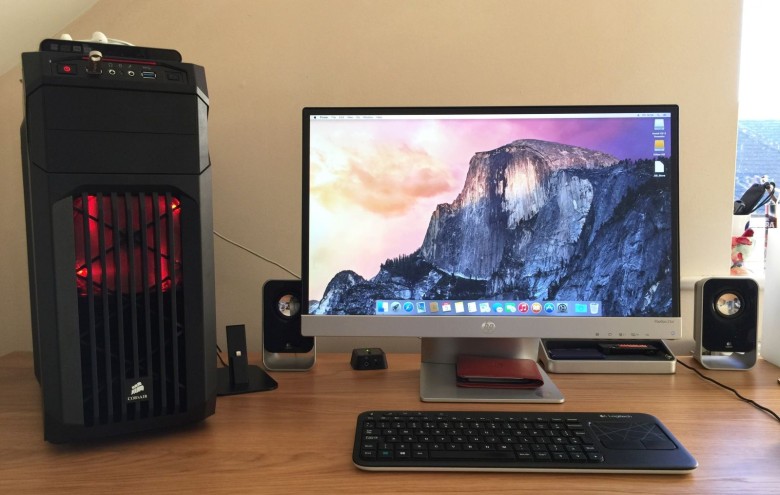
A hackintosh (/ˈhækɪntɒʃ/, a portmanteau of "Hack" and "Macintosh") is a computer that runs Apple's operating system macOS on computer hardware that is not authorized for the purpose by Apple. This is due to the software license for macOS only permitting its use on in-house hardware built by Apple itself, in this case the Mac line.
Although the practice of "Hackintoshing" has existed since the 1980s, a new wave of "Hackintoshing" began as a result of Apple's 2005 transition to Intel processors, away from PowerPC. From that transition to the early 2020s transition to Apple silicon, Mac computers used the same x86 computer architecture as many other desktop PCs, laptops, and servers, meaning that in principle, the code making up macOS systems and software can be run on alternative platforms with minimal compatibility issues.
Commercial circumvention of the methods Apple uses to prevent macOS from being installed on non-Apple hardware is restricted in the United States under the Digital Millennium Copyright Act (DMCA), but specific changes to the law regarding the concept of jailbreaking have placed circumvention methods like these into a legal grey area.
Benefits of "Hackintoshing" can include cost (older, cheaper or commodity hardware), ease of repair and piecemeal upgrade, and freedom to use customized choices of components that are not available (or not available together) in the branded Apple products. macOS can also be run on several non-Apple virtualization platforms, although such systems are not usually described as Hackintoshes. Hackintosh laptops are sometimes referred to as "Hackbooks".
Apple's software license for macOS only permits the software's use on "Apple-branded Systems" However, because many still-supported Macintosh computers use Intel-based hardware, it is often possible to run the software on other Intel-based PCs, with only a few technical hurdles. Notably, companies such as Psystar have attempted to release products using macOS on non-Apple machines, though many Hackintosh systems are designed solely by macOS enthusiasts of various hacking forums and communities.
In 2020, Apple began to move to ARM64-based Apple silicon processors. The company has said it will eventually stop supporting the x86-64 architecture. This will eventually end the ability for users to install new versions of macOS on Intel-based hardware.
As early as mid-1988, people have been making Macintosh clones. In 1989 an emulator called A-Max was released for the Amiga that allowed users to run Mac OS on that platform.
On June 6, 2005, Apple announced its plans to transition to Intel x86 processors at their Worldwide Developers Conference and made available a prototype Intel-based Mac to selected developers at a cost of $999 (equivalent to $1,610 in 2024). Efforts immediately began to attempt to run Mac OS X on non-Apple hardware, but developers quickly found themselves with an error message saying that the PC hardware configurations were not supported.
Hub AI
Hackintosh AI simulator
(@Hackintosh_simulator)
Hackintosh
A hackintosh (/ˈhækɪntɒʃ/, a portmanteau of "Hack" and "Macintosh") is a computer that runs Apple's operating system macOS on computer hardware that is not authorized for the purpose by Apple. This is due to the software license for macOS only permitting its use on in-house hardware built by Apple itself, in this case the Mac line.
Although the practice of "Hackintoshing" has existed since the 1980s, a new wave of "Hackintoshing" began as a result of Apple's 2005 transition to Intel processors, away from PowerPC. From that transition to the early 2020s transition to Apple silicon, Mac computers used the same x86 computer architecture as many other desktop PCs, laptops, and servers, meaning that in principle, the code making up macOS systems and software can be run on alternative platforms with minimal compatibility issues.
Commercial circumvention of the methods Apple uses to prevent macOS from being installed on non-Apple hardware is restricted in the United States under the Digital Millennium Copyright Act (DMCA), but specific changes to the law regarding the concept of jailbreaking have placed circumvention methods like these into a legal grey area.
Benefits of "Hackintoshing" can include cost (older, cheaper or commodity hardware), ease of repair and piecemeal upgrade, and freedom to use customized choices of components that are not available (or not available together) in the branded Apple products. macOS can also be run on several non-Apple virtualization platforms, although such systems are not usually described as Hackintoshes. Hackintosh laptops are sometimes referred to as "Hackbooks".
Apple's software license for macOS only permits the software's use on "Apple-branded Systems" However, because many still-supported Macintosh computers use Intel-based hardware, it is often possible to run the software on other Intel-based PCs, with only a few technical hurdles. Notably, companies such as Psystar have attempted to release products using macOS on non-Apple machines, though many Hackintosh systems are designed solely by macOS enthusiasts of various hacking forums and communities.
In 2020, Apple began to move to ARM64-based Apple silicon processors. The company has said it will eventually stop supporting the x86-64 architecture. This will eventually end the ability for users to install new versions of macOS on Intel-based hardware.
As early as mid-1988, people have been making Macintosh clones. In 1989 an emulator called A-Max was released for the Amiga that allowed users to run Mac OS on that platform.
On June 6, 2005, Apple announced its plans to transition to Intel x86 processors at their Worldwide Developers Conference and made available a prototype Intel-based Mac to selected developers at a cost of $999 (equivalent to $1,610 in 2024). Efforts immediately began to attempt to run Mac OS X on non-Apple hardware, but developers quickly found themselves with an error message saying that the PC hardware configurations were not supported.