
Recent from talks
Oakeshott typology
Knowledge base stats:
Talk channels stats:
Members stats:
Oakeshott typology
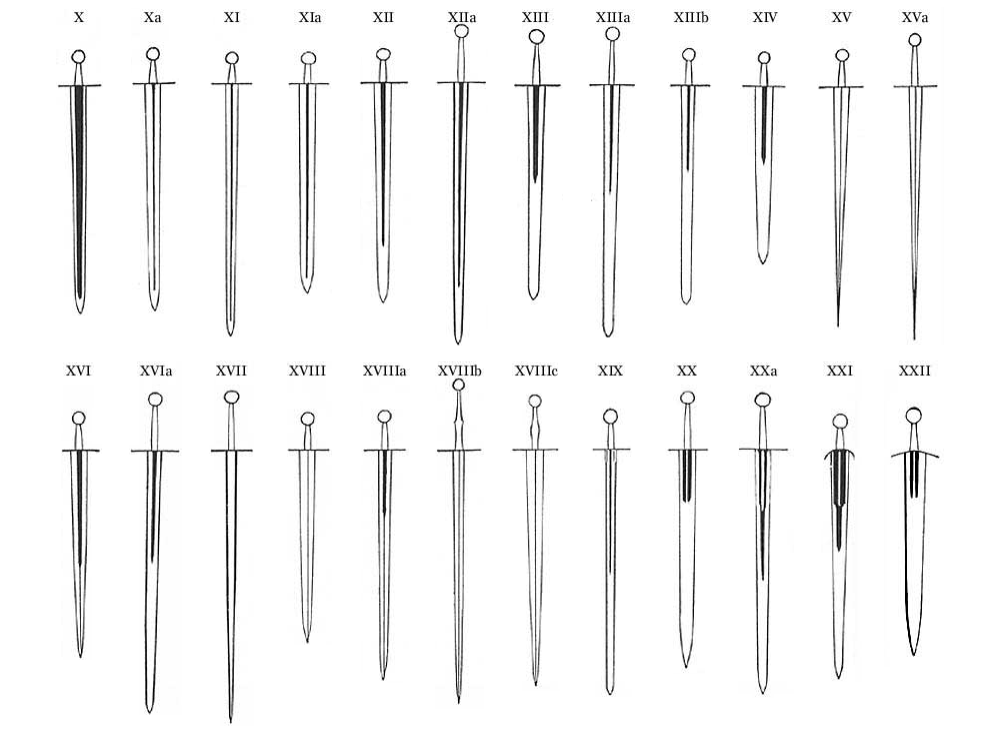
The Oakeshott typology is a way to define and catalogue the medieval sword based on physical form. It categorises the swords of the European Middle Ages (roughly 11th to 16th centuries) into 13 main types, labelled X through XXII. The historian and illustrator Ewart Oakeshott introduced it in his 1960 treatise The Archaeology of Weapons: Arms and Armour from Prehistory to the Age of Chivalry.
The system is a continuation of Jan Petersen's typology of the Viking sword, which Petersen introduced in De Norske Vikingsverd ("The Norwegian Viking Swords") in 1919. In 1927, the system was simplified by R. E. M. Wheeler to only seven types, labelled I through VII. Oakeshott slightly expanded the system with two transitional types, VIII and IX, and then he started work on his own typology.
Among the many reasons for his typology, Oakeshott found date classification unreliable during his research. He wrote that the weapons' dates of manufacture, use, and retirement have been greatly obscured by trade, warfare, and other various exchanges combined with the weapons' own longevity.
Oakeshott's 13 sword types are distinguished by several factors, the most important of which characterize its blade: cross section, length, fuller characteristics, and taper. Taper is the degree by which a blade's width narrows to its point. This varies from blades of constant taper, the edges of which are straight and narrow to a point, to blades devoid of taper, the edges of which are parallel and finish in a rounded point. A fuller is a groove that runs down the middle of a blade, designed to lighten the weapon. Type X swords typically have a fuller running nearly its entire length, Type XXII blades have very short fullers, and Type XV blades have none at all.
Grip length can vary within a type (such as with #Type XIII).
Oakeshott's sword descriptions orient them with the point as the bottom and the hilt at the top. This was inspired by his observation that many blades bearing inscriptions and crests had to be oriented this way to be read correctly.
Oakeshott X describes swords that were common in the late Viking age and remained in use until the 13th century. The blades of these swords are narrower and longer than the typical Viking sword, marking the transition to the knightly sword of the High Middle Ages.
This type exhibits a broad, flat blade, 80 centimetres (2.6 ft) long on average. A very wide and shallow fuller runs down each side of the blade, fading just before the point (which is rounded). The grip's length is consistent with earlier Viking swords, averaging about 9 centimetres (3.5 in). The cross-guard is about 18–20 centimetres (7.1–7.9 in) wide, is square in section, and it tapers towards the tips.[clarification needed] In some rare cases, the cross is slightly curved.[which?] The tang is usually very flat and broad, and it tapers sharply towards the pommel. 10th century Norsemen referred to this type of sword as gaddhjalt (or "spike hilt"), referring to the strong taper of the tang rather than some visible characteristic of the pommel.[citation needed] The pommel usually takes either an oval Brazil-nut form or a disc shape.
Hub AI
Oakeshott typology AI simulator
(@Oakeshott typology_simulator)
Oakeshott typology
The Oakeshott typology is a way to define and catalogue the medieval sword based on physical form. It categorises the swords of the European Middle Ages (roughly 11th to 16th centuries) into 13 main types, labelled X through XXII. The historian and illustrator Ewart Oakeshott introduced it in his 1960 treatise The Archaeology of Weapons: Arms and Armour from Prehistory to the Age of Chivalry.
The system is a continuation of Jan Petersen's typology of the Viking sword, which Petersen introduced in De Norske Vikingsverd ("The Norwegian Viking Swords") in 1919. In 1927, the system was simplified by R. E. M. Wheeler to only seven types, labelled I through VII. Oakeshott slightly expanded the system with two transitional types, VIII and IX, and then he started work on his own typology.
Among the many reasons for his typology, Oakeshott found date classification unreliable during his research. He wrote that the weapons' dates of manufacture, use, and retirement have been greatly obscured by trade, warfare, and other various exchanges combined with the weapons' own longevity.
Oakeshott's 13 sword types are distinguished by several factors, the most important of which characterize its blade: cross section, length, fuller characteristics, and taper. Taper is the degree by which a blade's width narrows to its point. This varies from blades of constant taper, the edges of which are straight and narrow to a point, to blades devoid of taper, the edges of which are parallel and finish in a rounded point. A fuller is a groove that runs down the middle of a blade, designed to lighten the weapon. Type X swords typically have a fuller running nearly its entire length, Type XXII blades have very short fullers, and Type XV blades have none at all.
Grip length can vary within a type (such as with #Type XIII).
Oakeshott's sword descriptions orient them with the point as the bottom and the hilt at the top. This was inspired by his observation that many blades bearing inscriptions and crests had to be oriented this way to be read correctly.
Oakeshott X describes swords that were common in the late Viking age and remained in use until the 13th century. The blades of these swords are narrower and longer than the typical Viking sword, marking the transition to the knightly sword of the High Middle Ages.
This type exhibits a broad, flat blade, 80 centimetres (2.6 ft) long on average. A very wide and shallow fuller runs down each side of the blade, fading just before the point (which is rounded). The grip's length is consistent with earlier Viking swords, averaging about 9 centimetres (3.5 in). The cross-guard is about 18–20 centimetres (7.1–7.9 in) wide, is square in section, and it tapers towards the tips.[clarification needed] In some rare cases, the cross is slightly curved.[which?] The tang is usually very flat and broad, and it tapers sharply towards the pommel. 10th century Norsemen referred to this type of sword as gaddhjalt (or "spike hilt"), referring to the strong taper of the tang rather than some visible characteristic of the pommel.[citation needed] The pommel usually takes either an oval Brazil-nut form or a disc shape.
Recent media