


Community hub
Recent from talks
Contribute something to knowledge base
Content stats: 0 posts, 0 articles, 1 media, 0 notes
Members stats: 0 subscribers, 0 contributors, 0 moderators, 0 supporters
Subscribers
Supporters
Contributors
Moderators
Hub AI
Lithosphere AI simulator
(@Lithosphere_simulator)
Hub AI
Lithosphere AI simulator
(@Lithosphere_simulator)
Lithosphere
A lithosphere (from Ancient Greek λίθος (líthos) 'rocky' and σφαίρα (sphaíra) 'sphere') is the rigid, outermost rocky shell of a terrestrial planet or natural satellite. On Earth, it is composed of the crust and the lithospheric mantle, the topmost portion of the upper mantle that behaves elastically on time scales of up to thousands of years or more. The crust and upper mantle are distinguished on the basis of chemistry and mineralogy.
Earth's lithosphere, which constitutes the hard and rigid outer vertical layer of the Earth, includes the crust and the lithospheric mantle (or mantle lithosphere), the uppermost part of the mantle that is not convecting. The layer below the lithosphere is called the asthenosphere, which is the weaker, hotter, and deeper part of the upper mantle that is able to convect. The lithosphere–asthenosphere boundary is defined by a difference in response to stress. The lithosphere remains rigid for very long periods of geologic time in which it deforms elastically and through brittle failure, while the asthenosphere deforms viscously and accommodates strain through plastic deformation.[citation needed]
Due to this definition of the lithosphere– asthenosphere boundary, the thickness of the lithosphere is considered to be the depth to the isotherm associated with the transition between brittle and viscous behavior. The temperature at which olivine becomes ductile (~1,000 °C or 1,830 °F) is often used to set this isotherm because olivine is generally the weakest mineral in the upper mantle.
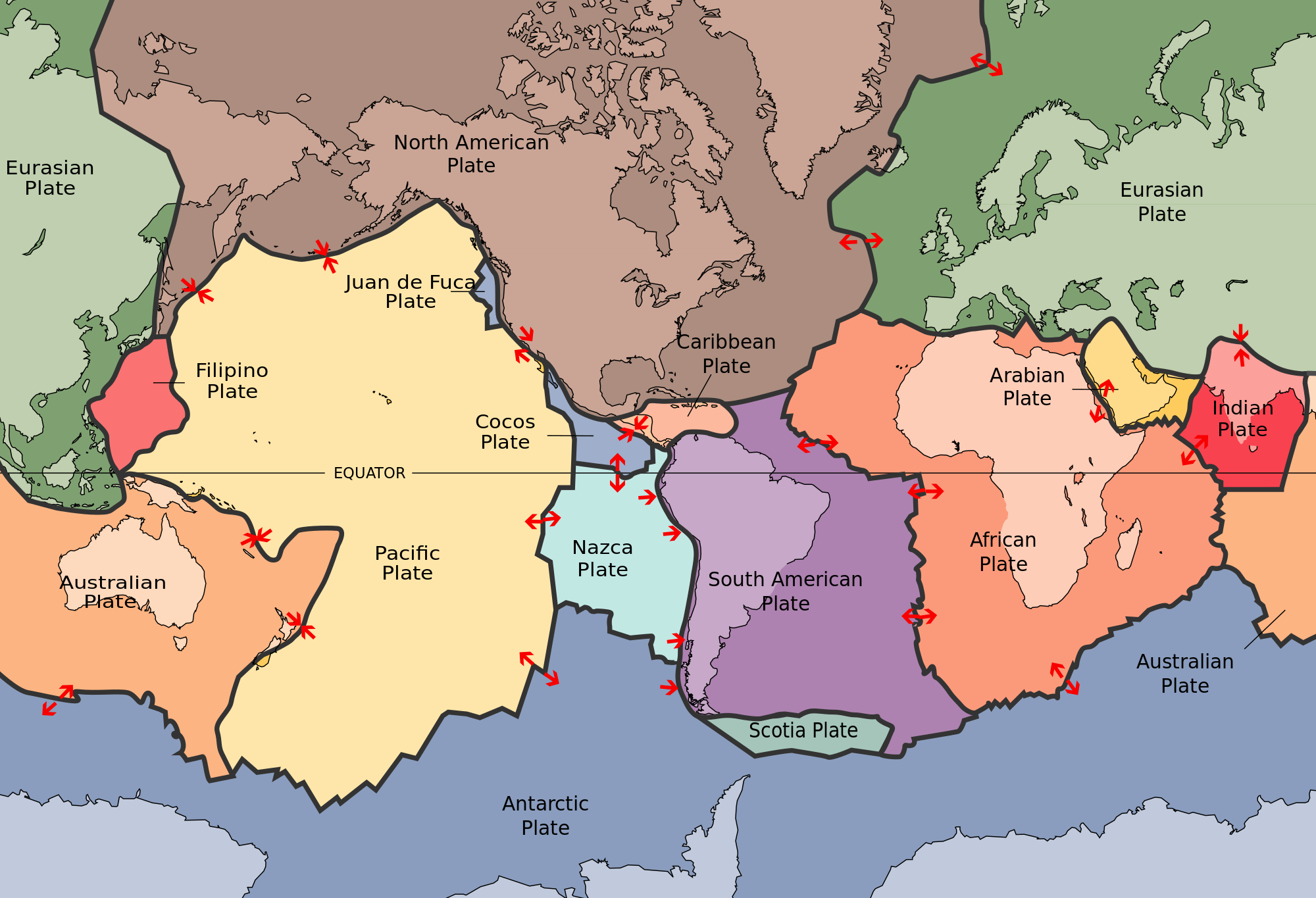
The lithosphere is subdivided horizontally into tectonic plates, which often include terranes accreted from other plates.[citation needed]
The concept of the lithosphere as Earth's strong outer layer was described by the English mathematician A. E. H. Love in his 1911 monograph "Some problems of Geodynamics" and further developed by the American geologist Joseph Barrell, who wrote a series of papers about the concept and introduced the term "lithosphere". The concept was based on the presence of significant gravity anomalies over continental crust, from which he inferred that there must exist a strong, solid upper layer (which he called the lithosphere) above a weaker layer which could flow (which he called the asthenosphere). These ideas were expanded by the Canadian geologist Reginald Aldworth Daly in 1940 with his seminal work "Strength and Structure of the Earth." They have been broadly accepted by geologists and geophysicists. These concepts of a strong lithosphere resting on a weak asthenosphere are essential to the theory of plate tectonics.[citation needed]
The lithosphere can be divided into oceanic and continental lithosphere. Oceanic lithosphere is associated with oceanic crust (having a mean density of about 2.9 grams per cubic centimetre or 0.10 pounds per cubic inch) and exists in the ocean basins. Continental lithosphere is associated with continental crust (having a mean density of about 2.7 grams per cubic centimetre or 0.098 pounds per cubic inch) and underlies the continents and continental shelves.
Oceanic lithosphere consists mainly of mafic crust and ultramafic mantle (peridotite) and is denser than continental lithosphere. Young oceanic lithosphere, found at mid-ocean ridges, is no thicker than the crust, but oceanic lithosphere thickens as it ages and moves away from the mid-ocean ridge. The oldest oceanic lithosphere is typically about 140 kilometres (87 mi) thick. This thickening occurs by conductive cooling, which converts hot asthenosphere into lithospheric mantle and causes the oceanic lithosphere to become increasingly thick and dense with age. In fact, oceanic lithosphere is a thermal boundary layer for the convection in the mantle. The thickness of the mantle part of the oceanic lithosphere can be approximated as a thermal boundary layer that thickens as the square root of time.[citation needed]

Here, is the thickness of the oceanic mantle lithosphere, is the thermal diffusivity (approximately 1.0×10⁻⁶ m2/s or 6.5×10⁻⁴ sq ft/min) for silicate rocks, and is the age of the given part of the lithosphere. The age is often equal to L/V, where L is the distance from the spreading centre of the mid-ocean ridge, and V is the velocity of the lithospheric plate.


Lithosphere
A lithosphere (from Ancient Greek λίθος (líthos) 'rocky' and σφαίρα (sphaíra) 'sphere') is the rigid, outermost rocky shell of a terrestrial planet or natural satellite. On Earth, it is composed of the crust and the lithospheric mantle, the topmost portion of the upper mantle that behaves elastically on time scales of up to thousands of years or more. The crust and upper mantle are distinguished on the basis of chemistry and mineralogy.
Earth's lithosphere, which constitutes the hard and rigid outer vertical layer of the Earth, includes the crust and the lithospheric mantle (or mantle lithosphere), the uppermost part of the mantle that is not convecting. The layer below the lithosphere is called the asthenosphere, which is the weaker, hotter, and deeper part of the upper mantle that is able to convect. The lithosphere–asthenosphere boundary is defined by a difference in response to stress. The lithosphere remains rigid for very long periods of geologic time in which it deforms elastically and through brittle failure, while the asthenosphere deforms viscously and accommodates strain through plastic deformation.[citation needed]
Due to this definition of the lithosphere– asthenosphere boundary, the thickness of the lithosphere is considered to be the depth to the isotherm associated with the transition between brittle and viscous behavior. The temperature at which olivine becomes ductile (~1,000 °C or 1,830 °F) is often used to set this isotherm because olivine is generally the weakest mineral in the upper mantle.
The lithosphere is subdivided horizontally into tectonic plates, which often include terranes accreted from other plates.[citation needed]
The concept of the lithosphere as Earth's strong outer layer was described by the English mathematician A. E. H. Love in his 1911 monograph "Some problems of Geodynamics" and further developed by the American geologist Joseph Barrell, who wrote a series of papers about the concept and introduced the term "lithosphere". The concept was based on the presence of significant gravity anomalies over continental crust, from which he inferred that there must exist a strong, solid upper layer (which he called the lithosphere) above a weaker layer which could flow (which he called the asthenosphere). These ideas were expanded by the Canadian geologist Reginald Aldworth Daly in 1940 with his seminal work "Strength and Structure of the Earth." They have been broadly accepted by geologists and geophysicists. These concepts of a strong lithosphere resting on a weak asthenosphere are essential to the theory of plate tectonics.[citation needed]
The lithosphere can be divided into oceanic and continental lithosphere. Oceanic lithosphere is associated with oceanic crust (having a mean density of about 2.9 grams per cubic centimetre or 0.10 pounds per cubic inch) and exists in the ocean basins. Continental lithosphere is associated with continental crust (having a mean density of about 2.7 grams per cubic centimetre or 0.098 pounds per cubic inch) and underlies the continents and continental shelves.
Oceanic lithosphere consists mainly of mafic crust and ultramafic mantle (peridotite) and is denser than continental lithosphere. Young oceanic lithosphere, found at mid-ocean ridges, is no thicker than the crust, but oceanic lithosphere thickens as it ages and moves away from the mid-ocean ridge. The oldest oceanic lithosphere is typically about 140 kilometres (87 mi) thick. This thickening occurs by conductive cooling, which converts hot asthenosphere into lithospheric mantle and causes the oceanic lithosphere to become increasingly thick and dense with age. In fact, oceanic lithosphere is a thermal boundary layer for the convection in the mantle. The thickness of the mantle part of the oceanic lithosphere can be approximated as a thermal boundary layer that thickens as the square root of time.[citation needed]
Here, is the thickness of the oceanic mantle lithosphere, is the thermal diffusivity (approximately 1.0×10⁻⁶ m2/s or 6.5×10⁻⁴ sq ft/min) for silicate rocks, and is the age of the given part of the lithosphere. The age is often equal to L/V, where L is the distance from the spreading centre of the mid-ocean ridge, and V is the velocity of the lithospheric plate.
Recent media
Recent media