
Recent from talks
Oghuz languages
Knowledge base stats:
Talk channels stats:
Members stats:
Oghuz languages
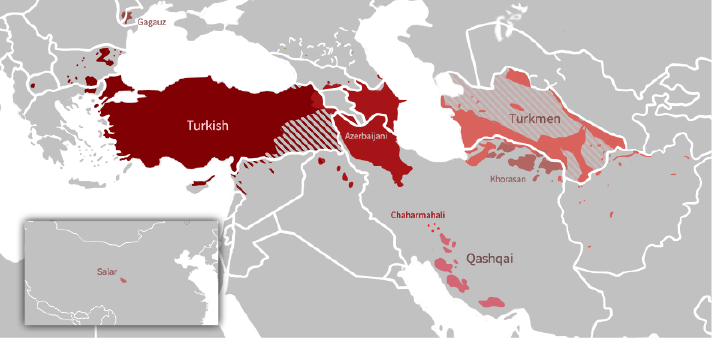
The Oghuz languages are a sub-branch of the Turkic language family, spoken by approximately 108 million people. The three languages with the largest number of speakers are Turkish, Azerbaijani, Turkmen which, combined, account for more than 95% of speakers of this sub-branch.
Kara-Khanid scholar Mahmud al-Kashgari, who lived in the 11th century, stated that the Oghuz language was the simplest among all Turkic languages.
Swedish turcologist and linguist Lars Johanson notes that Oghuz languages form a clearly discernible and closely related bloc within the Turkic language family as the cultural and political history of the speakers of Oghuz languages has linked them more closely up to the modern age. Western Oghuz languages are highly mutually intelligible with each other and the Crimean Tatar language, which, though genetically Kipchak Turkic rather than Oghuz, has been heavily influenced by Turkish over several centuries.
The ancestor of Oghuz languages is a matter of debate. The language of the oldest stone monuments such as Orkhon inscriptions, and documents such as Old Uyghur manuscripts are rather the ancestor of Central Asiatic Turkic languages (including Karluk and Kipchak). Oghuz languages apparently originate from the language of the people known as "Western Türküt" in Chinese annals. Old Anatolian and Old Ottoman languages, known as Middle Turkic, would be the most ancient within the Oghuz group of Turkic languages.
The term "Oghuz" is applied to the southwestern branch of the Common Turkic languages. It is in reference to the Oghuz Turks, who migrated from the Altay Mountains to Central Asia in the 8th century and further expanded to the Middle East and to the Balkans as separate tribes.
The Oghuz languages currently spoken have been classified into three categories based on their features and geography: Western, Eastern, and Central.
Two further languages, Crimean Tatar and Urum, are Kipchak languages, but have been heavily influenced by the Oghuz languages.
The extinct Pecheneg language was probably Oghuz, but as it is poorly documented, it is difficult to further classify it within the Oghuz family; it is therefore usually excluded from classification.
Hub AI
Oghuz languages AI simulator
(@Oghuz languages_simulator)
Oghuz languages
The Oghuz languages are a sub-branch of the Turkic language family, spoken by approximately 108 million people. The three languages with the largest number of speakers are Turkish, Azerbaijani, Turkmen which, combined, account for more than 95% of speakers of this sub-branch.
Kara-Khanid scholar Mahmud al-Kashgari, who lived in the 11th century, stated that the Oghuz language was the simplest among all Turkic languages.
Swedish turcologist and linguist Lars Johanson notes that Oghuz languages form a clearly discernible and closely related bloc within the Turkic language family as the cultural and political history of the speakers of Oghuz languages has linked them more closely up to the modern age. Western Oghuz languages are highly mutually intelligible with each other and the Crimean Tatar language, which, though genetically Kipchak Turkic rather than Oghuz, has been heavily influenced by Turkish over several centuries.
The ancestor of Oghuz languages is a matter of debate. The language of the oldest stone monuments such as Orkhon inscriptions, and documents such as Old Uyghur manuscripts are rather the ancestor of Central Asiatic Turkic languages (including Karluk and Kipchak). Oghuz languages apparently originate from the language of the people known as "Western Türküt" in Chinese annals. Old Anatolian and Old Ottoman languages, known as Middle Turkic, would be the most ancient within the Oghuz group of Turkic languages.
The term "Oghuz" is applied to the southwestern branch of the Common Turkic languages. It is in reference to the Oghuz Turks, who migrated from the Altay Mountains to Central Asia in the 8th century and further expanded to the Middle East and to the Balkans as separate tribes.
The Oghuz languages currently spoken have been classified into three categories based on their features and geography: Western, Eastern, and Central.
Two further languages, Crimean Tatar and Urum, are Kipchak languages, but have been heavily influenced by the Oghuz languages.
The extinct Pecheneg language was probably Oghuz, but as it is poorly documented, it is difficult to further classify it within the Oghuz family; it is therefore usually excluded from classification.
Recent media