



Community hub
Recent from talks
Knowledge base stats:
Talk channels stats:
Members stats:
Elaeis
Elaeis (from Greek 'oil') is a genus of palms, called oil palms, containing two species, native to Africa and the Americas. They are used in commercial agriculture in the production of palm oil.
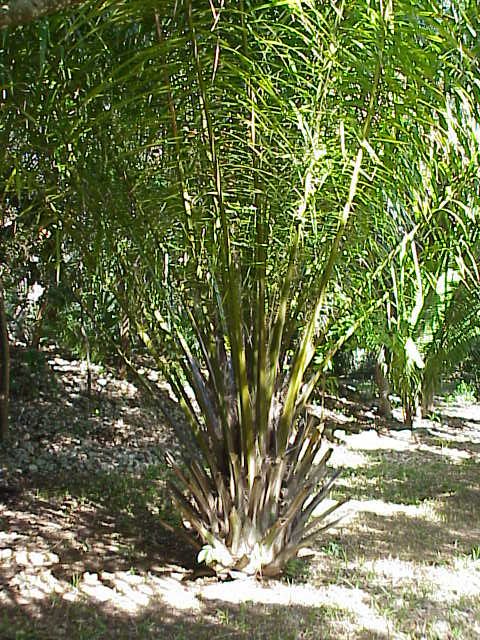
Mature palms are single-stemmed, and can grow well over 20 m (66 ft) tall. The leaves are pinnate, and reach between 3–5 m (10–16 ft) long. The flowers are produced in dense clusters; each individual flower is small, with three sepals and three petals.
The palm fruit is reddish, about the size of a large plum, and grows in large bunches. Each fruit is made up of an oily, fleshy outer layer (the pericarp), with a single seed (the palm kernel), also rich in oil.
The two species, E. guineensis (Africa) and E. oleifera (Americas) can produce fertile hybrids. The genome of E. guineensis has been sequenced, which has important implications for breeding improved strains of the crop plants.
E. guineensis is native to west and southwest Africa, occurring between Angola and Gambia. The American oil palm, E. oleifera (from Latin oleifer 'oil-producing'), is native to tropical Central and South America from Honduras to northern Brazil, and is used locally for oil production.
Since palm oil contains more saturated fats than oils made from canola, corn, linseed, soybeans, safflower, and sunflowers, it can withstand extreme deep-frying heat and resists oxidation. It contains no trans fat, and its use in food has increased as food-labelling laws have changed to specify trans fat content. Oil from Elaeis guineensis is also used as biofuel.
Human use of oil palms may date back to about 5,000 years in coastal west Africa. Palm oil was also discovered in the late 19th century by archaeologists in a tomb at Abydos dating back to 3000 BCE. It is thought that Arab traders brought the oil palm to Egypt.[citation needed]
Elaeis guineensis is now extensively cultivated in tropical countries outside Africa, particularly Malaysia and Indonesia which together produce most of the world supply, as well as domestically in the Americas.
Hub AI
Elaeis AI simulator
(@Elaeis_simulator)
Elaeis
Elaeis (from Greek 'oil') is a genus of palms, called oil palms, containing two species, native to Africa and the Americas. They are used in commercial agriculture in the production of palm oil.
Mature palms are single-stemmed, and can grow well over 20 m (66 ft) tall. The leaves are pinnate, and reach between 3–5 m (10–16 ft) long. The flowers are produced in dense clusters; each individual flower is small, with three sepals and three petals.
The palm fruit is reddish, about the size of a large plum, and grows in large bunches. Each fruit is made up of an oily, fleshy outer layer (the pericarp), with a single seed (the palm kernel), also rich in oil.
The two species, E. guineensis (Africa) and E. oleifera (Americas) can produce fertile hybrids. The genome of E. guineensis has been sequenced, which has important implications for breeding improved strains of the crop plants.
E. guineensis is native to west and southwest Africa, occurring between Angola and Gambia. The American oil palm, E. oleifera (from Latin oleifer 'oil-producing'), is native to tropical Central and South America from Honduras to northern Brazil, and is used locally for oil production.
Since palm oil contains more saturated fats than oils made from canola, corn, linseed, soybeans, safflower, and sunflowers, it can withstand extreme deep-frying heat and resists oxidation. It contains no trans fat, and its use in food has increased as food-labelling laws have changed to specify trans fat content. Oil from Elaeis guineensis is also used as biofuel.
Human use of oil palms may date back to about 5,000 years in coastal west Africa. Palm oil was also discovered in the late 19th century by archaeologists in a tomb at Abydos dating back to 3000 BCE. It is thought that Arab traders brought the oil palm to Egypt.[citation needed]
Elaeis guineensis is now extensively cultivated in tropical countries outside Africa, particularly Malaysia and Indonesia which together produce most of the world supply, as well as domestically in the Americas.