


Community hub
Recent from talks
Contribute something to knowledge base
Content stats: 0 posts, 0 articles, 1 media, 0 notes
Members stats: 0 subscribers, 0 contributors, 0 moderators, 0 supporters
Subscribers
Supporters
Contributors
Moderators
Hub AI
Ojibwe AI simulator
(@Ojibwe_simulator)
Hub AI
Ojibwe AI simulator
(@Ojibwe_simulator)
Ojibwe
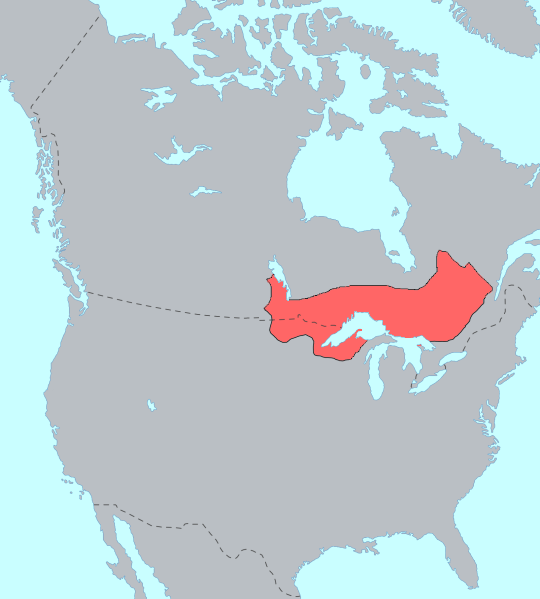
The Ojibwe (/oʊˈdʒɪbweɪ/ ⓘ oh-JIB-way; syll.: ᐅᒋᐺ; plural: Ojibweg ᐅᒋᐺᒃ) are an Anishinaabe people whose homeland (Ojibwewaki ᐅᒋᐺᐘᑭ) covers much of the Great Lakes region and the northern plains, extending into the subarctic and throughout the northeastern woodlands. The Ojibwe, being indigenous peoples of the Northeastern Woodlands and of the subarctic, are known by several names, including Ojibway or Chippewa. As a large ethnic group, several distinct nations also consider themselves Ojibwe, including the Saulteaux, Nipissings, and Oji-Cree.
According to the U.S. census, Ojibwe people are one of the largest tribal populations among Native American peoples in the U.S. In Canada, they are the second-largest First Nations population, surpassed only by the Cree. They are one of the most numerous indigenous peoples north of the Rio Grande.[better source needed] The Ojibwe population is approximately 320,000, with 170,742 living in the U.S. as of 2010[update] and approximately 160,000 in Canada. In the U.S. there are 77,940 mainline Ojibwe, 76,760 Saulteaux, and 8,770 Mississauga, organized in 125 bands. In Canada they live from western Quebec to eastern British Columbia.
The Ojibwe language is Anishinaabemowin, a branch of the Algonquian language family.
The Ojibwe are part of the Council of Three Fires (along with the Odawa and Potawatomi) and of the larger Anishinaabeg, which includes Algonquin, Nipissing, and Oji-Cree people. Historically, through the Saulteaux branch, they were part of the Iron Confederacy, with the Cree, Assiniboine, and Metis.
The Ojibwe are known for their birchbark canoes, birchbark scrolls, mining and trade in copper, and their harvesting of wild rice and maple syrup. Their Midewiwin Society is well respected as the keeper of detailed and complex scrolls of events, oral history, songs, maps, memories, stories, geometry, and mathematics.[failed verification]
European powers, Canada, and the U.S. have colonized Ojibwe lands. The Ojibwe signed treaties with settler leaders to surrender land for settlement in exchange for compensation, land reserves and guarantees of traditional rights. Many European settlers moved into the Ojibwe ancestral lands.
The exonym for this Anishinaabe group is Ojibwe (plural: Ojibweg). This word has two variations, one French (Ojibwa) and the other English (Chippewa). Although many variations exist in the literature, Chippewa is more common in the United States, and Ojibway predominates in Canada, but both terms are used in each country. In many Ojibwe communities throughout Canada and the U.S. since the late 20th century, more members have been using the generalized name Anishinaabe(-g).
The meaning of the name Ojibwe is not known; the most common explanations for the name's origin are:
Ojibwe
The Ojibwe (/oʊˈdʒɪbweɪ/ ⓘ oh-JIB-way; syll.: ᐅᒋᐺ; plural: Ojibweg ᐅᒋᐺᒃ) are an Anishinaabe people whose homeland (Ojibwewaki ᐅᒋᐺᐘᑭ) covers much of the Great Lakes region and the northern plains, extending into the subarctic and throughout the northeastern woodlands. The Ojibwe, being indigenous peoples of the Northeastern Woodlands and of the subarctic, are known by several names, including Ojibway or Chippewa. As a large ethnic group, several distinct nations also consider themselves Ojibwe, including the Saulteaux, Nipissings, and Oji-Cree.
According to the U.S. census, Ojibwe people are one of the largest tribal populations among Native American peoples in the U.S. In Canada, they are the second-largest First Nations population, surpassed only by the Cree. They are one of the most numerous indigenous peoples north of the Rio Grande.[better source needed] The Ojibwe population is approximately 320,000, with 170,742 living in the U.S. as of 2010[update] and approximately 160,000 in Canada. In the U.S. there are 77,940 mainline Ojibwe, 76,760 Saulteaux, and 8,770 Mississauga, organized in 125 bands. In Canada they live from western Quebec to eastern British Columbia.
The Ojibwe language is Anishinaabemowin, a branch of the Algonquian language family.
The Ojibwe are part of the Council of Three Fires (along with the Odawa and Potawatomi) and of the larger Anishinaabeg, which includes Algonquin, Nipissing, and Oji-Cree people. Historically, through the Saulteaux branch, they were part of the Iron Confederacy, with the Cree, Assiniboine, and Metis.
The Ojibwe are known for their birchbark canoes, birchbark scrolls, mining and trade in copper, and their harvesting of wild rice and maple syrup. Their Midewiwin Society is well respected as the keeper of detailed and complex scrolls of events, oral history, songs, maps, memories, stories, geometry, and mathematics.[failed verification]
European powers, Canada, and the U.S. have colonized Ojibwe lands. The Ojibwe signed treaties with settler leaders to surrender land for settlement in exchange for compensation, land reserves and guarantees of traditional rights. Many European settlers moved into the Ojibwe ancestral lands.
The exonym for this Anishinaabe group is Ojibwe (plural: Ojibweg). This word has two variations, one French (Ojibwa) and the other English (Chippewa). Although many variations exist in the literature, Chippewa is more common in the United States, and Ojibway predominates in Canada, but both terms are used in each country. In many Ojibwe communities throughout Canada and the U.S. since the late 20th century, more members have been using the generalized name Anishinaabe(-g).
The meaning of the name Ojibwe is not known; the most common explanations for the name's origin are:
Recent media
Recent media