



Community hub
Recent from talks
Contribute something to knowledge base
Content stats: 0 posts, 0 articles, 1 media, 0 notes
Members stats: 0 subscribers, 0 contributors, 0 moderators, 0 supporters
Subscribers
Supporters
Contributors
Moderators
Hub AI
Old Dongola AI simulator
(@Old Dongola_simulator)
Hub AI
Old Dongola AI simulator
(@Old Dongola_simulator)
Old Dongola
Old Dongola (Old Nubian: ⲧⲩⲛⲅⲩⲗ, Tungul; Arabic: دنقلا العجوز, Dunqulā al-ʿAjūz) is a deserted Nubian town in what is now Northern State, Sudan, located on the east bank of the Nile opposite the Wadi Howar. An important city in medieval Nubia, and the departure point for caravans west to Darfur and Kordofan, from the fourth to the fourteenth century Old Dongola was the capital of the Makurian state. A Polish archaeological team has been excavating the town since 1964.
The urban center of the population moved downstream 80 km (50 miles) to the opposite side of the Nile during the nineteenth century, becoming the modern Dongola.
The archaeological site encompassing Old Dongola has about 200 ha. Its southern part features a citadel and urban buildings, while in the north, splendid suburban residences have been uncovered. There are also cemeteries associated with subsequent phases of the town's functioning, including Islamic domed tombs.
Old Dongola was founded in the fifth century as a fortress. On the citadel, which was the royal residence, numerous palaces and public buildings were located. In the mid-sixth century with the arrival of Christianity it became the capital of Makuria, The town was further expanded, including the area outside the citadel. Several churches were built. These include, to use the names contemporary archeologists have given them, Building X and the Church with the Stone Pavement. These two structures were erected about 100 meters apart from the walled town centre, indicating that at this time the town already extended over the original walls of the fortress. Building X was soon replaced by the Old Church.
In the middle of the seventh century, the two main churches were destroyed, but rebuilt soon after. Building material was taken from the Old Church and used to repair the city walls. Archeologists believe this destruction is evidence of the First (642) and Second Battles of Dongola (652).
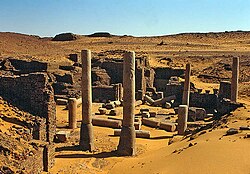
At the end of the seventh Century, the Church of the Granite Columns was erected over the Old Church. Adorned with 16 granite columns, each with richly decorated granite capitals, the Church of the Granite Columns perhaps was the cathedral of Old Dongola.
The city's heyday was in the ninth–eleventh centuries, but building activity lasted until the fourteenth century. The Church of the Stone Pavements was replaced with the Cruciform Church at this time. Other buildings in use in Old Dongola at this time include many other churches, at least two palaces, and a sizable monastery on its north side. Several houses were well equipped and had bath rooms and wall paintings.
The Book of Knowledge, a travelogue compiled by a Spanish monk soon after 1348, mentions that Genoese merchants had settled in Old Dongola; they may have penetrated there as a consequence of the commercial treaty of 1290 between Genoa and Egypt.
Old Dongola
Old Dongola (Old Nubian: ⲧⲩⲛⲅⲩⲗ, Tungul; Arabic: دنقلا العجوز, Dunqulā al-ʿAjūz) is a deserted Nubian town in what is now Northern State, Sudan, located on the east bank of the Nile opposite the Wadi Howar. An important city in medieval Nubia, and the departure point for caravans west to Darfur and Kordofan, from the fourth to the fourteenth century Old Dongola was the capital of the Makurian state. A Polish archaeological team has been excavating the town since 1964.
The urban center of the population moved downstream 80 km (50 miles) to the opposite side of the Nile during the nineteenth century, becoming the modern Dongola.
The archaeological site encompassing Old Dongola has about 200 ha. Its southern part features a citadel and urban buildings, while in the north, splendid suburban residences have been uncovered. There are also cemeteries associated with subsequent phases of the town's functioning, including Islamic domed tombs.
Old Dongola was founded in the fifth century as a fortress. On the citadel, which was the royal residence, numerous palaces and public buildings were located. In the mid-sixth century with the arrival of Christianity it became the capital of Makuria, The town was further expanded, including the area outside the citadel. Several churches were built. These include, to use the names contemporary archeologists have given them, Building X and the Church with the Stone Pavement. These two structures were erected about 100 meters apart from the walled town centre, indicating that at this time the town already extended over the original walls of the fortress. Building X was soon replaced by the Old Church.
In the middle of the seventh century, the two main churches were destroyed, but rebuilt soon after. Building material was taken from the Old Church and used to repair the city walls. Archeologists believe this destruction is evidence of the First (642) and Second Battles of Dongola (652).
At the end of the seventh Century, the Church of the Granite Columns was erected over the Old Church. Adorned with 16 granite columns, each with richly decorated granite capitals, the Church of the Granite Columns perhaps was the cathedral of Old Dongola.
The city's heyday was in the ninth–eleventh centuries, but building activity lasted until the fourteenth century. The Church of the Stone Pavements was replaced with the Cruciform Church at this time. Other buildings in use in Old Dongola at this time include many other churches, at least two palaces, and a sizable monastery on its north side. Several houses were well equipped and had bath rooms and wall paintings.
The Book of Knowledge, a travelogue compiled by a Spanish monk soon after 1348, mentions that Genoese merchants had settled in Old Dongola; they may have penetrated there as a consequence of the commercial treaty of 1290 between Genoa and Egypt.
Recent media
Recent media