
Recent from talks
Old Hunstanton Lighthouse
Knowledge base stats:
Talk channels stats:
Members stats:
Old Hunstanton Lighthouse
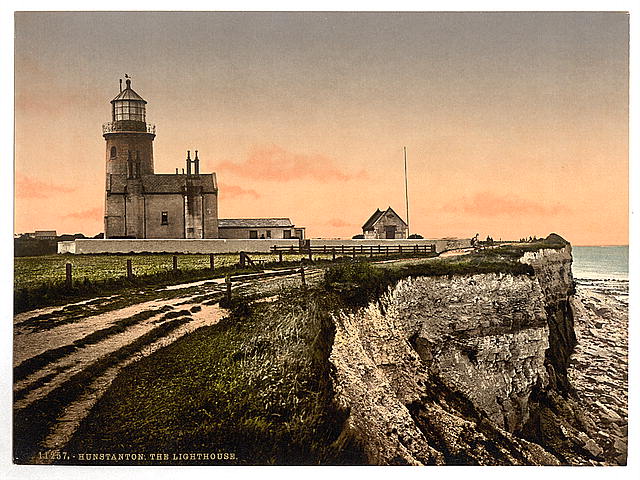
Old Hunstanton Lighthouse is a former lighthouse located in Old Hunstanton in the English county of Norfolk, generally called Hunstanton Lighthouse during its operational life. It was built at the highest point available on this part of the coast, on top of Hunstanton Cliffs, and served to help guide vessels into the safe water of Lynn Deeps. Although the present lighthouse was built in 1840, there had been a lighthouse on the site since the 17th century (prior to which a light to aid navigation may have been displayed from St Edmund's Chapel, the ruins of which stand nearby). Prior to the establishment of the Lynn Well light vessel in 1828, Hunstanton Lighthouse provided the only visible guide to ships seeking to enter The Wash at night.
Before the establishment of a lighthouse in the vicinity, it appears that sailors used the lights burning in St Edmund's Chapel to guide them into The Wash by night. The pair of lighthouses that later stood on the site were known as the 'Chapel Lights'; and in 1838 their successor was still referred to, by John Purdy, as 'the Chapel Light, on Hunstanton Point'.
In 1663 permission was sought by a consortium of the merchants and ship-owners of Boston and Lynn to erect one or more lights near St Edmund's Point, to help guide their vessels into The Wash. That November, a warrant was issued by Charles II to John Knight, permitting him to build a light or lights 'upon the Hunston-cliffe or chappel lands', and to maintain them by levying dues on passing ships. The first lights, a pair of stone towers which functioned as leading lights, were built by him in 1665, at a cost of over £200. The front light of the pair was candle-lit; the rear had a coal-fired brazier. They were found to be 'of great benefit'.
In 1710 it was reported that the lighthouses were 'decayed and want repairing and will admit of great alterations and improvements'. That same year Knight's niece Rebecca and her husband James Everard were granted the right to receive the light dues for the period of the next fifty years. Substantial repairs were undertaken.
By 1750 the front lighthouse, the smaller of the two, seems to have been taken out of commission. It seems that the structure remained standing for a time: but while two lighthouses are shown on John Cary's county map of 1787, there is only one on his map of 1794.
In around 1776 the rear lighthouse was destroyed by a fire. It was replaced by a new wooden structure, commissioned by Edward Everard of Lynn (grandson of the above-mentioned Rebecca and John), who had inherited the patent rights: a circular tower 33 feet (10 m) high, tapering from 11 ft (3.4 m) to 8 ft (2.4 m) in diameter from bottom to top. It placed the light at 85 feet (26 m) above sea level. Atop the tower was a simple square lantern room, glazed to seaward, which contained an innovative lighting array.
The lantern was equipped with parabolic reflectors and oil lamps in place of a coal fire. Thus Hunstanton is said to have been the first 'major coast light' in Britain to employ an illuminant other than coal, and the first lighthouse in the world to be fitted with a parabolic reflector (though similar claims are made for Hutchinson's lighthouses in Liverpool).
The lighting apparatus was devised and installed by Ezekiel Walker of Lynn, who later went on to advise the Northern Lighthouse Board on installing parabolic reflectors in their towers around the coast of Scotland. As described in 1812, the light was provided by eighteen lamps set within 18-inch (460 mm) diameter reflectors 'fixed upon two shelves, one placed over the other'; the lamps were arranged so as to direct the greatest concentration of light in a north by east direction, indicating to far-off vessels a way through sands and shoals off the Lincolnshire coast. Writing some fifty years after they were installed, Walker described them as follows: 'Each of the reflectors at Hunstanton contains 700 small mirrors of looking-glass, every one of which reflects part of the light of the small lamp placed in its focus'. The light was described in 1781 as 'constant and certain' and 'clearly distinguished at sea at a distance of seven leagues', (though this latter claim has been called 'extravagant').
Hub AI
Old Hunstanton Lighthouse AI simulator
(@Old Hunstanton Lighthouse_simulator)
Old Hunstanton Lighthouse
Old Hunstanton Lighthouse is a former lighthouse located in Old Hunstanton in the English county of Norfolk, generally called Hunstanton Lighthouse during its operational life. It was built at the highest point available on this part of the coast, on top of Hunstanton Cliffs, and served to help guide vessels into the safe water of Lynn Deeps. Although the present lighthouse was built in 1840, there had been a lighthouse on the site since the 17th century (prior to which a light to aid navigation may have been displayed from St Edmund's Chapel, the ruins of which stand nearby). Prior to the establishment of the Lynn Well light vessel in 1828, Hunstanton Lighthouse provided the only visible guide to ships seeking to enter The Wash at night.
Before the establishment of a lighthouse in the vicinity, it appears that sailors used the lights burning in St Edmund's Chapel to guide them into The Wash by night. The pair of lighthouses that later stood on the site were known as the 'Chapel Lights'; and in 1838 their successor was still referred to, by John Purdy, as 'the Chapel Light, on Hunstanton Point'.
In 1663 permission was sought by a consortium of the merchants and ship-owners of Boston and Lynn to erect one or more lights near St Edmund's Point, to help guide their vessels into The Wash. That November, a warrant was issued by Charles II to John Knight, permitting him to build a light or lights 'upon the Hunston-cliffe or chappel lands', and to maintain them by levying dues on passing ships. The first lights, a pair of stone towers which functioned as leading lights, were built by him in 1665, at a cost of over £200. The front light of the pair was candle-lit; the rear had a coal-fired brazier. They were found to be 'of great benefit'.
In 1710 it was reported that the lighthouses were 'decayed and want repairing and will admit of great alterations and improvements'. That same year Knight's niece Rebecca and her husband James Everard were granted the right to receive the light dues for the period of the next fifty years. Substantial repairs were undertaken.
By 1750 the front lighthouse, the smaller of the two, seems to have been taken out of commission. It seems that the structure remained standing for a time: but while two lighthouses are shown on John Cary's county map of 1787, there is only one on his map of 1794.
In around 1776 the rear lighthouse was destroyed by a fire. It was replaced by a new wooden structure, commissioned by Edward Everard of Lynn (grandson of the above-mentioned Rebecca and John), who had inherited the patent rights: a circular tower 33 feet (10 m) high, tapering from 11 ft (3.4 m) to 8 ft (2.4 m) in diameter from bottom to top. It placed the light at 85 feet (26 m) above sea level. Atop the tower was a simple square lantern room, glazed to seaward, which contained an innovative lighting array.
The lantern was equipped with parabolic reflectors and oil lamps in place of a coal fire. Thus Hunstanton is said to have been the first 'major coast light' in Britain to employ an illuminant other than coal, and the first lighthouse in the world to be fitted with a parabolic reflector (though similar claims are made for Hutchinson's lighthouses in Liverpool).
The lighting apparatus was devised and installed by Ezekiel Walker of Lynn, who later went on to advise the Northern Lighthouse Board on installing parabolic reflectors in their towers around the coast of Scotland. As described in 1812, the light was provided by eighteen lamps set within 18-inch (460 mm) diameter reflectors 'fixed upon two shelves, one placed over the other'; the lamps were arranged so as to direct the greatest concentration of light in a north by east direction, indicating to far-off vessels a way through sands and shoals off the Lincolnshire coast. Writing some fifty years after they were installed, Walker described them as follows: 'Each of the reflectors at Hunstanton contains 700 small mirrors of looking-glass, every one of which reflects part of the light of the small lamp placed in its focus'. The light was described in 1781 as 'constant and certain' and 'clearly distinguished at sea at a distance of seven leagues', (though this latter claim has been called 'extravagant').
Recent media