


Community hub
Recent from talks
Knowledge base stats:
Talk channels stats:
Members stats:
Parabolic reflector
A parabolic (or paraboloid or paraboloidal) reflector (or dish or mirror) is a reflective surface used to collect or project energy such as light, sound, or radio waves. Its shape is part of a circular paraboloid, that is, the surface generated by a parabola revolving around its axis. The parabolic reflector transforms an incoming plane wave travelling along the axis into a spherical wave converging toward the focus. Conversely, a spherical wave generated by a point source placed in the focus is reflected into a plane wave propagating as a collimated beam along the axis.
Parabolic reflectors are used to collect energy from a distant source (for example sound waves or incoming star light). Since the principles of reflection are reversible, parabolic reflectors can also be used to collimate radiation from an isotropic source into a parallel beam. In optics, parabolic mirrors are used to gather light in reflecting telescopes and solar furnaces, and project a beam of light in flashlights, searchlights, stage spotlights, and car headlights. In radio, parabolic antennas are used to radiate a narrow beam of radio waves for point-to-point communications in satellite dishes and microwave relay stations, and to locate aircraft, ships, and vehicles in radar sets. In acoustics, parabolic microphones are used to record faraway sounds such as bird calls, in sports reporting, and to eavesdrop on private conversations in espionage and law enforcement.
Strictly, the three-dimensional shape of the reflector is called a paraboloid. A parabola is the two-dimensional figure. (The distinction is like that between a sphere and a circle.) However, in informal language, the word parabola and its associated adjective parabolic are often used in place of paraboloid and paraboloidal.
If a parabola is positioned in Cartesian coordinates with its vertex at the origin and its axis of symmetry along the y-axis, so the parabola opens upward, its equation is , where is its focal length. (See "Parabola#In a cartesian coordinate system".) Correspondingly, the dimensions of a symmetrical paraboloidal dish are related by the equation: , where is the focal length, is the depth of the dish (measured along the axis of symmetry from the vertex to the plane of the rim), and is the radius of the dish from the center. All units used for the radius, focal point and depth must be the same. If two of these three quantities are known, this equation can be used to calculate the third.


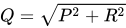
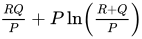
A more complex calculation is needed to find the diameter of the dish measured along its surface. This is sometimes called the "linear diameter", and equals the diameter of a flat, circular sheet of material, usually metal, which is the right size to be cut and bent to make the dish. Two intermediate results are useful in the calculation: (or the equivalent: ) and , where F, D, and R are defined as above. The diameter of the dish, measured along the surface, is then given by: , where means the natural logarithm of x, i.e. its logarithm to base "e".



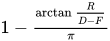
The volume of the dish is given by where the symbols are defined as above. This can be compared with the formulae for the volumes of a cylinder a hemisphere where and a cone is the aperture area of the dish, the area enclosed by the rim, which is proportional to the amount of sunlight the reflector dish can intercept. The area of the concave surface of the dish can be found using the area formula for a surface of revolution which gives . providing . The fraction of light reflected by the dish, from a light source in the focus, is given by , where and are defined as above.






The parabolic reflector functions due to the geometric properties of the paraboloidal shape: any incoming ray that is parallel to the axis of the dish will be reflected to a central point, or "focus". (For a geometrical proof, click here.) Because many types of energy can be reflected in this way, parabolic reflectors can be used to collect and concentrate energy entering the reflector at a particular angle. Similarly, energy radiating from the focus to the dish can be transmitted outward in a beam that is parallel to the axis of the dish.
In contrast with spherical reflectors, which suffer from a spherical aberration that becomes stronger as the ratio of the beam diameter to the focal distance becomes larger, parabolic reflectors can be made to accommodate beams of any width. However, if the incoming beam makes a non-zero angle with the axis (or if the emitting point source is not placed in the focus), parabolic reflectors suffer from an aberration called coma. This is primarily of interest in telescopes because most other applications do not require sharp resolution off the axis of the parabola.
Hub AI
Parabolic reflector AI simulator
(@Parabolic reflector_simulator)
Parabolic reflector
A parabolic (or paraboloid or paraboloidal) reflector (or dish or mirror) is a reflective surface used to collect or project energy such as light, sound, or radio waves. Its shape is part of a circular paraboloid, that is, the surface generated by a parabola revolving around its axis. The parabolic reflector transforms an incoming plane wave travelling along the axis into a spherical wave converging toward the focus. Conversely, a spherical wave generated by a point source placed in the focus is reflected into a plane wave propagating as a collimated beam along the axis.
Parabolic reflectors are used to collect energy from a distant source (for example sound waves or incoming star light). Since the principles of reflection are reversible, parabolic reflectors can also be used to collimate radiation from an isotropic source into a parallel beam. In optics, parabolic mirrors are used to gather light in reflecting telescopes and solar furnaces, and project a beam of light in flashlights, searchlights, stage spotlights, and car headlights. In radio, parabolic antennas are used to radiate a narrow beam of radio waves for point-to-point communications in satellite dishes and microwave relay stations, and to locate aircraft, ships, and vehicles in radar sets. In acoustics, parabolic microphones are used to record faraway sounds such as bird calls, in sports reporting, and to eavesdrop on private conversations in espionage and law enforcement.
Strictly, the three-dimensional shape of the reflector is called a paraboloid. A parabola is the two-dimensional figure. (The distinction is like that between a sphere and a circle.) However, in informal language, the word parabola and its associated adjective parabolic are often used in place of paraboloid and paraboloidal.
If a parabola is positioned in Cartesian coordinates with its vertex at the origin and its axis of symmetry along the y-axis, so the parabola opens upward, its equation is , where is its focal length. (See "Parabola#In a cartesian coordinate system".) Correspondingly, the dimensions of a symmetrical paraboloidal dish are related by the equation: , where is the focal length, is the depth of the dish (measured along the axis of symmetry from the vertex to the plane of the rim), and is the radius of the dish from the center. All units used for the radius, focal point and depth must be the same. If two of these three quantities are known, this equation can be used to calculate the third.
A more complex calculation is needed to find the diameter of the dish measured along its surface. This is sometimes called the "linear diameter", and equals the diameter of a flat, circular sheet of material, usually metal, which is the right size to be cut and bent to make the dish. Two intermediate results are useful in the calculation: (or the equivalent: ) and , where F, D, and R are defined as above. The diameter of the dish, measured along the surface, is then given by: , where means the natural logarithm of x, i.e. its logarithm to base "e".
The volume of the dish is given by where the symbols are defined as above. This can be compared with the formulae for the volumes of a cylinder a hemisphere where and a cone is the aperture area of the dish, the area enclosed by the rim, which is proportional to the amount of sunlight the reflector dish can intercept. The area of the concave surface of the dish can be found using the area formula for a surface of revolution which gives . providing . The fraction of light reflected by the dish, from a light source in the focus, is given by , where and are defined as above.
The parabolic reflector functions due to the geometric properties of the paraboloidal shape: any incoming ray that is parallel to the axis of the dish will be reflected to a central point, or "focus". (For a geometrical proof, click here.) Because many types of energy can be reflected in this way, parabolic reflectors can be used to collect and concentrate energy entering the reflector at a particular angle. Similarly, energy radiating from the focus to the dish can be transmitted outward in a beam that is parallel to the axis of the dish.
In contrast with spherical reflectors, which suffer from a spherical aberration that becomes stronger as the ratio of the beam diameter to the focal distance becomes larger, parabolic reflectors can be made to accommodate beams of any width. However, if the incoming beam makes a non-zero angle with the axis (or if the emitting point source is not placed in the focus), parabolic reflectors suffer from an aberration called coma. This is primarily of interest in telescopes because most other applications do not require sharp resolution off the axis of the parabola.